The two dead men, Seán South and Fergal O’Hanlon, are hailed as republican martyrs. Their funerals are attended by thousands of people and their lives immortalised in republican ballads.
The Brookeborough raid is the central action in the IRA’s border campaign of 1956-62, yet it is over and done within a matter of minutes. The aim is to unite Ireland by setting up “liberated zones” in Northern Ireland and overthrowing the Stormont government. The campaign is preceded by a series of raids carried out by republican splinter group Saor Uladh. An attack on Rosslea police station in County Fermanagh in November 1955 results in the death of Saor Uladh member Connie Green.
Royal Ulster Constabulary (RUC) officer Gordon Knowles finds himself on the sharp end of the assault as the republicans blow the front wall from the barracks. “I was blown right across the guard room,” he says. “The only thing I felt was like somebody hitting me in the back and that was the bullet going in through the left-hand side of the spine, round the back of the spine and lodging one inch from the back. They shone a torch in my face and said: ‘Oh, let’s go, he’s had it.'”
Knowles is lucky to be alive as medical staff discover thirteen bullet holes in his body. He recovers to resume his police career and still carries bullet splinters in his body to this day.
The Brookeborough raid, involving fourteen IRA men, is planned along identical lines to the Rosslea attack, with very different results. The IRA aims to explode a bomb in front of the police station and to seize RUC weapons.
Just two days previously, the police suffer their first death of the border campaign when Constable John Scally is killed in an attack on Derrylin barracks, another County Fermanagh border station.
Ahead of the Brookeborough attack, the men gather at the County Monaghan family home of Fergal O’Hanlon, who takes part in the raid. O’Hanlon’s sister Pádraigín Uí Mhurchadha describes the scene. “I remember Fergal, on the night, saying to my mother ‘These men, give them a good meal because there are faces here tonight you won’t see again.’ Now it turned out that he happened to be one of the men that she would not see again.”
The BBC has recently spoken to three of the IRA men involved the raid.
Micheal Kelly, now in his 80s, has never given an interview before about his role in the attack. “The objective was to attack the barracks, take their guns from them and if necessary, if we had the time and space, to actually destroy the barracks,” he says.
Phil O’Donoghue is also part of the IRA unit. Today, he is honorary president of the 32 County Sovereignty Movement, which is believed to be closely aligned to the Real IRA. He insists the Brookeborough operation was about taking arms rather than killing police officers. “We had strict orders – under no circumstances were we to take on the B Specials (Ulster Special Constabulary) or RUC. We were, if at all possible, to try and take their weapons but we were not in any way to attack them.”
The IRA men arrive in Brookeborough in a stolen tipper lorry, but the driver is unfamiliar with the village and stops in the wrong place. Paddy O’Regan, from Dublin, is in the back of the lorry. His job is to assist Seán South in operating a Bren light machine gun. “When the truck actually stopped, and I got up off the floor and looked over the side of the truck I was looking into a shop – no sign of a barracks.” It is the first in a series of errors – the bomb placed by the station door fails to explode.
Barry Flynn, who has written a history of the border campaign, says he saw Brookeborough as a kind of tragic fiasco. “It became like the Keystone Cops,” he says. “There were a number of grenades thrown at the police station when they found it. One bounced back underneath the lorry and actually damaged the lorry very badly.”
RUC Sgt. Kenneth Cordner is quick to react to the attack. The truck is eventually parked up close to the barracks, allowing Sgt. Cordner a clear field of fire from an upstairs window. Using a Sten sub-machine gun, he opens up with deadly effect on the IRA men below.
Paddy O’Regan is wounded in the ensuing firefight. “We started to return fire on the barracks,” he says. “And after a while I looked down and I saw Seán South lying flat on his face and I felt two thumps in my hip. I knew I was wounded but it didn’t hurt particularly bad. It’s just like somebody hit you a couple of digs and it was just my hips started going numb.”
The order is given to withdraw, according to ex-IRA man Micheal Kelly. “Fergal, the last thing I heard him say, ‘Oh, my legs, oh, my legs!’ He was shot in the legs and bled to death. Seán South, I would say, was dead at this stage.”
The attackers flee across the border leaving the two dead men at a remote farm building where they are found by police.
Bobbie Hanvey is a well-known broadcaster and photographer. In 1957 he is just twelve years old and living across the road from the Brookeborough barracks. He remembers hiding under a bed with two of his friends as the attack unfolded. “The bedroom lit up – it was like daylight with the flames coming out of the guns. That image and the sounds of those guns and that experience has stayed with me to the present day – I’ll never forget it.”
Historian Barry Flynn explains that the Brookeborough raid is also a symbolic moment for the republican movement. The lives of the dead IRA men are subsequently remembered in two famous ballads, “Seán South from Garryowen” and the “Patriot Game.”
“People were writing the songs and, regardless of what was going to happen in the rest of the campaign, the names of Seán South and Fergal O’Hanlon were there forever as the martyrs of Brookeborough”, says Flynn.
The border campaign never again reaches the intensity of the Brookeborough incident, but police officers and IRA men continue to die. The IRA calls a ceasefire in 1962. By then it is clear that its strategy for overthrowing the Stormont government has failed.
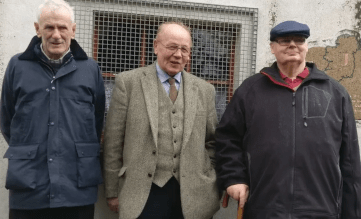
(From: “Brookeborough: Failed IRA attack and republican legend” by Robin Sheeran and Bernadette Allen, BBC News NI, http://www.bbc.com, February 22, 2019 | Pictured: Ex-IRA men Micheal Kelly, Phil O’Donoghue and Paddy O’Regan who have a role in the Brookeborough raid)
Ó Brádaigh is born into a middle-class republican family. His father, Matt Brady, is an IRA volunteer who is severely wounded in an encounter with the Royal Irish Constabulary (RIC) in 1919. His mother, May Caffrey, is a Cumann na mBan volunteer and a 1922 graduate of University College Dublin (UCD). His father dies when he is ten and is given a paramilitary funeral led by his former IRA colleagues. His mother, prominent as the Secretary for the County Longford Board of Health, lives until 1974. He is educated at Melview National School at primary level and attends secondary school at St. Mel’s College, leaving in 1950, and graduates from University College Dublin in 1954. That year he takes a job teaching Irish language at Roscommon Vocational School in Roscommon. He is a deeply religious Catholic who refrains from smoking or drinking.
Ó Brádaigh joins Sinn Féin in 1950. While at university, in 1951, he joins the Irish Republican Army. In September 1951, he marches with the IRA at the unveiling of the Seán Russell monument in Fairview Park, Dublin. A teacher by profession, he is also a Training Officer for the IRA. In 1954, he is appointed to the Military Council of the IRA, a subcommittee set up by the IRA Army Council in 1950 to plan a military campaign against Royal Ulster Constabulary (RUC) barracks in Northern Ireland.
On August 13, 1955, Ó Brádaigh leads a ten-member IRA group in an arms raid on Hazebrouck Barracks, near Arborfield, Berkshire, England, a depot for the No. 5 Radar Training Battalion of the Royal Electrical and Mechanical Engineers. It is the biggest IRA arms raid in Britain. Most, if not all, of the weapons are recovered in a relatively short period of time. A van, traveling too fast, is stopped by the police and IRA personnel are arrested. Careful police work leads to weapons that had been transported in a second van and stored in London.
The IRA Border Campaign commences on December 12, 1956. As an IRA General Headquarters Staff (GHQ) officer, Ó Brádaigh is responsible for training the Teeling Column in the west of Ireland. During the Campaign, he serves as second-in-command of the Teeling Column. On December 30, 1956, he partakes in the Teeling Column attack on RUC barracks in Derrylin, County Fermanagh. RUC Constable John Scally is killed in the attack and is the first fatality of the new IRA campaign. Ó Brádaigh and others are arrested by the Garda Síochána across the border in County Cavan the day after the attack. They are tried and jailed for six months in Mountjoy Prison. A leading abstentionist, upon his arrest he refuses to recognize the authority of the Irish government and refuses to renounce violence in exchange for his release.
Upon completing his prison sentence, Ó Brádaigh is immediately interned at the Curragh Camp along with other republicans. On September 27, 1958, he escapes from the camp along with Dáithí Ó Conaill. While a football match is in progress, the pair cuts through a wire fence and escapes from the camp under a camouflage grass blanket. This is an official escape, authorised by the officer commanding (OC) of the IRA internees, Tomás Óg Mac Curtain. He is the first Sinn Féin TD on the run since the 1920s.
In October 1958, Ó Brádaigh becomes the IRA Chief of Staff, a position he holds until May 1959, when Seán Cronin is elected as his replacement. He is arrested in November 1959, refuses to answer questions, and is jailed in Mountjoy Prison under the Offences against the State Act. He is released in May 1960 and, after Cronin is arrested, again becomes Chief of Staff. Although he always emphasises that it is a collective declaration, he is the primary author of the statement ending the IRA Border Campaign in 1962. At the IRA 1962 Convention he indicates that he is not interested in continuing as Chief of Staff.
After Ó Brádaigh’s arrest in December 1956, he takes a leave from teaching at Roscommon Vocational School. He is re-instated and begins teaching again in late 1962, just after he is succeeded by Cathal Goulding in the position of Chief of Staff of the IRA. He remains an active member of Sinn Féin and is also a member of the IRA Army Council throughout the decade.
Ó Brádaigh opposes the decision of the IRA and Sinn Féin to drop abstentionism and to recognise the Westminster parliament in London, the Stormont parliament in Belfast and the Leinster House parliament in 1969/1970. On January 11, 1970, along with Seán Mac Stíofáin, he leads the walkout from the 1970 Sinn Féin Ard Fheis after the majority votes to end the policy of abstentionism, although the vote to change the Sinn Féin constitution fails to receive the required two-thirds majority. The delegates who walk out reconvene at the Kevin Barry Hall in Parnell Square, Dublin, and establish Provisional Sinn Féin.
Ó Brádaigh is voted chairman of the Caretaker Executive of Provisional Sinn Féin. That October, he formally becomes president of the party. He holds this position until 1983. In his presidential address to the 1971 Provisional Sinn Féin Ard Fheis, he says that the first step to achieving a United Ireland is to make Northern Ireland ungovernable. He apparently also serves on the Army Council or the executive of the Provisional Irish Republican Army until he is seriously injured in a car accident on January 1, 1984.
On May 31, 1972, Ó Brádaigh is arrested under the Offences Against the State Act and immediately commences a hunger strike. A fortnight later the charges against him are dropped and he is released. With Dáithí Ó Conaill he develops the Éire Nua policy, which is launched on June 28, 1972. The policy calls for a federal Ireland.
On December 3, 1972, Ó Brádaigh appears on the London Weekend TelevisionWeekend World programme. He is arrested by the Gardaí again on December 29, 1972, and charged in the newly established Special Criminal Court with Provisional IRA membership. In January 1973 he is the first person convicted under the Offences Against the State (Amendment) Act 1972 and is sentenced to six months in the Curragh Camp.
On December 10, 1974, Ó Brádaigh participates in the Feakle talks between the IRA Army Council and Sinn Féin leadership and the leaders of the Protestant churches in Ireland. Although the meeting is raided and broken up by the Gardaí, the Protestant churchmen pass on proposals from the IRA leadership to the British government. These proposals call on the British government to declare a commitment to withdraw, the election of an all-Ireland assembly to draft a new constitution and an amnesty for political prisoners.
The IRA subsequently calls a “total and complete” ceasefire intended to last from December 22, 1974, to January 2, 1975, to allow the British government to respond to proposals. British government officials also hold talks with Ó Brádaigh in his position as president of Sinn Féin from late December to January 17, 1975.
On February 10, 1975, the IRA Army Council, unanimously endorses an open-ended cessation of IRA “hostilities against Crown forces,” which becomes known as the 1975 truce. The IRA Chief of Staff at the time is Seamus Twomey of Belfast. It is reported in some quarters that the IRA leaders mistakenly believe they had persuaded the British Government to withdraw from Ireland and the protracted negotiations between themselves and British officials are the preamble to a public declaration of intent to withdraw. In fact, as British government papers now show, the British entertain talks with the IRA in the hope that this would fragment the movement further and score several intelligence coups during the talks. This bad faith embitters many in the republican movement, and another ceasefire does not happen until 1994.
In late December 1976, along with Joe Cahill, Ó Brádaigh meets two representatives of the Ulster Loyalist Central Co-ordinating Committee (ULCCC), John McKeague and John McClure, at the request of the latter body. Their purpose is to try to find a way to accommodate the ULCCC proposals for an independent Northern Ireland with the Sinn Féin’s Éire Nua programme. It is agreed that if this can be done, a joint Loyalist-Republican approach can then be made to request the British government to leave Ireland. Desmond BoalQC and Seán MacBrideSC are requested and accepted to represent the loyalist and republican positions. For months they have meetings in various places including Paris. The dialogue eventually collapses when Conor Cruise O’Brien, then Minister for Posts and Telegraphs and vociferous opponent of the Provisional IRA, becomes aware of it and condemns it on RTÉ Radio. As the loyalists had insisted on absolute secrecy, they feel unable to continue with the talks as a result.
In the aftermath of the 1975 truce, the Ó Brádaigh/Ó Conaill leadership comes under severe criticism from a younger generation of activists from Northern Ireland, headed by Gerry Adams, who becomes a vice-president of Sinn Féin in 1978. By the early 1980s, Ó Brádaigh’s position as president of Sinn Féin is openly under challenge and the Éire Nua policy is targeted in an effort to oust him. The policy is rejected at the 1981 Sinn Féin Ard Fheis and finally removed from the Sinn Féin constitution at the 1982 Ard Fheis. At the following year’s Ard Fheis, Ó Brádaigh and Ó Conaill resign from their leadership positions, voicing opposition to the dropping of the Éire Nua policy by the party.
On November 2, 1986, the majority of delegates to the Sinn Féin Ard Fheis vote to drop the policy of abstentionism if elected to Dáil Éireann, but not the British House of Commons or the Northern Ireland parliament at Stormont, thus ending the self-imposed ban on Sinn Féin elected representatives from taking seats at Leinster House. Ó Brádaigh and several supporters walk out and immediately assemble at Dublin’s West County Hotel and set up Republican Sinn Féin (RSF). As an ordinary member, he had earlier spoken out against the motion (resolution 162) in an impassioned speech. The Continuity IRA becomes publicly known in 1996. Republican Sinn Féin’s relationship with the Continuity IRA is similar to the relationship between Sinn Féin and the Provisional IRA when Ó Brádaigh was Sinn Féin’s president.
Ó Brádaigh believes RSF to be the sole legitimate continuation of the pre-1986 Sinn Féin, arguing that RSF has kept the original Sinn Féin constitution. RSF readopts and enhances his Éire Nua policy. His party has electoral success in only a few local elections.
Ó Brádaigh remains a vociferous opponent of the Good Friday Agreement, viewing it as a programme to copperfasten Irish partition and entrench sectarian divisions in the north. He condemns his erstwhile comrades in Provisional Sinn Féin and the Provisional IRA for decommissioning weapons while British troops remain in the country. In his opinion, “the Provo sell-out is the worst yet – unprecedented in Irish history.” He condemns the Provisional IRA’s decision to seal off a number of its arms dumps as “an overt act of treachery,” “treachery punishable by death” under IRA General Army Order Number 11.
In July 2005, Ó Brádaigh hands over a portion of his personal political papers detailing discussions between Irish Republican leaders and representatives of the British Government during 1974–1975 to the James Hardiman Library, National University of Ireland, Galway.
In September 2009, Ó Brádaigh announces his retirement as leader of Republican Sinn Féin. His successor is Des Dalton. He is also a long-standing member of the Celtic League, an organization which fosters cooperation between the Celtic people and promotes the culture, identity and eventual self-determination for the people, in the form of six sovereign states, for the Celtic nations – Wales, Cornwall, Brittany, Scotland, Isle of Man and Ireland.
After suffering a period of ill-health, Ó Brádaigh dies on June 5, 2013, at Roscommon County Hospital. His funeral is attended by 1,800 mourners including Fine Gael TD Frank Feighan and is policed by the Garda Emergency Response Unit and Gardaí in riot gear, for “operational reasons,” a show of force believed to have been to deter the republican tradition of firing a three-volley salute of shots over the final place of rest during the graveyard oration. As a result, there are some minor scuffles between gardai and mourners.
On February 26, 1962, due to lack of support, the Irish Republican Army (IRA) ends what it calls “The Campaign of Resistance to British Occupation,” which is also known as the “Border Campaign.”
The Border Campaign is the first major military undertaking carried out by the IRA since the harsh security measures of the Republic of Ireland and Northern Ireland governments had severely weakened it in the 1940s.
The campaign is launched with simultaneous attacks by approximately 150 IRA members on targets on the Border in the early hours of December 12, 1956. A BBC relay transmitter is bombed in Derry, a courthouse is burned in Magherafelt, a B-Specials post near Newry is burned, and a half-built Army barracks at Enniskillen is blown up. A raid on Gough barracks in Armagh is beaten off after a brief exchange of fire.
On December 14, an IRA column under Seán Garland detonates four bombs outside LisnaskeaRoyal Ulster Constabulary (RUC) station before raking it with gunfire. Further attacks on Derrylin and Roslea RUC barracks on the same day are beaten off.
On the evening of December 30, 1956, the Teeling Column attacks the Derrylin RUC barracks again, killing RUC constable John Scally, the first fatality of the campaign. The new year of 1957 begins with Seán Garland and Dáithí Ó Conaill planning an attack on the Police station at Brookeborough but they assault the wrong building. Two IRA men, Seán South and Fergal O’Hanlon, are killed in the abortive attack. Garland is seriously wounded in the raid. He and the remainder of the group are pursued back over the border by British soldiers.
The year 1957 is the most active year of the IRA’s campaign, with 341 incidents recorded. In November, the IRA suffers its worst loss of life in the period when four of its members die preparing a bomb, which explodes prematurely, in a farmhouse at Edentubber, County Louth. The civilian owner of the house is also killed.
By 1958, the campaign’s initial impetus has largely dissipated with many within the IRA in favour of calling the campaign off. By mid-year, 500 republicans are in gaol or interned. The decline in IRA activity leads the Fianna Fáil government in the South to end internment in March 1959.
Following their release, some of the interned leaders met Seán Cronin in a farmhouse in County Laois and are persuaded to continue the campaign “to keep the flame alive.” The number of incidents falls to just 26 in 1960, with many of these actions consisting of minor acts of sabotage.
The final fatality of the conflict comes in November 1961, when an RUC officer, William Hunter, is killed in a gun battle with the IRA in south County Armagh.
By late 1961, the campaign is over and has cost the lives of eight IRA men, four republican supporters, and six RUC members. In addition, 32 RUC members are wounded. A total of 256 Republicans are interned in Northern Ireland during the campaign and another 150 or so in the Republic.
The Campaign is officially called off on February 26, 1962, with a press release drafted by Ruairí Ó Brádaigh and several other persons including members of the Army Council. The statement is released by the Irish Republican Publicity Bureau and signed “J. McGarrity, Secretary.”



 seamus dubhghaill