
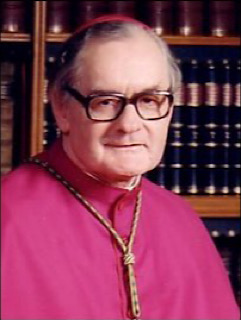
Kevin McNamara, a senior Catholic academic and bishop who serves for three years as Archbishop of Dublin, is born on June 10, 1926, in Newmarket-on-Fergus, County Clare. In the early 1980s he is seen as one of the most outspoken members of the Irish hierarchy on issues such as abortion and divorce.
McNamara is ordained a priest in St. Patrick’s College Maynooth in June 1949. His natural academic talent is recognised and he is soon appointed to teach moral theology rising to become Professor of Dogmatic Theology.
In 1976, McNamara is appointed by Pope Paul VI to succeed Bishop Eamon Casey in the Diocese of Kerry and is ordained bishop in November 1976 from Cardinal William Conway.
In office, McNamara and the neighbouring Bishop of Limerick, Jeremiah Newman, become the most outspoken conservative voices in the Irish hierarchy. They are seemingly out of step with the more diplomatic Archbishop of Armagh and Primate of All Ireland, Tomás Ó Fiaich, and with the Archbishop of Dublin and Primate of Ireland, Dermot Ryan.
McNamara and Newman are particularly outspoken on the issue of a proposed anti-abortion amendment to the Constitution of Ireland. While other bishops advocate people vote with their conscience in the referendum on the issue, McNamara and Newman instruct Catholics that they have a duty to “vote yes” to the referendum.
In 1984, the Archdiocese of Dublin becomes vacant when Archbishop Ryan is given a senior appointment in the Roman Curia. Ryan is expected to be made a cardinal as a result of the appointment but dies suddenly in office before a consistory can be held. McNamara’s selection to replace the more liberal Ryan in Dublin creates media reports linking his appointment to the ongoing tensions between the papal nuncio in Ireland, Archbishop Gaetano Alibrandi, and the liberal Fine Gael–Labour Party coalition under Garret FitzGerald. Relations between Alibrandi and the coalition break down, with the government requesting that Alibrandi be removed because of his suspected closeness to Irish republicans in Sinn Féin and to the opposition Fianna Fáil party and in particular its leader, Charles Haughey. Critics accused Alibrandi of engineering McNamara’s appointment in the belief that the outspoken McNamara can help derail the coalition’s liberal policies on divorce and contraception.
McNamara, as expected, takes a far more outspoken stance of issues than had Ryan previously. While the coalition succeeds in liberalising the law on contraception, its efforts to amend the constitution on divorce are defeated.
McNamara’s service in Dublin is short-lived. Already suffering from what proves to be terminal cancer, he dies on April 8, 1987 after a three year battle with the disease, months after the Fine Gael minority government is defeated in the 1987 Irish general election. He is succeeded as archbishop by a university lecturer, Desmond Connell.
In the early 2000s, amid growing scandals within the Catholic Church in Ireland about clerical sex abuse, it is revealed that as archbishop McNamara had sought legal advice as to the Church’s liability arising from such abuse.

