seamus dubhghaill

Promoting Irish Culture and History from Little Rock, Arkansas, USA


Leave a comment

Thomas MacDonagh’s Letter to Family at End of Easter Week 1916

In a letter to his family written on April 30, 1916, Thomas MacDonagh recalls “I was astonished to receive by a messenger from P.H. Pearse, Commandant General of the Army of the Irish Republic, an order to surrender unconditionality to the British General. I did not obey the order as it came from a prisoner. I as then in supreme command of the Irish Army, consulted with my second in command and decided to confirm the order. I knew that it would involve my death and the deaths of other leaders. I hoped that it would save many true men among our followers, good lives for Ireland. God grant it has done so and God approve our deed. For my self I have no regret. The one bitterness that death has for me is the separation it brings from my beloved wife Muriel, and my beloved children, Donagh and Barbara. My country will then treat them as wards, I hope. I have devoted myself too much to National work and too little to the making of money to leave them a competence. God help them and support them, and give them a happy and prosperous life. Never was there a better, truer, purer woman than my wife Muriel, or more adorable children than Don and Barbara. It breaks my heart that I shall never see my children again, but I have not wept or murmured. I counted the cost of this and am ready to pay it. Muriel has been sent for here. I do not know if she can come. She may have no one to take the children while she is coming. If she does.”

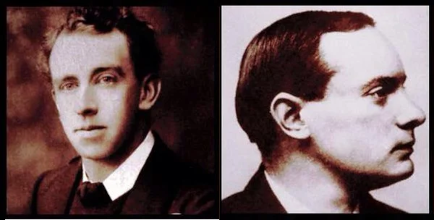
MacDonagh and Pearse are contemporaries of one another: poets, progressive educators, Gaelic revivalists. They are men who gird for battle “with a revolver in one hand and a copy of Sophocles in the other.” Each man commands a unit of Irish Volunteers during the Easter Rising, which takes place the week of April 24-30,1916. MacDonagh occupies Jacob’s biscuit factory and Pearse the General Post Office (GPO), from which he issues the surrender at the end of the week.

McDonagh and Pearse are signatories of the Proclamation of the Irish Republic, a document issued by the Irish Volunteers and the Irish Citizen Army at the beginning of the Easter Rising, proclaiming Ireland’s independence from the United Kingdom. The reading of the proclamation by Pearse outside the General Post Office (GPO) on Sackville Street (now O’Connell Street), Dublin‘s main thoroughfare, marks the beginning of the Rising.

Pearse’s and MacDonagh’s signatures on the Proclamation are a fatal endorsement for them and for each of the other five men to lend it their signatures. After being court-martialed, both Pearse and MacDonagh, along with Thomas Clarke, are executed by firing squad at Kilmainham Gaol in Dublin on May 3, 1916, the first of the rebels to be executed.

(Pictured: Thomas McDonagh (left) and Patrick Pearse)

Leave a comment

Death of Character Actor Liam Redmond

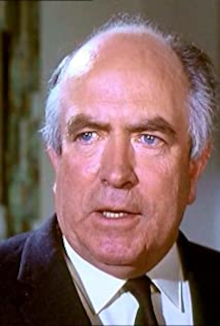
Liam Redmond, Irish character actor known for his stage, film and television roles, dies in Dublin on October 28, 1989, following a lengthy illness.

Redmond is born in Limerick, County Limerick, on July 27, 1913, one of four children born to cabinet-maker Thomas and Eileen Redmond. Educated at the Christian Brothers schools in Dublin, he later attends University College Dublin (UCD) and initially reads medicine before moving into drama.

While Director of the Dramatic Society, Redmond meets and marries the society’s secretary, Barbara MacDonagh, sister of Donagh MacDonagh and daughter of 1916 Easter Rising leader Thomas MacDonagh and Muriel Gifford. They have four children.

Redmond is invited to join the Abbey Theatre in 1935 as a producer by William Butler Yeats, the Irish poet. Yeats writes his play Death of Cú Chulainn for Redmond to star as Cú Chulainn, hero of one of Ireland’s foundational myths.

Redmond makes his acting debut at the Abbey Theatre in 1935 in Seán O’Casey‘s The Silver Tassie. His first stage appearance is in 1939 in New York City in The White Steed. After returning to Britain at the outbreak of World War II he is a regular on the London stage. He is one of the founders of the Writers’, Artists’, Actors’ and Musicians’ Association (WAAMA), a precursor of the Irish Actors’ Equity Association. His insistence that “part-time professionals” – usually civil servants who act on the side – should be paid a higher rate than professional actors for both rehearsal time and performance, effectively wiping out this class, raising the wages and fees of working actors.

Redmond stars in Broadway, among other plays starring in Paul Vincent Carroll‘s The White Steed in 1939, playing Canon McCooey in The Wayward Saint in 1955, winning the George Jean Nathan Award for Dramatic Criticism for his performance, and starring in 1968 in Joe Orton‘s Loot and Brian Friel‘s The Loves of Cass Maguire.

Redmond works in television and film throughout the 1950s to the 1980s and is regularly seen in television series such as The Avengers, Daniel Boone, The Saint and Z-Cars. He is often called upon as a character actor in various military, religious and judicial roles in films such as I See a Dark Stranger (1946), Captain Boycott (1947), High Treason (1951), The Cruel Sea (1953), The Playboy of the Western World (1962), Kid Galahad (1962), The Luck of Ginger Coffey (1964), Tobruk (1967), The Ghost and Mr. Chicken (1966) and Barry Lyndon (1975). His performance as the kindly occult expert in the cult horror film Night of the Demon (1957) is a favourite of fans of the film.

Redmond retires to Dublin and dies at age 76, after a long period of ill health, on October 28, 1989. His wife Barbara predeceases him in 1987.


Leave a comment

Death of Muriel Gifford MacDonagh

Muriel MacDonagh (née Gifford), Irish nationalist and member of Inghinidhe na hÉireann, dies in Skerries, Dublin, on July 9, 1917. Her husband, Thomas MacDonagh, is one of the signees of the Proclamation of the Irish Republic, which leads to the Easter Rising of 1916.

Muriel Enid Gifford is born at 12 Cowper Road, Rathmines, on December 18, 1884. She is the fourth daughter and eighth child of twelve of Frederick and Isabella Gifford. As a child, she suffers at different times from rheumatic fever and phlebitis. She attends Alexandra College and spends a brief time in England training to as a poultry instructor. Returning to Ireland, she trains at Sir Patrick Dun’s Hospital, Dublin, as a student nurse, but her health suffers from the work.

Along with her sisters, MacDonagh is active in the Irish Women’s Franchise League and Inghinidhe na hÉireann, a nationalist organisation. She is involved in the school meals programme of 1910 to 1911, takes part in a 1914 Women’s Franchise League fundraiser, appearing in a tableau vivant as Maeve, the Warrior Queen. Less ardently feminist than her sisters, she takes delight in inviting home activists and artists for a “proper meal.” In an outgoing family, she is shy and reserved, known for her gentle manner. In 1908, she is introduced to Thomas MacDonagh by suffragette journalist Nannie Dryhurst along with her sisters, Grace and Sidney, on a visit to St. Enda’s School. Dryhurst advises Thomas to “fall in love with one of these girls and marry her,” to which he replies laughingly, “That would be easy; the only difficulty would be to decide which one.” The Gifford sisters remain acquaintances with Thomas until the autumn of 1911, when the couple has a short and intense courtship. They meet secretly in galleries and museums and have copious correspondence. When he is appointed assistant lecturer to University College Dublin (UCD) in December 1911, they marry on January 3, 1912. They have one son, Donagh MacDonagh, and one daughter, Barbara MacDonagh Redmond. The family lives first at 32 Baggot Street, and later at 29 Oakley Road, Rathmines.

MacDonagh suffers with poor health and depression, which leads to periods of convalescence and confinement. When her husband is arrested after the Easter Rising, she is unable to see him before his execution on May 3, 1916, which heightens the intensity of her bereavement. Devastated by his death and estranged from her parents due to their disapproval of his involvement in the Rising, she briefly lives with the Plunketts at Larkfield, Kimmage, and then with relatives of her husband in Thurles, County Tipperary. She later returns to Dublin to rent rooms in a Plunkett family property, 50 Marlborough Road. With two young children to support, she is nearly destitute, but like the other widows and orphans of the executed leaders of the Rising, they are aided by the Irish Volunteers Dependents’ Fund, in her case with £250. She also serves as an officer and committee member on this aid association. Her husband had named her as his literary executor, and she prepares a collected edition of his poetry that is published in October 1916. The success of this volume, and his bestselling Literature in Ireland, published at the time he is executed, ease her financial difficulties somewhat.

MacDonagh converts to Catholicism on May 3, 1917.

MacDonagh dies while swimming in the sea during a holiday with other 1916 widows and orphans in Skerries, County Dublin, on July 9, 1917. She almost does not attend the holiday, as her son is in hospital having been injured in a fall. It is believed that she is attempting to swim to Shenick Island from Skerries, possibly to place a tricolour flag on the island’s Martello tower. Her body is found near Loughshinny Beach and, as there is no water in her lungs, it is concluded that she died of heart failure and not drowning. As there is great interest in the 1916 widows and their families, her funeral at Glasnevin Cemetery attracts a large crowd of mourners estimated at 5,000 in the funeral procession.

Following MacDonagh’s death, there is a legal custody battle between the Giffords and the MacDonaghs over Donagh and Barbara. Their aunt Mary MacDonagh, a nun known as Sister Francesca and with whom MacDonagh had grown close, wins custody. Even though several of her siblings offer to take the children, she places them in a foster home.

On the centenary of MacDonagh’s death, a festival takes place in Skerries in her memory.


Leave a comment

Birth of Liam Redmond, Stage, Film & Television Character Actor

Liam Redmond, Irish character actor known for his stage, film and television roles, is born in Limerick, County Limerick, on July 27, 1913.

Redmond is one of four children born to cabinet-maker Thomas and Eileen Redmond. Educated at the Christian Brothers schools in Dublin, he later attends University College Dublin and initially reads medicine before moving into drama.

While Director of the Dramatic Society Redmond meets and marries the society’s secretary, Barbara MacDonagh, sister of Donagh MacDonagh and daughter of 1916 Easter Rising leader Thomas MacDonagh and Muriel Gifford. They have four children.

Redmond is invited to join the Abbey Theatre in 1935 as a producer by William Butler Yeats, the Irish poet. Yeats writes his play Death of Cú Chulainn for Redmond to star as Cú Chulainn, hero of one of Ireland’s foundational myths.

Redmond makes his acting debut at the Abbey Theatre in 1935 in Seán O’Casey‘s The Silver Tassie. His first stage appearance is in 1939 in New York City in The White Steed. After returning to Britain at the outbreak of World War II he is a regular on the London stage. He is one of the founders of the Writers’, Artists’, Actors’ and Musicians’ Association (WAAMA), a precursor of the Irish Actors’ Equity Association. His insistence that “part-time professionals” – usually civil servants who act on the side – should be paid a higher rate than professional actors for both rehearsal time and performance, effectively wiping out this class, raising the wages and fees of working actors.

Redmond stars in Broadway, among other plays starring in Paul Vincent Carroll‘s The White Steed in 1939, playing Canon McCooey in The Wayward Saint in 1955, winning the George Jean Nathan Award for Dramatic Criticism for his performance, and starring in 1968 in Joe Orton‘s Loot and Brian Friel‘s The Loves of Cass Maguire.

Redmond works in television and film throughout the 1950s to the 1980s and is regularly seen in television series such as The Avengers, Daniel Boone, The Saint and Z-Cars. He is often called upon as a character actor in various military, religious and judicial roles in films such as I See a Dark Stranger (1946), Captain Boycott (1947), High Treason (1951), The Cruel Sea (1953), The Playboy of the Western World (1962), Kid Galahad (1962), The Luck of Ginger Coffey (1964), Tobruk (1967), The Ghost and Mr. Chicken (1966) and Barry Lyndon (1975). His performance as the kindly occult expert in the cult horror film Night of the Demon (1957) is a favourite of fans of the film.

Redmond retires to Dublin and dies at age 76, after a long period of ill health, on October 28, 1989. His wife Barbara predeceases him in 1987.


Leave a comment

Birth of Mervyn Wall, Novelist & Playwright

Mervyn Wall, novelist and playwright who writes under the pseudonym of Eugene Welply, is born in Dublin on August 23, 1908. He attends Belvedere College and works as a civil servant from 1934-48. He is a member of the Irish Academy of Letters.

Wall is probably the last survivor of the remarkably gifted generation which emerged from University College Dublin (UCD) in the 1930s. It includes Brian O’Nolan, Donagh MacDonagh, Cyril Cusack, Liam Redmond, Denis Devlin, Niall Sheridan, and the shortlived poet Charles Donnelly who dies in the Spanish Civil War. Brian O’Nolan/Flann O’Brien’s novel At Swim-Two-Birds contains portraits of many of these people, under fictitious names, and evokes the whole ambience of intellectual student life in Dublin at the time.

Like other literary civil servants of the period, Wall often takes a satirical view of bureaucracy. Unlike Brian O’Nolan, however, he can play the bureaucrats at their own game and by most accounts he is a highly efficient public servant in his own right. His late novel Hermitage (1982) has some sharp sidelights on the world of Green Tape.

Wall makes his mark mainly as a novelist, but he begins as a playwright and has at least two works performed in the Abbey Theatre. His first real success comes in 1946 with The Unfortunate Fursey, in which he creates a mythical monk who is tormented by the Devil. The picaresque humour and fantasy of the story are enjoyed by the public as essentially good-natured farce, but it is possible that he also intends it as oblique satire on the Irish clergy in general, at a time when any open criticism of them might invite trouble. Fergus Linehan later turns it into a successful musical.

The first Fursey book has successors, and all of them are published in a single volume in 1985, entitled The Complete Fursey. During the 1950s Wall writes two “serious” novels of social criticism, Leaves for the Burning and No Trophies Raise, in which his satirical sense takes a more direct route. They are praised at the time by respected critics and are still well worth rereading.

Apart from his writing, Wall has a distinguished career in Radio Éireann, where he and his colleagues, the novelist Francis MacManus and the poet Roibeard O Farachain, make up a literary and administrative trio nicknamed “Frank, Incense and Mer” by a staff wit. He later becomes secretary of the Arts Council, a sometimes-difficult job which he handles with tact and fairness.

Wall is himself a witty, observant, sometimes catty man in a generation famous for its wit. He and his wife Fanny, who is known as a leading music critic, are for decades an almost indispensable duo in Dublin cultural and social life, although Wall, in spite of his various public roles, is at heart a home loving and industrious man who never seeks publicity.

Wall dies on May 19, 1997, just eight months after his wife, in St. Michael’s Hospital, Dún Laoghaire, after a short illness.

If and when a fullscale cultural history of Ireland in the 1940s and 1950s comes to be written, Wall’s place in it should be assured. As a successful, long term civil servant, he learned how to work the system in favour of literature and the arts in an age when patronage of them was thin on the ground.


Leave a comment

Birth of Donagh MacDonagh, Playwright & Writer

donagh-macdonagh

Donagh MacDonagh, Irish writer, judge, presenter, broadcaster, and playwright, is born in Dublin on November 22, 1912. He is the son of Irish nationalist and poet Thomas MacDonagh.

MacDonagh is still a young child when his father is executed in 1916 for his part in the Easter Rising. Tragedy strikes again when his mother dies of a heart attack a year afterwards while swimming at Skerries to Lambay Island, County Dublin on July 9, 1917. He and his sister are then cared for by their maternal aunts, in particular Catherine Wilson.

His parents’ families then engage in a series of child custody lawsuits as the MacDonaghs are Roman Catholic and the Giffords are Protestant. In the climate of Ne Temere, the MacDonaghs are successful.

He and his sister Barbara, who later marries actor Liam Redmond, live briefly with their paternal aunt Eleanor Bingham in County Clare before being put into the custody of strangers until their late teens when they are taken in by Jack MacDonagh.

MacDonagh is educated at Belvedere College and University College Dublin (UCD) with contemporaries Cyril Cusack, Denis Devlin, Charles Donnelly, Brian O’Nolan, Niall Sheridan and Mervyn Wall. In 1935 he is called to the Bar and practises on the Western Circuit. In 1941 he is appointed a District Justice in County Mayo. To date, he remains the youngest person appointed as a judge in Ireland. He is Justice for the Dublin Metropolitan Courts at the time of his death.

MacDonagh publishes three volumes of poetry: Veterans and Other Poems (1941), The Hungry Grass (1947) and A Warning to Conquerors (1968). He also edits the Oxford Book of Irish Verse (1958) with Lennox Robinson. He also writes poetic dramas and ballad operas. One play, Happy As Larry, is translated into a number of languages. He has three other plays produced: God’s Gentry (1951), Lady Spider (1959) and Step in the Hollow, a piece of situation comedy nonsense.

MacDonagh also writes short stories. He publishes Twenty Poems with Niall Sheridan, stages the first Irish production of “Murder in the Cathedral” with Liam Redmond, later his brother-in-law, and is a popular broadcaster on Radio Éireann.

MacDonagh is married twice, to Maura Smyth and, following her death after she drowns in a bath whilst having an epileptic seizure, to her sister, Nuala Smyth. He has four children, Iseult and Breifne by Maura and Niall and Barbara by Nuala.

Donagh MacDonagh dies in Dublin on January 1, 1968, and is buried at Deans Grange Cemetery.


Leave a comment

Birth of Playwright & Poet Lennox Robinson

lennox-robinson

Esmé Stuart Lennox Robinson, playwright, poet, theatre producer, and director who is involved with the Abbey Theatre, is born in Westgrove, Douglas, County Cork, on October 4, 1886.

Robinson is raised in a Protestant and Unionist family in which he is the youngest of seven children. His father, Andrew Robinson, is a middle-class stockbroker who in 1892 decides to become a clergyman in the Church of Ireland in the small Ballymoney parish, near Ballineen in West Cork. A sickly child, Robinson is educated by private tutor and at Bandon Grammar School. In August 1907, his interest in the theatre begins after he goes to see an Abbey production of plays by W.B. Yeats and Lady Gregory at the Cork Opera House. He publishes his first poem that same year. His first play, The Cross Roads, is performed in the Abbey in 1909 and he becomes manager of the theatre towards the end of that year. He resigns in 1914 as a result of a disastrous tour of the United States but returns in 1919. He is appointed to the board of the theatre in 1923 and continues to serve in that capacity until his death. His Abbey career and production involvement can be found in the Abbey archives.

As a playwright, Robinson shows himself as a nationalist with plays like Patriots (1912) and Dreamers (1915). On the other hand, he belongs to a part of Irish society which is not seen as fully Irish. This division between the majority native Irish (Roman Catholics) on one side and the Anglo-Irish (Protestants) on the other can be seen in a play such as The Big House (1926), which depicts the burning of a Protestant manor home by the Irish Republican Army (IRA). Robinson’s most popular play is The Whiteheaded Boy (1916).

Other plays include Crabbed Youth and Age (1924), The Far Off Hills (1928), Drama at Inish (1933), and Church Street (1935). Drama at Inish, which is presented in London and on Broadway as Is Life Worth Living?, is revived as part of the 2011 season at the Shaw Festival at Niagara-on-the-Lake, Ontario, Canada, with Mary Haney in the role of Lizzie Twohig. Robinson’s fiction includes Eight Short Stories (1919). In 1931 he publishes a biography of Bryan Cooper, who had recently died. In 1951, he publishes Ireland’s Abbey Theatre, the first full-length history of the company.

He publishes an edited edition of Lady Gregory’s diaries in 1947. In 1958 he co-edits with Donagh MacDonagh The Oxford Book of Irish Verse. He is also a director and producer, in 1930 producing a play by Irish playwright Teresa Deevy called The Reapers. In 1931 he is co-director of A Disciple along with W.B. Yeats and Walter Starkie.

Melancholic and alcoholic in later years, Lennox Robinson dies in Monkstown, County Dublin, on October 15, 1958. He is buried St. Patrick’s Cathedral.