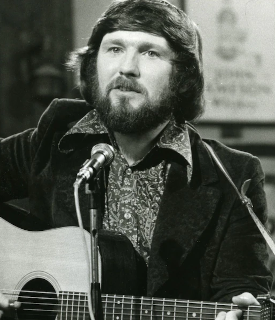
Daniel Doyle, Irish folk singer, is born in Dublin on April 28, 1940. During the 1960s and 1970s, he is one of the top Irish singers, regularly featuring in the Irish charts and scoring three No.1 singles. He records twenty-five albums and is known for his chart-topping songs “Whiskey on a Sunday,” “Daisy a Day” and “The Rare Ould Times.”
After leaving school at the age of fourteen, Doyle starts doing odd jobs, including working as general factotum in Dublin’s Pike Theatre, where he begins to pick up, from the travelling players, songs from the Irish countryside.
During the 1960s and 1970s, Doyle is one of the top Irish singers, regularly featuring in the Irish charts and scoring three No.1 singles. His song “The Rare Auld Times” notably displaces ABBA‘s “Take a Chance on Me” after just one week at the top. The song is composed in the 1970s by Pete St. John for the Dublin City Ramblers and peaks on the Irish Music Charts for twelve weeks. In 1979, he is the first artist to record St. John’s song “The Fields of Athenry.” He is probably best known for his 1967 number one hit “Whiskey on a Sunday.” His other notable works are “A Daisy a Day” and “The Rare Auld Times.” The hit songs “Daisy A Day,” “Streets of London,” “Lizzie Lindsay” and “Whiskey on a Sunday” that are released in the 1960s make him popular.
In 1983, Doyle moves to the United States from Ireland.
St. John is the eldest of six children born to Tommy and Lottie Mooney. He is educated at Scoil Muire Gan Smál and Synge Street CBS. He emigrates to Ontario, Canada in 1958 where he takes what labouring jobs he can find. Within six months he meets a woman named Gert Gorman who has an electrical contracting company in the United States. She and her husband sponsor him to move to Washington, D.C., where he is able to work as an electrician. He marries his sweetheart, Susie Bourke, who is from a well-known Dublin theatrical family with links to both the Gaiety and the Olympia theatres. They have two sons, Kieron and Brian. He travels widely and becomes involved in the peace movement and the civil rights movement. He remains in the United States until 1970, returning to settle in Collins Avenue in north Dublin.
The Dublin city that St. John returns to is a changed place from the one he had grown up in and proves to be the spur that inspires his songwriting. He chooses “St. John” as his nom de plume, inspired by a middle name he had been given while at school when all the boys in his class were assigned saints’ names. In 1975, he is running a theatre in Petticoat Lane on Marlborough Street, and while fixing an alarm outside a window on the first floor, the ledge on which he is leaning gives way, resulting in a bad fall. He breaks his elbow and hip and spends six months in the hospital recuperating. It is during this time that he takes to songwriting in earnest.
St. John is an extrovert who loves people. He is a voracious reader with a particular interest in Irish history. His son Kieron recalls his father writing “The Rare Aul Times” during this recovery period and singing it to his family. The Dublin City Ramblers is the first band to cover the song, but it is Danny Doyle’s version that achieves a real breakthrough, spending eleven weeks in the Irish Singles Chart, reaching No. 1 in 1978.
In 1978, St. John writes “The Fields of Athenry,” a tale of a man exiled to Botany Bay for stealing food to feed his family during the Famine. It has been recorded by several artists, charting in the Irish Singles Chart on a number of occasions. A recording by Paddy Reilly, which is released in 1982, remains in the Irish charts for 72 weeks.
St. John pays close attention to the melding of lyric and melody and has particular form in writing memorable melodies that sound timeless, resonating deeply with listeners across all walks of life. His songs sometime express regret for the loss of old certainties, for example, the loss of Nelson’s Pillar and the Metropole Ballroom, two symbols of old Dublin, as progress makes a “city of my town.”
St. John describes his chosen craft with affection. “Songs are magic carpets. They can tell a story over and over again without boring the pants off the listener and maybe take us out of ourselves for a few moments of peaceful escapism. With easy to remember melody lines, the words can tell of times and events in our daily lives that are worth noting or remembering.”
St. John’s songbook consists of hundreds of compositions, including “The Ferryman,” “Waltzing on Borrowed Time” and “The Furey Man” and are recorded by over 2,500 artists. He is a founding member of the Irish Music Rights Organisation (IMRO) and is always generous and supportive of younger writers, some of whom he continues to mentor well into his 80s.
St. John is surprised and delighted at the affiliation that emerges between “The Fields of Athenry” and rugby and football sporting events. He is present in Croke Park in 2007 when Ireland beats England in the Six Nations, and where the song is sung three times over. It is a song often heard in Anfield in Liverpool, and at Glasgow Celtic games, and reverberates around the stadium at Chicago’s Soldier Field when Ireland beats the All Blacks on November 5, 2016.
St. John wins several awards, including the Irish Music Rights Organisation “Irish Songwriter of the Year.”
St. John lives life to the fullest, and while he suffers ill health in his later years with both diabetes and Parkinson’s disease, he never loses his zest for life. His son Kieron describes his father with affection as a man who had nine lives and lived them all to the fullest. He lives independently at home until his admission to Beaumont Hospital in Dublin. He dies peacefully there at the age of 90 on March 12, 2022. After his funeral, Paddy Reilly and Glen Hansard perform “The Fields of Athenry” at Beaumont House in Dublin as a tribute.
Watchorn first comes to prominence in 1969 as the lead singer of The Quare Fellas, a Dublin-based ballad group. They evolve into the Dublin City Ramblers in the early 1970s and with Watchorn as their lead singer they have hits with songs such as “The Rare Ould Times” and “The Ferryman,” both of which are written by Pete St. John.
Watchorn also writes and sings the Irish Football Team anthem, “We are the Boys in Green” (Home & Away album), with The Dublin City Ramblers for the teams European Championship campaign in Germany and again for the 1990 FIFA World Cup in Italy. The lyrics change slightly in both releases in 1988 and 1990.
In 1995, Watchorn leaves The Dublin City Ramblers and makes a number of solo albums. He joins The Dubliners in 2005, taking Paddy Reilly‘s place. He is well received throughout Ireland, the United Kingdom, Europe, Australia and the United States. He appears on their Tour Sampler EP in 2005, as well as the double album Live at Vicar Street (2006). He plays the banjo, bodhrán and spoons. He cites Luke Kelly, former lead singer with The Dubliners, as his favourite singer.
When The Dubliners announce their retirement in 2012 after finishing their 50 Years Anniversary Tour, Watchorn decides to keep on touring with former band members Seán Cannon and Eamonn Campbell and banjo player Gerry O’Connor under the name of “The Dublin Legends.”
On April 28, 2014, Watchorn posts a message on his website, stating that he has “decided to take a break from the music business for a while” and will not be touring the rest of 2014 with The Dublin Legends. He later admits this is due to ill health and that doctors had advised him that touring would do further damage to his health.
Watchorn’s distinctive and passionate vocals have made him a huge rock on the Irish folk scene. In his solo projects in the mid- and late-1990s, after his departure from The Dublin City Ramblers, he has session men who used to play alongside him and he uses the stage name “Patsy Watchorn, agus a Cháirde” (which means “and his Friends” in Irish).
Michael J. Moran, an Irish street rhymer popularly known as Zozimus, dies in Dublin on April 3, 1846. He is a resident of Dublin and also known as the “Blind Bard of the Liberties” and the “Last of the Gleemen.”
Moran is born around 1794 in Faddle Alley off the Blackpitts in Dublin’s Liberties and lives in Dublin all his life. At two weeks old he is blinded by illness. He develops an astounding memory for verse and makes his living reciting poems, many of which he has composed himself, in his own lively style. He is described by songwriter Patrick Joseph McCall as the last gleeman of the Pale.
Many of his rhymes have religious themes while others are political or recount current events. He is said to have worn “a long, coarse, dark, frieze coat with a cape, the lower parts of the skirts being scalloped, an old soft, greasy, brown beaver hat, corduroy trousers and Francis Street brogues, and he carried a long blackthorn stick secured to his wrist with a strap.”
In his last few years, Moran’s voice grows weak, costing him his means of livelihood. He ends up feeble and bedridden and he dies on April 3, 1846 at his lodgings in 15 Patrick Street. He is buried two days later on Palm Sunday in Glasnevin’s Prospect Cemetery, which is guarded day and night, as he had feared grave robbers, who are busy in Dublin at the time.
His grave remains unmarked until the late 1960s, when the band Dublin City Ramblers erect a tombstone in his memory. His grave is in the “Poor Ground” of the cemetery, not far from Daniel O’Connell‘s monument.
Moran’s nickname is derived from a poem written by Anthony Coyle, Bishop of Raphoe about Saint Mary of Egypt. According to legend, she had followed pilgrims to Jerusalem with the intent of seducing them, then, turning penitent on finding herself prevented from entering the Church of the Holy Sepulchre by a supernatural force, she flees to the desert and spends the remainder of her life in solitary penance. When she is at the point of death, God sends Zosimas of Palestine to hear her confession and give her Holy Communion, and a lion to dig her grave. The poem has the intolerable cadence of the eighteenth century, but is so popular, and so often called for, that Moran is soon nicknamed “Zozimus,” and by that name is remembered.



 seamus dubhghaill