seamus dubhghaill

Promoting Irish Culture and History from Little Rock, Arkansas, USA


Leave a comment

Birth of Bernadette Devlin, Civil Rights Leader & Politician

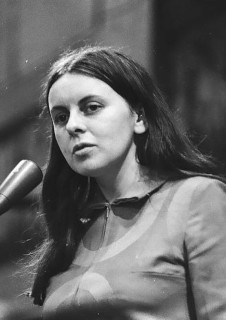
Bernadette Devlin, Irish civil rights leader and former politician, is born in CookstownCounty Tyrone, Northern Ireland, on April 23, 1947. She serves as the Member of Parliament (MP) for Mid Ulster in Northern Ireland from the 1969 Mid Ulster by-election on April 17, 1969 until February 1974.

Devlin is born into a Roman Catholic family and attends St. Patrick’s Girls Academy in Dungannon. She is studying Psychology at Queen’s University Belfast (QUB) in 1968 when she takes a prominent role in a student-led civil rights organisation, People’s Democracy. She is subsequently excluded from the university.

Devlin stands unsuccessfully against James Chichester-Clark in the 1969 Northern Ireland general election. When George Forrest, the MP for Mid Ulster, dies, she fights the subsequent by-election on the “Unity” ticket, defeating Forrest’s widow Anna, the Ulster Unionist Party (UUP) candidate, and is elected to the Parliament of the United Kingdom. At age 21, she is the youngest MP at the time, and remains the youngest woman ever elected to Westminster until the 2015 United Kingdom general election when 20-year-old Mhairi Black succeeds to the title.

After engaging on the side of the residents in the Battle of the Bogside, Devlin is convicted of incitement to riot in December 1969, for which she serves a short jail term.

Having witnessed the events of Bloody Sunday, Devlin is infuriated that she is consistently denied the floor in the House of Commons by the Speaker Selwyn Lloyd, despite the fact that parliamentary convention decrees that any MP witnessing an incident under discussion would be granted an opportunity to speak about it. She slaps Reginald Maudling, the Home Secretary in the Conservative government, across the face when he states in the House of Commons that the paratroopers had fired in self-defence on Bloody Sunday.

Devlin helps to form the Irish Republican Socialist Party (IRSP), a revolutionary socialist breakaway from Official Sinn Féin, with Seamus Costello in 1974. She serves on the party’s national executive in 1975 but resigns when a proposal that the Irish National Liberation Army (INLA) become subordinate to the party executive is defeated. In 1977, she joins the Independent Socialist Party, but it disbands the following year.

In 1971, Devlin gives birth to a daughter, Róisín, which costs her some political support because she is unmarried. She later marries Róisín’s father, Michael McAliskey, on her 26th birthday on April 23, 1973.

McAliskey stands as an independent candidate in support of the prisoners at Long Kesh prison in the 1979 European Parliament elections in Northern Ireland and wins 5.9% of the vote. She is a leading spokesperson for the Smash H-Block Campaign, which supports the hunger strikes of 1980 and 1981.

On January 16, 1981, McAliskey and her husband are shot by members of the Ulster Defence Association (UDA), who break into their home near Coalisland, County Tyrone. She is shot fourteen times in front of her children. British soldiers are watching the McAliskey home at the time but fail to prevent the assassination attempt. The couple are taken by helicopter to a hospital in nearby Dungannon for emergency treatment and then transported to the Musgrave Park Hospital, Military Wing, in Belfast, under intensive care. The attackers, all three members of the South Belfast UDA, are captured by the army patrol and subsequently jailed.

In 1982, McAliskey twice fails in an attempt to be elected to the Dublin North–Central constituency of Dáil Éireann. In 2003, she is barred from entering the United States and is deported on the grounds that the United States Department of State has declared that she “poses a serious threat to the security of the United States,” apparently referring to her conviction for incitement to riot in 1969.

On May 12, 2007, McAliskey is the guest speaker at Éirígí‘s first Annual James Connolly commemoration in Arbour Hill, Dublin. She currently co-ordinates a not-for-profit community development organisation based in Dungannon, the South Tyrone Empowerment Programme, and works with migrant workers to improve their treatment in Northern Ireland.

During the 2016 Northern Ireland Assembly election, McAliskey is an election agent for People before Profit‘s candidate in FoyleEamonn McCann. McCann is successfully elected.

During the campaigning for the 2024 European Parliament election in Ireland, McAliskey endorses Clare Daly in the Dublin constituency.


Leave a comment

Birth of Irish Journalist Mary Holland

mary-holland

Mary Holland, Irish journalist who specialises in writing about Ireland and in particular Northern Ireland, is born in Dover, Kent, South East England on June 19, 1935. She is raised in Ireland and married a British diplomat, Ronald Higgins. They lived in Indonesia but the marriage is annulled.

Holland originally works in fashion for Vogue magazine and then The Observer. She comes to prominence as one of the first Irish journalists to report on the rise of the Northern Ireland Civil Rights Association and becomes an increasingly prominent commentator on the affairs of the region.

In 1977 Conor Cruise O’Brien is appointed editor-in-chief of The Observer. He is a writer and politician who serves as a government minister in the Irish Parliament, Oireachtas. He is often criticized for his uncompromising opposition to “physical force Irish republicanism,” and his actions to that end during Liam Cosgrave‘s tenure as Taoiseach are labelled as censorship by some. Shortly after starting as editor, he sends a memo to Holland:

“It is a very serious weakness of your coverage of Irish affairs that you are a very poor judge of Irish Catholics. That gifted and talkative community includes some of the most expert conmen and conwomen in the world and I believe you have been conned.”

Holland subsequently leaves The Observer and joins The Irish Times as their Northern Ireland correspondent. In 1988, she witnesses the Provisional Irish Republican Army (IRA) Corporals killings.

Holland’s awards include the Prix Italia award for her television documentary on the Creggan in Derry (Creggan, 1980) and, in 1989, the Christopher Ewart-Biggs Memorial Prize for the promotion of peace and understanding in Ireland. She writes and campaigns for abortion rights in Ireland and admits, in an article on the topic of abortion, that she had had one.

Holland dies from scleroderma on June 7, 2004, just twelve days before her 69th birthday. She is survived by her children with fellow journalist Eamonn McCann. Daughter Kitty is now a journalist for The Irish Times, and son Luke works for the United States-based human rights think tank, the Center for Economic and Social Rights.


Leave a comment

Death of Playwright Brian Friel

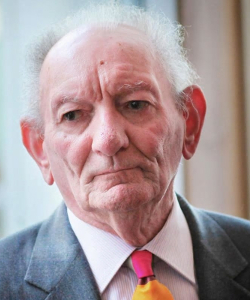
Brian Patrick Friel, Irish playwright, short story writer and founder of the Field Day Theatre Company, dies on October 2, 2015, in Greencastle, County Donegal. He has been considered one of the greatest living English-language dramatists. He has been likened to an “Irish Chekhov” and described as “the universally accented voice of Ireland.” His plays have been compared favourably to those of contemporaries such as Samuel Beckett, Arthur Miller, Harold Pinter and Tennessee Williams.

Friel is born in Knockmoyle, close to Omagh, County Tyrone, Northern Ireland. The family moves to Derry when Friel is ten years old. There, he attends St. Columb’s College, the same school attended by Seamus Heaney, John Hume, Seamus Deane, Phil Coulter, Eamonn McCann and Paul Brady. He receives his B.A. from St. Patrick’s College, Maynooth (1945–48).

Recognised for early works such as Philadelphia, Here I Come! and Faith Healer, Friel has 24 plays published in a career of more than a half-century. He is elected to the honorary position of Saoi of Aosdána. His plays are commonly produced on Broadway in New York City throughout this time, as well as in Ireland and the United Kingdom. In 1980 Friel co-founds Field Day Theatre Company, and his play Translations is the company’s first production. With Field Day, Friel collaborates with Seamus Heaney, 1995 recipient of the Nobel Prize in Literature. Heaney and Friel first become friends after Friel sends the young poet a letter following publication of his book Death of a Naturalist. Friel’s play Dancing at Lughnasa wins three Tony Awards in 1992.

Friel is a member of the American Academy of Arts and Letters, the British Royal Society of Literature and the Irish Academy of Letters. He is appointed to Seanad Éireann in 1987 and serves until 1989. In later years, Dancing at Lughnasa reinvigorates Friel’s oeuvre, bringing him Tony Awards, including Best Play, the Laurence Olivier Award for Best New Play and the New York Drama Critics Circle Award for Best Play. It is also adapted into a film, starring Meryl Streep, directed by Pat O’Connor, script by Frank McGuinness.

After a long illness Friel dies at the age of 86 in the early morning of Friday, October 2, 2015, in Greencastle, County Donegal. He is survived by his wife Anne and children Mary, Judy, Sally and David. A daughter, Patricia, predeceases him in 2012.


Leave a comment

Birth of Irish Playwright Brian Patrick Friel

brian-patrick-friel

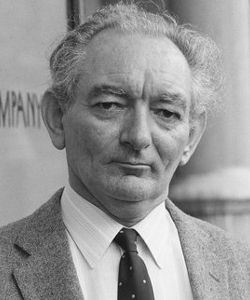
Brian Patrick Friel, Irish playwright, short story writer, and founder of the Field Day Theatre Company, is born on January 9, 1929, at Knockmoyle, near Omagh, County Tyrone. Prior to his death, he had been considered one of the greatest living English-language dramatists and referred to as an “Irish Chekhov” and “the universally accented voice of Ireland.” His plays have been compared favourably to those of contemporaries such as Samuel Beckett, Arthur Miller, Harold Pinter, and Tennessee Williams.

Friel is the son of Patrick “Paddy” Friel, a primary school teacher and councillor on Londonderry Corporation, the local city council in Derry. Friel’s mother, Mary McLoone, is postmistress of Glenties, County Donegal. The family moves to Derry when Friel is ten years old. There, he attends St. Columb’s College, the same school attended by Seamus Heaney, John Hume, Seamus Deane, Phil Coulter, Eamonn McCann, and Paul Brady.

Friel receives his B.A. from St. Patrick’s College, Maynooth (1945–48), and qualifies as a teacher at St. Joseph’s Training College in Belfast. He marries Anne Morrison in 1954, with whom he has four daughters and one son. Between 1950 and 1960, he works as a math teacher in the Derry primary and intermediate school system, taking leave in 1960 to pursue a career as a writer, living off his savings. In the late 1960s, the Friels move from 13 Malborough Street, Derry to Muff, County Donegal, eventually settling outside Greencastle, County Donegal.

Recognised for early works such as Philadelphia, Here I Come! and Faith Healer, Friel has 24 plays published in a more than half-century spanning career that culminates in his election to the position of Saoi of Aosdána. His plays are commonly featured on Broadway throughout this time. In 1980, Friel co-founds Field Day Theatre Company, and his play Translations is the company’s first production. With Field Day, Friel collaborates with Seamus Heaney, 1995 recipient of the Nobel Prize in Literature. Heaney and Friel first become friends after Friel sends the young poet a letter following the publication of Death of a Naturalist.

Friel is a member of the American Academy of Arts and Letters, the British Royal Society of Literature, and the Irish Academy of Letters. He is appointed to Seanad Éireann in 1987 and serves until 1989. In later years, Dancing at Lughnasa reinvigorates Friel’s oeuvre, bringing him Tony Awards, including Best Play, the Laurence Olivier Award for Best New Play, and the New York Drama Critics Circle Award for Best Play. It is also adapted into a film, starring Meryl Streep, directed by Pat O’Connor, script by Frank McGuinness.

After a long illness Friel dies at the age of 86 in the early morning of Friday, October 2, 2015, in Greencastle, County Donegal.