seamus dubhghaill

Promoting Irish Culture and History from Little Rock, Arkansas, USA


Leave a comment

Birth of Bernadette Devlin, Civil Rights Leader & Politician

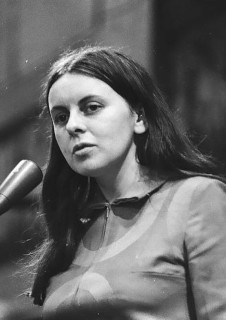
Bernadette Devlin, Irish civil rights leader and former politician, is born in CookstownCounty Tyrone, Northern Ireland, on April 23, 1947. She serves as the Member of Parliament (MP) for Mid Ulster in Northern Ireland from the 1969 Mid Ulster by-election on April 17, 1969 until February 1974.

Devlin is born into a Roman Catholic family and attends St. Patrick’s Girls Academy in Dungannon. She is studying Psychology at Queen’s University Belfast (QUB) in 1968 when she takes a prominent role in a student-led civil rights organisation, People’s Democracy. She is subsequently excluded from the university.

Devlin stands unsuccessfully against James Chichester-Clark in the 1969 Northern Ireland general election. When George Forrest, the MP for Mid Ulster, dies, she fights the subsequent by-election on the “Unity” ticket, defeating Forrest’s widow Anna, the Ulster Unionist Party (UUP) candidate, and is elected to the Parliament of the United Kingdom. At age 21, she is the youngest MP at the time, and remains the youngest woman ever elected to Westminster until the 2015 United Kingdom general election when 20-year-old Mhairi Black succeeds to the title.

After engaging on the side of the residents in the Battle of the Bogside, Devlin is convicted of incitement to riot in December 1969, for which she serves a short jail term.

Having witnessed the events of Bloody Sunday, Devlin is infuriated that she is consistently denied the floor in the House of Commons by the Speaker Selwyn Lloyd, despite the fact that parliamentary convention decrees that any MP witnessing an incident under discussion would be granted an opportunity to speak about it. She slaps Reginald Maudling, the Home Secretary in the Conservative government, across the face when he states in the House of Commons that the paratroopers had fired in self-defence on Bloody Sunday.

Devlin helps to form the Irish Republican Socialist Party (IRSP), a revolutionary socialist breakaway from Official Sinn Féin, with Seamus Costello in 1974. She serves on the party’s national executive in 1975 but resigns when a proposal that the Irish National Liberation Army (INLA) become subordinate to the party executive is defeated. In 1977, she joins the Independent Socialist Party, but it disbands the following year.

In 1971, Devlin gives birth to a daughter, Róisín, which costs her some political support because she is unmarried. She later marries Róisín’s father, Michael McAliskey, on her 26th birthday on April 23, 1973.

McAliskey stands as an independent candidate in support of the prisoners at Long Kesh prison in the 1979 European Parliament elections in Northern Ireland and wins 5.9% of the vote. She is a leading spokesperson for the Smash H-Block Campaign, which supports the hunger strikes of 1980 and 1981.

On January 16, 1981, McAliskey and her husband are shot by members of the Ulster Defence Association (UDA), who break into their home near Coalisland, County Tyrone. She is shot fourteen times in front of her children. British soldiers are watching the McAliskey home at the time but fail to prevent the assassination attempt. The couple are taken by helicopter to a hospital in nearby Dungannon for emergency treatment and then transported to the Musgrave Park Hospital, Military Wing, in Belfast, under intensive care. The attackers, all three members of the South Belfast UDA, are captured by the army patrol and subsequently jailed.

In 1982, McAliskey twice fails in an attempt to be elected to the Dublin North–Central constituency of Dáil Éireann. In 2003, she is barred from entering the United States and is deported on the grounds that the United States Department of State has declared that she “poses a serious threat to the security of the United States,” apparently referring to her conviction for incitement to riot in 1969.

On May 12, 2007, McAliskey is the guest speaker at Éirígí‘s first Annual James Connolly commemoration in Arbour Hill, Dublin. She currently co-ordinates a not-for-profit community development organisation based in Dungannon, the South Tyrone Empowerment Programme, and works with migrant workers to improve their treatment in Northern Ireland.

During the 2016 Northern Ireland Assembly election, McAliskey is an election agent for People before Profit‘s candidate in FoyleEamonn McCann. McCann is successfully elected.

During the campaigning for the 2024 European Parliament election in Ireland, McAliskey endorses Clare Daly in the Dublin constituency.


Leave a comment

Founding of the Alliance Party of Northern Ireland

The Alliance Party of Northern Ireland (APNI), or simply Alliance, a liberal and centrist political party in Northern Ireland, is founded on April 21, 1970, with Phelim O’Neill as leader.

As of the 2022 Northern Ireland Assembly election, the Alliance Party is the third-largest party in the Northern Ireland Assembly, holding seventeen seats, and has made recent breakthroughs to place third in first preference votes in the 2019 European Parliament election and third highest-polling regionally at the 2019 United Kingdom general election. The party wins one of the three Northern Ireland seats in the European Parliament, and one seat, North Down, in the House of Commons, the lower house of the Parliament of the United Kingdom.

Founded in 1970 from the New Ulster Movement, the Alliance Party originally represents moderate and non-sectarian unionism. However, over time, particularly in the 1990s, it moves towards neutrality on the Union, and has come to represent wider liberal and non-sectarian concerns. It supports the Good Friday Agreement but maintains a desire for the reform of the political system toward a non-sectarian future. In the Northern Ireland Assembly, it is designated as neither unionist nor Irish nationalist, but “Other.”

The Alliance Party wins their first seat in the UK House of Commons in the 2010 United Kingdom general election, unseating the former Belfast East MP Peter Robinson, First Minister of Northern Ireland and leader of the Democratic Unionist Party (DUP). Naomi Long is the first MP from the Alliance Party since Stratton Mills, who joined the party from the Ulster Unionist Party (UUP) in 1973. However, the DUP regains the seat at the 2015 United Kingdom general election following an electoral pact with the UUP. In the 2019 United Kingdom general election, the Alliance Party regains its presence in the House of Commons when Stephen Farry wins the North Down seat vacated by the independent unionist, Sylvia Hermon. Earlier in the year, the party’s leader, Naomi Long, wins the party’s first seat in the European Parliament in the last European election before Brexit. Under Long’s leadership, the Alliance Party exceeds expectations in the 2022 Northern Ireland Assembly election and gains numerous seats in the Northern Ireland Assembly.

The Alliance Party is a member of Liberal International and the Alliance of Liberals and Democrats for Europe Party and is aligned with the Liberal Democrats in Great Britain.


Leave a comment

The 2017 Northern Ireland Elections

2017-northern-ireland-elections

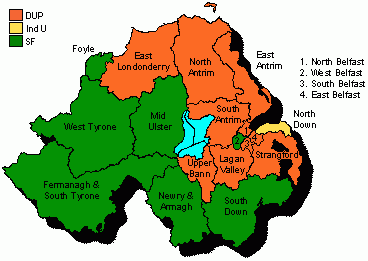
The 2017 United Kingdom general election in Northern Ireland takes place on June 8, 2017. All eighteen seats in Northern Ireland are contested. The Democratic Unionist Party (DUP) gain two seats for a total of ten, and Sinn Féin wins seven, an improvement of three. Independent Unionist Sylvia Hermon is also re-elected in her constituency of North Down. Meanwhile, the Social Democratic & Labour Party (SDLP) loses three seats, and the Ulster Unionist Party (UUP) loses two seats, meaning they both lose all their representation in the House of Commons. The two parties so central to the Good Friday Agreement are not represented in Westminster nineteen years after the signing of the historic deal.

As Sinn Féin maintains a policy of abstentionism in regard to the Parliament of the United Kingdom, the 2017 election marks the first parliament since 1964 without any Irish nationalist MPs who take their seats in the House of Commons in Westminster.

Nationally, the governing Conservative Party falls eight seats short of a parliamentary majority after the election, reduced to four if the absence of Sinn Féin is taken into account. The DUP thus holds the balance of power and announces on June 10 that it will support the Conservative government on a “confidence and supply” basis.

Five seats change hands in Northern Ireland. The SDLP loses its seats in Foyle and South Down to Sinn Féin and the constituency of Belfast South to the DUP. Meanwhile, the UUP loses South Antrim to the DUP and Fermanagh and South Tyrone to Sinn Féin. The number of unionist and nationalist representatives, eleven and seven respectively, remain unchanged from the 2015 United Kingdom general election, although none of the nationalist members are participating in the current Parliament.