seamus dubhghaill

Promoting Irish Culture and History from Little Rock, Arkansas, USA


2 Comments

Birth of Frances Browne, Poet & Novelist

frances-browne

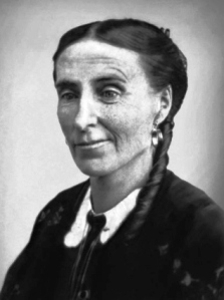
Frances Browne, Irish poet and novelist, best remembered for Granny’s Wonderful Chair, her collection of short stories for children, is born on January 16, 1816, at Stranorlar, County Donegal, the seventh child in a family of twelve children.

Browne is blind from infancy as a consequence of an attack of smallpox when she is only 18 months old. In her writings, she recounts how she learned by heart the lessons which her brothers and sisters said aloud every evening, and how she bribed them to read to her by doing their chores. She then worked hard at memorising all that she had heard. She writes her first poem, a version of “The Lord’s Prayer,” when she is seven years old.

In 1841, her first poems are published in the Irish Penny Journal and in the London Athenauem. One of those included in the Irish Penny Journal is the beautiful lyric “Songs of Our Land” which can be found in many anthologies of Irish patriotic verse. She publishes a complete volume of poems in 1844, and a second volume in 1847. The provincial newspapers, especially the Belfast-based Northern Whig reprint many of her poems and she becomes widely known as “The Blind Poetess of Ulster.”

In 1845 she makes her first contribution to the popular magazine Chambers’s Journal and she writes for this journal for the next 25 years. The first short story that she has published in the Journal is entitled, “The Lost New Year’s Gift,” appearing in March 1845. She also contributes many short stories to magazines that have a largely female readership.

In 1847, she leaves Donegal for Edinburgh with one of her sisters as her reader and amanuensis. She quickly establishes herself in literary circles, and writes essays, reviews, stories, and poems, in spite of health problems. In 1852, she moves to London, where she writes her first novel, My Share of the World (1861). Her best-known work, Granny’s Wonderful Chair, is published in 1856. It remains in print to this day and has been translated into several languages. It is a richly imaginative collection of fairy stories. It is also in 1856 that Pictures and Songs of Home appears, her third volume of poetry. This is directed at very young children and contains beautiful illustrations. The poems focus on her childhood experiences in County Donegal and provide evocative of its countryside.

After her move to London she writes for the Religious Tract Society, making many contributions to their periodicals The Leisure Hour and The Sunday at Home. One of these is “1776: a tale of the American War of Independence” which is printed in The Leisure Hour on the centenary of that event in 1876. As well as describing some of the revolutionary events, it is also a touching love story and is beautifully illustrated. Her last piece of writing is a poem called “The Children’s Day” which appears in The Sunday at Home in 1879.

Frances Brown dies from apoplexy on August 21, 1879, at 19 St. John’s Grove in Richmond-upon-Thames. She is buried on August 25, 1879, in plot 40 in the cemetery at St. Mary Magdalene Church in Richmond, London. Frances dies unmarried and leaves all her belongings, valued at less than 100 pounds, to Eliza Hickman who had been her faithful companion and secretary for many years.

(Pictured:  Frances Brown from the family photo collection of Selwyn Glynn, Brisbane, Australia)


Leave a comment

Birth of Richard John Griffith, Author of Griffith’s Valuation

richard-john-griffith

Richard John Griffith, Irish geologist, mining engineer, and chairman of the Board of Works of Ireland, is born in Hume Street, Dublin, on September 20, 1784. He completed the first complete geological map of Ireland and is author of the valuation of Ireland, known ever since as Griffith’s Valuation.

Griffith goes to school in Portarlington and later, while attending school in Rathangan, his school is attacked by the rebels during the Irish Rebellion of 1798. He also studies in Edinburgh, Scotland.

In 1799 he obtains a commission in the Royal Irish Artillery, but a year later, when the corps is incorporated with that of England, he retires, and devotes his attention to civil engineering and mining. He studies chemistry, mineralogy, and mining for two years in London under William Nicholson and afterwards examines the mining districts in various parts of England, Wales, and Scotland.

While in Cornwall he discovers ores of nickel and cobalt in material that has been rejected as worthless. He completes his studies under Robert Jameson and others at Edinburgh, is elected a Fellow of the Royal Society of Edinburgh in 1807, a member of the newly established Geological Society of London in 1808, and in the same year he returns to Ireland.

In 1809, he is appointed by the commissioners to inquire into the nature and extent of the bogs in Ireland and the means of improving them. In 1812 he is elected Professor of Geology and Mining Engineer to the Royal Dublin Society. Shortly afterwards he expresses his intention of preparing a geological map of Ireland. During subsequent years he makes many surveys and issues many reports on mineral districts in Ireland. These form the foundation of his first geological map of the country in 1815. He also succeeds Dr. Richard Kirwan as government inspector of mines in Ireland. In 1822 Griffith becomes engineer of public works in Cork, Kerry, and Limerick, and is occupied until 1830 in repairing old roads and in laying out many miles of new roads in some of the most inaccessible parts of the country.

Meanwhile, in 1825, he is appointed by the government to carry out a boundary survey of Ireland. He is to mark the boundaries of every county, barony, civil parish, and townland in preparation for the first Ordnance Survey. He is also called upon to assist in the preparation of a parliamentary Bill to provide for the general valuation of Ireland, which passes in 1826. Griffith is appointed Commissioner of Valuation in 1827 but does not start work until 1830 when the new 6″ maps become available from the Ordnance survey and which he is required to use as provided for by statute. He continues to work on this until 1868. On Griffith’s valuation the various local and public assessments are made.

His extensive investigations furnish him with ample material for improving his geological map and the second edition is published in 1835. A third edition on a larger scale (1 in. to 4 m.) is issued under the Board of Ordnance in 1839 and it is further revised in 1855. For this great work and his other services to science Griffith is awarded the Wollaston Medal by the Geological Society in 1854. In 1850 he is made chairman of the Irish Board of Works and in 1858 he is created a baronet.

Griffith dies at the age of 95 at his residence in Dublin on September 22, 1878. At the time of his death, he is the oldest surviving fellow of the Geological Society of London and is the last survivor of the long-since disbanded Royal Irish Regiment of Artillery. He is buried alongside his wife, Maria Jane, in Mount Jerome Cemetery, Harold’s Cross, Dublin.


Leave a comment

The Great Dublin Lockout

great-dublin-lockout

The Great Dublin Lockout, a major industrial dispute between approximately 20,000 workers and 300 employers, begins in Dublin on August 26, 1913, and lasts until January 18, 1914. It is often viewed as the most severe and significant industrial dispute in Irish history.

Irish workers live in terrible conditions in tenements. The infant mortality rate among the poor is 142 per 1,000 births, extraordinarily high for a European city. Poverty is perpetuated in Dublin by the lack of work for unskilled workers, who lack any form of representation before trade unions are founded.

James Larkin, the main protagonist on the side of the workers in the dispute, is a docker in Liverpool and a union organiser. In 1907 he is sent to Belfast as local organiser of the British-based National Union of Dock Labourers (NUDL). His tactic of the sympathetic strike is deemed highly controversial and as a result Larkin is transferred to Dublin.

Larkin sets about organising the unskilled workers of Dublin, which is a cause of concern for the NUDL, who are reluctant to engage in a full-scale industrial dispute with the powerful Dublin employers. They suspended Larkin from the NUDL in 1908. Larkin then leaves the NUDL and sets up the Irish Transport and General Workers’ Union (ITGWU), the first Irish trade union to cater for both skilled and unskilled workers.

Another important figure in the rise of an organised workers’ movement in Ireland at this time is James Connolly, an Edinburgh-born Marxist of Irish parentage. In 1911, Connolly is appointed the ITGWU’s Belfast organiser. In 1912, Connolly and Larkin form the Irish Labour Party to represent workers in the imminent Home Rule Bill debate in Parliament.

Foremost among employers opposed to trade unionism in Ireland is William Martin Murphy, Ireland’s most prominent capitalist, born in Castletownbere, County Cork. In 1913, Murphy is chairman of the Dublin United Tramway Company and owns Clery’s department store. Murphy is vehemently opposed to trade unions, which he sees as an attempt to interfere with his business. In particular, he is opposed to Larkin, whom he sees as a dangerous revolutionary.

The resulting industrial dispute is the most severe in Ireland’s history. Employers in Dublin lock out their workers and employ blackleg labour from Britain and elsewhere in Ireland. Dublin’s workers apply for help and are sent £150,000 by the British Trades Union Congress (TUC) and other sources in Ireland, doled out dutifully by the ITGWU.

The “Kiddies’ Scheme,” allowing for the starving children of Irish strikers to be temporarily looked after by British trade unionists, is blocked by the Roman Catholic Church and especially the Ancient Order of Hibernians, who claim that Catholic children will be subject to Protestant or atheist influences when in Britain. The Church supports the employers during the dispute, condemning Larkin as a socialist revolutionary.

Guinness, the largest employer and biggest exporter in Dublin, refuses to lock out its workforce. It has a policy against sympathetic strikes and expects its workers, whose conditions are far better than the norm in Ireland, not to strike in sympathy. Six who do strike are dismissed.

Strikers use mass pickets and intimidation against strike breakers, who are also violent towards strikers. The Dublin Metropolitan Police baton charge worker’s rallies, including a rally on Sackville Street which results in two deaths and over 300 injuries. James Connolly, Larkin, and ex-British Army Captain Jack White form a worker’s militia, the Irish Citizen Army, to protect workers’ demonstrations.

For seven months, the lockout affects tens of thousands of Dublin families. The lock-out eventually concludes in January 1914, when the Trades Union Congress (TUC) in Britain rejects Larkin and Connolly’s request for a sympathetic strike. Most workers, many of whom are on the brink of starvation, go back to work and sign pledges not to join a union. The ITGWU is badly damaged by its defeat in the Lockout and is further hit by the departure of Larkin to the United States in 1914 and the execution of Connolly, one of the leaders of the Easter Rising in 1916.

Although the actions of the ITGWU are unsuccessful in achieving substantially better pay and conditions for workers, they mark a watershed in Irish labour history. The principle of union action and workers’ solidarity has been firmly established. No future employer would ever try to “break” a union in the way that Murphy attempted with the ITGWU.


Leave a comment

Birth of Francis Fowke, Engineer & Architect

francis-fowke

Francis Fowke, engineer, architect, and a Captain in the Corps of Royal Engineers, is born in Ballysillan, Belfast, on July 7, 1823. Most of his architectural work is executed in the Renaissance style, although he makes use of relatively new technologies to create iron framed buildings, with large open galleries and spaces.

Fowke studies at The Royal School Dungannon, County Tyrone, and the Royal Military Academy, Woolwich. He obtains a commission in the Royal Engineers and serves with distinction in Bermuda and Paris. On his return to England, he is appointed architect and engineer in charge of the construction of several government buildings.

Among his projects are the Prince Consort’s Library in Aldershot, the Royal Albert Hall and parts of the Victoria and Albert Museum in London, the Royal Museum in Edinburgh, and the National Gallery of Ireland in Dublin. He is also responsible for planning the 1862 International Exhibition in London. The Crystal Palace at the Great Exhibition of 1851 being a hard act to follow, the International Exhibition building is described as “a wretched shed” by The Art Journal. Parliament declines the Government’s proposal to purchase the building. The materials are sold and used for the construction of Alexandra Palace.

Before his sudden death from a burst blood vessel on December 4, 1865, Fowke wins the competition for the design of the Natural History Museum, although he does not live to see it executed. His renaissance designs for the museum are altered and realised in the 1870s by Alfred Waterhouse, on the site of Fowke’s Exhibition building.

Francis Fowke is buried in Brompton Cemetery, London.

A medal is issued by the Royal Engineers in 1865, as a memorial prize for architectural works carried out by members of the corps. With the demise of great architectural works, the prize has transformed into the prize awarded to the top student on the Royal Engineers Clerks of Works course.


Leave a comment

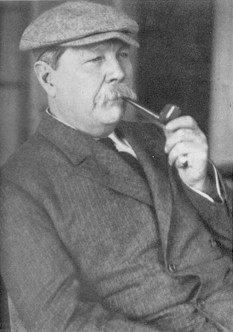
Birth of Sir Arthur Conan Doyle, Creator of Sherlock Holmes

Sir Arthur Ignatius Conan Doyle, British writer and physician, most noted for creating the fictional detective Sherlock Holmes and writing stories about him which are generally considered milestones in the field of crime fiction, is born at 11 Picardy Place, EdinburghScotland, on May 22, 1859.

Doyle’s father, Charles Altamont Doyle, is an Englishman of Irish Catholic descent and his mother, Mary (née Foley), is Irish Catholic. Charles dies in 1893, in the Crichton Royal HospitalDumfries, after many years of psychiatric illness. Supported by wealthy uncles, Doyle is sent to the Jesuit preparatory school Hodder PlaceStonyhurst, at the age of nine. He then goes on to Stonyhurst College until 1875. From 1875 to 1876, he is educated at the Jesuit school Stella Matutina in FeldkirchAustria. Doyle later rejects the Catholic faith and becomes an agnostic. He also later becomes a spiritualist mystic.

From 1876 to 1881 Doyle studies medicine at the University of Edinburgh Medical School. While studying, he begins writing short stories. His first published piece, The Mystery of Sasassa Valley, is printed in Chambers’s Edinburgh Journal on September 6, 1879. After stints as a ship’s doctor and a failed medical practice with former classmate George Turnavine Budd, Doyle arrives in Portsmouth in June 1882 and sets up a medical practice at 1 Bush Villas in Elm Grove, Southsea. The practice is slow to develop and while waiting for patients, Doyle again begins writing fiction. In 1890, Doyle studies ophthalmology in Vienna and moves to London.

Doyle’s first work featuring Sherlock Holmes and Dr. Watson, A Study in Scarlet, is published by Ward Lock & Co. in November 1886. The piece appears one year later in the Beeton’s Christmas Annual and receives good reviews in The Scotsman and the Glasgow Herald.

A sequel to A Study in Scarlet is commissioned and The Sign of the Four appears in Lippincott’s Magazine in February 1890, the last under agreement with the Ward Lock company. Short stories featuring Sherlock Holmes are published in The Strand Magazine.

In December 1893, wanting to dedicate more time to historical novels, Doyle has Holmes and Professor Moriarty plunge to their deaths together down the Reichenbach Falls in the The Final Problem. Public outcry, however, leads him to feature Holmes in 1901 in the novel The Hound of the Baskervilles. Holmes is ultimately featured in a total of 56 short stories, the last published in 1927, and four novels by Doyle.

Between 1888 and 1906, Doyle writes seven historical novels, which many critics regard as his best work. He also authors nine other novels and, later in his career between 1912 and 1929, five stories, two of novella length, featuring the irascible scientist Professor Challenger.

He twice stands for Parliament as a Liberal Unionist, in 1900 in Edinburgh Central and in 1906 in the Hawick Burghs, but he is not elected. In May 1903, he is appointed a Knight of Grace of the Order of the Hospital of Saint John of Jerusalem.

Doyle is a supporter of the campaign for the reform of the Congo Free State, led by the journalist E. D. Morel and diplomat Roger Casement. He becomes acquainted with Morel and Casement and, together with Bertram Fletcher Robinson, they inspire several characters in the 1912 novel The Lost World. When Casement is found guilty of treason against the Crown during the 1916 Easter Rising, Doyle tries unsuccessfully to save him from facing the death penalty, arguing that Casement has been driven mad and cannot be held responsible for his actions.

Found clutching his chest in the hall of Windlesham Manor, his house in CrowboroughEast Sussex, on July 7, 1930, Doyle dies of a heart attack at the age of 71. At the time of his death there is some controversy concerning his burial place, as he is avowedly not a Christian, but rather considers himself a Spiritualist. He is first buried on July 11, 1930, in Windlesham rose garden. He is later reinterred together with his wife in Minstead churchyard in the New ForestHampshire.


Leave a comment

Executions of Seán MacDiarmada & James Connolly

macdiarmada-connolly

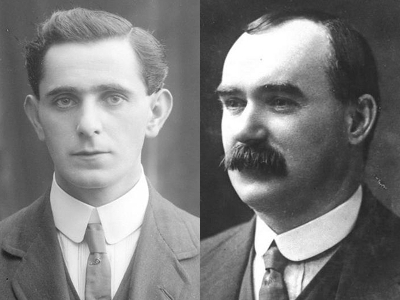
The British army executes Seán MacDiarmada and James Connolly, the last of the Easter Rising leaders to be executed in Dublin, in the Stonebreaker’s Yard at Kilmainham Gaol on May 12, 1916.

Seán MacDiarmada is born in 1884 in Leitrim. He emigrates to Glasgow in 1900 and from there to Belfast in 1902. A member of the Gaelic League, he is acquainted with Bulmer Hobson. He joins the Irish Republican Brotherhood (IRB) in 1906 while still in Belfast, transferring to Dublin in 1908 where he assumes managerial responsibility for the IRB newspaper Irish Freedom in 1910. Although MacDiarmada is afflicted with polio in 1912, he is appointed as a member of the provisional committee of Irish Volunteers from 1913 and is subsequently drafted onto the military committee of the IRB in 1915. During the Rising, MacDiarmada serves in the General Post Office (GPO). Following the surrender, MacDiarmada nearly escapes execution by blending in with the large body of prisoners. He is eventually recognised by Daniel Hoey of G Division and faces a court-martial on May 9.

James Connolly is born in Edinburgh in 1868. Connolly is first introduced to Ireland as a member of the British Army. Despite returning to Scotland, the strong Irish presence in Edinburgh stimulates Connolly’s growing interest in Irish politics in the mid-1890s, leading to his emigration to Dublin in 1896 where he founds the Irish Socialist Republican Party. He spends much of the first decade of the twentieth century in America. He then returns to Ireland to campaign for worker’s rights with James Larkin. A firm believer in the perils of sectarian division, Connolly campaigns tirelessly against religious bigotry. In 1913, Connolly is one of the founders of the Irish Citizen Army. During the Easter Rising he is appointed Commandant-General of the Dublin forces, leading the group that occupies the General Post Office.

The treatment accorded to Connolly is particularly despicable. Crippled by an infected wound in the ankle, he is carried to Kilmainham Gaol, tied to a chair, and shot. As the men are loading their rifles, Connolly forgives the men of the army firing squad for their actions. Shaken by their distasteful task, a ragged volley of shots resounds from their rifles. He is the last of the leaders to be executed.