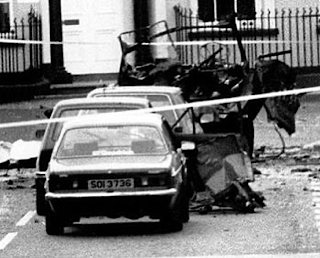
On June 15, 1988, an unmarked military van carrying six British Army soldiers is blown up by the Provisional Irish Republican Army (IRA) at Market Place in Lisburn, County Antrim, Northern Ireland. The explosion takes place at the end of a charity marathon run in which the soldiers had participated. All six soldiers are killed in the attack – four outright, one on his way to hospital and another later on in hospital.
Lisburn is the headquarters of the British Army in Northern Ireland. Four of the dead are from the Royal Corps of Signals while the other two are from the Green Howards and the Royal Army Ordnance Corps. A booby trap bomb is hidden under the Ford Transit van in which the soldiers are traveling, and is designed in such a way that the blast goes upward to cause maximum damage to the vehicle. Eleven civilian bystanders are injured, including a two-year-old child and 80-year-old man. The bombing is sometimes referred to as the Lisburn “Fun Run” bombing.
On Wednesday, June 15, 1988, at 8:50 p.m., an unmarked blue Ford Transit van carrying six off-duty British soldiers in civilian clothes drives off from a leisure centre carpark in Lisburn. The soldiers have just taken part in the “Lisburn Fun Run”, a 13-mile (21 km) charity half marathon held in the town. They leave the van unattended in the car park, which is the start and finish point for the run. It is there that an IRA active service unit (ASU), who has been following the van, hides a bomb underneath the vehicle. The half marathon and shorter “fun runs” are organised by Lisburn Borough Council, together with the YMCA, to raise funds for the disabled. There are 4,500 participants that day and at least 200 British Army personnel have been given leave to participate in the event.
Nine minutes later, the van stops at traffic lights at Market Place, in Lisburn’s town centre. As the van moves on, the seven-pound (3.2 kg) bomb detonates, turning the van into a massive fireball and instantly killing four of the soldiers as the vehicle disintegrates with the force of the blast. The Semtex device has been designed in a cone shape to channel the blast upward, thereby causing maximum damage to the vehicle and the soldiers inside. The area around Market Place is crowded with onlookers, including many teenagers and families with young children, although the biggest crowd is at the carpark. In all, about 10,000 onlookers have attended the charity run. There is pandemonium as frightened parents search for their children, while others rush to give aid to the dead and dying soldiers before fire engines and ambulances arrive.
Eleven civilian bystanders are injured in the attack, including a two-year-old child and an 80-year-old man. Another soldier dies on the way to hospital while a sixth soldier dies later that night after undergoing surgery for severe head injuries. The dead soldiers are stationed at Ebrington Barracks in Derry and are returning to base when the bomb goes off. Four of the men – Sergeant Michael Winkler (31), Signalman Mark Clavey (24), Lance Corporal Graham Lambie (22), and Corporal William Patterson (22) – are from the Royal Corps of Signals, while the other two – Corporal Ian Metcalf (36) and Lance Corporal Derek Green (20) – are from the Green Howards and Royal Army Ordnance Corps respectively.
Lisburn is a mainly Ulster Protestant town, 14 miles (23 km) southwest of Belfast. It serves as the garrison headquarters of the British Army in Northern Ireland. Six months before the van bombing, a booby trap bomb planted by the IRA kills Ulster Defence Association (UDA) leader John McMichael in the town.
The van bombing results in the greatest loss of life suffered by the British Army since eleven soldiers were killed in the Droppin Well Disco bombing on December 6, 1982.
On June 16, the Provisional IRA Belfast Brigade claims responsibility for the bombing, promising to wage “unceasing war” against the British security forces in Northern Ireland. Sinn Féin president Gerry Adams allegedly says that the IRA’s killing of the six soldiers is “vastly preferable” to killing members of the (locally recruited) Ulster Defence Regiment (UDR) or Royal Ulster Constabulary (RUC). The leisure centre is forced to remain shut for a time after the loyalistProtestant Action Force (a cover-name of the UVF) issues a warning that they regard Catholic staff working there as “legitimate targets,” inferring that they may have had a hand in the bombing. Lisburn mayor Councillor William Bleakes condemns the threats by the PAF.
That same day, Tom King, then Secretary of State for Northern Ireland, travels to Lisburn where he holds a meeting with Lieutenant General Sir John Waters, the British Army Commander in Northern Ireland, and senior RUC officers. They discuss the attack and proposals for heightened security. The soldiers had failed to follow proper security procedures, as they had left their vehicle unguarded for over two hours and had then driven off without having checked under it beforehand. After the Lisburn meeting, King flies to London where he reports directly to British Prime MinisterMargaret Thatcher, who describes the attack as a “terrible atrocity.” However, she rejects demands from Conservative members of Parliament to bring back internment, regarding the proposal as “a very serious step.”
In his statement to the House of Commons, Tom King suggests that there would have been a much higher death toll had the bomb exploded in the carpark, where thousands of people had gathered after the run.
The Republic of Ireland‘s government also strongly condemns the killings and extends its sympathy to the families of the dead soldiers. The bombing is a topic of debate in the Seanad Éireann on June 16, 1988. Bishop Cahal Daly of the Roman Catholic Diocese of Down and Connor denounces the bombers and the killings in the “strongest possible terms.”
Questions are raised as to how the IRA knew the soldiers were attending the charity run in Lisburn, how they recognised their unmarked van, and how the unit was able to plant a bomb in the predominantly loyalist town without being spotted, despite the number of people in the carpark. The RUC believes that the bombers may have been wearing sports gear as they mingled with the crowd that evening. They appeal to onlookers who had attended the event to hand over any film they may have taken of the “fun run” in an attempt to identify the IRA bombers.
The following Saturday, between 1,000 and 2,000 people gather in Lisburn town centre to attend a remembrance service for the six soldiers. A book of condolences is also opened.
O’Riordan is the youngest child among two sons and three daughters of Daniel O’Connell O’Riordan, a barrister and justice of the peace (JP), and Katharine O’Riordan (née O’Neil), who is her husband’s first cousin. At age of four he witnesses his mother’s death in a carriage accident. His formal education, firstly as a day student at Belvedere College, Dublin (1881–85), and secondly as a boarder at Clongowes Wood College, County Kildare (1887–88), is interrupted by ill health and periods of self-education at home, marked by omnivorous reading in his father’s library.
While engaged in military studies in Bonn, Germany (March–September 1890), preparatory to entering Royal Military Academy Sandhurst in Great Britain, he falls from a horse during riding lessons, suffering a back injury that results in permanent spinal damage, thus precluding a military career.
Left with limited means after his father’s death, O’Riordan moves to London in 1891, where, after attempting suicide, he finds work as a stage actor with the Independent Theatre Society of J. T. Grein and other companies, both in London and touring the provinces, and is noted for his interpretations of Henrik Ibsen. Active in the Irish Literary Society, where he meets W. B. Yeats, he writes fiction under the pseudonym “F. Norreys Connell,” which he also adopts for his stage work.
O’Riordan’s early publications include In the Green Park (1894), a collection of connected short stories, The House of the Strange Woman (1895), a provocative novel of sexual promiscuity in upper-class London bohemia, boycotted by some booksellers as being “morally tainted,” and several books reflecting his deep interest in all things military, most notably The pity of war (1906), a collection of Kiplingesque short stories. Largely abandoning fiction for some years to concentrate on writing for the stage, he returns to Dublin for the first time in fourteen years to direct his controversial one-act play The Piper, which opens at the Abbey Theatre on February 13, 1908. It is jeered as a slander on Irish patriots in disturbances mildly reminiscent of the “Playboy” riots thirteen months previously. The audience on the third night is placated by Yeats, who in a speech from the stage interprets the play – in which a party of rebels in the 1798 rising disdain to set sentries as they argue interminably and discursively, only to be surprised and slaughtered by yeomanry – as a satirical allegory on the fruitless debate that followed the Parnellite split. The work can more usefully be read as a meditation on the propensity of democracy to disintegrate at moments of crisis into ineffectual and dillusory demagoguery. The Piper weathers the controversy to become a frequently performed staple of the Abbey Theatre repertoire during the 1910s.
After the death of John Millington Synge, O’Riordan serves briefly as managing director of the Abbey Theatre from March 25 to July 2, 1909, during which time he produces and directs two of his own one-act plays – Time on April 1, in which he also acts, and An Imaginary Conversation on May 13 – as well as the first revival of Synge’s The Playboy of the Western World on May 27. Wearied by the repeated interferences in the theatre’s affairs by its financial backer, Annie Horniman, he resigns abruptly during her fit of pique when the actress Sara Allgood recites poetry at a private gathering of suffragettes.
O’Riordan scores a major triumph on the London stage with Captain Hannibal (1909), his adaptation of a novel by Stanley Weyman, on the proceeds of which he lives for many years. Settling permanently in London, in 1910 he purchases a house at 106 Meadvale Road, Ealing, his home for the rest of his life. Rejected by the British Army at the outset of World War I owing to his disability, after several failed attempts to secure war work he eventually goes to the front in 1918 in charge of YMCA rest huts at Étaples railway junction, where he befriends the doomed soldier poet Wilfred Owen.
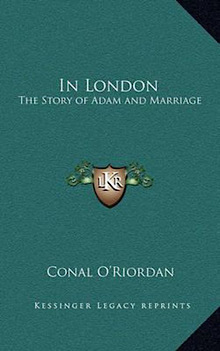
O’Riordan achieves his most accomplished writing within a cycle of twelve novels, published under his own name, chronicling the experiences of several inter-connected Irish and English families from the Napoleonic Wars to the 1920s. First of the series to appear was Adam of Dublin (1920), a combined Bildungsroman and roman-à-clef of the literary revival, with vignettes of Dublin slum life, Belvedere College, and the early years of the Abbey Theatre. He follows his protagonist, Adam Quinn, through the sexual turmoil of adolescence, an itinerant acting career, and an unhappy marriage in three sequels: Adam and Caroline (1921), In London (1922), and Married life (1924). These four novels chronologically conclude the narrative of the completed cycle. The narrative commences with the “Soldier” tetralogy – Soldier Born (1927), Soldier of Waterloo (1928), Soldier’s Wife (1935), and Soldier’s End (1938) – a picaresque treatment of the multifarious and farflung experiences of David Quinn, a forebear of Adam, from an Irish childhood and English education, to the Battle of Waterloo, where he suffers horrible facial mutilation, through the Irish famine and the American Civil War, to his death at the hands of Versaillais troops during the suppression of the Paris commune. Judith Quinn (1939) and Judith’s Love (1940), about the disappointments in love and marriage of a late-Victorian Dublin woman, link the narratives of the “Adam” and “Soldier” tetralogies, while The Age of Miracles(1925) and Young Lady Dazincourt (1926) are chronologically contemporaneous with the latter “Adam” novels. Inconsistent in intention, and uneven in execution, the cycle is strongest in its evocative descriptions of Dublin, London, and other cities, with their varied social strata, in different historical periods, in the sharp-edged, witty dialogue, and in the juxtaposition of dazzling comedy and an ironic sense of tragedy.
O’Riordan continues to write successful, if lightweight, stage plays. His 1928 production of Napoleon’s Josephine features a stellar cast including Edith Evans. Among his published plays are Shakespeare’s End, and Other Irish Plays (1912), Rope Enough (1914), His Majesty’s Pleasure (1925), The King’s Wooing (1929), and Captain Falstaff and Other Plays (1935). The historical commentary Napoleon Passes (1933) reflects his abiding interest in the French emperor. President of the Irish Literary Society from 1937 to 1939, he resigns after failing to persuade his colleagues to repudiate Ireland’s wartime neutrality. Despite age, disability, and increasing reclusivity, throughout World War II he serves as an air raid warden from 1940 to 1945. Elected a fellow of the Royal Society of Literature (1945–48), he represents the society on the council of the newly formed National Book League, and is the society’s Tredegar lecturer in 1946. Charming and convivial, a witty and erudite conversationalist, he cultivates numerous literary friendships, and is an inveterate womaniser, enjoying countless intimate relationships, both sexual and platonic.
O’Riordan marries firstly Florence Derby in 1903, a nurse eight years his senior, with whom he has one son. They are estranged by the time of her death in 1923. In 1924, he marries secondly Olga Buckley, his lover since 1920, and secretary to the wife of G. K. Chesterton. They have two sons (both born before the marriage) and one daughter. Despite considerable contemporary celebrity and critical acclaim, his work compared to that of Charles Dickens and Honoré de Balzac, he has been ignored by posterity. The best of his writing, especially the “Adam” and “Soldier” novels, merit rediscovery.
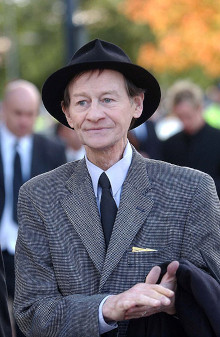
O’Riordan dies at his London home on June 18, 1948, the anniversary of the Battle of Waterloo. A special O’Riordan number of the Journal of Irish Literature (September 1985), edited by his daughter Judith, includes a portrait photograph, the text of The Piper, and a detailed chronology.
(From: “O’Riordan, Conal Holmes O’Connell (‘Norreys Connell’)” by Lawrence William White and Aideen Foley, Dictionary of Irish Biography, http://www.dib.ie, October 2009)
The Irish Citizen Army also becomes involved in the battle, supporting the anti-Treaty IRA in the O’Connell Street area. The fighting begins with an assault by Provisional Government forces on the Four Courts building and ends in a decisive victory for the Provisional Government.
On April 14, 1922, about 200 Anti-Treaty IRA militants, with Rory O’Connor as their spokesman, occupy the Four Courts in Dublin, resulting in a tense stand-off. They want to spark a new armed confrontation with the British, which they hope will bring down the Anglo-Irish Treaty, unite the two factions of the IRA against their former common enemy and restart the fight to create an all-Ireland Irish Republic. At the time the British Army still has thousands of soldiers concentrated in Dublin, awaiting evacuation.
Winston Churchill and the British cabinet have been applying pressure on the Provisional Government to dislodge the rebels in the Four Courts, as they consider their presence a violation of the Treaty. Such pressure falls heaviest on Michael Collins, President of the Provisional Government Cabinet and effective head of the regular National Army. Collins, a chief IRA strategist during the War of Independence from Britain, has resisted giving open battle to the anti-Treaty militants since they occupied Four Courts in April. His colleagues in the Provisional Government Cabinet, including Arthur Griffith, agree that Collins must mount decisive military action against them.
In June 1922 the Provisional Government engages in intense negotiations with the British Cabinet over a draft Constitution that seeks to avert the impending civil war. They particularly seek to remove the requirement of an oath to the British Crown by all members of the Dublin government, a key point of contention with anti-Treaty partisans. However, the conservative British Cabinet refuses to cooperate. The pro-treaty element of Sinn Féin wins the elections on June 16.
Following the assassination of Sir Henry Wilson in London on June 22, 1922, and the arrest by Four Courts troops of National Army Deputy Chief of Staff Gen. J. J. “Ginger” O’Connell, British pressure on the Provisional Government intensifies. The British now threaten to invade and re-occupy all of Ireland. On June 27 the Provisional Government Cabinet agrees on an ultimatum to the Four Courts garrison to evacuate or face immediate military action.
Churchill offers a loan of British artillery for use by the National Army, along with 200 shells from their store of 10,000 at Kilmainham, three miles away. It is possible that some British special troops are also covertly loaned. Two 18-pounder field guns are placed on Bridge Street and Winetavern Street, across the River Liffey from the Four Courts complex. After an ultimatum is delivered to the anti-Treaty garrison in the early hours of June 28, the National Army commences the bombardment of Four Courts.
No authoritative record exists regarding the order to commence bombardment. Historians tend to attribute the order to Collins, but some biographers dispute this. Anti-Treaty survivors allege that they are preparing for an 8:00 a.m. evacuation when the bombardment begins at 4:00 a.m.
Inside the building are 12 members of the Irish Republican Army Executive, including Chief of StaffJoe McKelvey, Director of Engineering Rory O’Connor, Quartermaster General Liam Mellows and Director of Operations Ernie O’Malley. The garrison consists of roughly 180 men drawn from the 1st and 2nd Battalions of the IRA’s 1st Dublin Brigade, commanded by Commandant Paddy O’Brien, armed for the most part only with small arms apart from one captured armoured car, which they name “The Mutineer.” The members of the IRA Army Executive are the political leaders of the garrison but serve as common soldiers under the command of O’Brien. The Anti-Treaty side fortifies the Four Courts to some extent, planting mines around the complex and barricading the doors and windows, but their leadership orders them not to fire first, in order to retain the moral high ground, and so the Free State troops are allowed to surround the Four Courts.
After the first day’s bombardment proves ineffective, the British give the Free State two more 18-pounder cannon and proffer 60-pounder howitzers along with an offer to bomb the Four Courts from the air. Collins turns down the latter two offers because of the risk of causing heavy civilian casualties. On June 29, Free State troops storm the eastern wing of the Four Courts, losing three killed and 14 wounded and taking 33 prisoners. The republicans’ armoured car is disabled and abandoned by its crew. Early the next day O’Brien is injured by shrapnel and O’Malley takes over military command in the Four Courts. By this time the shelling has caused the Four Courts to catch fire. In addition, orders arrive from Oscar Traynor, the anti-treaty IRA commander in Dublin, for the Four Courts garrison to surrender, as he cannot reach their position to help them. O’Malley rules this order invalid, as the Four Courts is a GHQ operation. However, in view of the rapidly deteriorating situation, at 3:30 p.m. on June 30, O’Malley surrenders the Four Courts to Brigadier GeneralPaddy Daly of the Free State’s Dublin Guard unit. Three of the republican garrison die in the siege.
Several hours before the surrender, the Public Record Office of Ireland (PRO) block located in the western block of the Four Courts, which is used as an ammunition store by the Four Courts garrison, is the centre of a huge explosion, destroying Irish state records going back to the Anglo-Norman conquest. Forty advancing Free State troops are badly injured. Assigning blame for the explosion remains controversial. It is alleged by the National Army Headquarters that the Anti-treaty forces deliberately booby-trapped the PRO to kill advancing Free State troops. Tim Healy, a government supporter, later claims that the explosion is the result of land mines laid before the surrender, which explode after the surrender. However, a study of the battle concludes that the explosion is caused by fires ignited by the shelling of the Four Courts, which eventually reach two truckloads of gelignite in the munitions factory. A towering mushroom cloud rises 200 feet over the Four Courts.
At this stage in the battle troops on each side still have a sense of kinship with the other, as most of them had fought together in the Irish Republican Army during the Irish War of Independence. By appealing to friends on the Free State side, several anti-Treaty leaders among the Four Courts garrison, notably Ernie O’Malley and Seán Lemass, escape from captivity to continue the fight.
Despite the Free State force’s success in taking the Four Courts, fighting continues in Dublin until July 5. On June 29 anti-Treaty IRA units from the Dublin Brigade led by Oscar Traynor have occupied O’Connell Street, part of Parnell Square, York Street and some of other locations to try to distract Free State attention from their attack on the Four Courts. Not all the IRA units in the capital are prepared to fight against the new Irish government, however, and their numbers are probably about 500 throughout the city. Their numbers are supplemented by about 150 Citizen Army men and women who bring with them arms and ammunition dumped since the insurrection of Easter 1916.
The republicans occupy the northeastern part of O’Connell Street, with their strong point at “the block,” a group of buildings that the Anti-Treatyites had connected by tunneling through the walls. They had also taken over the adjoining Gresham, Crown, Granville and Hammam hotels. Their only position on the western side of the street is in the YMCA building. Additionally, they have an outpost south of the River Liffey at the Swan Pub on Aungier Street. Oscar Traynor apparently hopes to receive reinforcements from the rest of the country, but only Anti-Treaty units in Belfast and Tipperary reply and both of them arrive too late to take part in the fighting.
The Provisional Government troops, commanded by General Tom Ennis, start by clearing out the outlying anti-treaty garrisons, which is accomplished by July 1. They then draw a tighter cordon around O’Connell Street. Artillery is used to drive the Anti-Treaty fighters out of positions on Parnell Street and Gardiner Street, which gives the Free State troops a clear field of fire down O’Connell Street.
The republican outpost in the YMCA is eliminated when Free State troops tunnel underneath it and detonate a bomb. Traynor’s men in “the block” hold out until artillery is brought up, under the cover of armored cars, to bombard them at point-blank range. Incendiary bombs are also planted in the buildings. Traynor and most of his force make their escape when the buildings they are occupying catch fire. They mingle with civilian crowds and make their way to Blessington.
Left behind is Republican leader Cathal Brugha and a rear guard of 15 men, who stay behind in the Hammam Hotel after Traynor, and most other IRA men have left. At 5:00 p.m. on July 5, when the fires make the hotel untenable, Brugha orderes his men to surrender. He, however, stays behind, only to emerge from the building alone, armed with a revolver. He is shot in the thigh by Free State troops and dies later from blood loss. There are some further sporadic incidents of fighting around the city as Free State troops disperse anti-treaty IRA groups.
Cathal Brugha is the last casualty in the Battle of Dublin, which costs the lives of at least 80 people (15 anti-Treaty IRA Volunteers, 29 National Army soldiers, one British Royal Air Force serviceman and 35 civilians) and over 280 wounded. In addition, the Free State takes over 450 Republican prisoners. The high civilian casualties are doubtless the result of the use of heavy weapons, especially artillery, in a densely populated urban area.
When the fighting in Dublin dies down, the Free State government is left firmly in control of the Irish capital and the anti-treaty forces disperse around the country. Roundups after the fighting result in more Republican prisoners and the death of prominent anti-Treaty activist Harry Boland who is shot dead in Skerries, Dublin, on July 31.
Oscar Traynor, Ernie O’Malley and the other anti-Treaty fighters who escape the fighting in Dublin regroup in Blessington, around 30 km southwest of the city. An anti-Treaty IRA force from County Tipperary had arrived there but too late to participate in the Dublin fighting. Instead, this force heads south and takes a string of towns, including Enniscorthy and Carlow, but quickly abandons them when faced with superior Free State forces. Most of the Republicans then retreat further south to the so-called Munster Republic, territory southwest of a line running from Limerick to Waterford. This in turn is taken by the Free State in an offensive from July to August 1922.
Four of the Republican leaders captured in the Four Courts, Rory O’Connor, Liam Mellows, Joe McKelvey and Richard Barrett, are later executed by the government in reprisal for the Anti-Treaty side’s killing of TDSeán Hales. The street where Cathal Brugha is killed is later renamed Cathal Brugha Street in his honour.
Alexander Gordon “Alex” Higgins, Northern Irish professional snooker player, who is remembered as one of the most iconic figures in the game, dies in Belfast, Northern Ireland on July 24, 2010. He is nicknamed “Hurricane Higgins” because of his fast play.
Higgins is born in Belfast on March 18, 1949. He starts playing snooker at the age of eleven, often in the Jampot club in his native Sandy Row area of south Belfast and later in the YMCA in the nearby city centre. At age fourteen and weighing seven and a half stone (47.6 kg), he leaves for England and a career as a jockey. However, he never makes the grade because, in his youth, he drinks a lot of Guinness and eats a lot of chocolate, making him too heavy to ride competitively. He returns to Belfast and by 1965, at the age of sixteen, he has compiled his first maximum break. In 1968 he wins the All-Ireland and Northern Ireland Amateur Championships.
Higgins turns professional at the age of 22, winning the World Snooker Championship at his first attempt in 1972, against John Spencer winning 37–32. Higgins is then the youngest ever winner of the title, a record retained until Stephen Hendry‘s 1990 victory at the age of 21. In April 1976, Higgins reaches the final again and faces Ray Reardon. Higgins leads 11–9, but Reardon makes four centuries and seven breaks over 60 to pull away and win the title for the fifth time with the score of 27–16. Higgins is also the runner-up to Cliff Thorburn in 1980, losing 18–16, after being 9–5 up. Higgins wins the world title for a second time in 1982 after beating Reardon 18–15 (with a 135 total clearance in the final frame). It was an emotional as well as professional victory for him. Higgins would have been ranked No. 1 in the world rankings for the 1982-1983 season had he not forfeited ranking points following disciplinary action.
Throughout his career, Higgins wins 20 other titles, one of the most notable being the 1983 UK Championship. In the final he trails Steve Davis 0–7 before producing a famous comeback to win 16–15. He also wins the Masters twice, in 1978 and in 1981, beating Cliff Thorburn and Terry Griffiths in the finals respectively. Another notable victory is his final professional triumph in the 1989 Irish Masters at the age of 40 when he defeats a young Stephen Hendry, which becomes known as “The Hurricane’s Last Hurrah.”
Higgins comes to be known as the “People’s Champion” because of his popularity, and is often credited with having brought the game of snooker to a wider audience, contributing to its peak in popularity in the 1980s. He has a reputation as an unpredictable and difficult character. He is a heavy smoker, struggles with drinking and gambling, and admits to using cocaine and marijuana.
First diagnosed with throat cancer in 1998, Higgins is found dead in bed in his flat on July 24, 2010. The cause of death is a combination of malnutrition, pneumonia, and a bronchial condition. Higgins’ funeral service is held in Belfast on August 2, 2010. He is cremated and his ashes are interred in Carnmoney Cemetery in Newtownabbey, County Antrim.
Alexander Gordon “Alex” Higgins, Northern Irish professional snooker player, who is remembered as one of the most iconic figures in the game, is born in Belfast on March 18, 1949. He is nicknamed “Hurricane Higgins” because of his fast play.
Higgins starts playing snooker at the age of eleven, often in the Jampot club in his native Sandy Row area of south Belfast and later in the YMCA in the nearby city centre. At age fourteen and weighing seven and a half stone (47.6 kg), he leaves for England and a career as a jockey. However, he never makes the grade because, in his youth, he drinks a lot of Guinness and eats a lot of chocolate, making him too heavy to ride competitively. He returns to Belfast and by 1965, at the age of sixteen, he has compiled his first maximum break. In 1968 he wins the All-Ireland and Northern Ireland Amateur Snooker Championships.
Higgins turns professional at the age of 22, winning the World Snooker Championship at his first attempt in 1972, against John Spencer winning 37–32. Higgins is then the youngest ever winner of the title, a record retained until Stephen Hendry‘s 1990 victory at the age of 21. In April 1976, Higgins reaches the final again and faces Ray Reardon. Higgins leads 11–9, but Reardon makes four centuries and seven breaks over 60 to pull away and win the title for the fifth time with the score of 27–16. Higgins is also the runner-up to Cliff Thorburn in 1980, losing 18–16, after being 9–5 up. Higgins wins the world title for a second time in 1982 after beating Reardon 18–15 (with a 135 total clearance in the final frame). It was an emotional as well as professional victory for him. Higgins would have been ranked No. 1 in the world rankings for the 1982-1983 season had he not forfeited ranking points following disciplinary action.
Throughout his career, Higgins wins 20 other titles, one of the most notable being the 1983 UK Championship. In the final he trails Steve Davis 0–7 before producing a famous comeback to win 16–15. He also wins the Masters twice, in 1978 and in 1981, beating Cliff Thorburn and Terry Griffiths in the finals respectively. Another notable victory is his final professional triumph in the 1989 Irish Masters at the age of 40 when he defeats a young Stephen Hendry, which becomes known as “The Hurricane’s Last Hurrah.”
Higgins comes to be known as the “People’s Champion” because of his popularity, and is often credited with having brought the game of snooker to a wider audience, contributing to its peak in popularity in the 1980s. He has a reputation as an unpredictable and difficult character. He is a heavy smoker, struggles with drinking and gambling, and admits to using cocaine and marijuana.
First diagnosed with throat cancer in 1998, Higgins is found dead in bed in his flat on July 24, 2010. The cause of death is a combination of malnutrition, pneumonia, and a bronchial condition. Higgins’ funeral service is held in Belfast on August 2, 2010. He is cremated and his ashes are interred in Carnmoney Cemetery in Newtownabbey, County Antrim.