seamus dubhghaill

Promoting Irish Culture and History from Little Rock, Arkansas, USA


Leave a comment

Erskine Childers Elected Fourth President of Ireland

In a political upset, Erskine Hamilton Childers defeats Tom O’Higgins by a very narrow margin and is elected as the fourth President of Ireland on May 30, 1973.

Incumbent president Éamon de Valera is 90 years old and constitutionally barred from seeking a third term. His party, Fianna Fáil, seeks to get former Tánaiste Frank Aiken to run for the presidency, but he declines. Under pressure, former Tánaiste Erskine H. Childers agrees to run. The odds-on favourite is Fine Gael deputy leader, Tom O’Higgins, who had come within 1% of defeating Éamon de Valera in the 1966 presidential election.

Childers is a controversial nominee, owing not only to his British birth and upbringing but to his Protestantism. However, on the campaign trail his personal popularity proves enormous. In a political upset, Erskine H. Childers wins the presidency by 635,867 votes to 578,771.

Childers, though 67, quickly gains a reputation as a vibrant, extremely hard-working president, and becomes highly popular and respected. However, he has a strained relationship with the incumbent government, led by Taoiseach Liam Cosgrave of Fine Gael. Childers has campaigned on a platform of making the presidency more open and hands-on, which Cosgrave views as a threat to his own agenda as head of government. He refuses to co-operate with Childers’ first priority upon taking office, the establishment of a think tank within Áras an Uachtaráin to plan the country’s future. Childers considers resigning from the presidency, but is convinced to remain by Cosgrave’s Foreign MinisterGarret FitzGerald. However, Childers remains detached from the government. Whereas previously, presidents had been briefed by taoisigh once a month, Cosgrave briefs President Childers and his successor, Cearbhall Ó Dálaigh, on average once every six months.

Though frustrated about the lack of power he has in the office, Childers plays an important behind-the-scenes role in easing the Northern Ireland conflict as former Northern Ireland Prime Minister Terence O’Neill meets secretly with Childers at Áras an Uachtaráin on at least one occasion.

Prevented from transforming the presidency as he desires, Childers instead throws his energy into a busy schedule of official visits and speeches, which is physically taxing. On November 17, 1974, just after making a speech to the Royal College of Physicians in Dublin, Childers suffers a heart attack. He dies the same day at Mater Misericordiae University Hospital.

Childers’s state funeral in St. Patrick’s Cathedral, Dublin, is attended by world leaders including the Earl Mountbatten of Burma (representing Queen Elizabeth II), the Prime Minister of the United Kingdom and leader of the Opposition, and presidents and crowned heads of state from Europe and beyond. He is buried in the grounds of the Church of Ireland Derralossary church in RoundwoodCounty Wicklow.


Leave a comment

Birth of Michael Joseph O’Rahilly, Republican & Nationalist

Michael Joseph O’Rahilly, Irish republican and nationalist known as The O’Rahilly, is born in BallylongfordCounty Kerry, on April 22, 1875.

O’Rahilly is educated in Clongowes Wood College. As an adult, he becomes a republican and a language enthusiast. He joins the Gaelic League and becomes a member of An Coiste Gnotha, its governing body. He is well travelled, spending at least a decade in the United States and in Europe before settling in Dublin.

O’Rahilly is a founding member of the Irish Volunteers in 1913, which is organized to work for Irish independence and resist the proposed Home Rule. He serves as the IV Director of Arms. He personally directs the first major arming of the Irish Volunteers, the landing of 900 Mausers at the Howth gun-running on July 26, 1914.

O’Rahilly is not party to the plans for the Easter Rising, nor is he a member of the Irish Republican Brotherhood (IRB), but he is one of the main people who train the Irish Volunteers for the coming fight. The planners of the Rising go to great lengths to prevent those leaders of the Volunteers who are opposed to unprovoked, unilateral action from learning that a rising is imminent, including its Chief-of-Staff Eoin MacNeillBulmer Hobson, and O’Rahilly. When Hobson discovers that an insurrection is planned, he is kidnapped by the Military Council leadership.

Learning this, O’Rahilly goes to Patrick Pearse‘s school, Scoil Éanna, on Good Friday. He barges into Pearse’s study, brandishing his revolver as he announces, “Whoever kidnaps me will have to be a quicker shot!” Pearse calms O’Rahilly, assuring him that Hobson is unharmed, and will be released after the rising begins.

O’Rahilly takes instructions from MacNeill and spends the night driving throughout the country, informing Volunteer leaders in CorkKerryTipperary, and Limerick that they are not to mobilise their forces for planned manoeuvres on Sunday.

Arriving home, O’Rahilly learns that the Rising is about to begin in Dublin on the next day, Easter Monday, April 24, 1916. Despite his efforts to prevent such action which he feels can only lead to defeat, he sets out to Liberty Hall to join Pearse, James ConnollyThomas MacDonaghTom ClarkeJoseph PlunkettCountess MarkieviczSeán Mac DiarmadaEamonn Ceannt and their Irish Volunteers and Irish Citizen Army troops. Arriving in his De Dion-Bouton motorcar, he gives one of the most quoted lines of the rising, “Well, I’ve helped to wind up the clock — I might as well hear it strike!”

O’Rahilly fights with the General Post Office (GPO) garrison during Easter Week. On Friday, April 28, with the GPO on fire, O’Rahilly volunteers to lead a party of men along a route to Williams and Woods, a factory on Great Britain Street, now Parnell Street. A British machine-gun at the intersection of Great Britain and Moore streets cuts him and several of the others down. Wounded and bleeding badly, O’Rahilly slumps into a doorway on Moore Street, but hearing the English marking his position, makes a dash across the road to find shelter in Sackville Lane, now O’Rahilly Parade. He is wounded diagonally from shoulder to hip by sustained fire from the machine-gunner.

The specific timing of O’Rahilly’s death is very difficult to pin down but understanding can be gained from his final thoughts. Despite his obvious pain, he takes the time to write a message to his wife on the back of a letter he received from his son in the GPO. It is this last message to Nancy that artist Shane Cullen etches into his limestone and bronze sculpture. The text reads:

Written after I was shot. Darling Nancy I was shot leading a rush up Moore Street and took refuge in a doorway. While I was there, I heard the men pointing out where I was and made a bolt for the laneway I am in now. I got more [than] one bullet, I think. Tons and tons of love dearie to you and the boys and to Nell and Anna. It was a good fight anyhow. Please deliver this to Nannie O’ Rahilly, 40 Herbert Park, Dublin. Goodbye Darling.


Leave a comment

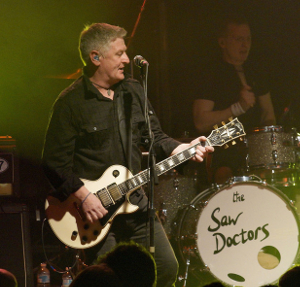
Birth of Davy Carton, Co-Founder of The Saw Doctors

Davy Carton, singer, songwriter, and rhythm guitarist, is born in IslingtonLondon, on April 10, 1959. He is best known as a core member of The Saw Doctors, the folk-rock band he co-founds with Leo Moran and others in 1987.

Carton moves permanently to TuamCounty Galway, with his family in 1966. As a teenager he attends Tuam’s Christian Brothers school, where he forms the punk band Blaze X with fellow students Paul Cunniffe, Paul Ralph, and Ja Keating. He works in a local textile factory after leaving school but continues to play with Blaze X until the band dissolves in 1981, the year Carton marries his girlfriend, Trisha.

Working full-time in the textile factory throughout Ireland’s economically bleak 1980s, Carton largely puts his musical career on hold to support his wife and three young sons.

In the late 1980s, Carton gets together for a pint with Leo Moran, formerly of Irish reggae band Too Much for the White Man. Carton and Moran begin gigging around Galway with a handful of their own rootsy-rock compositions.

The duo adopts the name Saw Doctors — travelers who earn money by sharpening saws in old Ireland — until they can think of something better. As the band grows, the opportunity to find a better name never arises.

Carton finally gives up his day job in 1989, when the Saw Doctors rise to prominence and begin touring with bands including The WaterboysHothouse Flowers, and The Stunning.

Carton’s achievements with the Saw Doctors include six studio albums, two live albums, a concert DVD, several compilation albums, and extensive tours throughout Europe and the United States. Noted for his witty, rapacious lyrics, Carton has co-written almost all of the band’s songs, including “I Useta Lover,” one of the all-time best-selling singles in Ireland.

The Saw Doctors’ lyrics tend to stay out of political issues. “I’m not a politician, and I never will be a politician,” Carton tells the website PopMatters in 2003. “What I like to do is go into a room of people and make them sing along and whatever. I’m not going to tell them how to vote – there’s enough people doing that already. I’d rather talk about girlfriends and football. We don’t like to write about things we don’t really know about. We know about rejection from girls and all that, so we can write about that.”


Leave a comment

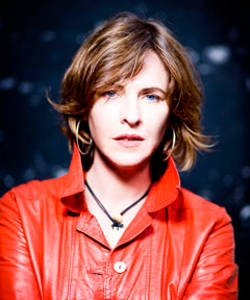
Birth of Singer/Songwriter Eleanor McEvoy

eleanor-mcevoy

Eleanor McEvoy, one of Ireland’s most accomplished contemporary singer/songwriters, is born in Dublin on January 22, 1967. McEvoy composes the song “Only A Woman’s Heart,” the title track of A Woman’s Heart, the best-selling Irish album in Irish history.

McEvoy’s life as a musician begins at the age of four when she begins playing piano. At the age of eight she takes up violin and, as a teen, she joins the Junior Irish Youth Orchestra. Upon finishing school, she attends Trinity College, Dublin where she studies music by day and works in pit orchestras and music clubs by night.

McEvoy graduates from Trinity with an Honors Degree in music and spends four months busking in New York City. In 1988, she is accepted into the RTÉ National Symphony Orchestra where she spends four years before leaving to concentrate on songwriting.

During a solo date in July 1992, she performs a little-known, self-penned song, “Only a Woman’s Heart.” Mary Black, of whose band McEvoy is a member, is in the audience and invites her to add the track to an album of Irish female artists. The album is subsequently titled A Woman’s Heart and the track is released as the lead single. The album goes on to sell over three-quarters of a million copies in Ireland alone and remains the biggest selling Irish album of all time. The record’s success makes McEvoy a superstar virtually overnight.

Eleanor McEvoy, the self-titled debut offering, recorded in Windmill Lane Studios, is released in February 1993, and tours in the United States, Asia, and Europe follow. Back on Irish soil, McEvoy is awarded Best New Artist, Best New Performer, and Best Songwriter Awards by the Irish entertainment and music industries.

McEvoy signs a contract with Columbia Records and begins working on a new, edgier second album, which is eventually entitled What’s Following Me? The album is released in 1996 and the sound is louder and grungier than her debut.

McEvoy releases her third album Snapshots in 1999. Her primary goal is to make Snapshots her most song-oriented album to date. Toward that goal, she hooks up with legendary producer Rupert Hine, who has worked with Stevie Nicks, Tina Turner, Suzanne Vega, and Duncan Sheik, and records the album at Rupert’s “Chateau de la Tour de Moulin” and then in Metropolis Studios in London.

As the century closes, McEvoy has had enough of major-label involvement, making the decision to take the fourth album and head down the independent road. Yola was a turning point in McEvoy’s musical direction. Released in 2001, it reflects the acoustic, jazz-influenced style she had developed on stage with Brian Connor.

March 2004 sees the release of Early Hours, produced by McEvoy and Brian Connor. The style differs from McEvoy’s previous work, taking on a jazz/blues feel for many of the songs. She continues to tour with Brian Connor until April 2005. She then begins performing solo, accompanying herself on bass guitar, electric guitar, mandolin, and violin.

McEvoy continues to release new albums almost on a yearly basis with Out There (2006), Love Must Be Tough (2008), Singled Out (2009), I’d Rather Go Blonde (2010), Alone (2011), If You Leave… (2013), and Stuff (2014).

Naked Music (2016) is McEvoy’s twelfth studio album. It is recorded at the Grange Studio in Norfolk, UK. McEvoy records the tracks by “studio-performing,” in other words, playing the songs as she would in a live performance. The album features exclusive artwork by famed painter Chris Gollon.


Leave a comment

Birth of Shane MacGowan, Lead Singer of The Pogues

shane-macgowan

Shane Patrick Lysaght MacGowan, Anglo-Irish musician and singer, best known as the lead singer and songwriter of Celtic trad punk band The Pogues, is born to Irish parents in Pembury, Kent, England, on December 25, 1957.

MacGowan spends his early childhood in County Tipperary, before his family moves back to England when he is six years old. He lives in many parts of the southeast of England, including Brighton and London.

MacGowan’s father, Maurice, works for a department store. MacGowan’s mother, Therese, is a singer and traditional Irish dancer, and has worked as a model in Dublin. In 1971, after attending Holmewood House School at Langton Green, Tunbridge Wells, MacGowan earns a literature scholarship and is accepted into Westminster School. He is found in possession of drugs and is expelled in his second year.

MacGowan gets his first taste of fame in 1976 at a concert by British punk band The Clash, when his earlobe is damaged by Jane Crockford, later to be a member of Mo-dettes. A photographer snaps a picture of him covered in blood and it makes the papers, with the headline “Cannibalism at Clash Gig.” Shortly after this, he forms his own punk rock band, The Nipple Erectors, later renamed The Nips.

MacGowan draws upon his Irish heritage when founding The Pogues and changes his early “punk” voice for a more authentic sound with tutoring from his extended family. Many of his songs are influenced by Irish nationalism, Irish history, the experiences of the Irish in London and the United States, and London life in general.

Between 1985 and 1987, he co-writes “Fairytale of New York,” which he performs with Kirsty MacColl. In the coming years MacGowan and The Pogues release several albums.

After The Pogues throw MacGowan out for unprofessional behaviour, he forms a new band, Shane MacGowan & The Popes, recording two studio albums, a live album, three tracks on The Popes Outlaw Heaven (2010) and a live DVD, and touring internationally. From December 2003 until May 2005, Shane MacGowan & The Popes tour extensively in the UK, Ireland, and Europe.

The Pogues and MacGowan reform for a sell-out tour in 2001 and each year from 2004 to 2009 for further tours, including headline slots at GuilFest in England and the Azkena Rock Festival in Basque Country. In May 2005, he rejoins The Pogues permanently.

The Pogues’ last performance on British soil occurs on July 5, 2014 at the British Summer Time festival in London’s Hyde Park.

For many years MacGowan suffers from binge drinking and heroin use. In 2001, Sinéad O’Connor reports MacGowan to the police in London for drug possession in what she says is an attempt to discourage him from using heroin. Initially furious, MacGowan later expresses gratitude towards O’Connor and claims that the incident helped him kick his heroin habit.

MacGowan has long been known for having very bad teeth. He loses the last of his natural teeth around 2008. In 2015, he has 28 new dentures on a titanium frame fitted in a nine-hour procedure which is the subject of an hour-long television programme. Dr. Darragh Mulrooney, the dental surgeon who carries out the procedure, comments that MacGowan recorded most of his great works while he still had some teeth: “We’ve effectively re-tuned his instrument and that will be an ongoing process.”

In the summer of 2015, MacGowan falls as he is leaving a Dublin studio, fracturing his pelvis. He is seen in public on crutches by December 2015, and continues to experience difficulty with general mobility.


Leave a comment

Birth of Sir Hugh Percy Lane, Gallery Director & Collector

hugh-percy-lane

Sir Hugh Percy Lane, art dealer, collector, and gallery director, is born in County Cork on November 9, 1875. He is best known for establishing Dublin‘s Municipal Gallery of Modern Art, the first known public gallery of modern art in the world, and for his contribution to the visual arts in Ireland, including the Lane Bequest.

Lane is brought up in Cornwall, England, and begins his career as an apprentice painting restorer and later becomes a successful art dealer in London.

Through regular visits to the home of his aunt, Lady Gregory, in Coole Park, near Gort in County Galway, Lane remains in contact with Ireland. He soon counts among his family, friends, and social circle those who collectively form the core of the Irish cultural renaissance in the early decades of the 20th century.

Extolling the cause of Irish art abroad, Lane also becomes one of the foremost collectors and dealers of Impressionist paintings in Europe, and amongst those works purchased by him for the new gallery are La Musique aux Tuileries by Édouard Manet, Sur la Plage by Edgar Degas, Les Parapluies by Pierre-Auguste Renoir, and La Cheminée by Jean-Édouard Vuillard.

The Municipal Gallery of Modern Art opens in January 1908 in temporary premises in Harcourt Street, Dublin. Lane hopes that Dublin Corporation will run it, but the corporation is unsure if it will be financially viable. Lane does not live to see his gallery permanently located as he dies on May 7, 1915, during the sinking of the RMS Lusitania off the west coast of Cork. The gallery, extended in 2005, is now in Parnell Square in central Dublin.

For his “services to art” in Ireland, Lane is knighted in June 1909 at the comparatively young age of 33.

Following his death, Lane’s will bequeaths his collection to London, but an unwitnessed later codicil bequeaths it to Dublin. Having possession, London’s National Gallery does not recognise the codicil. At the request of Lane’s aunt, Lady Gregory, W.T. Cosgrave, leader of the Irish Government unsuccessfully approaches Ramsay MacDonald on the matter in 1929. When John A. Costello becomes Taoiseach in 1948, he initiates further negotiations with the government of the United Kingdom, eventually leading to a compromise in 1959, under Taoiseach Seán Lemass, whereby half of the Lane Bequest will be loaned and shown in Dublin every five years. In 1993 the agreement is varied so that 31 of the 39 paintings would stay in Ireland. The remaining 8 are divided into two groups, so that four would be loaned for six years at a time to Dublin. In 2008, The National Gallery in London arranges for the entire collection to be on display in Dublin together for the first time.


Leave a comment

Pope Gregory XIII Commissions the Gregorian Calendar

pope-gregory-xiii

Pope Gregory XIII commissions the new Gregorian calendar on February 24, 1582, replacing the Julian calendar introduced by Julius Caesar in 45BCE.

The reason for the reform is that the average length of the year in the Julian calendar is too long. It treats each year as 365 days, 6 hours in length, whereas calculations show that the actual mean length of a year is 365 days, 5 hours, and 49 minutes. As a result, the date of the actual vernal equinox, over the course of 13 centuries, has slowly slipped to March 10, while the calculation of the date of Easter still follows the traditional date of March 21.

These calculations are verified by the observations of mathematician and astronomer Christopher Clavius, and the new calendar is instituted when Gregory decrees on February 24, 1582, that the day after Thursday, October 4, 1582 will not be Friday, October 5, but rather Friday, October 15, 1582. The new calendar duly replaces the Julian calendar and has since come into universal use. Because of Gregory’s involvement, the reformed Julian calendar comes to be known as the Gregorian calendar.

The switchover is bitterly opposed by much of the populace, who fear it is an attempt by landlords to cheat them out of a week and a half of rent. However, the Catholic countries of Spain, Portugal, Poland, and Italy comply almost immediately. France, some states of the Dutch Republic, and various Catholic states in Germany and Switzerland follow suit within a year or two, and Hungary follows in 1587.

More than a century passes before Protestant Europe accepts the new calendar. Denmark, the remaining states of the Dutch Republic, and the Protestant states of the Holy Roman Empire and Switzerland adopt the Gregorian calendar in 1700–1701. Ireland and Great Britain, along with its American colonies, reform in 1752, where Wednesday, September 2, 1752 is immediately followed by Thursday, September 14, 1752. They are joined by the last Protestant holdout, Sweden, on March 1, 1753.

The Gregorian calendar is not accepted in eastern Christendom for several hundred years, and then only as the civil calendar. The Gregorian Calendar is instituted in Russia by the Bolsheviks in 1917. Romania accepts it in 1919 and is followed by Turkey in 1923. The last Orthodox country to accept the calendar is Greece, also in 1923.