seamus dubhghaill

Promoting Irish Culture and History from Little Rock, Arkansas, USA


Leave a comment

The Battle of Ballinamuck

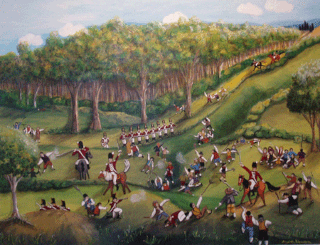
The Battle of Ballinamuck takes place at Ballinamuck, County Longford, on September 8, 1798, marking the defeat of the main force of the French incursion during the Irish Rebellion of 1798.

The victory of General Jean Joseph Amable Humbert at the Battle of Castlebar, despite gaining him around 5,000 extra Irish recruits, did not lead to a renewed outbreak of the rebellion in other areas as hoped. The defeat of the earlier revolt devastated the Irish republican movement to the extent that few are willing to renew the struggle. A massive British force of 26,000 men is assembled under Charles Cornwallis, 1st Marquess Cornwallis, the new Lord Lieutenant of Ireland, and is steadily moving west. Humbert abandons Castlebar and moves toward Ulster, with the apparent intention of igniting an uprising there. He defeats a blocking force of government troops at Collooney in County Sligo. Following reports that rebellions have broken out in County Westmeath and County Longford, he alters course.

Humbert crosses the River Shannon at Ballintra Bridge on September 7, destroying it behind them, and continues to Drumshanbo where they spend the night – halfway between his landing-point and Dublin. News reaches him of the defeat of the Westmeath and Longford rebels at Wilson’s Hospital School at Multyfarmham and Granard from the trickle of rebels who have survived the slaughter and reached his camp. With Cornwallis’ huge force blocking the road to Dublin, facing constant harassment of his rearguard and the pending arrival of General Gerard Lake‘s command, Humbert decides to make a stand the next day at the townland of Ballinamuck on the Longford/Leitrim county border.

Humbert faces over 12,000 Irishmen and English forces. General Lake is close behind with 14,000 men, and Cornwallis is on his right at Carrick-on-Shannon with 15,000. The battle begins with a short artillery duel followed by a dragoon charge on exposed Irish rebels. There is a brief struggle when French lines are breached which only ceases when Humbert signals his intention to surrender and his officers order their men to lay down their muskets. The battle lasts little more than an hour.

While the French surrender is being taken, the 1,000 or so Irish allies of the French under Colonel Bartholomew Teeling, an Irish officer in the French army, hold onto their arms without signaling the intention to surrender or being offered terms. An attack by infantry followed by a dragoon charge breaks and scatters the Irish who are pursued into a bog where they are either bayoneted or drowned.

A total of 96 French officers and 746 men are taken prisoner. British losses are initially reported as 3 killed and 16 wounded or missing, but the number of killed alone is later reported as twelve. Approximately 500 French and Irish lay dead on the field. Two hundred Irish prisoners are taken in the mopping-up operations, almost all of whom are later hanged, including Matthew Tone, brother of Wolfe Tone. The prisoners are moved to the Carrick-on-Shannon Gaol. The French are given prisoner or war status however the Irish are not and some are hanged and buried in St. Johnstown, today known as Ballinalee, where most are executed in a field that is known locally as Bully’s Acre.

Humbert and his men are transported by canal to Dublin and exchanged for British prisoners of war. Government forces subsequently slowly spread out into the rebel-held “Irish Republic,” engaging in numerous skirmishes with rebel holdouts. These sweeps reach their climax on September 23 when Killala is captured by government forces. During these sweeps, suspected rebels are frequently summarily executed while many houses thought to be housing rebels are burned. French prisoners of war are swiftly repatriated, while United Irishmen rebels are executed. Numerous rebels take to the countryside and continue guerrilla operations, which take government forces some months to suppress. The defeat at Ballinamuck leaves a strong imprint on Irish social memory and features strongly in local folklore. Numerous oral traditions are later collected about the battle, principally in the 1930’s by historian Richard Hayes and the Irish Folklore Commission.

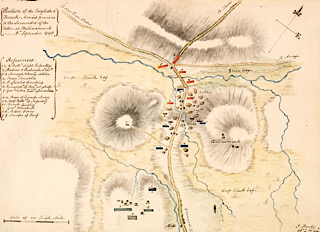
(Pictured: Watercolour plan by an I. Hardy of the Battle of Ballinamuck in County Longford on September 8, 1798, showing position of the English & French Armies previous to the surrender of the latter at Balinamuck)

Leave a comment

The Gibbet Rath Executions

The Gibbet Rath executions, sometimes called the Gibbet Rath massacre, refers to the execution of several hundred surrendering rebels by government forces during the Irish Rebellion of 1798 at the Curragh of Kildare on May 29, 1798.

News of the outbreak of the rebellion prompts Major-General Sir James Duff, Military Commander in Limerick, to gather a force of about 600 men, mainly Dublin militia members, backed up by seven artillery pieces, and sets out on a forced march to Dublin on May 27. His twin objectives are to restore communications between the two cities and to crush any resistance encountered on the way. As the soldiers enter County Kildare, they discover the bodies of several rebel victims, among them Lieutenant William Giffard, the son of the commander of the Dublin militia, Captain John Giffard, which reportedly inflames the soldiers.

However, by the time Duff’s column arrives in Monasterevin in County Kildare, at 7:00 a.m. on May 29, the bulk of the rebel forces have already accepted a government amnesty from Generals Gerard Lake and Ralph Dundas, following their defeat at the Battle of Kilcullen and had surrendered at Knockaulin Hill, several kilometres to the east of the Curragh on May 27. Not aware that the rebels are gathering to surrender on the Curragh plain, Duff reinforces his column and marches to the nearby town of Kildare, and on to the adjacent southwest corner of the Curragh.

Duff’s force had by now grown to 700 militia, dragoons and yeomanry with four pieces of artillery, three having been presumably left at Monasterevin. The designated place of surrender, the ancient fort of Gibbet Rath, is a wide expanse of plain with little or no cover for several kilometres around but neither the rebels nor Duff’s force have seemingly any reason to fear treachery as a separate peaceful surrender to General Dundas at Knockaulin Hill, who is accompanied only by two dragoons, has been successfully accomplished without bloodshed.

By the time of Duff’s arrival at Gibbet Rath on the morning of May 29, an army of between 1,000 and 2,000 rebels is waiting to surrender in return for the promised amnesty. They are subjected to an angry tirade for their treason by Duff who orders them to kneel for pardon and then to stack their arms. Shortly after the weapons are stacked, an infantry and cavalry assault results in the death of about 350 men. Accounts of why the massacre began differ. Rebel claims that Duff orders his troops to attack the disarmed and surrounded men are denied by Duff himself who claims that the rebels fired on his men, while another source records “one man in the crowd, saying he would not hand over his fire-lock loaded, blazed it off in the air”.

However, Duff redrafts his own official report of the engagement before submission to Dublin Castle, his final draft is transmitted without references to his knowledge of the surrender preparations. The original report reads as follows with the items in brackets excised from his final report:

“My Dear Genl. (I have witnessed a melancholy scene) We found the Rebels retiring from this Town on our arrival armed. We followed them with Dragoons; I sent on some of the Yeomen to tell them, on laying down their arms, they should not be hurt. Unfortunately some of them Fired on the Troops; from that moment they were attacked on all sides, nothing could stop the Rage of the Troops. I believe from Two to Three hundred of the Rebels were killed. (They intended, we are told, to lay down their arms to General Dundas). We have 3 men killed & several wounded. I am too fatigued to enlarge. I have forwarded the mails to Dublin.”

The grieving Captain John Giffard expresses his own satisfaction as follows:

“My troops did not leave my hero unavenged – 500 rebels bleaching on the Curragh of Kildare—that Curragh over which my sweet innocent girls walked with me last Summer, that Curragh was strewed with the vile carcasses of popish rebels and the accursed town of Kildare has been reduced to a heap of ashes by our hands.”

General Duff receives no censure for the massacre and, upon his arrival in Dublin the following day, is feted as a hero by the population who honour him with a victory parade. General Dundas, by contrast, is denounced for having shown clemency toward the rebels. However, because of the massacre, wavering rebels are discouraged from surrendering and there are no further capitulations in County Kildare until the final surrender of William Aylmer in July. Dr. Chambers considers that Lake and Duff are not in communication about the surrenders, being on opposite sides of the Curragh. Duff and his 500 men arrive in Kildare after a forced march from Limerick and find it sacked by the rebels, along with the piked body of Duff’s nephew.

Duff is later involved in an unsuccessful campaign after the Battle of Vinegar Hill to trap and destroy a surviving rebel column in Wexford led by Anthony Perry who fights and eludes Duff’s forces at the battle of Ballygullen/Whiteheaps on 5 July.

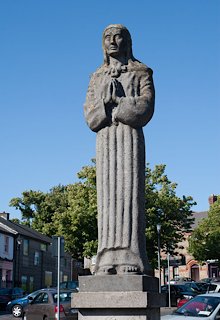
(Pictured: The statue of Saint Brigid at the Market Square of Kildare which is dedicated to the memory of the victims at Gibbet Rath)


Leave a comment

Birth of Richard Colley Wellesley, 1st Marquess Wellesley

Richard Colley Wellesley, 1st Marquess Wellesley, Anglo-Irish politician and colonial administrator, is born on June 20, 1760, at Dangan Castle, County Meath. He, as governor of Madras (now Chennai) and governor-general of Bengal (both 1797–1805), greatly enlarges the British Empire in India and, as Lord Lieutenant of Ireland (1821–28, 1833–34), attempts to reconcile Protestants and Roman Catholics in a bitterly divided country. Throughout his life he displays an ever-increasing jealousy of his younger brother Arthur Wellesley, 1st Duke of Wellington, despite his own achievements.

Born Richard Colley Wesley, he is the eldest son of Garret Wesley, 1st Earl of Mornington (he changes the family surname to Wellesley in 1789). He is educated at the Royal School, Armagh, Harrow School, Eton College, and Christ Church, Oxford, although he leaves the latter in 1781, following his father’s death, before completing his degree. He enters the Irish House of Commons in 1780 and, after he inherits his father’s Irish titles in 1781, moves to the Irish House of Lords. A moderately liberal disciple of Prime Minister William Pitt the Younger, he wins a seat in the British House of Commons in 1784 and serves there until 1797. From 1793 he is a member of the British Privy Council and a commissioner of the India Board of Control.

As Governor-General of India, Wellesley uses military force and diplomacy to strengthen and expand British authority. East India Company forces defeat and kill Tipu Sultan, Indian Muslim ruler of the Kingdom of Mysore (present-day Mysuru) and sympathizer for Revolutionary France, in the Fourth Anglo-Mysore War (1799), and he then restores the Hindu dynasty there that had been deposed by Tipu’s father, Hyder Ali. He annexes much territory after his brother Arthur and General Gerard Lake defeat the Maratha Confederacy of states in the Deccan Plateau (peninsular India). In addition, he forces the Oudh State to surrender numerous important cities to the British, and he contracts with other states a series of “subsidiary alliances” by which all parties recognize British preponderance. He receives a barony in the British peerage in 1797 at the time of his appointment as governor-general, and in 1799 he is awarded a marquessate in the Irish peerage for his victory in the Mysore War.

When Wellesley is faced with an invasion by Zaman Shah Durrani, ruler (1793–1800) of Kabul (Afghanistan), he utilizes his envoy, Captain John Malcolm, to induce Fatḥ-Alī Shah Qajar of Qajar Iran to restrain Zaman Shah Durrani and to give British political and commercial interests preference over the French. On receiving a British government order to restore to France its former possessions in India, he refuses to comply. His policy is vindicated when the Treaty of Amiens (1802) is violated, and Great Britain resumes war against Napoleonic France.

Wellesley’s annexations and the vast military expenditure that he had authorized alarms the court of directors of the East India Company. In 1805, he is recalled, and soon afterward he is threatened with impeachment, although two years later he refuses an offer of the foreign secretaryship. In 1809, he goes to Spain to make diplomatic arrangements for the Peninsular War against France and later that year becomes foreign secretary under Prime Minister Spencer Perceval. In that office he antagonizes his colleagues, who consider him an indolent megalomaniac and welcome his resignation in February 1812. Unlike most of them, however, he had urged a stronger war effort in Spain and had advocated political rights for British Roman Catholics. After Perceval’s assassination on May 11, 1812, he attempts unsuccessfully to form a government at the request of the prince regent (the future King George IV).

As Lord Lieutenant of Ireland, Wellesley disappoints the anti-Catholic George IV, and he is about to be removed when his brother, Arthur, is appointed prime minister in January 1828. He then resigns because his brother is opposed to Roman Catholic emancipation, although the duke is constrained to accept that policy as a political necessity in 1829. His second term as Lord Lieutenant of Ireland (1833–34) ends with the fall of Charles Grey, 2nd Earl Grey’s reform government. When the Whig Party returns to power in April 1835, he is not sent back to Ireland, and in his rage, he threatens to shoot the prime minister, William Lamb, 2nd Viscount Melbourne. He wants to be created Duke of Hindustan so that his rank will equal that of his brother.

Wellesley dies at the age of 82 on September 26, 1842, at Knightsbridge, London. He is buried in Eton College Chapel, at his old school. He and Arthur, after a long estrangement, had been once more on friendly terms for some years. Arthur weeps at the funeral and says that he knows of no honour greater than being Lord Wellesley’s brother.

Wellesley’s library is sold at auction in London by R. H. Evans on January 17, 1843 (and three following days); a copy of the catalogue, annotated with prices and buyers’ names, is held at Cambridge University Library.

Wellesley has several children, including three sons, but none are legitimate. The marquessate thus becomes extinct upon his death. The earldom of Mornington goes to his next surviving brother, William Wellesley-Pole.

(From: “Richard Colley Wellesley, Marquess Wellesley, British statesman,” written and fact-checked by the Editors of Encyclopaedia Britannica, http://www.britannica.com, April 2024 | Pictured: “Richard Colley Wellesley, Marquess of Wellesley (1760-1842),” oil on canvas portrait by Thomas Lawrence, 1812-13)


2 Comments

The Battle of Vinegar Hill

The Battle of Vinegar Hill, an engagement during the Irish Rebellion of 1798, takes place on June 21, 1798 when over 13,000 British soldiers launch an attack on Vinegar Hill outside Enniscorthy, County Wexford, the largest camp and headquarters of the Wexford United Irishmen. It marks a turning point in the rebellion, as it is the last attempt by the United Irishmen to hold and defend ground against the British military. The battle is actually fought in two locations: on Vinegar Hill itself and in the streets of nearby Enniscorthy.

By June 18, the British have surrounded County Wexford with between 13,000 and 18,000 troops and are ready to pour into Wexford to crush the insurgency. The United Irishmen leadership issues a call to all its fighters to gather at Vinegar Hill to meet the army in one great, decisive battle. The number assembled is estimated at between 16,000 and 20,000, but the majority lack firearms and have to rely on pikes as their main weapon. The camp also includes many thousands of women and children who are staying there for protection against the rampaging military.

The British plan, as formulated by General Gerard Lake, envisages the complete annihilation of the United Irishmen, women and children by encircling the hill and seizing the only escape route to the west, the bridge over the River Slaney. Lake divides his force into four columns to accomplish this. Three columns, under Generals David Dundas, James Duff and Francis Needham are to assault Vinegar Hill, while the fourth column, under General Johnson, is to storm Enniscorthy and its bridge.

The battle begins shortly before dawn with an artillery bombardment of Irish positions on the hill. Advance units quickly move against the United Irishmen outposts under cover of the bombardment and move artillery closer as forward positions are secured. The tightening ring forces the United Irishmen into an ever-shrinking area and increases exposure to the constant bombardment, including new experimental delayed-fuse shells resulting in hundreds of dead and injured. At least two mass charges are launched by the United Irishmen which fail to break the lines of the military and the situation on Vinegar Hill soon becomes desperate for the United Irishmen.

Meanwhile, a detachment of light infantry under the command of General Johnson attacks the town of Enniscorthy but meets with fierce resistance. Buildings in the town have been fortified and the initial attack is driven back with the loss of munitions and men. A second attack commences with reinforcements including cavalry, which retake the lost cannon and ammunition while also incurring considerable casualties. The United Irishmen are slowly driven out of the town but manage to hold the Slaney bridge and prevent the British from crossing.

When British troops crest the eastern summit of Vinegar Hill, the rebels begin to slowly withdraw through a gap in the British lines later known as “Needham’s Gap”, so-named because the late arrival of General Needham’s troops prevented a total encirclement of the hill. Although the bulk of the United Irishmen army escape, many are left behind and killed in the routing phase of the battle from both cavalry and infantry attack, but also from the advanced field guns which are switched to grapeshot to maximize casualties.

In addition to conventional casualties, there are also instances of British troops raping the women accompanying the United Irishmen and in Enniscorthy, United Irishmen wounded are burned to death when soldiers set fire to a building used as a casualty station. These atrocities may have been perpetrated in revenge for the execution by the United Irishmen of numbers of mostly Protestant loyalist prisoners of war in the preceding weeks. The United Irishmen abandon much of the supplies they had taken from surrounding areas, and thirteen cannons are captured by the British, a number of which had been taken from the British forces previously.

Meanwhile, the bulk of the United Irishmen force streams uninterrupted towards the Three Rocks camp outside Wexford and, following the decision to abandon the town, split into two separate columns in a new campaign to spread the rebellion beyond Wexford. One immediately sets out to the west, the other northwards towards the Wicklow Mountains to link up with General Joseph Holt‘s forces.

The defeat is therefore not the immediate crushing blow to the Wexford United Irishmen that it has falsely been depicted as, but it does alter the course of the fighting as continued resistance now takes the form of mobile warfare, raids, and large scale, guerilla-type operations.

Casualties for the United Irishmen have been variously reported, with estimates ranging from 400 to around 1,200. Kevin Whelan estimates a figure of between 500 and 1,000 including camp followers, while Archibald McLaren, a British soldier eyewitness, writes that the United Irishmen casualties total about 1,200 men. British casualties are around one hundred.


Leave a comment

The Trial & Conviction of Theobald Wolfe Tone

Theobald Wolfe Tone, a leading Irish revolutionary figure and one of the founding members of the Society of United Irishmen, is tried and convicted of treason by a court-martial in Dublin on November 10, 1798, and sentenced to be hanged.

When the Irish Rebellion of 1798 breaks out in Ireland, Wolfe Tone urges the French Directory to send effective assistance to the Irish rebels. All that can be promised is a number of raids to descend simultaneously around the Irish coast. One of these raids under General Jean Joseph Amable Humbert succeeds in landing a force near Killala, County Mayo, and gains some success in Connacht (particularly at Castlebar) before it is subdued by General Gerard Lake and Charles Cornwallis. Wolfe Tone’s brother Matthew is captured, tried by court-martial and hanged. A second raid, accompanied by James Napper Tandy, comes to a disastrous end on the coast of County Donegal.

Wolfe Tone takes part in a third raid, under Admiral Jean-Baptiste-François Bompart, with General Jean Hardy in command of a force of 2,800 men. He certainly knows before departing that the odds against them are incredibly long. Most of the United Irish organization has already spent itself in Wexford, Ulster, and other places. There is one slim reed of hope for success – the news from Hubert, who is sweeping the British before him in Mayo with his 1,000 Frenchmen and Irish rebel allies. Wolfe Tone once said he would accompany any French force to Ireland even if it were only a corporal’s guard, so he sails off with Hardy’s Frenchmen aboard the Hoche.

They are intercepted by a large British fleet at Buncrana on Lough Swilly on October 12, 1798. Escape aboard one of the small, fast ships is Wolfe Tone’s only hope to avoid a hangman’s noose but he refuses to transfer from the large, slow Hoche, which has little choice but certain sinking or capture. He refuses offers by Napoleon Bonaparte and other French officers of escape in a frigate before the Battle of Tory Island. “Shall it be said,” he asks them, “that I fled while the French were fighting the battle of my country?”

The Hoche withstands an attack by five British ships for several hours, with Wolfe Tone commanding one of her batteries. Inevitably the masts and rigging of the Hoche are shot away and she strikes her colors. Wolfe Tone is dressed in a French adjutant general‘s uniform, but there is little chance of him avoiding detection with so many former acquaintances among the British. He is thrown into chains taken prisoner when the Hoche surrenders.

When the prisoners are landed at Letterkenny Port a fortnight later, Sir George Hill recognises Wolfe Tone in the French adjutant general’s uniform in Lord Cavan’s privy-quarters at Letterkenny. At his trial by court-martial in Dublin on November 8, 1798, Wolfe Tone makes a speech avowing his determined hostility to England and his intention “by frank and open war to procure the separation of the countries.” Recognising that the court is certain to convict him, he asks that “the court should adjudge me to die the death of a soldier, and that I may be shot.” His request to be shot is denied.

On November 10, 1798, Wolfe Tone is found guilty and sentenced to be hanged on November 12. Before this sentence is carried out, either he attempts suicide by slitting his throat or British soldiers torture and mortally wound him. Military surgeon Benjamin Lentaigne treats him just hours before he is due to be hanged. The story goes that he is initially saved when the wound is sealed with a bandage, and he is told if he tries to talk the wound will open and he will bleed to death.

A pamphlet published in Latin by Dr. Lentaigne some years after Wolfe Tone’s official “suicide” refers to an unusual neck wound suffered by an unnamed patient which indicates that “a bullet passed through his throat.” This leads to speculation that Wolfe Tone may have been shot.

Theobald Wolfe Tone dies on November 19, 1798, at the age of 35 in Provost’s Prison, Dublin, not far from where he was born. He is buried in Bodenstown Graveyard in County Kildare, near his birthplace at Sallins, and his grave is in the care of the National Graves Association.

(Pictured: “Capture Of Wolfe Tone Date 1798,” a drawing by Mary Evans Picture Library, the UK’s leading source for historical images)


Leave a comment

John Hely-Hutchinson Created Baron Hutchinson of Alexandria & Knocklofty

Generated by IIPImage

General John Hely-Hutchinson, Jr., Member of Parliament (MP) for Cork Borough, is created Baron Hutchinson of Alexandria and Knocklofty on December 18, 1801, for his military service.

Hely-Hutchinson is born on May 15, 1757, the son of John Hely-Hutchinson and the Christiana Hely-Hutchinson, 1st Baroness Donoughmore. He is educated at Eton College, Magdalen College, Oxford, and Trinity College, Dublin.

Hely-Hutchinson enters the Army as a cornet in the 18th Royal Hussars in 1774, rising to a lieutenant the following year. In 1776 he is promoted to become a captain in the 67th (South Hampshire) Regiment of Foot, and a major there in 1781. He moves regiments again in 1783, becoming a lieutenant-colonel in, and colonel-commandant of, the 77th Regiment of Foot, which is, however, disbanded shortly afterwards following an earlier mutiny. He spends the next 11 years on half-pay, studying military tactics in France before serving as a volunteer in the Flanders campaigns of 1793 as aide-de-camp to Sir Ralph Abercromby.

In March 1794 Hely-Hutchinson obtains brevet promotion to colonel and the colonelcy of the old 94th Regiment of Foot and then becomes a major-general in May 1796, serving in Ireland during the Irish Rebellion of 1798, where he is second-in-command at the Battle of Castlebar under General Gerard Lake. In 1799, he is in the expedition to the Netherlands.

Hely-Hutchinson is second-in-command of the 1801 expedition to Egypt, under Abercromby. Following Abercromby’s death in March after being wounded at the Battle of Alexandria, he takes command of the force. From then he is able to besiege the French firstly at Cairo which capitulates in June and then besieges and takes Alexandria, culminating in the capitulation of over 22,000 French soldiers. In reward for his successes there, the Ottoman Sultan Selim III makes him a Knight, 1st Class, of the Order of the Crescent.

On December 18, 1801, Hely-Hutchinson is created Baron Hutchinson in the Peerage of the United Kingdom, gaining a seat in the House of Lords. In recognition of his “eminent services” during the “late glorious and successful campaign in Egypt,” at the request of the King, the Parliament of the United Kingdom settles on Lord Hutchinson and the next two succeeding male heirs of his body an annuity of £2000 per annum, paid out of the Consolidated Fund.

Hely-Hutchinson is promoted lieutenant-general in September 1803 and made a full general in June 1813. In 1806, he becomes colonel of the 57th (West Middlesex) Regiment of Foot, transferring in 1811 to be colonel of the 18th Regiment of Foot, a position he holds until his death. He also holds the position of Governor of Stirling Castle from 1806 until his death.

Hely-Hutchinson sits as Member of Parliament (MP) for Lanesborough from 1776 to 1783 and for Taghmon from 1789 to 1790. Subsequently, he represents Cork City in the Irish House of Commons until the Act of Union 1800 and is then member for Cork City in the after-Union Parliament of the United Kingdom until 1802.

Hely-Hutchinson dies on June 29, 1832, never having married.


Leave a comment

Publication of the First Issue of the “Northern Star”

northern-star

The first issue of the Northern Star, the newspaper of the Society of United Irishmen, is published in Belfast on January 4, 1792. It is published from 1792 until its suppression by the British army in May 1797.

The publication of an Irish newspaper that reflects and disseminates liberal views is an early goal of Irish republicans in the late 18th century. By the founding of the Society of United Irishmen in October 1791, the project is well underway, and the first edition of the Northern Star appears in Belfast in January 1792. Like the United Irishmen, the first financial backers of the Northern Star are Presbyterian and one of the United Irish leadership, Samuel Neilson, is made editor.

Political content dominates the Northern Star but its publication of local news, as opposed to the focus on British and international affairs of other Irish newspapers of the time, brings it wide popularity. Leading members of the United Irishmen are regular contributors and mixed direct political analyses with cutting political satire. William Orr is among those who contributed to its content and his letters lead to his eventual arrest and execution under the Insurrection Act of 1797. The newspaper also enjoys an excellent voluntary distribution network as its penetration follows rapidly wherever the United Irishmen set up new branches. It was estimated that for each copy of the Northern Star sold there are at least five readers, as the reading aloud of articles from the paper is a regular feature of United Irish meetings.

The newspaper is initially protected from the authorities due to the support of well-connected liberals but following the outbreak of war between Great Britain and Revolutionary France in 1793 and the subsequent banning of the United Irishmen as a seditious body it begins to draw increasing attention. The massive popularity of the newspaper protects it from serious harassment until January 1797 when the establishment goes into a state of panic following the French invasion scare at Bantry Bay. The paper is alleged to be behind the Dublin-based Union Star, a militant, low-circulation newssheet, often posted in public places, which specializes in naming informers, “notorious Orangemen,” and other enemies of the United Irishmen, being regarded by Dublin Castle as a republican hitlist.

The extensive distribution network and potency of the Northern Star in spreading United Irish opinion alarms the authorities and possession of a copy comes to be regarded as an admission of seditious intent. The end finally comes with the uncovering of supposed United Irish infiltration of the Monaghan militia in Belfast, which results in the execution of four soldiers. General Gerard Lake, 1st Viscount Lake, already engaged in a brutal counter-insurgency campaign, is quick to put much of the blame on the Northern Star and requests permission to suppress the paper.

As it turns out, official suppression is not necessary as on May 19, 1797, three days after the execution of their ex-comrades, a mob of Monaghan militiamen anxious to prove their loyalty attack the offices of the Northern Star and destroy not only the printing presses but the building itself. The attack results in the demise of the Northern Star to the undoubted satisfaction of the authorities as no action is taken against those involved in the destruction. The Chartist movement later pays tribute to the Northern Star by using the same name for their newspaper that is founded in 1837 by Feargus O’Connor.


2 Comments

The Battle of Foulksmills

During the Irish Rebellion of 1798, the Battle of Foulksmills, known locally as the Battle of Horetown and also known as the Battle of Goff’s Bridge, takes place on June 20, 1798 between advancing British forces seeking to stamp out the rebellion in County Wexford and a rebel army assembled to oppose them.

By June 19 the threat of the United Irish rebellion spreading outside County Wexford had been largely contained and Crown forces were positioned to move against rebel held territory. A force of about 1,500 men under Sir John Moore move out of New Ross toward Wexford as part of an overall encirclement operation in conjunction with General Gerard Lake‘s forces moving from the north.

Moore’s force is to link up and combine with the isolated garrison holding Duncannon before moving deeper into County Wexford, but after waiting several hours with no sign of their arrival, Moore decides to press ahead to the village of Taghmon alone. Upon nearing Goff’s Bridge at Foulkesmill, his scouts report a rapidly moving rebel force of some 5,000 moving along the road with the intent to give battle. Moore despatches a force of riflemen from the 60th Regiment to hold the bridge until artillery can be brought up in support.

The rebels however, led by Father Philip Roche, spot this move and move away from the road to the high ground on the left intending to outflank Moore’s force. The 60th are forced to engage the rebels on the roads, fields and forests of the area and the rebel flanking move briefly threatens to overturn Moore’s left. Moore has to personally rally his fleeing troops to hold the line and lead them in a successful counter-attack. As more troops begin to arrive the rebels are flushed out of their concealed positions, allowing the artillery to be brought into play and the rebels’ move is foiled. The rebels are gradually pushed back field by field but are able to withdraw the bulk of their force safely.

The road to Wexford is opened and the town recaptured by the Crown the next day but during this battle followers of rebel captain Thomas Dixon massacre up to 100 loyalist prisoners at Wexford bridge.

Casualties are estimated at 500 on the rebel side and 100 of the military.