seamus dubhghaill

Promoting Irish Culture and History from Little Rock, Arkansas, USA


Leave a comment

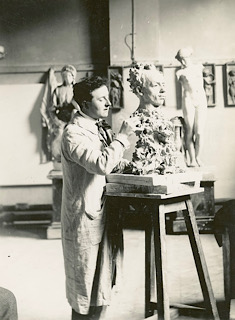
Birth of Irish Sculptor Albert Power

Albert George Power, Irish sculptor in the academic realist style, is born at 8 Barrack Street (now Benburb Street) in Dublin on November 16, 1881. He is particularly known for his iconic statue of the Irish writer Pádraic Ó Conaire.

Power is born to Henry Power, a watchmaker, and Mary (née Atkins), an embroideress. He has one older brother, and one younger sister. He attends a Christian Brothers national school in North Brunswick Street. As a child he plays in local clay brickyards and sculpts busts of his friends. After finishing his primary school education, he trains with a firm of sculptors run by Edward Smyth. In 1884, he enrolls as an evening pupil at the Dublin Metropolitan School of Art (DMSA), later attending as a full-time student from 1906 to 1911. During his time at the DMSA he is taught and strongly influenced by John HughesOliver Sheppard and William Orpen. He wins a number of prizes during his time at the DMSA, including medals, three scholarships, book prizes, and the national gold medal for the best modeling of a nude figure, in Ireland, Scotland, and the Channel Islands in 1911.

Power marries Agnes Kelly in 1903. The couple has ten children, four daughters and six sons, including May and James who also become sculptors.

Power establishes his own stone-carving business in 1912 from his new home at 18 Geraldine Street, Phibsborough, Dublin. As the firm grows, it moves to premises nearby at 15 Berkeley Street from 1930. He executes a wide range of works, including monuments and architectural features in bronze, marble, and stone. Among his notable works are the figure of “Science” designed by Sheppard from the façade of the new Royal College of Science for Ireland (later Government Buildings) on Merrion Street, Dublin, carved motifs and sphinxes for the Gresham Hotel, O’Connell Street, and four statues on the dome of Christ the King church, Carndonagh, County Donegal.

Power is considered the leading Irish sculptor of the 1920s and 1930s. He is a nationalist and promotes the use of Irish materials such as limestone from Durrow and Connemara marble. He is noted for his academic realist style. He exhibits regularly with the Royal Hibernian Academy from 1906, becoming an associate member in 1911, and a full member in 1919. Among those he models sculptures for are James Stephens (1913), W. B. Yeats (1918), and Lord Dunsany (1920). Among his patrons are Oliver St. John Gogarty, and through Gogarty he is commissioned to model a number of prominent Irish nationalists. Gogarty asks him to carve a portrait of Terence MacSwiney in 1920, while MacSwiney is on hunger strike in HM Prison Brixton, London. Smuggled into the prison to do a thumbnail sketch, Power then carves a portrait in the form of a life mask.

On Gogarty’s recommendation, Power is commissioned by the Irish Free State government to create portraits of a number of leading politicians including Arthur Griffith (1922), Michael Collins (1936), and Austin Stack (1939). He is also privately commissioned to execute a portrait of Éamon de Valera in 1944. Among his monumental works are sculptures of Tom Kettle (1919) at St. Stephen’s Green, Dublin, Christ the King in Gort, County Galway, (1933), Pádraic Ó Conaire (1935) at Eyre Square, Galway, and W. B. Yeats (1939) at Sandymount Green, Dublin. He is one of the artists invited to submit designs for the new coinage of the Irish Free State in 1928.

Power dies in Dublin on July 10, 1945, following complications from a double hernia. His is buried in Glasnevin Cemetery, Dublin.


Leave a comment

The Shooting Death of Eileen Quinn

Eileen Quinn, age 24 and within two months of the birth of her fourth child, is shot by Galway police on November 1, 1920, during the Irish War of Independence (1919-21), while holding her nine-month-old child in her arms and sitting on the lawn in front of her farmhouse at Kiltartan near Gort, bleeding to death later that night. She leaves three children, the eldest of whom is not yet four years old.

Afraid of ambushes, police have begun to “reconnoiter by fire,” shooting blindly into woods and possible ambush sites. Quinn is near one such site when the police open fire, and she is hit by a stray bullet.

At the time of the shooting, her husband Malachy Quinn, who is a farmer, is in Gort. Another messenger going to Ardrahan for Dr. Foley is, it is reported, wounded by a bullet. Uniformed men pass into Gort subsequently firing shots. When the lorry passes the house where the dying woman lay, the terror-stricken occupants flee by the back way.

Rev. Fr. John Considine, C.C., Gort, gives a graphic description of Quinn’s last moments.

“It is too awful, too inhuman, to contemplate.” These are Father Considine’s opening remarks concerning the tragedy. Pressed to explain what occurred, he says, “I have read of Turkish atrocities; I have read of the death of Joan of Arc; I have read of the sufferings of Nurse Cavell, and as I read those things I often felt my blood boil and I often prayed that the good God might change the minds and hearts of those cruel monsters.”

“Little did I then dream that I should witness a tragedy, an atrocity more hideous, more revolting, more frightful, more brutal, more cruel than any of those things, and here in our own little peaceful parish of Gort. My God, it is awful! About three o’clock on Tuesday, Malachy Quinn weeping bitterly, called for me. Father, says he, ‘I have just heard that my wife had been shot. Will you run down immediately?’ I procured a motor car and hurried to the scene. At the gateway there we beheld a large pool of blood. In the yard another pool, and the porch leading to the kitchen was covered with blood. I entered the room. Oh, God! what a sight. There lay the poor woman, the blood oozing out through her clothes.”

“She turned her eyes towards me and said, ‘Oh, Father John, I have been shot.’ ‘Shot!’ I exclaimed. ‘Yes,’ she replied. By whom, I asked. ‘Police’ she answered.”

Quinn then becomes weaker, Father Considine explains, and on rallying exclaims, “Father John, will you do something for me?” He tries to console her and administers the Last Sacrament.

“When I finished, she whispered to me, bring me Malachy, bring him to me, I hear him crying. I have something to tell him. I did so. What a scene. Then she became weak and fainted off. Gradually she became worse.”

“I sent word immediately to the Head Constable at Gort. He arrived with police and military. All seemed shocked at the tragedy. I asked him to go in and see the woman. He and his men felt the trial too much, as he answered, ‘I cannot.’ No trace of the bullet could be found.”

Continuing, Father Considine says Quinn is sitting on the lawn with her child when the lorry passes from which the fatal shot is fired. The bullet pierces her stomach and the child she is holding falls from her arms. She crawls over the wall into the yard, and then crawls to the porch to tell her servant that she has been shot. “Take in the little children!” she exclaims.

From 3:00 p.m. to 10:30 p.m. she lingers on in pain. Occasionally she clasps Father Considine’s hand and pulls him toward her, and says, “I’m done, I’m done!” At 10:30 her condition becomes worse, and they kneel by her bedside to recite the Rosary and prayers for the dying. She tries to join but is too weak.

At 10:45 p.m. the little children begin to cry, and with them the crowded house bursts into tears. As Father Considine reads the last prayer of the Ritual she looks around, then closes her eyes and dies.

Irish public opinion is outraged when a military court of inquiry subsequently returns a verdict of “death by misadventure.” Soon afterward, the Royal Irish Constabulary (RIC) Headquarters and the Chief of Police issue orders against wild firing from motor vehicles.

(From: The Galway Observer, November 1920)


Leave a comment

First Edition of the “Irish Bulletin” is Produced

First edition of the Irish Bulletin, the official gazette of the government of the Irish Republic, is produced by Dáil Éireann’s Department of Propaganda on November 11, 1919, during the Irish War of Independence. The Irish Bulletin appears in weekly editions until July 11, 1921, and becomes very important in getting the Irish side of events known to a wide audience.

In April 1919, Terence MacSwiney proposes the establishment of a daily paper by the Dáil for the purpose of publicity. His suggestion is not implemented until November, when Desmond FitzGerald decides that some form of printed counterpropaganda is vital to republican aims and to take advantage of the success of Sinn Féin and the increasing international interest in Ireland. Fitzgerald succeeds Laurence Ginnell in the Ministry following the latter’s arrest in April 1919, though he does not take up the position until July. At a Cabinet meeting held on November 7, there is agreement that there should be “A scheme for daily news bulletin to foreign correspondents, weekly lists of atrocities; entertainment of friendly journalists approved, and £500 voted for expenses under Mr. Griffith’s personal supervision.” Four days later the Irish Bulletin makes its debut, in a run consisting of just thirty copies. Five issues of the bulletin are issued each week for the next two years, despite efforts by the British authorities to suppress it.

The Irish Bulletin‘s offices are originally located at No. 6 Harcourt Street, Dublin. FitzGerald is the paper’s first editor, until his arrest and replacement by Erskine Childers. In the early days, the paper is produced mainly by Frank Gallagher and Robert Brennan. Brennan, as Sinn Féin’s Director of Publicity since April 1918, had played a leading role in that party’s success in the 1918 Irish General Election.

Following FitzGerald’s arrest in 1921, Childers is appointed Director of Propaganda taking charge of publicity and thus becoming the paper’s new editor. On May 9, 1921, both Childers and Gallagher are arrested and taken to Dublin Castle. Following the intervention of Sir Alfred Cope, both are released that night and go on the run. The hasty release of the two leads to speculation between Art O’Brien and Michael Collins that there is a rift developing between the British military authorities and the civil administration. Despite the arrests, the Irish Bulletin continues to appear on schedule. Alan J. Ellis, a journalist with The Cork Examiner makes occasional contributions to the paper. Kathleen Napoli McKenna is “a key force behind the daily newssheet.”

In the early days, the Irish Bulletin consists mainly of lists of raids by the security forces and the arrests of suspects. In order to stimulate interest, this is expanded in 1921 at the behest of the Irish President, Éamon de Valera, in his direction to Childers to give more detailed accounts of events. Extracts from foreign publications, particularly sympathetic English papers, are frequently included. A regular feature is accounts from the Dáil Courts, which are reported in detail.

The Irish Bulletin is more graphic in its coverage of violence than is usual for its time. An example is its reporting on the deaths of two prominent Sinn Féin leaders, Henry and Patrick Loughnane, from Shanaglish, Gort, County Galway. The men had been handed over by the Royal Irish Constabulary (RIC) to local members of the Auxiliary Division. On December 6, the bodies are found in a pond. The skulls had been battered in and the flesh was hanging loose on both bodies.The two men were evidently tied by the neck to a motor lorry and dragged behind it until they were dead. Before the bodies were hidden in a pond an effort was made to burn them.

On the night of March 26-27, 1921, the offices of the Irish Bulletin are discovered by the British authorities. Captured typewriters and duplicators are used to fabricate bogus issues of the paper. These are distributed to the usual subscribers using lists found at the office. Lord Henry Cavendish-Bentinck MP on receiving some of the counterfeit papers through the post, asks in the House that those responsible “not (to) waste their money in sending me any more of their forgeries.” The initial efforts of the forgers, Captains Hugh Pollard and William Darling, are of poor quality and easily identified as counterfeit.

(Pictured: The “Irish Bulletin” issue of October 12, 1920, National Museum of Ireland)


2 Comments

Death of Francis Arthur Fahy, Songwriter & Poet

francis-arthur-fahy

Francis Arthur Fahy, Irish nationalist, songwriter and poet, dies on April 1, 1935. He is probably best remembered as the composer of the evergreen “The Ould Plaid Shawl”. He collaborates with various composers, including Alicia Adélaide Needham, an associate of the Royal Academy of Music.

Fahy is born in Kinvara, County Galway, on September 29, 1854 into a family of seventeen, eight of whom survive. His father, Thomas, comes from the Burren area and his mother, Celia Marlborough, is born near Gort, County Galway.

In 1896, Fahy becomes president of the emerging Conradh na Gaeilge (Gaelic League) in London, a position he holds until 1908. He is also a long time member of the London Irish Literary Society. Described as a small, brisk man, his enthusiasm and energy knows no bounds. His most memorable poems and songs include “The Ould Plaid Shawl,” “The Queen of Connemara,” the original “Galway Bay,” and “The Tide Full In.” His publications include The Child’s Irish Song Book (1881), The Irish Reciter (1882), Irish History in Rhyme (1882) and Irish Songs and Poems (1887).

Fahy retires from the Civil Service at the age of 65. He dies at the age of 81 on April 1, 1935.


Leave a comment

Birth of Lady Gregory, Writer & Playwright

lady-gregory

Isabella Augusta, Lady Gregory (née Isabella Augusta), Irish playwright, folklorist and theatre manager, is born on March 15, 1852, at Roxborough, County Galway. Her translations of Irish legends, her peasant comedies and fantasies based on folklore, and her work for the Abbey Theatre, play a considerable part in the late 19th-century Irish Literary Revival.

Augusta is the youngest daughter of the Anglo-Irish gentry family Persse. Her mother, Frances Barry, is related to Standish O’Grady, 1st Viscount Guillamore, and her family home, Roxborough, is a 6,000-acre estate located between Gort and Loughrea, the main house of which is later burned down during the Irish Civil War. She is educated at home, and her future career is strongly influenced by the family nanny, Mary Sheridan, a Catholic and a native speaker of the Irish language, who introduces the young Augusta to the history and legends of the local area.

In 1880 Augusta marries Sir William Henry Gregory, a neighbouring landowner who had previously served as a Member of Parliament and as governor of Ceylon. He is a well-educated man with many literary and artistic interests, and his estate at Coole Park houses a large library and extensive art collection, both of which Lady Gregory is eager to explore. He also has a house in London, where the couple spends a considerable amount of time.

Lady Gregory’s literary career does not begin until after Sir Gregory’s death in 1892. In 1896 she meets William Butler Yeats and becomes his lifelong friend and patron. She takes part in the foundation of the Irish Literary Theatre in 1899 and becomes a director of the Abbey Theatre in 1904, which owes much of its success to her skill at smoothing the disputes among its highly individualistic Irish nationalist founders. As a playwright, she writes pleasant comedies based on Irish folkways and picturesque peasant speech, offsetting the more tragic tones of the dramas of Yeats and John Millington Synge.

Lady Gregory writes or translates nearly forty plays. Seven Short Plays (1909), her first dramatic works, are among her best, vivid in dialogue and characterization. The longer comedies, The Image and Damer’s Gold, are published in 1910 and 1913 and her strange realistic fantasies, The Golden Apple and The Dragon, in 1916 and 1920. She also arranges and makes continuous narratives out of the various versions of Irish sagas, translating them into an Anglo-Irish peasant dialect that she labels “Kiltartan.” These are published as Cuchulain of Muirthemne (1902) and Gods and Fighting Men (1904).

Lady Gregory returns to live in Galway after ill health forces her retirement from the Abbey Theatre board in 1928, although she continues to visit Dublin regularly. The house and demesne at Coole Park are sold to the Irish Forestry Commission in 1927, with Lady Gregory retaining life tenancy. Her Galway home had long been a focal point for the writers associated with the Irish Literary Revival, and this continues after her retirement. On a tree in what were the grounds of the house, one can still see the carved initials of Synge, Æ, Yeats and his artist brother Jack, George Moore, Seán O’Casey, George Bernard Shaw, Katharine Tynan and Violet Martin.

Lady Gregory, whom Shaw once described as “the greatest living Irishwoman,” dies at the age of 80 on May 22, 1932, at home from breast cancer. She is buried in the New Cemetery in Bohermore, County Galway. The entire contents of Coole Park are auctioned three months after her death, and the house is demolished in 1941.


Leave a comment

The Ballyturin House Ambush

In what is known as the Ballyturin House Ambush, an Irish Republican Army (IRA) unit in County Galway ambushes a motor car as it leaves Ballyturin House near Gort on May 15, 1921.

The IRA gets into position at about 1:00 PM. They see Royal Irish Constabulary (RIC) District Inspector Cecil Blake arrive, as they have positively identified him through prior reconnaissance. They take over the gatehouse, and make any passersby prisoner in it, seventeen in all, until Blake’s car is seen about 8:30 PM. Passengers in the car with Blake include his wife Eliza, Captain Cornwallis of the 17 Lancers, Lieutenant McCreery of the 17 Lancers, and the daughter-in-law of Lady Gregory of Coole Park.

The car drives down the long drive to the gate. When they get there, one of the gates is closed, unbeknown to them a ploy by the IRA ambushers to force the car to stop. The car stops and Captain Cornwallis gets out to open the gate. It is at this point that they are ambushed by a group of twenty IRA men.

One of the IRA men in the bushes to the right shouts, “Hands up.” Cornwallis dashes outside the gate to protect himself from the men in the bushes, and fires a couple of revolver shots at the group. He is completely protected from them by the wall, but completely exposed to the men in the gatehouse and is shot and killed.

Mrs. Gregory gets out of the car on the side facing the IRA ambushers, which is believed to have saved her life, as they leave her alone. She works her way around to the back of the car and is led back towards the house by some of the IRA men after the firing stops.

Blake, Mrs. Blake, and Lt. McCreery are apparently killed without firing a shot. The IRA men then move in and remove the guns of their victims.

John and Anna Bagot, who are the owners of Ballyturin House, run down the long drive to the gate when they hear the shooting. Mrs. Gregory was handed over to Miss Molly Bagot. She tells the inquiry that she does not recognise any of the men. John Bagot is held at gunpoint and handed a note which apparently reads, “Volunteer HQ. Sir, if there is any reprisals after this ambush, your house will be set on fire as a return. By Order IRA.”

John Bagot dies on the April 27, 1935. His wife, Anna, lives until January 17, 1963. She dies in London at the age of 96 and is buried at Gresford Church near WrexhamNorth Wales. Ballyturin House is abandoned and falls into a total ruin.

The ambush is believed to be in retaliation for an incident in which soldiers or police had tortured three local men for information by forcing them to dig their own graves and then threatening to bury them alive. It is also rumoured in the vicinity, although unsubstantiated, that Lady Gregory conspires with the IRA in planning the ambush which is why her daughter-in-law survives.

(Pictured: Death on a Summer’s evening: The deadly ambush at Ballyturin House on May 15 1921. London Illustrated News May 28 1921)


Leave a comment

Birth of Sir Hugh Percy Lane, Gallery Director & Collector

hugh-percy-lane

Sir Hugh Percy Lane, art dealer, collector, and gallery director, is born in County Cork on November 9, 1875. He is best known for establishing Dublin‘s Municipal Gallery of Modern Art, the first known public gallery of modern art in the world, and for his contribution to the visual arts in Ireland, including the Lane Bequest.

Lane is brought up in Cornwall, England, and begins his career as an apprentice painting restorer and later becomes a successful art dealer in London.

Through regular visits to the home of his aunt, Lady Gregory, in Coole Park, near Gort in County Galway, Lane remains in contact with Ireland. He soon counts among his family, friends, and social circle those who collectively form the core of the Irish cultural renaissance in the early decades of the 20th century.

Extolling the cause of Irish art abroad, Lane also becomes one of the foremost collectors and dealers of Impressionist paintings in Europe, and amongst those works purchased by him for the new gallery are La Musique aux Tuileries by Édouard Manet, Sur la Plage by Edgar Degas, Les Parapluies by Pierre-Auguste Renoir, and La Cheminée by Jean-Édouard Vuillard.

The Municipal Gallery of Modern Art opens in January 1908 in temporary premises in Harcourt Street, Dublin. Lane hopes that Dublin Corporation will run it, but the corporation is unsure if it will be financially viable. Lane does not live to see his gallery permanently located as he dies on May 7, 1915, during the sinking of the RMS Lusitania off the west coast of Cork. The gallery, extended in 2005, is now in Parnell Square in central Dublin.

For his “services to art” in Ireland, Lane is knighted in June 1909 at the comparatively young age of 33.

Following his death, Lane’s will bequeaths his collection to London, but an unwitnessed later codicil bequeaths it to Dublin. Having possession, London’s National Gallery does not recognise the codicil. At the request of Lane’s aunt, Lady Gregory, W.T. Cosgrave, leader of the Irish Government unsuccessfully approaches Ramsay MacDonald on the matter in 1929. When John A. Costello becomes Taoiseach in 1948, he initiates further negotiations with the government of the United Kingdom, eventually leading to a compromise in 1959, under Taoiseach Seán Lemass, whereby half of the Lane Bequest will be loaned and shown in Dublin every five years. In 1993 the agreement is varied so that 31 of the 39 paintings would stay in Ireland. The remaining 8 are divided into two groups, so that four would be loaned for six years at a time to Dublin. In 2008, The National Gallery in London arranges for the entire collection to be on display in Dublin together for the first time.