seamus dubhghaill

Promoting Irish Culture and History from Little Rock, Arkansas, USA


Leave a comment

Birth of Tom Hales, IRA Volunteer & Fianna Fáil Politician

Thomas Hales, Irish Republican Army (IRA) volunteer and Fianna Fáil politician, is born in Knocknacurra House, Ballinadee, near Bandon, County Cork, on March 5, 1892.

Hales is born on a family farm owned by his father, Robert Hales, an activist in the Irish Land War and a reputed member of the Irish Republican Brotherhood (IRB) and his wife, Margaret (née Fitzgerald). He is the sixth of nine children (five sons and four daughters). He is educated at Ballinadee national school and Warner’s Lane school, Bandon. After leaving school he works at Harte’s timber yard, Bandon.

Hales joins and is involved with the Irish Volunteers movement from its inception in November 1913. Elected a delegate at the Volunteer national convention in the Abbey Theatre in 1915, he is among the majority who vote for the election of the national executive.

Hales is a part of a group of volunteers who are mobilised and plan to rise up in Cork during the 1916 Easter Rising. He sends a number of dispatches to Cork requesting further instructions. However, they receive last minute orders to stand down and there is no uprising in Cork to match that in Dublin. The Volunteers give up their arms and are later arrested.

By May 1916, Hales and his brothers, Seán, Bob, and William, are fighting with the IRA in west Cork during the Irish War of Independence. Terence MacSwiney is arrested in Hales’ home on May 3, 1916, and Hales himself escapes and goes on the run. He states that he was listed as “wanted” in the Hue and Cry police gazette.

In 1918, Hales takes part in a raid on a British gunboat and holds 25 armed Royal Irish Constabulary (RIC) members prisoner at Snugmore Castle. He takes part in a decoy in assisting his elder brother, Seán, to escape after his arrest in connection with the German Plot. He is elected Battalion Commandant of the 1st (Bandon) Battalion (1917–19), and Brigade Commandant of Cork 3rd Brigade, IRA, in January 1919.

In December 1919, Hales takes part in an ambush against the RIC at Kilbrittain and Bandon and is involved in the manufacture of gunpowder for IRA munitions. By this point he is the commander of the Third Cork Brigade of the IRA. In July 1920, he along with Harte is arrested by soldiers from the Essex Regiment.

The pair are taken to a nearby military barracks, where they are severely beaten while being interrogated by officers of the regiment. Hales has his fingernails pulled out, an event that later inspires a scene in the film The Wind That Shakes the Barley. However, neither Hales nor Harte give up any information and are eventually sent to a military hospital to recuperate. Hales is tried and is eventually sentenced to two years’ penal servitude, which he serves in Pentonville and Dartmoor prisons in England. He is commander of the Irish prisoners at Pentonville, but is released following a general amnesty after the Anglo-Irish Treaty in December 1921. According to Tom Barry, Harte suffers brain damage and goes insane before dying in Broadmoor Hospital.

A fifth Hales brother, Donal, settles in Genoa from 1913, and is appointed Irish Consular and Commercial Agent for Italy in February 1919. In this capacity he plays a leading propaganda role. Several letters from Michael Collins to Donal Hales still exist which are used by Hales to promote international awareness of the Irish conflict in Italian publications. Donal oversees a failed attempt to import a substantial number of Austrian weapons and ammunition captured from World War I, from Genoa in the spring of 1921, through the person of Gabriele D’Annunzio.

During the Irish Civil War, Tom and Seán Hales fight on opposite sides, with Hales fighting against the Anglo-Irish Treaty with the Anti-Treaty IRA while Seán joins the newly formed National Army of the Irish Free State. While the bothers end up on opposite sides of the war, they never openly criticise one another for their rival political stances.

Hales is elected to the anti-Treaty IRA executive in March 1922, but resigns in June over a proposal to prevent the Free State’s first general election in June 1922. He resumes his old rank during the Irish Civil War as commander of Cork 3 Brigade.

During the Irish Civil War in July 1922, Hales takes part in the raid and capture of Skibbereen Barracks and Ballineen by anti-Treaty forces. He is also involved in a skirmish with Free State troops at Newcestown. He is arrested in November 1922 and imprisoned first in Cork and then at the Curragh. He is released in December 1923, having taken part in a hunger strike for fourteen days. He mentions in his application for a military pension that he was a member of the Supreme Council of the IRB at this time.

In December 1922, Hales’s brother Seán is assassinated by the anti-Treaty IRA in Dublin, in reprisal for the Free State government’s execution of IRA prisoners. Hales later applies to the Irish government for a service pension under the Military Service Pensions Act, 1934 and is awarded nine years’ service in 1935 at Grade B for his service with the Irish Volunteers and the IRA between April 1, 1917, and September 30, 1923.

Hales is elected to Dáil Éireann as a Fianna Fáil Teachta Dála (TD) for the Cork West constituency at the 1933 Irish general election. He resigns from Fianna Fáil in June 1936 stating he cannot support their policy on interning IRA members. He fails to retain his seat as an independent candidate at the 1937 Irish general election. He also unsuccessfully contests the 1944 Irish general election as an independent candidate and the 1948 Irish general election as a candidate for Clann na Poblachta, receiving 2,287 votes (7.93%).

Hales makes his living as farmer. A member of the Mallow area board of the beet growers’ association from 1934 to 1942, he is also connected with other farming organisations. He marries Ann Lehane from Tirelton, Macroom, on April 30, 1927. They have five children, Seán, Robert, Thomas, Eileen, and Margaret.

Hales dies on April 29, 1966, at St. Finbarr’s Hospital, Cork, and is buried at St. Patrick’s Cemetery, Bandon.


1 Comment

The Philadelphia Nativist Riots

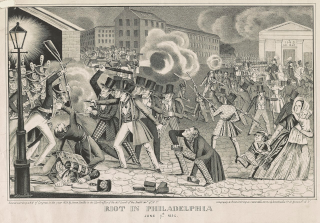
The Philadelphia nativist riots (also known as the Philadelphia Prayer Riots, the Bible Riots and the Native American Riots) are a series of riots that take place on May 6—8 and July 6—7, 1844, in Philadelphia, Pennsylvania, and the adjacent districts of Kensington and Southwark. The riots are a result of rising anti-Catholic sentiment at the growing population of Irish Catholic immigrants.

On July 3, Father John Patrick Dunn of the Church of St. Philip Neri in the Southwark District is warned that the church might be attacked during an upcoming parade held by the Native American Party. The Native American Party, a nativist political party, plans to hold a large parade the next day on Independence Day.

To prepare for violence, the church applies for an arsenal that a volunteer company could use in case the church is attacked. Pennsylvania Governor David R. Porter authorizes the formation of a company and the procurement of twenty-five muskets from the Frankford Arsenal. Major General Robert Patterson, commander of the Pennsylvania militia, puts the troops on alert in case of violence.

Five of the muskets placed in St. Philip Neri’s Church are discovered to be defective and are sent back to the Frankford Arsenal to be repaired. No violence occurs before or during the parade, but on July 5, a nativist mob numbering in the thousands gathers at the church after some observe five defective muskets being returned to the church. They then demand that the sheriff remove the weapons, while Father Dunn and volunteers rally to protect the church. Sheriff Morton McMichael and two aldermen search the church and remove twelve muskets. After leaving the church, the sheriff urges the crowd to disperse and leaves a volunteer posse to guard the church. The mob remains, and a man injured in the May riots makes a speech to the crowd, calling for a second search of the church. The sheriff, an alderman, and seventeen nativists enter the church and find three armed men, fifty-three muskets, ten pistols, a keg of gunpowder and ammunition. To avoid inciting the mob, the sheriff decides not to remove the armaments, and the search party stays in the church. Just after midnight, July 6, Major General Patterson orders a company of city guards to clear the streets. After the crowd disperses, the arms found within the church are removed.

By midday, the crowds return around St. Philip Neri’s Church. General George Cadwalader orders the crowds to disperse, but they do not. By the evening, the sheriff arrives with a 150-strong posse. Throughout the evening, the military presence grows, and three cannons are stationed on the streets. The soldiers clear the streets near the church, despite being pelted with rocks by the mob. Responding to the rock throwers, General Cadwalader orders a cannon to be fired at the crowd on Third Street. Former U.S. Congressman Charles Naylor begs the general not to fire. He and several others are arrested and held within the church. By the morning of July 7, most of the soldiers have left, but the crowds, led by an alderman and the sheriff, return and demand that the remaining guard release Naylor. Everyone except Naylor is released. The crowds grow, and a cannon is brought from a nearby wharf and used to threaten the church. After further negotiations, Naylor is released and carried home to cheers on people’s shoulders.

After Naylor is brought home, the mob attacks the church, damaging a wall with the cannon. A second cannon is brought from the wharfs and fired at the church, after which the mob pelts the building with rocks and break in through a side door. The soldiers fire on the men breaking into the church, who promptly retreat. After retreating, the nativists negotiate with the guard, who agrees to withdraw, allowing the nativists to guard the church. The crowd pelts the soldiers with rocks and some soldiers fire back, which only incites the mob further. The mob forces its way into the church, causing extensive damage to the interior. After about an hour, a group of twenty men organizes themselves to guard St. Philip Neri’s, and the mob leaves the church.

By the evening, a large number of soldiers arrive with orders to clear the streets, only to be stoned in the process. After a captain is attacked, the order is given to fire on the mob, which results in seven fatalities and nine injuries. Not long after, people with muskets and cannons arrive and fierce fighting breaks out between the soldiers and the mob. The fighting lasts for several hours, with the soldiers being fired upon from alleyways and the windows of nearby buildings. The soldiers bring in two cannons of their own and fire on the mob. The mob returns fire using their own cannons, armed with items such as nails, chains, knives and broken bottles. In an attempt to capture the mob’s cannons, soldiers charge one cannon’s position, only to be knocked off their horses by a rope tied across the street. The cannons are all eventually captured, and by early morning on July 8, the fighting has ended.

At least fifteen people, including rioters and soldiers, are killed in the riot, and at least fifty people are injured. Under Governor Porter’s orders, state troops continue to arrive in the city in the days afterward, but no further violence takes place. An estimated 5,000 militia are used to stop violence. Troops begin to withdraw from the city on July 10, and the church takes over responsibility from the district of Southwark of protecting the church on July 11. As with the May riots, a grand jury blames the Irish Catholics for the riots but supports the military’s response to the violence.

The riots gain national attention and condemnation. The riots are used as an issue in the 1844 U.S. Presidential election, the Democratic Party condemning the growing Native American Party and the Whig Party, which the Democrats accuse of involvement in the nativist movement. In Philadelphia, the Native American Party ends up making a strong showing in the city’s October election.

On July 11, 1844, Philadelphia passes an ordinance that gives the city a battalion of artillery, a regiment of infantry, and at least one full troop of cavalry to preserve peace within the city when necessary. The difficulty of quelling the riots and other crime leads the Pennsylvania General Assembly to pass an 1845 act that requires Philadelphia, the township of Moyamensing and the unincorporated districts of Spring Garden, Northern Liberties, and Penn to maintain a police force of one man per 150 taxable inhabitants. In 1850, another act is passed that establishes that the Philadelphia police force will police the city and seven surrounding districts. The inability to maintain order effectively in Philadelphia’s suburbs is an important argument for the consolidation of the city in 1854.

After the riots, Bishop Kenrick ends his efforts to influence the public education system and begins encouraging the creation of Catholic schools, with 17 being founded by 1860. The friars of the Church of St. Augustine sue the city of Philadelphia for not providing the church with adequate protection, claiming $80,000 in damages. The city argues that the friars cannot claim their civil rights were violated, as the Order of Saint Augustine is a foreign organization under the Pope. Furthermore, the city argues that the friars took a vow of poverty and cannot be property owners. The Augustinians end up proving the Order is incorporated in 1804 and is awarded $45,000. The church is rebuilt in 1848.

(Pictured: “Riot in Philadelphia,” lithograph by H. Bucholzer, 1844, Library of Congress)


Leave a comment

The Clerkenwell Explosion

The Clerkenwell explosion, also known as the Clerkenwell Outrage, is a bombing that takes place in London on December 13, 1867. The Irish Republican Brotherhood (IRB), nicknamed the “Fenians“, explode a bomb to try to free one of their members being held on remand at Clerkenwell Prison. The explosion damages nearby houses, kills 12 people and causes 120 injuries. None of the prisoners escape.

The whole of Ireland has been under British rule since the end of the Nine Years’ War in 1603. The Irish Republican Brotherhood is founded on March 17, 1858 with the aim of establishing an independent democratic republic in Ireland, and the Fenian Brotherhood, ostensibly the American wing of the Irish Republican Brotherhood, is founded in New York City in 1859.

On November 20, 1867, Ricard O’Sullivan Burke and his companion Joseph Casey are arrested in Woburn Square in London. Burke had purchased weapons for the Fenians in Birmingham. Burke is charged with treason and Casey with assaulting a constable. They are remanded in custody pending trial, and imprisoned at the Middlesex House of Detention, also known as Clerkenwell Prison.

Burke’s IRB colleagues try to free him on Thursday, December 12, without success. They try to blow a hole in the prison wall while the prisoners are exercising in the prison yard but their bomb fails to explode. They try again at about 3:45 PM the following day, December 13, using a barrel of gunpowder concealed on a costermonger‘s barrow. The explosion demolishes a 60-foot section of the wall, but no one escapes. The prison authorities had been forewarned and the prisoners were exercised earlier in the day, so they are locked in their cells when the bomb explodes. The blast also damages several nearby tenement houses on Corporation Lane on the opposite side of the road, killing 12 people and causing many injuries, with estimates ranging from around 30 to over 120.

Charges are laid against eight, but two turn Queen’s evidence. Michael Barrett and five others are tried at the Old Bailey in April 1868. Lord Chief Justice Sir Alexander Cockburn and Baron George Bramwell preside with a jury. The prosecution is led by the Attorney General Sir John Karslake and the Solicitor General Sir William Baliol Brett supported by Hardinge Giffard QC and two junior counsel. Defence barristers included Montagu Williams and Edward Clarke.

Barrett, a native of County Fermanagh, protests his innocence, and some witnesses testify that he was in Scotland on December 13, but another identifies him as being present at the scene. Two defendants are acquitted on the instructions of the presiding judges in the course of the trial, leaving four before the jury. Following deliberations, three of the defendants are acquitted, but Barrett is convicted of murder on April 27 and sentenced to death. Barrett is hanged by William Calcraft on the morning of Tuesday, May 26, 1868, outside Newgate Prison. He is the last man to be publicly hanged in England, with the practice being ended from May 29, 1868, by the Capital Punishment Amendment Act 1868.

The trial of Burke and Casey, and a third defendant, Henry Shaw, begains on April 28, all charged with treason. The prosecution claims that Burke had been involved in finding arms for the Fenians in Birmingham in late 1865 and early 1866, where he was using the name “Edward C Winslow.” The case against Casey is ultimately withdrawn, but Burke and Shaw are found guilty of treason on April 30 and sentenced to 15 years and 7 years of penal servitude respectively.

The bombing enrages the British public, souring relations between England and Ireland and causing a panic over the Fenian threat. The radical, Charles Bradlaugh, condemns the incident in his newspaper, the National Reformer, as an act “calculated to destroy all sympathy, and to evoke the opposition of all classes.” The Metropolitan Police form a Special Irish Branch at Scotland Yard in March 1883, initially as a small section of the Criminal Investigation Department, to monitor Fenian activity.

In April 1867, the supreme council of the Irish Republican Brotherhood condemns the Clerkenwell Outrage as a “dreadful and deplorable event,” but the organisation returns to bombings in Britain in 1881 to 1885, with the Fenian dynamite campaign.

(Pictured: The House of Detention in Clerkenwell after the bombing as seen from within the prison yard)