seamus dubhghaill

Promoting Irish Culture and History from Little Rock, Arkansas, USA


Leave a comment

Death of Cathal O’Shannon, Journalist & Television Presenter

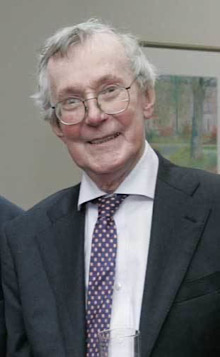
Cathal O’Shannon, Irish journalist and television presenter, dies in Dublin on October 22, 2011. He is a former journalist with The Irish Times and television reporter/presenter and documentary film maker with RTÉ. He is probably best known for presenting documentaries on Irish history, produced mainly for Irish television viewers and broadcast by RTÉ.

O’Shannon is awarded lifetime membership of the Irish Film & Television Academy in 2010, to which he says it is “particularly gratifying that it occurs before I pop my clogs”.

The Irish radio and television broadcaster Terry Wogan describes O’Shannon as possibly the greatest Irish television journalist of the 20th century.

O’Shannon is born in Marino, Dublin, on August 23, 1928, the son of Cathal O’Shannon (Sr.), a socialist and Irish Republican. He receives his formal education at Coláiste Mhuire in Parnell Square, Dublin. In 1945, despite his father’s politics, as a 16-year-old, he volunteers for war time service with the Royal Air Force in Belfast during World War II, utilizing a forged birth certificate to disguise being underage for enlistment with the British Armed Forces. After air crew training he is posted to the Far East, as a tail gunner in an Avro Lancaster bomber to take part in the Burma campaign, but the war ends with the downfall of the Japanese Empire before he is required to fly combat sorties.

O’Shannon first becomes a journalist with The Irish Times on leaving the Royal Air Force in 1947. Later he joins the Irish state broadcasting service Raidió Teilifís Éireann (RTÉ).

In July 1972, O’Shannon records a notable television interview with 31-year-old Muhammad Ali, when Ali is in Dublin to compete at Croke Park in a bout with Alvin Lewis.

O’Shannon receives a Jacob’s Award for his 1976 TV documentary, Even the Olives are Bleeding, which details with the activities of the “Connolly Column” in the Spanish Civil War. Two years later he is honoured with a second Jacob’s Award for his television biography Emmet Dalton Remembers (1978).

In 1978, O’Shannon leaves RTÉ to join Canadian company Alcan which is setting up an aluminum plant at Aughinish, County Limerick, in 1978. He is head-hunted to become its Director of Public Affairs, an important post at a time when there are environmental concerns about the effects of aluminum production. He admits that he is attracted by the salary, “five times what RTÉ were paying me,” but he also later says that one reason for the move is that he had become unhappy with working at RTÉ, stating in an interview that: “The real reason I got out of RTÉ was that they wouldn’t let me do what I wanted to do journalistically.” He had submitted proposals to the station’s editors for television documentary series on the Irish Civil War, and also one on the wartime Emergency period, but they had been rejected. While he enjoys the social life with lavish expenses which his public relations duties involve, his friends believe that he misses the varied life and travel of journalism. He retires early from Aughinish in 1992, and returns to making television documentaries with RTÉ.

In January 2007, O’Shannon’s last documentary, Hidden History: Ireland’s Nazis, is broadcast by RTÉ as a two-part series. It explores how a number of former Nazis and Nazi collaborators from German-occupied Europe went to live in Republic of Ireland after World War II, the best known of whom is Otto Skorzeny, who lives for a period in County Kildare. Others include such Breton nationalists as Alan HeusaffYann Fouéré and Yann Goulet, as well as two BelgiansAlbert Folens and Albert Luykx.

O’Shannon’s wife, Patsy, whom he met while they were working at The Irish Times office in London, dies in 2006. They had been married for more than 50 years.

On January 12, 2007, O’Shannon announces his retirement at the age of 80. In a 2008 television documentary, he admits that throughout his marriage he had been a serial womaniser and had repeatedly engaged in extra-marital affairs unbeknownst to his wife.

After weakening health for two years, and spending his last days in a hospice at Blackrock, O’Shannon dies at the Beacon Hospital in Dublin on October 22, 2011, in his 84th year. His body is reposed at Fanagans Funeral Home in Dublin on October 25, followed by a funeral the following day at Glasnevin Cemetery Chapel, where his remains are cremated afterward.

Director General of RTÉ Noel Curran says O’Shannon had brought into being “some of the great moments in the RTÉ documentary and factual schedule over the past five decades.” In tribute, RTÉ One shows the documentary Cathal O’Shannon: Telling Tales on November 10, 2011. It had originally aired in 2008 to mark his 80th birthday


Leave a comment

Birth of Cathal O’Shannon, Journalist & Television Presenter

Cathal O’Shannon, Irish journalist and television presenter, is born in Marino, Dublin, on August 23, 1928. He is a reporter with The Irish Times, and television reporter/presenter and documentary film maker with RTÉ. The Irish radio and television broadcaster Terry Wogan describes O’Shannon as possibly the greatest Irish television journalist of the 20th century.

O’Shannon is the son of Cathal O’Shannon (Sr.), a Socialist and Irish Republican. He receives his formal education at Colaiste Mhuire School, in Parnell Square, Dublin. Despite his father’s politics, as a 16-year-old he volunteeres for war time service with the Royal Air Force (RAF) in Belfast in 1945 during World War II. He utilizes a forged birth certificate to disguise being underage for enlistment with the British Armed Forces. After air crew training, he is posted to the Far East, as a tail gunner in an Avro Lancaster bomber to take part in the Burma campaign, but the war ends with the downfall of the Japanese Empire before he is required to fly combat sorties.

O’Shannon first becomes a journalist with The Irish Times on leaving the RAF in 1947. Later he joins the Irish state broadcasting service Raidió Teilifís Éireann (RTÉ).

In July 1972 O’Shannon records a notable television interview with 31-year-old Muhammad Ali, when Ali is in Dublin to compete at Croke Park in a bout with Alvin Lewis.

O’Shannon receives a Jacob’s Award for his 1976 TV documentary, Even the Olives are Bleeding, which details the activities of the “Connolly Column” in the Spanish Civil War. Two years later he is honoured with a second Jacob’s Award for his television biography Emmet Dalton Remembers (1978).

In 1978, O’Shannon leaves RTÉ to join Canadian company Alcan, which is setting up an aluminum plant at Aughinish, County Limerick, in 1978. He is head-hunted to become its Director of Public Affairs, an important post at a time when there are environmental concerns about the effects of aluminium production. He admits that he was attracted by the salary, “five times what RTÉ were paying me,” but he also later says that one of the reasons for the move is that he had become unhappy with working at RTÉ, stating in an interview that “The real reason I got out of RTÉ was that they wouldn’t let me do what I wanted to do journalistically.” He had submitted proposals to the station’s editors for a television documentary series on the Irish Civil War, and also one on the wartime Emergency period, but they had been rejected. While he enjoys the social life with lavish expenses which his public relations duties involve, his friends believe that he missed the varied life and travel of journalism. He retires early from Aughinish in 1992 and returns to making television documentaries with RTÉ.

In January 2007, O’Shannon’s last documentary, Hidden History: Ireland’s Nazis, is broadcast by RTÉ as a two-part series. It explores how a number of former Nazis and Nazi collaborators from German-occupied Europe go to live in the Republic of Ireland after World War II — the best known of whom is Otto Skorzeny, who lives for a period in County Kildare. Others include such Breton nationalists as Alan Heusaff, Yann Fouéré and Yann Goulet, as well as two Belgians, Albert Folens and Albert Luykx.

O’Shannon announces his retirement at the age of 80 on January 12, 2007.

O’Shannon is awarded lifetime membership in the Irish Film & Television Academy in 2010, to which he says is “particularly gratifying that it occurs before I pop my clogs.”

After weakening health for two years, and spending his last days in hospice at Blackrock, O’Shannon dies at the Beacon Hospital in Dublin on October 22, 2011. His body is reposed at Fanagans Funeral Home in Dublin on October 25, 2011, followed by a funeral the following day at Glasnevin Cemetery Chapel, where it is afterwards cremated.

O’Shannon’s wife, Patsy, whom he met while they were working for The Irish Times office in London, dies in 2006. They are married for more than 50 years. In a 2008 television documentary O’Shannon admits that throughout his marriage he had been a serial womaniser, who had repeatedly engaged in extra-marital affairs unbeknownst to his wife.

Director-General of RTÉ Noel Curran says O’Shannon had brought into being “some of the great moments in the RTÉ documentary and factual schedule over the past five decades.” In tribute, RTÉ One shows the documentary Cathal O’Shannon: Telling Tales on November 10, 2011. It had originally aired in 2008 to mark his 80th birthday.


Leave a comment

Birth of Frank McCourt, Teacher & Writer

frank-mccourt

Francis “Frank” McCourt, Irish American teacher and writer, is born in New York City‘s Brooklyn borough on August 19, 1930.

McCourt is born to Malachy McCourt, Sr., who falsely claims to have been in the Irish Republican Army (IRA) during the Irish War of Independence, and Irish Catholic mother Angela Sheehan from Limerick. In the midst of the Great Depression, the family moves back to Ireland. Unable to find steady work in Belfast or Dublin and beset by his father’s alcoholism, the family returns to their mother’s native Limerick, where they sink even deeper into poverty.

In October 1949, at the age of 19, McCourt leaves Ireland, taking a boat from Cork to New York City. In 1951, he is drafted during the Korean War and sent to Bavaria for two years initially training dogs, then as a clerk. Upon his discharge from the US Army, he returned to New York City, where he held a series of jobs on docks, in warehouses, and in banks. Using his G.I. Bill education benefits, he talks his way into New York University by claiming he is intelligent and reads a great deal. He is admitted on one year’s probation provided he maintains a B average. He graduates in 1957 from NYU with a bachelor’s degree in English.

A New York city schoolteacher for more than thirty years, McCourt achieves literary fame later in life with his best-selling childhood memoir of the misery and squalor of his childhood, Angela’s Ashes. With a first printing of just 25,000 copies, the book becomes an instant favourite with critics and readers and is perhaps the ultimate case of the non-celebrity memoir, the extraordinary life of an ordinary man.

McCourt wins the annual Pulitzer Prize for Biography or Autobiography in 1997 and one of the annual National Book Critics Circle Awards for the book, which is eventually published in 25 languages and 30 countries. It is a bestseller and makes him a millionaire. Three years later, a movie version of Angela’s Ashes opens to mixed reviews with Northern Irish actor Michael Legge playing McCourt as a teenager.

McCourt is also the author of ‘Tis (1999), which continues the narrative of his life, picking up from the end of Angela’s Ashes and focusing on his life after returning to New York. He subsequently writes Teacher Man (2005) which details his teaching experiences and the challenges of being a teacher.

McCourt writes the book for a 1997 musical entitled The Irish…and How They Got That Way, which features an eclectic mix of Irish music – everything from the traditional Danny Boy to U2‘s I Still Haven’t Found What I’m Looking For.

It is announced in May 2009 that McCourt has been treated for melanoma and that he is in remission, undergoing home chemotherapy. On July 19, 2009, he dies from the cancer, with meningeal complications, at a hospice in Manhattan, New York City.


Leave a comment

Death of Christie Hennessy, Folk Singer-Songwriter

christie-hennessyChristie Hennessy, Irish folk singer-songwriter, dies in London on December 11, 2007. Although Hennessy is unable to read or write due to severe dyslexia, he still writes his own songs such as “Roll back the Clouds” and “All the lies that you told me.”

Hennessy is born in Tralee, County Kerry on November 19, 1945. His first guitar is made, especially for him, from a tea chest when he is six years old by his friend Jerry Quirke. He leaves school at the age of eleven.

Hennessy’s first job is as a messenger boy, and it is then that he discovers that it is important to be able to read. He is unable to read or write due to severe dyslexia, but still enjoys his library of books. He later works on building sites in London.

In 1972 Hennessy releases his first record, The Green Album, on Westwood, a small label. With scant publicity or promotion, the album makes little impact and only 500 copies of the record are pressed. He returns to labouring on building sites in the UK and does not release another album for twenty years. When he does, his 1992 release The Rehearsal outsells U2 in Ireland, eventually attaining triple platinum status. His following albums, A Year in the Life and Box also sell extremely well in Ireland.

A renowned songwriter as well as performer, Hennessy writes several songs that become hits for other singers including Don’t Forget your Shovel, made famous by Christy Moore, and All the Lies that You Told Me, recorded by Frances Black. He also composes the theme tune and incidental music for the BBC TV series Get Well Soon written by Ray Galton (of Steptoe & Son fame) and composes and writes a musical/feature film about his native Ireland, Two Stops to Paradise.

In 2005, Christy Moore’s rendition of Hennessy’s Don’t Forget Your Shovel is referenced in a UK Number One single JCB by Nizlopi. It is further referenced in the video for the same song. As the line is sung, the characters in the JCB pass a shop called “Christie’s Shovels.”

Hennessy returns to the studio in 2007, one final time to record an album with both Luka Bloom and Christy Moore sharing vocals on one of the tracks.

Christie Hennessy dies on December 11, 2007 in a London hospice, at the age of 62. He is reported to have died from pleural mesothelioma, a rare form of lung cancer, which has been attributed to his younger years spent working on building sites in London where he was exposed to asbestos dust. Just before he dies he had been touring in Ireland but had to cancel due to the illness. His ashes are buried in Old Rath Cemetery, Tralee. A commemorative statue of Christie is erected in Central Plaza, just off the town square in Tralee in November 2009.


Leave a comment

Death of Frank McCourt, Author of “Angela’s Ashes”

frank-mccourt

Francis “Frank” McCourt, Irish American teacher and writer, dies of cancer in Manhattan, New York City, on July 19, 2009.

A New York city schoolteacher for more than thirty years, McCourt achieves literary fame later in life with his best-selling childhood memoir of the misery and squalor of his childhood, Angela’s Ashes. With a first printing of just 25,000 copies, the book becomes an instant favourite with critics and readers and is perhaps the ultimate case of the non-celebrity memoir, the extraordinary life of an ordinary man.

McCourt wins the annual Pulitzer Prize for Biography or Autobiography in 1997 and one of the annual National Book Critics Circle Awards for the book, which is eventually published in 25 languages and 30 countries. It is a bestseller and makes him a millionaire. Three years later, a movie version of Angela’s Ashes opens to mixed reviews with Northern Irish actor Michael Legge playing McCourt as a teenager.

McCourt is also the author of ‘Tis (1999), which continues the narrative of his life, picking up from the end of Angela’s Ashes and focusing on his life after returning to New York. He subsequently writes Teacher Man (2005) which details his teaching experiences and the challenges of being a teacher.

McCourt writes the book for a 1997 musical entitled The Irish…and How They Got That Way, which features an eclectic mix of Irish music – everything from the traditional Danny Boy to U2‘s I Still Haven’t Found What I’m Looking For.

It is announced in May 2009 that McCourt has been treated for melanoma and that he is in remission, undergoing home chemotherapy. On July 19, 2009, he died from the cancer, with meningeal complications, at a hospice in Manhattan.