seamus dubhghaill

Promoting Irish Culture and History from Little Rock, Arkansas, USA


Leave a comment

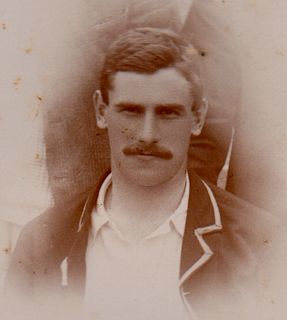
Birth of Arthur Gwynn, Cricketer & Rugby Union Player

Arthur Percival Gwynn, Irish cricketer and rugby union player, is born on June 11, 1874, in RameltonCounty Donegal.

Gwynn is the fifth son of the Very Reverend John Gwynn DD and Josephine O’Brien. He is educated at St. Columba’s College, Dublin, and Trinity College Dublin (TCD). He comes from a cricketing family. His elder brother Lucius plays several times for Ireland, and a younger brother, Robin, also plays for Dublin University and Ireland. A fourth brother, Jack, after several seasons with the university team goes on to play first-class cricket in India. Each of the four brothers has his turn as captain of the Dublin University XI. A cousin, Donough O’Brien, plays for Ireland and the Marylebone Cricket Club, and a nephew, John David Gwynn, also plays for Dublin University.

Gwynn excels academically as well as on the sporting field. The most outgoing of the Gwynn brothers at Trinity College, he cuts a handsome and dashing figure. He graduates from Trinity College in 1896, taking a double first in his finals.

A right-handed batsman and wicket-keeper, Gwynn plays for the Ireland cricket team five times between 1893 and 1896. He also plays four first-class matches for Dublin University in 1895.

Gwynn makes his debut for Ireland in a match against W. H. Laverton’s XI, scoring one run in the only Irish innings. The following year, he plays twice for Ireland, against I Zingari and South Africa. He scores 62 in the second innings against South Africa, his top score for Ireland.

May 1895 sees Gwynn make his first-class debut, playing for Dublin University against the Marylebone Cricket Club on May 20. This is followed three days later by a match for Ireland against the same opponents. He plays three further first-class matches that year, two against Cambridge University and one against Leicestershire. He scores 130 in the final match against Cambridge University, his highest first-class score.

In all matches for Ireland, Gwynn scores 220 runs at an average of 36.67. He takes six catches and one stumping.

Gwynn also plays once for the Ireland national rugby union team, in the 1895 Four Nations tournament against Wales.

After completing the induction course for the Indian Civil Service in the autumn of 1897, Gwynn travels to Burma for his first tour of duty. Tragically his promising career comes to an abrupt end a few months later. He dies in Rangoon of septicemia resulting from a tooth infection on February 14, 1898.


Leave a comment

Death of Lucius Gwynn, Academic & Sportsman

Lucius Henry Gwynn, Irish academic and sportsman who is noted for his prowess in both rugby union football and cricket, dies in Davos Platz, Switzerland, on December 23, 1902.

Gwynn is born in Ramelton, County Donegal, on May 5, 1873. He is a member of a family well known in Dublin at the time for its academic and sporting achievements. He is the fourth son of the Very Rev. John Gwynn, Regius Professor of Divinity at Trinity College Dublin (TCD), and Lucy Josephine, daughter of the Irish patriot William Smith O’Brien. He and his three immediate younger brothers, Arthur, Robin and Jack, all in turn captain their school and university cricket teams and play the game at first class level. He is also a talented rugby player.

Gwynn’s academic career outshines even his sporting achievements. He enters Trinity College Dublin as a foundation Scholar and achieves a double first in his degree finals. In 1899 he is elected a Fellow of Trinity College and commences what promises to be a distinguished academic career.

At school Gwynn is mainly a bowler, his brother Arthur being the superior bat, though this inequality is ironed out at university. He is captain of the Dublin University Cricket Club XI for two seasons, 1894 and 1895, then plays under Arthur’s captaincy. The three brothers make up a formidable threesome in those years.

Primarily noted for his bowling prowess during early outings with the Dublin University XI, Gwynn takes 44 wickets at an average of 8.14 in Trinity’s annus mirabilis of 1893, a season which witnesses victories over Leicestershire, Oxford University, Warwickshire (dismissed for a paltry total of 15 runs) and a draw against Essex.

Gwynn, a right-handed batsman, who records the highest first-class average (56.87) among those batsmen who complete ten innings or more during the English season of 1895, enjoys another remarkably productive season in 1896, plundering over a thousand runs in Trinity flannels, a superlative effort complemented by a haul of 93 wickets at 9.37. His irrepressible form reputedly earns him an invitation to represent England against Australia in the second Ashes Test at Old Trafford in July 1896. However, concurrent university examinations render him unable to participate. Instead, English cricket is introduced to the wizardry of K. S. Ranjitsinhji, who takes Gwynn’s place.

Gwynn makes his debut for Ireland against I Zingari in July 1892 and goes on to play for Ireland 13 times, his last game coming in May 1902 against Marylebone. Two of his matches for Ireland have first-class status.

Gwynn also plays first-class cricket in two Gentlemen v Players matches, representing the gentlemen, and four matches for Dublin University in 1895, for whom he makes his top score of 153 not out against Leicestershire. In all, he amasses 3,195 runs and 311 wickets for Dublin University, in addition to 499 runs and 14 wickets for Ireland.

Remarkably, Gwynn also represents Ireland seven times at rugby union, debuting against Scotland at Belfast in February 1893. He features in all three legs of Ireland’s 1894 Triple Crown-winning campaign.

In 1901 Gwynn marries Katharine Rawlins of Bristol. He is already suffering from persistent symptoms of debility and fatigue. A few months later a Harley Street physician diagnoses tuberculosis. He is admitted to a sanatorium at Davos Platz in Switzerland, but the illness has progressed too far for any treatment to succeed. He dies on December 23, 1902, at the age of 29. The couple’s only child, a daughter named Rhoda, is born in September 1902, just three months before his death.