seamus dubhghaill

Promoting Irish Culture and History from Little Rock, Arkansas, USA


Leave a comment

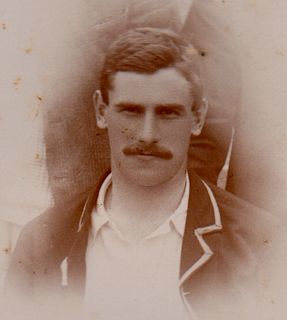
Birth of Arthur Gwynn, Cricketer & Rugby Union Player

Arthur Percival Gwynn, Irish cricketer and rugby union player, is born on June 11, 1874, in RameltonCounty Donegal.

Gwynn is the fifth son of the Very Reverend John Gwynn DD and Josephine O’Brien. He is educated at St. Columba’s College, Dublin, and Trinity College Dublin (TCD). He comes from a cricketing family. His elder brother Lucius plays several times for Ireland, and a younger brother, Robin, also plays for Dublin University and Ireland. A fourth brother, Jack, after several seasons with the university team goes on to play first-class cricket in India. Each of the four brothers has his turn as captain of the Dublin University XI. A cousin, Donough O’Brien, plays for Ireland and the Marylebone Cricket Club, and a nephew, John David Gwynn, also plays for Dublin University.

Gwynn excels academically as well as on the sporting field. The most outgoing of the Gwynn brothers at Trinity College, he cuts a handsome and dashing figure. He graduates from Trinity College in 1896, taking a double first in his finals.

A right-handed batsman and wicket-keeper, Gwynn plays for the Ireland cricket team five times between 1893 and 1896. He also plays four first-class matches for Dublin University in 1895.

Gwynn makes his debut for Ireland in a match against W. H. Laverton’s XI, scoring one run in the only Irish innings. The following year, he plays twice for Ireland, against I Zingari and South Africa. He scores 62 in the second innings against South Africa, his top score for Ireland.

May 1895 sees Gwynn make his first-class debut, playing for Dublin University against the Marylebone Cricket Club on May 20. This is followed three days later by a match for Ireland against the same opponents. He plays three further first-class matches that year, two against Cambridge University and one against Leicestershire. He scores 130 in the final match against Cambridge University, his highest first-class score.

In all matches for Ireland, Gwynn scores 220 runs at an average of 36.67. He takes six catches and one stumping.

Gwynn also plays once for the Ireland national rugby union team, in the 1895 Four Nations tournament against Wales.

After completing the induction course for the Indian Civil Service in the autumn of 1897, Gwynn travels to Burma for his first tour of duty. Tragically his promising career comes to an abrupt end a few months later. He dies in Rangoon of septicemia resulting from a tooth infection on February 14, 1898.


Leave a comment

Birth of Sir William Basil Goulding, Art Collector, Businessman & Cricketer

Sir William Basil Goulding, Irish cricketer, squash player, art collector and prominent businessman, is born in Dublin on November 4, 1909. He is an important art collector of contemporary art in Ireland and is renowned for his extensive collection which is dispersed posthumously. He is an adept businessman and sits on the boards of many companies.

Goulding is educated at Winchester College and Christ Church, Oxford. He inherits the family business W & HM Goulding Ltd. and succeeds his father as Chairperson in 1935. Goulding Ltd. is a well-established fertiliser manufacturer based in Dublin and Cork. The factory closes and is demolished in the mid-20th century and very little of it remains today. The land is donated to the people of Cork by Goulding in the late 1960s and is subsequently developed as an amenity park.

In 1939 Goulding marries Valerie Hamilton Monckton, daughter of Sir Walter Monckton, a lawyer, the UK Attorney General during the Edward VIII abdication crisis, and later a Member of Parliament (MP) for Bristol West. She is an Irish campaigner for disabled people, founder of the Central Remedial Clinic and senator. Together, they have three sons, Hamilton, Timothy and Lingard. The family lives in Enniskerry, County Wicklow, where he has the significant ‘Goulding Summer House’ built by Scott Tallon Walker architects.

During World War II, Goulding is commissioned as a pilot officer in the Royal Air Force. By the end of 1942 he has reached the rank of wing commander.

The Arts Act of 1951 establishes the Arts Council in response to the Bodkin Report which outlines the sad condition of the arts in Ireland. Goulding is a co-opted member of the Council from its formative years and is instrumental in acting on many of its policies.

Goulding is the founding Chairperson of the Contemporary Irish Art Society in 1962, along with Gordon Lambert, Cecil King, Stanley Mosse, James White and Michael Scott. The enthusiasm and vision of these founding members of the society is the catalyst which leads to the development of many important art collections in Ireland. The purpose of the society is to encourage a greater level of patronage of living Irish artists which, at the time, is extremely low. This is mainly achieved by raising funds to purchase artworks by living artists, which are then donated to public collections. The first purchase in 1962 is an important painting by Patrick Scott, donated to the Municipal Gallery of Modern Art (now the Hugh Lane Gallery). Over the following 12 years the society purchases 37 works for the gallery, until in 1974, Dublin Corporation starts to provide an annual purchasing fund for the gallery.

Following completion of the report ‘Design in Ireland,’ the Kilkenny Design Workshops (KDW) is set up in 1963. It endeavours to nurture native Irish crafts particularly textiles, metalwork, ceramics, glass and furniture to have a modern yet distinctly Irish sensibility. The KDW is the first State sponsored design agency in the world and is held as a model of governmental intervention in design. Goulding sits on the board of the KDW from its origination and occupies the role of Chairperson from 1977 until 1981.

A right-handed batsman and wicket-keeper, Goulding plays twice for the Ireland cricket team against the Marylebone Cricket Club (MCC) in 1934, the year in which his father is president of the Irish Cricket Union. He makes his debut in July in a two-day match, scoring seven runs in the Ireland second innings and taking one catch in the MCC first innings. The following month, he plays his only first-class match, not scoring in either inning. In addition to playing cricket, he also represents Ireland at squash, and captains Oxford University at football.

(Photo: Basil Goulding from Tim Goulding’s website, http://www.timgoulding.com)