In the summer of 1647, Murrough O’Brien (later created the Earl of Inchiquin), commander of the English Parliamentarian forces in Cork, ravages and burns the Confederate territory in Munster. This causes severe food shortages and earns O’Brien the Irish nickname, Murchadh na d’Tóiteán (Murrough the Burner). In addition, Inchiquinn takes the Rock of Cashel, which is garrisoned by Confederate troops and rich in emotive religious symbolism. In the sack of the castle, O’Brien’s troops massacre the garrison and all the clergy they find there.
The Confederates’ Munster army is incapable of stopping O’Brien because of political infighting between officers who support a deal with the English Royalists and those who reject such a deal. Eventually, in reaction to the sack of Cashel and famine conditions, the Confederate Supreme Council replaces Donough MacCarthy, 2nd Viscount Muskerry, as commander of the Munster army with Theobald Taaffe, 1st Earl of Carlingford, and order him to bring O’Brien to battle.
Taaffe is an English Catholic and not an experienced soldier. Although he has an excellent contingent of veteran troops under Alasdair Mac Colla, most of his men are similarly inexperienced. Furthermore, the Irish troops are demoralised by the internal factionalism in their ranks and most of them have little loyalty to Taafe. O’Brien, on the other hand, has been commanding his force since 1642 and is well experienced in battle. His troops are a mixture of well trained Parliamentarian soldiers from England and British settlers who have been driven from their homes in the Irish Rebellion of 1641. The two armies meet at Knocknanuss near Mallow, approximately 29 kilometers north of Cork.
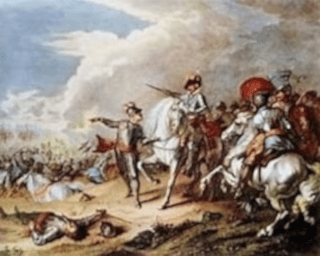
The battle that follows is essentially an uncoordinated rout of the Irish forces. Taaffe positions his men on either side of a hill, so that they cannot see one another. The result is that one wing of the Confederate army has no idea of what the other wing is doing. Mac Colla’s men charge the Parliamentarians opposite them putting them to flight and killing a large number of them. Thinking the battle is over, they then take to looting the enemy’s baggage train.
However, on the other wing, O’Brien’s cavalry has charged the raw Irish horsemen, causing them to run away. Despite Taaffe’s desperate attempt to rally them, the Irish infantry follow suit, many of them being cut down by the pursuing roundheads. The pursuit continues for miles and not only results in heavy casualties among the Irish, but also in the loss of most of their equipment and supplies. Inchiquin loses several senior officers, including the Judge-Advocate, Sir Robert Travers. Mac Colla and his men surrender when they realise what has happened but are subsequently killed by their captors. Around 3,000 Confederates die at Knocknanauss, and up to 1,000 English Parliamentarians. The carnage does not stop after the fighting is finished. The next day a couple of hundred Irish soldiers are found sheltering in a nearby wood. These are promptly put to the sword.
When combined with the Battle of Dungan‘s Hill in County Meath, the defeat leads to the collapse of the Confederate Catholic cause and forces them to make a deal with the English Royalists.
As a young man O’Neill leaves Ireland, one of the ninety-nine involved in the Flight of the Earls escaping the English conquest of his native Ulster. He grows up in the Spanish Netherlands and spends 40 years serving in the Irish regiment of the Spanish army. He sees most of his combat in the Eighty Years’ War against the Dutch Republic in Flanders, notably at the Siege of Arras, where he commands the Spanish garrison. He also distinguishes himself in the Franco-Spanish War by holding out for 48 days with 2,000 men against a French army of 35,000.
O’Neill is, like many Gaelic Irish officers in the Spanish service, very hostile to the English Protestant presence in Ireland. In 1627, he is involved in petitioning the Spanish monarchy to invade Ireland using the Irish Spanish regiments. He proposes that Ireland be made a republic under Spanish protection to avoid in-fighting between Irish Catholic landed families over which of them would provide a prince or king of Ireland. This plot comes to nothing. However in 1642, He returns to Ireland with 300 veterans to aid the Irish Rebellion of 1641.
The subsequent war, known as the Irish Confederate Wars, is part of the Wars of the Three Kingdoms, civil wars throughout Britain and Ireland. Because of his military experience, O’Neill is recognised on his return to Ireland in July 1642, at Doe Castle in County Donegal, as the leading representative of the O’Neills and head of the Ulster Irish. Sir Phelim O’Neill resigns the northern command of the Irish rebellion in his favour and escorts him from Lough Swilly to Charlemont.
Jealousy between the kinsmen is complicated by differences between O’Neill and the Catholic Confederation which meet at Kilkenny in October 1642. O’Neill professes to be acting in the interest of Charles I, but his real aim is the complete Independence of Ireland as a Roman Catholic country, while the Old English Catholics represented by the council desire to secure religious liberty and an Irish constitution under the crown of England. More concretely, O’Neill wants the Plantation of Ulster overturned and the recovery of the O’Neill clan’s ancestral lands. Moreover, he is unhappy that the majority of Confederate military resources are directed to Thomas Preston‘s Leinster army. Preston is also a Spanish veteran but he and O’Neill have an intense personal dislike of each other.
Although O’Neill is a competent general, he is outnumbered by the Scottish Covenanter army that lands in Ulster in 1642. Following a reverse at Clones, he has to abandon central Ulster and is followed by thousands of refugees, fleeing the retribution of the Scottish soldiers for some atrocities against Protestants in the rebellion of 1641. He does his best to stop the killings of Protestant civilians, for which he receives the gratitude of many Protestant settlers. From 1642–1646 a stalemate exists in Ulster, which he uses to train and discipline his Ulster Army. This poorly supplied force nevertheless gains a very bad reputation for plundering and robbing friendly civilians around its quarters in northern Leinster and southern Ulster.
In 1646 O’Neill, with substantial Gallowglass numbers and additionally furnished with supplies by the Papal Nuncio, Giovanni Battista Rinuccini, attacks the Scottish Covenanter army under Major-General Robert Monro, who had landed in Ireland in April 1642. On June 5, 1646 O’Neill utterly routs Monro at the Battle of Benburb, killing or capturing up to 3,000 Scots. However after being summoned to the south by Rinuccini, he fails to take advantage of the victory, and allows Monro to remain unmolested at Carrickfergus.
In March 1646 a treaty is signed between James Butler, 1st Duke of Ormond and the Catholics, which would have committed the Catholics to sending troops to aid the Royalist cause in the English Civil War. The peace terms however, are rejected by a majority of the Irish Catholic military leaders and the Catholic clergy including the Nuncio, Rinuccini. O’Neill leads his Ulster army, along with Thomas Preston’s Leinster army, in a failed attempt to take Dublin from Ormond. However, the Irish Confederates suffer heavy military defeats the following year at the hands of Parliamentarian forces in Ireland at Dungan’s Hill and Knocknanauss, leading to a moderation of their demands and a new peace deal with the Royalists. This time O’Neill is alone among the Irish generals in rejecting the peace deal and finds himself isolated by the departure of the papal nuncio from Ireland in February 1649.
So alienated is O’Neill by the terms of the peace the Confederates have made with Ormond that he refuses to join the Catholic/Royalist coalition and in 1648 his Ulster army fights with other Irish Catholic armies. He makes overtures for alliance to George Monck, 1st Duke of Albemarle, who is in command of the parliamentarians in the north, to obtain supplies for his forces, and at one stage even tries to make a separate treaty with the English Parliament against the Royalists in Ireland. Failing to obtain any better terms from them, he turns once more to Ormond and the Catholic confederates, with whom he prepares to co-operate more earnestly when Oliver Cromwell‘s arrival in Ireland in August 1649 brings the Catholic party face to face with serious danger.
Before, however, anything is accomplished by this combination, O’Neill dies on November 6, 1649 at the O’Reilly stronghold of Cloughoughter Castle located on an island in Lough Oughter in County Cavan. There is no clear evidence of the cause of death, with one belief being that he was poisoned by a priest, while others think it is more likely that he died from an illness resulting from an old wound. Under cover of night he is reputed to have been brought to the Franciscan abbey in Cavan town for burial. However some local tradition still suggests that it may have been at Trinity abbey located upon an island in Lough Oughter, which may be more likely given the logistics of his removal. His death is a major blow to the Irish of Ulster and is kept secret for some time.
The Catholic nobles and gentry meet in Ulster in March 1650 to appoint a commander to succeed O’Neill, and their choice is Heber MacMahon, Roman Catholic Bishop of Clogher, the chief organiser of the recent Clonmacnoise meeting. O’Neill’s Ulster army is unable to prevent the Cromwellian conquest of Ireland, despite a successful defence of Clonmel by O’Neill’s nephew Hugh Dubh O’Neill and is destroyed at the Battle of Scarrifholis in County Donegal in 1650. Its remnants continue guerrilla warfare until 1653, when they surrender at Cloughoughter Castle in County Cavan. Most of the survivors are transported to serve in the Spanish Army.
The rebellion begins on October 23, 1641 as an attempted coup d’état by Catholic gentry and military officers, who try to seize control of the English administration in Ireland. However, it develops into a widespread rebellion and ethnic conflict with English and Scottish Protestant settlers, leading to Scottish military intervention. The rebels eventually found the Irish Catholic Confederacy.
The plan to seize Dublin Castle is foiled, but the rebels swiftly capture numerous towns (including Dundalk), forts and fortified houses in the northern province of Ulster. Within days they hold most of the province. Rebel leader Felim O’Neill of Kinard issues a forged proclamation, the Proclamation of Dungannon, claiming he has the king’s blessing to secure Ireland against the king’s opponents. The uprising spreads southward and soon most of Ireland is in rebellion. In November, rebels besiege Drogheda and defeat an English relief force at Julianstown. The following month, many Anglo-Irish Catholic lords join the rebellion. In these first months, especially in Ulster, some Catholic rebels drive out or kill thousands of Protestant settlers (most notably the Portadown massacre), and settlers respond in kind. Reports of rebel massacres outrage Protestants in Britain, and leave a lasting impact on the Ulster Protestant community.
King Charles and the English parliament both seek to quell the rebellion, but parliament does not trust the king with command of any army raised to do so. This is one of the issues that lead to the English Civil War. Charles orders forces to be raised in Ireland, and the English parliament drafts a bill to give itself the power to raise armed forces. Eventually, in April 1642, following negotiations between the English and Scottish parliaments, the Scots send a Covenanter army to Ireland. It swiftly captures most of eastern Ulster, while a Protestant settler army holds northwestern Ulster. Government forces meanwhile recapture much of the Pale, and hold the region around Cork. Most of the rest of Ireland is under rebel control.
In May 1642, Ireland’s Catholic bishops meet at Kilkenny, declare the rebellion to be a just war and take steps to control it. With representatives of the Catholic nobility in attendance, they agree to set up an alternative government known as the Irish Catholic Confederacy and draw up the Confederate Oath of Association. The rebels, now known as Confederates, hold most of Ireland against the Protestant Royalists, Scottish Covenanters and English Parliamentarians. The rebellion is thus the first stage of the Irish Confederate Wars and part of the wider Wars of the Three Kingdoms, which lasts for the next ten years.
(Pictured: Depiction of the massacre of Ulster Protestants during the 1641 rebellion, the LIFE Picture Collection via Getty Images)
O’Reilly’s father, grandfather and several other ancestors are chiefs of the O’Reilly clan and Lords of Breifne O’Reilly. His mother is Catherine MacMahon. He resides at Bellanacargy Castle in the barony of Tullygarvey, near to present day village of Drung. Bellanacargy castle, anciently referred to as Ballynacarraig because it was built on a carraig (rock island) situated in the middle of the River Annalee, is destroyed in May 1689 by Williamite forces led by Thomas Lloyd.
During the Parliamentary session of 1640 O’Reilly is enlisted by Rory O’Moore in the plot to start a rebellion against English rule in Ireland. O’Moore is a distant relation as his sister Cecilia O’Moore is married to O’Reilly’s first cousin, Tirlagh O’Neill. On the outbreak of the Irish Rebellion in October 1641 he is elected chief of the O’Reillys. As a result, the Irish Parliament expels him on November 16, 1641. On November 6, 1641 he orders a general gathering of his clansmen from 16 to 60 years of age, to be held at Virginia, and on December 11, 1641 he has possession of the whole county, except the Killeshandra castles of Keelagh and Croghan which are defended by Sir Francis Hamilton and Sir James Craig. He raises a brigade of twelve hundred men, composed chiefly of his name and family, and serves with distinction as lieutenant-general in the service of the Confederate Catholics of Ireland. The Assembly of Kilkenny appoints him Lord President of Ulster. His second cousin Myles O’Reilly is High Sheriff of Cavan in 1641 at the outbreak of the Rebellion.
O’Reilly is detained for treason by the English government in 1642. In his diary for June 3, 1644, the historian Sir James Ware II states, “Intelligence came to Dublin that Roger Moore and Philip O’Reilly, two of the first incendiaries were committed to prison at Kilkenny.” O’Reilly is further denounced by the Act for the Settlement of Ireland 1652 at the end of the rebellion. Following the collapse of the Irish confederacy, he formally surrenders to Oliver Cromwell at Cloughoughter Castle on April 27, 1653, being the last Irish garrison to do so. He secures favourable terms and is obliged to leave Ireland. He retires with his brigade into Spain and thence to the Netherlands, where he serves in the Spanish army for about two years and dies in 1655. He is buried in the Irish monastery of St. Dominick in Leuven, Belgium.
By 1650, The Irish Confederates and their English Royalist allies have been driven out of eastern Ireland by the Cromwellian conquest of Ireland. They occupy a defensive position behind the River Shannon, of which Limerick is the southern stronghold. Oliver Cromwell himself had left Ireland in May 1650, delegating his command of the English Parliamentarian forces to Henry Ireton. Ireton moves his forces north from Munster to besiege Limerick in October 1650. The weather, however, is increasingly wet and cold and Ireton is forced to abandon the siege before the onset of winter.
Ireton returns the following June with 8,000 men, 28 siege artillery pieces and four mortars. He then summons Hugh Dubh O’Neill, the Irish commander of Limerick, to surrender but is refused. The siege is on.
Limerick in 1651 is split into two sections, English town and Irish town, which are separated by the Abbey River. English town, which contained the citadel of King John’s Castle, is encircled by water and known as King’s Island. Thomond bridge is the only entrance onto the island and is fortified with bastioned earthworks. Irish town is more vulnerable, but is also more heavily fortified. Its medieval walls have been buttressed by 20 feet of earth. In addition, Irish town has a series of bastions along its walls, mounted with cannon covering its approaches. The biggest of these bastions are at St. John’s Gate and Mungret gate.
Due to Limerick’s fortification, Ireton does not risk an assault on its walls. Instead he secures the approaches to the city, cuts off its supplies and builds artillery earthworks to bombard the defenders. His troops take the fort at Thomond bridge, but the Irish destroy the bridge itself, denying the Parliamentarians land access to English town. Ireton then tries an amphibious attack on the city, which is initially successful, but O’Neill’s men counterattack and beat them off. After this failed attack, Ireton resolves to starve the city into submission and builds two forts on nearby Singland Hill. An Irish attempt to relieve the city from the south is routed at the battle of Knocknaclashy. O’Neill’s only hope is to hold out until bad weather and hunger force Ireton to lift the siege. O’Neill tries to send the town’s old men, women and children out of the city so that his supplies will last a little longer. However, Ireton’s men kill 40 of these civilians and send the rest back into Limerick.
O’Neill comes under pressure from the town’s mayor and civilian population to surrender. The town’s garrison and civilians suffer terribly from hunger and disease. Ireton finds a weak point in the defenses of Irish town and knocks a breach in them, opening the prospect of an all out assault. Eventually, in October 1651, six months after the siege had started, part of Limerick’s garrison mutiny and turn some cannon inwards, threatening to fire on O’Neill’s men unless they surrender. Hugh Dubh O’Neill surrenders Limerick on October 27. The inhabitants lives and property are respected, but they are warned that they could be evicted in the future.
The garrison is allowed to march to Galway, which is still holding out, but has to leave their weapons behind. However, the lives of the civilian and military leaders of Limerick are excepted from the terms of surrender. Catholic Bishop Terence Albert O’Brien, an Alderman and the English Royalist officer Colonel Fennell are hanged. O’Neill is also sentenced to death, but is reprieved by the Parliamentarian commander Edmund Ludlow and imprisoned instead in London. Former mayor Dominic Fanning is drawn, quartered, and decapitated, with his head mounted over St. John’s Gate.
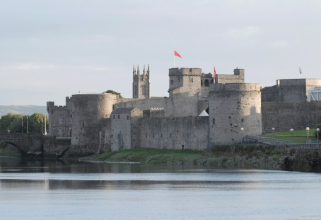
(Pictured: King John’s Castle on King John’s Island, Limerick)
The fall of Athlone occurs on June 30, 1691 during the Williamite War in Ireland. Despite the bravery of legendary Sergeant Custume and others, severely outnumbered, the Connacht side of the town falls. The remainder of the Irish garrison retreats to Limerick.
The first assault on Athlone comes in 1690 after the defeat of the Irish at the Battle of the Boyne. General Douglas, leading a substantial force of possibly ten thousand consisting mostly of Ulster regiments, is the Williamite commander. When he arrives at Athlone he is confident that he will quickly conquer the town for King William III. However, he had not reckoned on the spirited defence of Athlone by Colonel Richard Grace. Grace, who is at that time over seventy years of age and a veteran of the Irish Confederate Wars and Governor of Athlone, refuses to surrender. After a week the Williamite army retreats.
In 1691, determined to capture Athlone, the Williamites return with their full army of almost 25,000 men. The army is under the command of a Dutch general, Goderd de Ginkell. The Jacobite forces are under the command of a French general, the Marquis de St. Ruth. The Williamites breach the town wall and capture the Leinster town. The Jacobites, in a desperate attempt to keep the enemy at bay, break down several arches of the bridge and the Williamites quickly attempt to repair them. Sergeant Custume leads his men onto the bridge to dislodge the Williamite repair work. They succeed in doing so before meeting their death at the hands of enemy fire.
Ironically the capture of Athlone comes when the Williamites discover the ford that gave Athlone its name and in a surprise attack dislodge the Jacobites and take the castle by storm resulting in wholesale carnage and slaughter. For his services to King William III, but certainly not to Athlone, Ginkle is given the title Earl of Athlone. The bravery of Sergeant Custume has not been forgotten as the military barracks in Athlone is called Custume Barracks in his honour, the only barracks in Ireland named after a non-commissioned officer. A street adjoining the town bridge is named Custume Place.
In the summer of 1647, Murrough O’Brien, 6th Baron Inchiquin, the Irish Protestant commander of the Protestant army of Cork, commences a campaign against the Irish Catholic strongholds in Munster. The counties of Limerick and Clare are raided, and he soon turns his attention to the bountiful eastern counties of Munster. In early September, his forces quickly take the Cahir Castle in Tipperary. This strong castle is well positioned to become a base for the Cork Protestant army, and it is used to raid and devastate the surrounding countryside. The Munster army under Lord Taaffe does not make any serious effort to oppose Inchiquin, probably the result of the political scheming of Donough MacCarty, 2nd Viscount Muskerry and other powerful Irish lords who hope to keep the Munster army intact for their own ends. As such, Inchiquin is allowed to make a major push towards the town and ecclesiastical centre of Cashel.
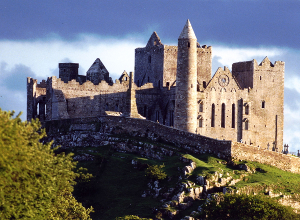
Inchiquin has already launched two minor raids against Cashel, and he now has the opportunity to launch a major assault. The Parliamentarian forces first storm nearby Roche Castle, putting fifty warders to the sword. This attack terrifies the local inhabitants of the region, some of whom flee to hiding places, while hundreds of others flee promptly to the Rock of Cashel, a stronger place than the town itself. Lord Taaffe has placed six companies in the fortified churchyard that sits upon the rock, and considers the place defensible, though he himself does not stay to put it to the test, leaving command to the Governor Lieutenant-Colonel Butler.
Arriving with his army at the Rock, Inchiquin calls for surrender within an hour. The defenders of the churchyard offer to negotiate but that is refused, and on the afternoon of September 15 the assault commences. The Parliamentarians are first reminded of earlier atrocities against Protestants, and then begin to deploy. The attack is led by around 150 dismounted horse officers with the remainder of the infantry following. Troops of horse ride along the flanks of the advancing force to encourage the infantry. The Irish soldiers attempt to drive off the attackers with pikes while the civilians inside hurl rocks down from the walls. In turn the attackers hurl firebrands into the compound, setting some of the buildings inside on fire. Although many are wounded, the Parliamentarians gradually fight their way over the walls, pushing the garrison into the church.
Initially, the Irish defenders manage to protect the Church, holding off the attackers trying to get through the doors, but the Parliamentarians then place numerous ladders against the many windows in the church and swarm the building. For another half an hour fighting rages inside the church, until the depleted defenders retreat up the bell tower. Only sixty soldiers of the garrison remain at this point, and they thus accept a call to surrender. However, after they have descended the tower and thrown their swords away, all are killed.
In the end all the soldiers and most of the civilians on the Rock are killed by the attackers. The Bishop and Mayor of Cashel along with a few others survive by taking shelter in a secret hiding place. Apart from these a few women are spared, after being stripped of their clothes, and a small number of wealthy civilians are taken prisoner, but these are the exceptions. Overall, close to 1,000 are killed, amongst them Lieutenant-Colonel Butler and catholic scholar Theobald Stapleton. The bodies in the churchyard are described by a witness as being five or six deep.
The slaughter is followed by extensive looting. There is much of value inside, for apart from pictures, chalices and vestments of the church, many of the slain civilians had also brought their valuables with them. The sword and ceremonial mace of the mayor of Cashel, as well as the coach of the bishop are captured. The plunder is accompanied by acts of iconoclasm, with statues smashed and pictures defaced. The deserted town of Cashel is also torched.
The atrocity at Cashel causes a deep impact in Ireland, as it is the worst single atrocity committed in Ireland since the start of fighting in 1641. Previously, the most infamous massacre amongst the Catholic population is that at Timolin in 1643, when 200 civilians are killed by James Butler, 1st Duke of Ormond‘s English Royalist army, but many more than this are killed at Cashel, and the Rock of Cashel is one of the chief holy places of Ireland. The slaughter of the garrison at Cashel and the subsequent devastation of Catholic held Munster earns Inchiquin the Irish nickname, Murchadh na Dóiteáin or “Murrough of the Burnings.”
Ormonde’s troops leave Dublin on April 2 and march unopposed from Naas to Athy and on to Maryborough, now Portlaoise, arriving on April 8. There they resupply the royalist garrisons and send cavalry forces to support those at Carlow and Birr, before returning to Athy on April 13. Setting out at 6:00 AM on April 15, and having decided to avoid a battle on their return march to Dublin, the government troops are blocked by Mountgarret’s rebel militias at Kilrush, two miles south of Suncroft, between Kilcullen and Moone in southeastern County Kildare.
The land is remarkably flat, with the exception of two ridges that run nearly parallel northward from a castle, with a marsh lying between. The army of Ormonde, consisting of 2,500 foot soldiers and 500 horses, assembles on the high grounds of Ardscull, Fontstown, and Kilrush, while the rebel army under Mountgarret, consisting of 8,000 foot soldiers and 400 horses, proceeds in the same direction along the heights of Birtown, Ballyndrum, Glasshealy, and Narraghmore. Mountgarret, having the advantage in numbers, and anxious for battle, outmarches Ormonde’s forces, and posts himself on Bull Hill and Kilrush, completely intercepting Ormonde’s further progress to Dublin. A general engagement becomes unavoidable. The left wing of the Irish is broken by the first charge. The right wing, animated by their leaders, maintains the contest for some time, but eventually falls back to neighbouring Battlemount. Here they break, flee and are pursued with great slaughter across the grounds they had marched over the previous day. Ormonde’s army then marches on to Dublin, arriving on April 17.
Ormonde’s army suffers twenty fatalities and approximately forty wounded in the Battle of Kilrush. Mountgarret’s rebel army loses more than 700, among which are several colonels. The victory is considered of such consequence that Ormonde is presented with a jewel valued at £50 by the Irish Government.
(Pictured: Sir Peter Lely’s oil painting of James Butler, 12th Earl of Ormonde)
By 1649, Ireland has already been at war for eight years, since the outbreak of the Irish Rebellion of 1641. The English Parliament holds only two small enclaves, Dublin and Derry, in Ireland.
In July 1649, Ormond, marches his coalition forces of 11,000 men to the outskirts of Dublin with the intent of taking the city from its Parliamentary garrison, which had landed there in 1647. Ormond takes Rathfarnham Castle and camps at Palmerston Park in Rathgar, about 4 km south of the city. The area from Ormond’s camp to the city of Dublin is now a heavily urbanised area, but in 1649, it is open countryside. Ormond begins inching his forces closer to Dublin by taking the villages around its perimeter and to this end, sends a detachment of troops to occupy Baggotrath Castle, on the site of present-day Baggot Street bridge. For reasons which have never been clear, they take several hours to reach Baggotrath, a distance of about a mile, and they arrive to find that the Parliamentary troops have already occupied the castle.
However, Ormond is not expecting Michael Jones, the Parliamentary commander, to take the initiative and has not drawn up his troops for battle. Unfortunately for the Royalists, this is exactly what Jones does, launching a surprise attack on August 2 from the direction of Irishtown with 5,000 men and sending Ormond’s men at Baggotsrath reeling backwards towards their camp in confusion.
Too late, Ormond and his commanders realise what is going on and send units into action piecemeal to try to hold up the Parliamentarian advance, so that they can form their army into battle formation. However, Jones’ cavalry simply outflanks each force sent against them, sending them too fleeing back south through the townland of Rathmines. The battle becomes a rout as scores of fleeing Royalist and Confederate soldiers are cut down by the pursuing Roundheads. The fighting finally ends when the English Royalist troops under Murrough O’Brien, 1st Earl of Inchiquin, mounts a disciplined rearguard action, allowing the rest to get away. Ormond claims he has lost less than a thousand men. Jones claims to have killed around 4,000 Royalist or Confederate soldiers and taken 2,517 prisoners, while losing only a handful himself. Ormond certainly loses at least one leading officer, Christopher Plunkett, 2nd Earl of Fingall, who is fatally wounded and dies in Dublin Castle a few days later. Ormond also loses his entire artillery train and all his baggage and supplies.
In the aftermath of the battle, Ormond withdraws his remaining troops from around Dublin, allowing Oliver Cromwell to land in the city at Ringsend with 15,000 veteran troops on August 15. Cromwell calls the battle “an astonishing mercy,” taking it as a sign that God has approved of his conquest of Ireland. Over the next four years he completes the Cromwellian conquest of Ireland.
Without Jones’ victory at Rathmines, the New Model Army would have had no port to land at in Ireland and the Cromwellian conquest of Ireland would have been much more difficult. Ormond’s incompetent generalship at Rathmines disillusions many Irish Confederates with their alliance with the English Royalists and Ormond is ousted as commander of the Irish forces the following year.
By 1650, the Irish Confederates and their English Royalist allies have been driven out of eastern Ireland by the Cromwellian conquest of Ireland. They occupy a defensive position behind the River Shannon, of which Limerick is the southern stronghold. Oliver Cromwell himself leaves Ireland in May 1650, delegating his command of the English Parliamentarian forces to Henry Ireton. Ireton moves his forces north from Munster to besiege Limerick in October of that year. However, the weather is increasingly wet and cold and Ireton is forced to abandon the siege before the onset of winter.
Ireton returns on June 4, 1651 with 8,000 men, 28 siege artillery pieces and 4 mortars. He summons Hugh Dubh O’Neill, the Irish commander of Limerick to surrender, but is refused. The siege is on.
Limerick in 1651 is split into two sections, English town and Irish town, which are separated by the Abbey River. English town, which contains the citadel of King John’s Castle, is encircled by water, the Abbey River on three sides and the River Shannon on the other, in what is known as King’s Island. Thomond bridge is only one bridge onto the island and is fortified with bastioned earthworks. Irish town is more vulnerable, but is also more heavily fortified. Its medieval walls have been buttressed by 20 feet of earth, making it difficult to knock a breach in them. In addition, Irish town has a series of bastions along its walls, mounted with cannon which cover its approaches. The biggest of these bastions are at St. John’s Gate and Mungret gate. The garrison of the city is 2,000 strong and composed mainly of veterans from the Confederate’s Ulster army, commanded by Hugh Dubh O’Neill, who had distinguished themselves at the siege of Clonmel the previous year.
Because Limerick is very well fortified, Ireton does not risk an assault on its walls. Instead he secures the approaches to the city, cuts off its supplies and builds artillery earthworks to bombard the defenders. His troops take the fort at Thomond bridge, but the Irish destroy the bridge itself, denying the Parliamentarians land access to English town. Ireton then tries an amphibious attack on the city, a storming party attacking the city in small boats. They are initially successful, but O’Neill’s men counterattack and beat them off.
After this attack fails, Ireton resolves to starve the city into submission and builds two forts known as Ireton’s fort and Cromwell’s fort on nearby Singland Hill. An Irish attempt to relieve the city from the south is routed at the battle of Knocknaclashy. O’Neill’s only hope is now to hold out until bad weather and hunger force Ireton to raise the siege. To this end, O’Neill tries to send the town’s old men, women and children out of the city so that his supplies will last a little longer. However, Ireton’s men kill forty of these civilians and send the rest back into Limerick.
O’Neill comes under pressure from the town’s mayor and civilian population to surrender. The town’s garrison and civilians suffer terribly from hunger and disease, especially an outbreak of plague. In addition, Ireton finds a weak point in the defences of Irish town, and knocks a breach in them, opening the prospect of an all out assault.
Eventually in October 1651, six months after the siege started, part of Limerick’s garrison mutinies and turns some cannon inwards, threatening to fire on O’Neill’s men unless they surrender. Hugh Dubh O’Neill surrenders Limerick on October 27. The inhabitants lives and property are respected, but they are warned that they could be evicted in the future. The garrison is allowed to march to Galway, which is still holding out, but has to leave their weapons behind.
The lives of the civilian and military leaders of Limerick are excepted from the terms of surrender. A Catholic Bishop Terence Albert O’Brien, an Alderman and the English Royalist officer Colonel Fennell are hanged. O’Neill is also sentenced to death, but is reprieved by the Parliamentarian commander Edmund Ludlow and imprisoned instead in London. Former mayor Dominic Fanning is drawn, quartered, and decapitated, with his head mounted over St. John’s Gate.
Over 2,000 English Parliamentary soldiers die at Limerick, mostly from disease. Among them is Henry Ireton, who dies a month after the fall of the city. About 700 of the Irish garrison and an estimated 5,000 citizens die.
(Pictured: The Treaty Stone on which the treaty of Limerick may have been signed in 1691)






 seamus dubhghaill