seamus dubhghaill

Promoting Irish Culture and History from Little Rock, Arkansas, USA


Leave a comment

Birth of John Kelly, Northern Irish Politician & IRA Volunteer

John Kelly, Northern Irish republican politician, is born in the New Lodge area of Belfast, Northern Ireland, on April 5, 1936. He joins the Irish Republican Army (IRA) in the 1950s and is a founder member and a leader of the Provisional Irish Republican Army in the early 1970s.

Kelly is one of five sons and four daughters born to William Kelly, retail and wholesale fruitier, and his wife Margaret (née Maginness). Living off Carlisle Circus in a flashpoint area of north Belfast and close to Crumlin Road Gaol, the Kellys are a strongly republican family, regularly supplying republican inmates with fruit and assisting them on their release.

Later in life Kelly moves to Maghera, County Londonderry, where he lives until his death in 2007. He and his wife have a daughter. He is a dedicated member of local Gaelic Athletic Association (GAA) club Watty Graham’s GAC, Glen and a keen supporter of Gaelic games and the Irish language.

Kelly joins the IRA in the early 1950s when he is eighteen and takes part in the Border Campaign of 1956–62 but is arrested in December 1956 and imprisoned until 1963. He is a member of the Northern Ireland Civil Rights Association (NICRA) in 1967–69 which leads on to sectarian riots in Belfast. A leader of the newly formed Provisional IRA in 1969, he is involved in the formation of “citizens’ defence groups” to protect nationalist areas of Belfast from loyalist rioters who are largely unhampered by the police.

Kelly is jailed on three occasions for IRA related activity spending a total of fifteen years in prison in Northern Ireland and the Republic of Ireland. His first term is for his activity in the 1956 IRA border campaign. He also serves a six-month term in 1973 in the Republic of Ireland for being a member of the IRA.

Commenting later on the Troubles, Kelly says, “Yes, it was a terrible period. But you can’t turn the clock back. The Irish government did not create the Provisional IRA. What happened was as inevitable as the changing seasons.”

The citizens’ defence groups seek help from the government in Dublin in 1969, then led by Jack Lynch. Several ministers respond and arrange a fund of £100,000 but the planned arms shipment fails. Kelly later says, “These discussions were all about guns. The whole thing was government-sponsored, government-backed and government-related.” The planning includes travel to Britain, Europe, and on to the United States where he meets the founders of NORAID. He is one of the co-defendants in the subsequent Dublin “Arms Trial” with ministers Charles Haughey and Neil Blaney, accused of conspiring to import arms illegally into the Republic of Ireland. The trial eventually collapses from a lack of evidence, as the relevant government files are kept secret, but the Irish government sacks several ministers as a result.

Kelly goes into electoral politics, serving on Magherafelt District Council from 1997. At the 1998 Northern Ireland Assembly election he is elected to the Northern Ireland Assembly as a Sinn Féin member for Mid Ulster. He is deselected before the 2003 election, and criticises the decision by the Sinn Féin leadership to support policing reforms. In January 2006 he co-writes a letter with Brendan Hughes which casts doubt on the claims that dissident republicans have threatened Sinn Féin leaders and claims that the real threats are being made by the Sinn Féin leadership against those who seek a debate on policing. He leaves Sinn Féin which he considers too controlled from the centre, opposing the leadership “deceit and the philosophy of creative ambiguity,” and he retires from politics.

Kelly dies in Maghera following a long battle with cancer on September 5, 2007. Many tributes are paid to him including a minute’s silence before the Derry Senior Football Championship quarter final between St. Patrick’s GAC, Loup, and Dungiven GAC on September 8, 2007, at the home of his local club, Watty Graham GAC, Glen. A Na Piarsaigh Belfast GAC jersey is draped over his coffin before he is interred at Maghera Catholic Graveyard.


Leave a comment

Birth of Michelle O’Neill, Vice President of Sinn Féin

Michelle O’Neill (née Doris), Irish politician who serves as deputy First Minister of Northern Ireland between 2020 and 2022, is born in Fermoy, County Cork, Republic of Ireland, on January 10, 1977. She has been serving as Vice President of Sinn Féin since 2018 and is the Member of the Legislative Assembly (MLA) for Mid Ulster since 2007.

O’Neill comes from an Irish republican family in Clonoe, County Tyrone, Northern Ireland. Her father, Brendan Doris, was a Provisional Irish Republican Army (IRA) prisoner and Sinn Féin councillor. Her uncle, Paul Doris, is a former national president of the Irish Northern Aid Committee (NORAID). A cousin, Tony Doris, was one of three IRA members killed by the British Army‘s Special Air Service (SAS) in the Coagh ambush in 1991. Another cousin, IRA volunteer Gareth Malachy Doris, was shot and wounded during the 1997 Coalisland attack.

After the death of Brendan Doris in 2006, Martin McGuinness pays tribute to the Doris family as “a well-known and respected republican family [who] have played a significant role in the republican struggle for many years.”

O’Neill attends St. Patrick’s Girls’ Academy, a Catholic grammar school in Dungannon, County Tyrone. She subsequently begins to train as an accounting technician, before pursuing a political career.

O’Neill becomes involved in republican politics in her teens, assisting her father with constituency work in his role as a Dungannon councillor. She joins Sinn Féin after the Good Friday Agreement in 1998, at the age of 21, and starts working as an advisor to Francie Molloy in the Northern Ireland Assembly, holding this role until 2005.

O’Neill serves on the Dungannon and South Tyrone Borough Council from 2005 to 2011. She serves as the first female Mayor of Dungannon and South Tyrone from 2010 to 2011. In the 2007 Northern Ireland Assembly election she is elected to represent Mid Ulster in the Northern Ireland Assembly. In 2011, she is appointed to the Northern Ireland Executive by deputy First Minister Martin McGuinness as Minister for Agriculture and Rural Development. In 2016, she is promoted to Minister of Health. In January 2020, she becomes deputy First Minister of Northern Ireland after the New Decade, New Approach (NDNA) agreement restores the power sharing executive.

O’Neill automatically relinquishes her office following Paul Givan‘s resignation as first minister on February 3, 2022. Sinn Féin becomes the largest party after the 2022 Northern Ireland Assembly election, putting O’Neill in line to become the First Minister of Northern Ireland, and the Democratic Unionist Party (DUP) leader to become the deputy First Minister of Northern Ireland. However, she remains to be officially sworn in as First Minister because, as part of its opposition to the Northern Ireland Protocol, the DUP has refused to nominate a deputy First minister and there is therefore no functioning executive of Northern Ireland.

In August 2022, O’Neill is asked in a BBC interview whether it was right during the Troubles for the Provisional IRA “to engage in violent resistance to British rule.” She is criticised for her response, “I think at the time there was no alternative, but now thankfully we have an alternative to conflict, and that is the Good Friday Agreement – that is why it’s so precious to us all.”

In May 2023, O’Neill attends the coronation of King Charles, saying, “Well obviously I wanted to be here. We live in changing times, and it was the respectful thing to do, to show respect and to be here for all those people at home, who I had said I would be a first minister for all. Attendance here is about honouring that and fulfilling my promise.”

Under O’Neill’s leadership, Sinn Fein has led most opinion polls for the next United Kingdom general election.


Leave a comment

Death of Michael Flannery, Irish Republican Founder of NORAID

Michael Flannery, Irish republican who fought in the Irish War of Independence and the Irish Civil War, dies in New York City on September 30, 1994. He supports the Provisional Irish Republican Army during The Troubles and is a founder of the Irish Northern Aid Committee (NORAID).

Flannery is born in Cangort, near Brosna, on the border of County Offaly and County Tipperary, on January 7, 1903.

In 1916 Flannery joins the Irish Volunteers alongside his brother Peter, although he does not take part in the Easter Rising. However, he does participate in the Irish War of Independence. Following the outbreak of the Irish Civil War, he fights as part of the Anti-Treaty IRA until his capture by the National Army on November 11, 1922, in Roscrea, County Tipperary. He is imprisoned for nearly a year and a half in Dublin’s Mountjoy Prison (C Wing). While there he witnesses the execution of Anti-Treaty IRA leaders Richard Barrett, Joe McKelvey, Liam Mellows and Rory O’Connor from his cell window. Following a 28-day hunger strike, he is placed in the Curragh Camp until May 1, 1924, when he is finally released, a full year after the end of the civil war.

In February 1927 Flannery immigrates to the United States, settling in Jackson Heights, Queens, New York City. In 1928 he marries Margaret Mary Egan, a Tipperary-born research chemist, who had been educated at University College Dublin and University of Geneva.

Following the creation of Fianna Fáil and their entry into the Irish Parliament Dáil Éireann, Flannery becomes affiliated with Sinn Féin, who had voted to retain their abstentionist policy towards the Dáil and their refusal to acknowledge it as the legitimate government of Ireland. Sinn Féin tasks him with drumming up support for the party in New York. However, following the start of the Great Depression he finds it difficult to focus on politics in the face of mounting poverty. By 1933 finding support for Sinn Féin and the IRA becomes particularly tough when Fianna Fáil expands greatly the range of people eligible for military pensions, which under the previous government had been biased against members of the Anti-Treaty IRA. For the next 40 years Flannery works for the Metropolitan Life Insurance Company.

Upon the onset of The Troubles in Northern Ireland, Flannery is once again drawn into the world of Irish Republicanism. In a response to the mounting violence, he sets up the Irish Northern Aid Committee, or as it became better known as, NORAID. The official purpose of NORAID is to provide funds to the families of imprisoned Irish Republicans and victims of violence. However, opponents level the accusation against the organisation that it is also providing funding directly to the Provisional Irish Republican Army, and perhaps even also supplying firearms.

In 1970 Flannery travels around America and sets up 62 chapters of NORAID. In 1971 he says, “The more coffins sent back to Britain, the sooner this will be all over,” referring to British soldiers.

In 1982 Flannery is indicted, with four other members of NORAID, for arms smuggling, but all defendants are acquitted after their legal defence is able to successfully argue their actions had been sanctioned the CIA.

Four months after the verdict of the arms trial, Flannery is named as Grand Marshal of the Saint Patrick’s Day Parade in New York City. His appointment causes considerable controversy within the Irish American community and several high-profile figures boycott the parade that year, including the Archbishop of New York Terence Cooke.

In 1986 Flannery quietly resigns from NORAID following the decision by Sinn Féin to drop its abstentionist policy in the Republic of Ireland and to recognise Dáil Éireann as the legitimate governing body of Ireland.

Flannery opposes the Northern Ireland peace process, believing that Sinn Féin and the Provisionals have “sold out,” and believes the removal of British troops from Northern Ireland is the only starting point upon which negotiations can begin.

Flannery dies at the age of 92 in New York City on September 30, 1994. He is buried in Mount Saint Mary’s Cemetery in Flushing, Queens, New York.


2 Comments

Founding of Clan na Gael in New York City

CREATOR: gd-jpeg v1.0 (using IJG JPEG v62), quality = 90

The Clan na Gael, an Irish republican organization in the United States in the late 19th and 20th centuries, is founded by John Devoy, Daniel Cohalan, and Joseph McGarrity in New York City on June 20, 1867. It is the successor to the Fenian Brotherhood and a sister organization to the Irish Republican Brotherhood (IRB). It has shrunk to a small fraction of its former size in the 21st century.

As Irish immigration to the United States begins to increase in the 18th century many Irish organizations are formed. In the later part of the 1780s, a strong Irish patriot character begins to grow in these organizations and amongst recently arrived Irish immigrants.

In 1858, the IRB is founded in Dublin by James Stephens. In response to the establishment of the IRB in Dublin, a sister organization is founded in New York City, the Fenian Brotherhood, led by John O’Mahony. This arm of Fenian activity in America produces a surge in radicalism among groups of Irish immigrants, many of whom had recently emigrated from Ireland during and after the Great Famine.

In October 1865, the Fenian Philadelphia Congress meets and appoints the Irish Republican Government in the United States. Meanwhile in Ireland, the IRB newspaper The Irish People is raided by the police and the IRB leadership is imprisoned. Another abortive uprising occurs in 1867, but the British remain in control.

After the 1865 crackdown in Ireland, the American organization begins to fracture over what to do next. Made up of veterans of the American Civil War, a Fenian army is formed. While O’Mahony and his supporters want to remain focused on supporting rebellions in Ireland, a competing faction, called the Roberts, or senate wing, wants this Fenian Army to attack British bases in Canada. The resulting Fenian raids strain U.S.–British relations. The level of American support for the Fenian cause begins to diminish as the Fenians are seen as a threat to stability in the region.

After 1867, the Irish Republican Brotherhood headquarters in Manchester chooses to support neither of the existing feuding factions, but instead promotes a renewed Irish republican organization in America, to be named Clan na Gael.

According to John Devoy in 1924, Jerome James Collins founds what is then called the Napper Tandy Club in New York on June 20, 1867, Wolfe Tone‘s birthday. This club expands into others and at one point at a picnic in 1870 is named the Clan na Gael by Sam Cavanagh. This is the same Cavanagh who killed the informer George Clark, who had exposed a Fenian pike-making operation in Dublin to the police.

Collins, who dies in 1881 on the disastrous Jeannette Expedition to the North Pole, is a science editor on the New York Herald, who had left England in 1866 when a plot he was involved in to free the Fenian prisoners at Pentonville Prison was uncovered by the police. Collins believes at the time of the founding in 1867 that the two feuding Fenians branches should patch things up.

The objective of Clan na Gael is to secure an independent Ireland and to assist the Irish Republican Brotherhood in achieving this aim. It becomes the largest single financier of both the Easter Rising and the Irish War of Independence.

Clan na Gael continues to provide support and aid to the Irish Republican Army (IRA) after it is outlawed in Ireland by Éamon de Valera in 1936 but becomes less active in the 1940s and 1950s. However, the organization grows in the 1970s. The organization plays a key part in the Irish Northern Aid Committee (NORAID) and is a prominent source of finance and weapons for the Provisional Irish Republican Army during the Troubles in Northern Ireland in 1969–1998.

The Clan na Gael still exists today, much changed from the days of the Catalpa rescue. In 1987 the policy of abstentionism is abandoned. As recently as 1997 another internal split occurs as a result of the IRA shift away from the use of physical force as a result of the 1998 Good Friday Agreement. The two factions are known to insiders as Provisional Clan na Gael (allied to Provisional Sinn Féin/IRA) and Republican Clan na Gael (associated with both Republican Sinn Féin/Continuity IRA and 32 County Sovereignty Movement/Real IRA, though primarily the former). These have been listed as terrorist organizations at various times by the UK Government.

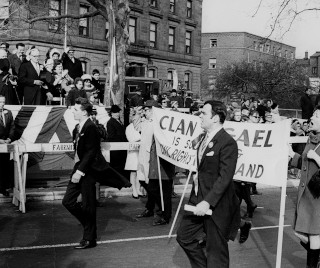
(Pictured: Clan na Gael marching in the 1970 St. Patrick’s Day Parade in Philadelphia, photograph by John Hamilton)


Leave a comment

Birth of Martin Galvin, Publisher & Activist

martin-galvin

Martin J. Galvin, Irish American lawyer, publisher and activist, and former director of the Irish Northern Aid Committee (NORAID), is born on January 8, 1950, supposedly in Long Island, New York, although he may have been born in the Republic of Ireland as he once, during an interview with 60 Minutes, refers to the “partition of the country of my birth.”

Galvin is the son of a fireman. He attends Catholic schools, Fordham University and Fordham University School of Law. He previously works as a hearing officer for the New York City Department of Sanitation.

Galvin serves as the publicity director for the New York-based NORAID, an Irish American group fundraising organization which raises money for the families of Irish republican prisoners, but is also accused by the American, British, and Irish governments to be a front for the supply of weapons to the Provisional Irish Republican Army

Galvin becomes a publisher of The Irish People in the 1980s. He is banned from Northern Ireland because of a speech he gives that seems to endorse terrorism. In August 1984 he defies the ban and enters Northern Ireland from the Republic of Ireland. The following year he returns to Northern Ireland to attend a funeral for an IRA member killed when a makeshift grenade launcher he is trying to fire at a Royal Ulster Constabulary barracks explodes. In 1989 Galvin is arrested and deported for violating the exclusion ban yet again.

Galvin has criticised the Northern Ireland peace process as a betrayal of republican ideals and characterizes the IRA’s decision to open up its arms dumps to Independent International Commission on Decommissioning inspectors as a surrender.

On May 28, 2016, Galvin attends a commemoration for PIRA volunteer George McBrearty in Creggan, Derry.