seamus dubhghaill

Promoting Irish Culture and History from Little Rock, Arkansas, USA


Leave a comment

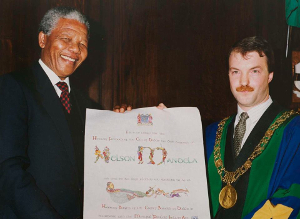
Nelson Mandela Awarded the Freedom of the City of Dublin

nelson-mandela-freedom-of-dublin

Nelson Rolihlahla Mandela, the first president of South Africa to be elected in a fully representative democratic election, is awarded the Freedom of the City of Dublin on his 70th birthday, July 18, 1988. Mandela is not available to receive his award on the date it is conferred, however, as he is a prisoner in South Africa at the time. On July 1, 1990, after his release from prison, Mandela  finally receives the Freedom of the City of Dublin at a ceremony in the Mansion House Dublin.

The Freedom of the City of Dublin is awarded by Dublin City Council after approving a person nominated by the Lord Mayor of Dublin. Eighty people have been honoured under the current process introduced in 1876. Most honourees have made a contribution to the life of the city or of Ireland in general, including politicians, public servants, humanitarians, artists, and entertainers. Others have been distinguished members of the Irish diaspora and foreign leaders, honoured visiting Dublin. Honourees sign the roll of freedmen in a ceremony at City Hall or the Mansion House and are presented with an illuminated scroll by the Lord Mayor.

Mandela is honoured with the Freedom of Dublin city for his contribution to society and commitment to the study and promotion of Human Rights and also his work in the area of development and social inclusion, which has enhanced the lives of local communities in Ireland and fostered global links with institutions and organisations.

Among the notable recipients of this award are American presidents John F. Kennedy and Bill ClintonMikhail Gorbachev, Éamon de Valera, Mother Teresa, Pope John Paul II, Aung San Suu Kyi, all four members of U2, Bob Geldof, and Ronnie Delaney.

Holders of this award have some ancient privileges and duties such as the right to bring goods into Dublin through the city gates without paying customs duties, the right to pasture sheep on common ground within the city boundaries including College Green and St. Stephen’s Green (this right is exercised as a publicity stunt by U2 members the day after their 2000 conferring), and the right to vote in municipal and parliamentary elections. Some of the ancient duties are that freemen/women must be ready to defend the city of Dublin from attack and, at short notice, can be called up to join a city militia. Also a law which was passed in 1454 states that freemen/women must own a bow, a coat of mail, a helmet, and a sword.

Leave a comment

State Visit of U.S. President John F. Kennedy

jfk-state-visit

John F. Kennedy, an Irish American and the first Catholic to become president of the United States, arrives in Ireland on a state visit on June 26, 1963. After Air Force One touches down at Dublin airport, Kennedy’s motorcade weaves through the streets of Dublin city, the thrilled crowd, lacking ticker tape, improvises by throwing rolls of bus tickets.

Kennedy is proud of his Irish roots and makes a special visit to his ancestral home in Dunganstown, County Wexford, while in the country. There, he is greeted by a crowd waving both American and Irish flags and is serenaded by a boys’ choir that sings The Boys of Wexford. Kennedy breaks away from his bodyguards and joins the choir for the second chorus, prompting misty-eyed reactions from both observers and the press.

Kennedy meets with 15 members of his extended Irish family at the Kennedy homestead in Dunganstown. There he enjoys a cup of tea and some cake and makes a toast to “all those Kennedys who went and all those Kennedys who stayed.” His great-grandfather, Thomas Fitzgerald, had left Ireland for the United States in the middle of the Great Famine of 1848 and settled in Boston, becoming a cooper. Generations of his descendants go on to make their mark on American politics.

At the time of JFK’s visit to Ireland, the predominantly Catholic Irish Republic has been an independent nation for 41 years. The northern counties of the island, however, remain part of the largely Protestant British Empire and still suffer from long-standing sectarian violence. On the day after his arrival in Dublin, Kennedy speaks before the Irish parliament, where he openly condemns Britain’s history of persecuting Irish Catholics. Two days later, he travels to England, America’s oldest ally, to meet with British Prime Minister Harold Macmillan and his cabinet to discuss setting up a pro-democratic regime in British Guiana.

Kennedy later tells his aides that his favourite part of the trip was the wreath laying and silent funeral drill done by the Irish Army cadets at Arbour Hill military cemetery in Dublin.

Five months later, his widow, Jacqueline Kennedy, makes a special request to the Irish government. She asks that those same Irish army cadets, who so impressed the President on his visit, perform the drill again at his state funeral. Within days, those awe-stuck, trembling young men stand just inches away from foreign dignitaries from over 90 countries and perform their silent funeral drill in memory of a president that had inspired their country just a few short months earlier.


Leave a comment

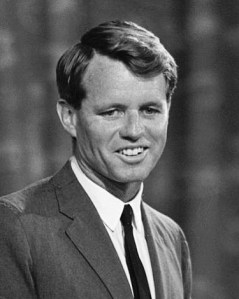
Assassination of Robert F. Kennedy

robert-f-kennedy

Robert F. Kennedy, Irish-American, United States Senator, Democratic presidential candidate, and brother of assassinated President John F. Kennedy, dies on June 6, 1968 in Los Angeles, California after being shot in the early morning hours of June 5.

After winning the California and South Dakota primary elections for the Democratic nomination for President of the United States and speaking to supporters in a ballroom at the Ambassador Hotel, Kennedy walks through the kitchen area frequently shaking hands with those he encounters. Kennedy starts down a passageway narrowed by an ice machine against the right wall and a steam table to the left. He turns to his left and shakes hands with busboy Juan Romero just as Sirhan Sirhan, a 24-year-old Palestinian/Jordanian immigrant, steps down from a low tray-stacker beside the ice machine and repeatedly fires what is later identified as a .22 caliber Iver-Johnson Cadet revolver.

After Kennedy had falls to the floor, former FBI agent William Barry sees Sirhan holding a gun and hits him twice in the face while others force Sirhan against the steam table and disarmed him as he continues firing his gun in random directions. Five other people are also wounded.

Kennedy is transferred several blocks to Good Samaritan Hospital for surgery. Surgery begins at 3:12 AM PDT and lasts three hours and 40 minutes. Despite extensive neurosurgery to remove bullet and bone fragments from his brain, his condition remains extremely critical until he dies at 1:44 AM PDT on June 6, nearly 26 hours after the shooting.

Sirhan pleads guilty on April 17, 1969, and is sentenced to death. The sentence is commuted to life in prison in 1972 after the California Supreme Court, in its decision in California v. Anderson, invalidates all pending death sentences imposed in California prior to 1972. Since that time, Sirhan has been denied parole fifteen times and is currently confined at the Richard J. Donovan Correctional Facility in southern San Diego County.

Kennedy’s body lay in repose at St. Patrick’s Cathedral in New York City for two days before a funeral Mass is held on June 8. His body is interred near his brother at Arlington National Cemetery in Washington, D.C. His death prompts the protection of presidential candidates by the United States Secret Service. Hubert Humphrey later goes on to win the Democratic nomination for the presidency, but ultimately loses the election to Republican Richard Nixon.

As with his brother’s death, Kennedy’s assassination and the circumstances surrounding it have spawned a variety of conspiracy theories. Kennedy remains one of only two sitting United States Senators to be assassinated, the other being Huey Long.


Leave a comment

Hillary Clinton Announced for Induction into Irish America Hall of Fame

hillary-clintonOn February 2, 2015, Irish America magazine announces that Hillary Rodham Clinton will be inducted into the Irish America Hall of Fame in March, in recognition of her work on the Irish peace process.

Clinton travels frequently to Ireland as First Lady and as U.S. Secretary of State, and often talks about the end of the civil strife, known as The Troubles, as a crowning foreign policy achievement of her husband’s administration. On her visit to Belfast in 2012, she pledges to continue to support peace in Ireland in whatever way possible.

“Hillary Rodham Clinton is one of the unsung heroes of the success of the Irish peace process,” says Niall O’Dowd, publisher of Irish America magazine. “As First Lady, U.S. Senator, and Secretary of State she always gave the issue top priority to help ensure it remained at the top of the U.S. foreign policy agenda. During that historic first trip to Northern Ireland with Bill Clinton in 1995, which I was privileged to be on, she galvanized women’s groups on both sides by meeting with them, shaping their agenda, and making sure they always had a friend in the U.S. administration. More than that, she constantly stayed involved, never giving up her focus on bringing an end to Europe’s longest conflict at the time.”

On the eve of St. Patrick’s Day, Clinton delivers the keynote address at the luncheon in Manhattan of high profile Irish-Americans who each year honor elected officials and others. She describes sitting at a table in Belfast, over cups of tea, with women from both sides of the conflict and watching as they discover how much they share.

She does not portray herself as instrumental to the Good Friday Agreement that President Clinton brokered in 1998, but says her outreach to women in Belfast on multiple visits during that period had played a critical role.

“You cannot bring peace and security to people just by signing an agreement,” she says. “In fact, most peace agreements don’t last.” She says that when “the work of peace permeates down to the kitchen table, to the backyard, to the neighborhood, around cups of tea, there’s a much greater chance the agreement will hold.”

Previous inductees into the Irish America Hall of Fame include former President John F. Kennedy, former President Bill Clinton, Vice President Joseph R. Biden, Jr., and former Maryland Governor Martin O’Malley, who addressed the luncheon in 2014 in a mix of English and Irish.