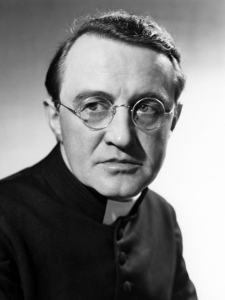
Arthur Shields, Irish actor on television, stage, and film, is born on February 15, 1896, into an Irish Protestant family in Portobello, Dublin. Shields starts acting in the Abbey Theatre when he is 17 years old. He is the younger brother of Oscar-winning actor Barry Fitzgerald. They are the sons of Adolphus Shields, who is well-known in Dublin as a labor organizer although the 1901 census lists his occupation as “press reader,” and Fanny Sophia Sheilds.
Shields returns to the Abbey Theatre and has a varied career there from 1914-1939 as actor, assistant director, director, and stage manager. He appears in more than 300 roles in 350 plays while he is at the Abbey. Three of the productions he appears in are by Irish playwright Teresa Deevy – The Reapers, Temporal Powers, and Katie Roche. Three times he brings the Abbey Company to the United States.
Shields dies of complications related to emphysema on April 27, 1970, in Santa Barbara, California. He is survived by his wife, actress Laurie Bailey, a daughter, a son, and four great-grandchildren. His body is cremated, with the ashes taken to Dublin, where a burial with full military honors takes place.
At the age of twelve, O’Flaherty goes to Rockwell College and later University College Dublin and the Dublin Diocesan teacher training college Holy Cross College. It is intended he enter the priesthood, but he joins the Irish Guards in 1917 under the name Bill Ganly. Serving on the Western Front, he finds trench life devastatingly monotonous and is badly injured in September 1917 during the Battle of Langemarck. It is speculated that shell shock is responsible for the mental illness which becomes apparent in 1933.
He returns from the front a socialist. Having become interested in Marxism as a schoolboy, atheistic and communistic beliefs evolve in his 20s and he is a founding member of the Communist Party of Ireland. Two days after the establishment of the Irish Free State, O’Flaherty and other unemployed Dublin workers seize the Rotunda Concert Hall in Dublin and hold it for four days in protest at “the apathy of the authorities.” Free State troops force their surrender.
O’Flaherty then leaves Ireland and moves first to England where, destitute and jobless, he takes to writing. In 1925 he scores immediate success with his best-selling novel The Informer about a rebel with confused ideals in the Irish War of Independence, which wins him the 1925 James Tait Black Memorial Prize for fiction. Four years later his next short novel Return of the Brute, set in the World War I trenches, proves another success. He then travels to the United States, where he lives in Hollywood for a short time. The well-known director John Ford, a cousin, later makes a film of O’Flaherty’ first novel. The novel is also the source of a 1929 film of the same name directed by Arthur Robison.
Many of his works have the common theme of nature and Ireland. He is a distinguished short story writer, and some of his best work in that genre is in Irish. The collection Dúil, published towards the end of his life, contains Irish language versions of a number of stories published elsewhere in English. This collection, now widely admired, has a poor reception at the time, and this seems to discourage him from proceeding with an Irish language novel he has in hand.
In a letter written to The Sunday Times in later years he confesses to a certain ambivalence regarding his work in Irish and speaks of other Irish writers who receive little praise for their work in the language. This gives rise to some controversy. His First Flight, a short story which symbolizes the nervousness one experiences before doing something new, is regarded as one of his most famous works. In 1923, O’Flaherty publishes his first novel, Thy Neighbour’s Wife, thought to be one of his best. Over the next couple of years, he publishes other novels and short stories. In 1933 he suffers the first of two mental breakdowns.
He travels in the United States and Europe, and the letters he writes while travelling have now been published. He has a love of French and Russian culture. Before his death he leaves the Communist Party and returns to the Roman Catholic faith. O’Flaherty dies in Dublin on September 7, 1984, and many of his works are subsequently republished. He is remembered today as a powerful writer and a strong voice in Irish culture.
Maureen O’Hara, Irish actress and singer, is born Maureen FitzSimons on August 17, 1920, in Ranelagh, County Dublin. The famously red-headed O’Hara is known for her beauty and playing fiercely passionate but sensible heroines, often in westerns and adventure films. She works on numerous occasions with director John Ford and longtime friend John Wayne and is one of the last surviving stars from the Golden Age of Hollywood.
O’Hara grows up in the Dublin suburb of Ranelagh to an “eccentric” devout Catholic family and aspires to become an actress from a very young age. She trains with the Rathmines Theatre Company from the age of 10 and at the Abbey Theatre from the age of 14. She is given a screen test, which is deemed unsatisfactory, but Charles Laughton sees potential and arranges for her to co-star with him in Alfred Hitchcock‘s Jamaica Inn in 1939. She moves to Hollywood the same year to appear with him in the production of The Hunchback of Notre Dame and is given a contract by RKO Pictures. From there, she goes on to enjoy a long and highly successful career, and acquires the nickname “The Queen of Technicolor,” which she detests, believing that people see her only for her beauty rather than talent.
O’Hara appears in her first film with John Wayne, the actor with whom she is most closely associated, with Rio Grande (1950). This is followed by The Quiet Man (1952), her best-known film, and The Wings of Eagles (1957), by which time her relationship with Ford has deteriorated. Such is her strong chemistry with Wayne that many assume they are married or in a relationship. In the 1960s O’Hara increasingly turns to more motherly roles as she ages, appearing in films such as The Deadly Companions (1961), The Parent Trap (1961), and The Rare Breed (1966).
O’Hara retires from the industry in 1971 after starring with Wayne one final time in Big Jake but returns 20 years later to appear with John Candy in Only the Lonely (1991). In the late 1970s, O’Hara helps run her third husband’s flying business in St. Croix in the American Virgin Islands, and edits a magazine, but later sells them to spend more time in Glengariff in Ireland. She is married three times and has one daughter, Bronwyn, born in 1944 to her second husband.
Her autobiography, ‘Tis Herself, is published in 2004 and becomes a New York Times Bestseller. In November 2014, she is presented with an Honorary Academy Award with the inscription “To Maureen O’Hara, one of Hollywood’s brightest stars, whose inspiring performances glowed with passion, warmth and strength.”
Maureen O’Hara dies of natural causes in her sleep at the age of 95 on October 24, 2015, at her home in Boise, Idaho. O’Hara is buried at Arlington National Cemetery in Virginia next to her late husband Charles Blair.
Maurice Walsh, Irish novelist best known for the short story The Quiet Man which is later made into an Oscar-winning movie, is born on April 21, 1879, in Ballydonoghue near Listowel, County Kerry.
Walsh is the third child of ten and the first son born to John Walsh, a local farmer, and his wife Elizabeth Buckley who live in a three-room thatched farmhouse. John Walsh’s main interests are books and horses and he himself does little work about the farm, preferring to have a hired man. The most famous of these hired men is Paddy Bawn Enright, whose name is immortalised by Walsh in his story The Quiet Man, although the name is not used in the later motion picture. John Walsh passes on to his son not only a love of books but also legends and folk tales that are later featured of many of Walsh’s books.
Walsh goes to school in Lisselton, a mile or so up the road from Ballydonoghue, and later goes to St. Michael’s College in Listowel to prepare for the Civil Service examination. He enters the service on July 2, 1901, as an Assistant Revenue Officer in the Customs and Excise Service. He is posted to Scotland before the year is out and, although he subsequently has a number of postings outside Scotland, he spends most of his time there while in the British service.
Walsh has a life-long interest in writing and, during his early years in Scotland, this interest starts to bear fruit. He submits some of his stories and has two published in the Irish Emerald in 1908. Later that year, on August 8, 1908, Walsh marries Caroline Begg in Dufftown, Banffshire, Scotland.
When the Irish Free State is formed in 1922, Walsh transfers to its excise service and moves to Dublin. Fighting is still going on there at the time, and he leaves his family in Scotland until it is safe for them to join him in 1923. The story The Key Above the Door is written during the months of separation although it is not published until some years later, appearing first in Chambers Journal as a serial between December 1925 and May 1926 and then in book form, published by W & R Chambers Ltd., in July 1926.
Sales of Walsh’s books grow steadily, especially in the wake of an unsolicited and generous letter from J. M. Barrie, the creator of Peter Pan, praising The Key Above the Door, which Chambers is subsequently able to use on dust covers of Walsh’s books.
Walsh retires from government service in 1933 but his success as a writer continues. In that same year he sells a story to TheSaturday Evening Post, then a well-known weekly magazine published in the United States. That story, later to be incorporated in the collection of stories published under the title Green Rushes, is The Quiet Man.
Director John Ford reads the story in 1933 and soon purchases the rights to it for $10. Walsh is paid another $2,500 when Republic Pictures buys the idea and receives a final payment of $3,750 when the film is actually made. Filming commences on June 7, 1951, with John Wayne and Maureen O’Hara in the leading roles. All of the outdoor scenes are shot on location in County Mayo and County Galway. The inside scenes are filmed in late July at the Republic Studios in Hollywood. The Quiet Man wins the Academy Award for Best Director for John Ford, his fourth, and for Best Cinematography.
Walsh becomes President of the Irish branch of PEN International in 1938 and visits the United States for an international meeting that year as the Irish delegate. His wife Caroline is able to accompany him although she has been in failing health for some years and ultimately dies in January 1941. Walsh himself dies on February 18, 1964, in Blackrock, a suburb of Dublin, and is buried in the Esker cemetery at Lucan, County Dublin. President Éamon de Valera attended Walsh’s funeral Mass.
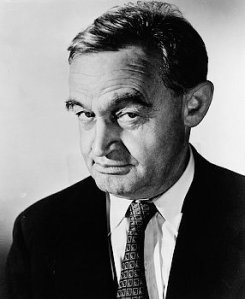
Unknown to many, Fitzgerald is also a patriot. In 1916 he is a member of the Irish Volunteers and is prepared to fight in the Easter Rising on Easter Sunday when the orders are countermanded. On Easter Monday the revolution is on again, and Shields goes to the Abbey Theatre and retrieves his rifle from under the stage. He goes around the corner to Liberty Hall and joins with James Connolly’s Irish Citizen Army.
Fitzgerald goes to Hollywood to star in another O’Casey work, The Plough and the Stars (1936), directed by John Ford. He has a successful Hollywood career in such films as The Long Voyage Home (1940), How Green Was My Valley (1941), And Then There Were None (1945), The Naked City (1948), and The Quiet Man (1952). Fitzgerald achieves a feat unmatched in the history of the Academy Awards. He is nominated for both the Best Actor Oscar and the Best Supporting Actor Oscar for the same performance, as Father Fitzgibbon in Going My Way (1944). He wins the Best Supporting Actor Award. This feat will likely never be matched as the Academy Award rules have since been changed to prevent this. During World War II, Oscar statues are made of plaster rather than gold due to wartime metal shortages. Being an avid golfer, Fitzgerald later breaks the head off his Oscar statue while practicing his golf swing.
Fitzgerald has two stars on the Hollywood Walk of Fame, one for films located at 6220 Hollywood Blvd. and one for television located at 7001 Hollywood Blvd.
Fitzgerald returns to live in Dublin in 1959. He dies of heart failure on January 14, 1961, and is buried at Deansgrange Cemetery in Dublin.



 seamus dubhghaill