Ward, 25, from Stockport in Cheshire, receives a life term for each of those who died when the coach exploded on the M62 motorway. The sentences are to run concurrently with three other sentences of up to twenty years for causing explosions. She remains impassive as Justice Waller passes sentence.
During the trial the court hears that Ward had joined the army – from which she later deserts – on the instructions of the republican group, the IRA. Her detailed knowledge of bases helps to facilitate the coach bombing, prosecution barrister John Cobb QC alleges. She also gives information to the IRA which leads to two attacks on army targets in which six people die, Cobb adds.
Ward initially confesses her crimes in a statement to police which she later retracts. She denies being a member of the IRA but photographs of her in the outlawed organisation’s uniform are shown to the jury at Wakefield Crown Court.
It also emerges in court that Ward was arrested after the bombing of Euston railway station in September 1973 but is later released. Questions are raised as to why the police let her go even though traces of explosives were found on her hands.
As Ward is led from the courtroom to the cells, the only member of her family present, sister-in-law Jean Ward, sobs. Her father, Thomas, says earlier he does not believe his daughter is capable of such “brutal and callous acts.” Her brother, Tommy, says none of the family think Judith has ever been in the IRA. “We don’t think she was so heavily involved. There has been a lot of romancing,” he says.
That is a point echoed in court by Ward’s solicitor, Andrew Rankin QC, who highlights many improbabilities in her confessions. They include having been married to an IRA man and having borne a child by another.
Ward spends 18 years in jail before her conviction is quashed in 1992. Her lawyers argue that the trial jury should have been told of her history of mental illness.
Three Appeal Court judges conclude that Ward’s conviction had been “secured by ambush.” They say government forensic scientists had withheld information that could have changed the course of her trial. Her case is one of a spate of miscarriage of justices revealed in the early 1990s.
After her release, Ward writes an autobiography, Ambushed, published in 1992. She subsequently starts a course in criminology and becomes a campaigner for prisoners’ rights.
(From: “On This Day – 4 November,” BBC News, news.bbc.co.uk)
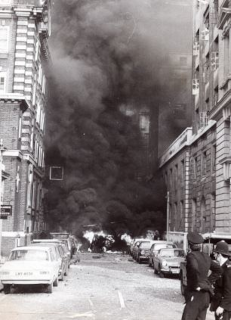
A man with an Irish accent telephones the Press Association with a warning given just six minutes before the device explodes. London police say a recognised IRA codeword is given. The bomb explodes in a corner of Westminster Hall at about 8:30 a.m. on June 17, 1974. The IRA in a telephoned warning says it planted the bomb that weighed approximately 20 lbs. (9.1 kg). The explosion is suspected to have damaged a gas main and a fire spreads quickly through the centuries-old hall in one of Britain’s most security-tight buildings. An annex housing a canteen and a number of offices is destroyed, but the great hall itself receives only light damage. The attack signals the start of a renewed IRA bombing campaign in England that is to last until late 1975 and is to claim the lives of dozens of people. The most notorious attacks of the bombing campaign are the Guildford pub bombings on October 5, 1974, that kill five and injure sixty, and the Birmingham pub bombings on November 21, 1974, which kill twenty-one people and injured one hundred eighty.
The year 1974 ends with the IRA killing twenty-eight people (twenty-three civilians and five British soldiers) in bombing operations in England. Twenty-one people are killed in the Birmingham pub bombings and a further seven are killed in the Guildford and Woolwich Pub bombings. Nearly three hundred people are injured from these bombings alone. The IRA calls off their bombing campaign in February 1975 but restarts it on August 27, 1975, with the Caterham Arms pub bombing which injures over thirty people. A week later, the IRA carries out the London Hilton bombing which kills two and injures over sixty.
In 1971, during the Troubles, after two years engaged in violence based on a defensive strategy in Irish communal districts of Northern Ireland, the Provisional IRA launches an offensive against the United Kingdom. At a meeting of the IRA Army Council in June 1972 the organization’s Chief of Staff, Seán Mac Stíofáin, first proposes making bombing attacks in England. The Army Council does not at first agree to the suggestion, but in early 1973 after its negotiations with the British Government for a truce the previous year had failed to advance the political objective of the removal of Northern Ireland from the United Kingdom by the application of the threat of violence, it re-engages its paramilitary campaign and sanctions Mac Stíofáin’s proposal. Mac Stíofáin had put the strategy forward on the basis that extending the urban paramilitary violence of the Northern Ireland state into England would help to relieve pressure being exerted by the British Army on the IRA’s strongholds of Irish communal support in districts in the province, such as west Belfast and Derry, by diverting British security strength from them back into England, while at the same time increasing strategic pressure upon the British Government to resolve the conflict by political concessions to the IRA’s demands. He also believes that a successful bombing campaign in London, as the capital city of the United Kingdom, will offer substantial propaganda value for paramilitary Irish Republicanism, and provide a morale boost to its supporters.
The effects of the previous 1973 Old Bailey bombing appear to give some credence to the idea of the propaganda value of extending violence into London as, although it is considered almost routine in Northern Ireland by the mid-1970s and draws only brief media notice, being carried out instead in London, a global capital city, makes the event world news headlines. However, although the bombing of the Old Bailey is successfully carried out, and gains media attention, increasing political pressure upon the British Government to address the issue of the conflict in Northern Ireland with more urgency, it is costly to the IRA, as 10 out of the 11-man active service unit that carry it out are arrested by the British police while trying to leave England before the bombs they had planted detonate. Drawing the tactical lesson that large teams are a security liability, for the second wave of bombings in England later in 1973, instead of sending a large team to carry it out with orders to withdraw back to Ireland immediately afterwards, smaller detached “cell” units of 3-4 personnel are sent to carry out the operation, with instructions to remain in England afterward and wage a campaign of bombings around England upon a variety of targets.
There are bombings on September 8, 1973, including one at London Victoria station which injures four civilians.
On September 10, 1973, a bomb (with no warning issued beforehand) explodes at King’s Cross railway station in the booking hall at 12:24 p.m. when a youth of around 16 to 17 years of age walks up to the entrance of the station’s old booking hall and throws a bag into it which contains a 3 lb. (1.4 kg) device, which detonates, shattering glass throughout the hall and throwing a baggage trolley several feet into the air. The youth then flees into the station’s crowd and escapes the scene.
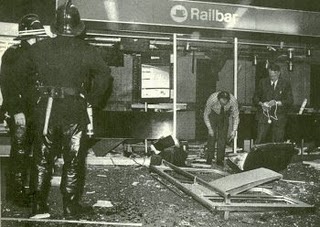
Approximately 45 minutes after the attack at King’s Cross, after a telephone call warning to the Press Association five minutes beforehand by a man with an Irish accent, a second bomb detonates in a snack bar at Euston railway station, injuring another eight civilians. One witness at Euston says, “I saw a flash and suddenly people were being thrown through the air – it was a terrible mess, they were bleeding and screaming.” A total of 13 civilians are injured in the two attacks. The Metropolitan Police issue a photofit picture of a 5 ft. 2 in. (157 cm) tall youth they are seeking in regard to the King’s Cross attack.
On September 12, 1973, two more bombs explode, one in Oxford Street and another in Sloane Square, targeting retail shopping centres. Police subsequently announce that they are looking for five people in connection with this second wave of bomb attacks in England.
Judith Ward is later wrongly convicted of having been involved in the late 1973 London bombings, along with the M62 coach bombing. She is later acquitted. No one else is brought to trial for this IRA bombing campaign.
The 1973 Old Bailey bombing, a car bomb attack carried out by the Provisional Irish Republican Army (IRA) and dubbed as Bloody Thursday by newspapers in Britain, takes place outside the Central Criminal Court of England and Wales, commonly referred to as the Old Bailey, in London on March 8, 1973. This is the Provisional IRA’s first major attack in England since the Troubles began in the late 1960s. The unit also explodes a second bomb outside the Ministry of Agriculture building near Whitehall at around the same time the bomb at the Old Bailey explodes.
England had been relatively untouched by the violence up until the beginning of 1973, but the IRA Army Council draws up plans for a bombing campaign to take place in England some time early in 1973. In the late 1960s and early 1970s, loyalist paramilitaries had bombed Dublin and other parts of the Republic of Ireland a number of times before the IRA began its bombing campaign in England. Following the Dublin bombings in late 1972 and in January 1973 carried out by Loyalists which killed three people and injured over 150, the media attention these bombings received helped the IRA decide to take its campaign to Britain in return. The arrest of top IRA personnel in both the Republic and Northern Ireland like Máire Drumm, Seán Mac Stíofáin, Ruairí Ó Brádaigh and Martin McGuinness in late 1972 help to convince the IRA to bomb England to take the heat off of the IRA in Ireland.
The IRA selects the volunteers who constitute the Active Service Unit (ASU) for the England bombing operation, which is scheduled to take place on March 8, 1973, the same day that a border poll, boycotted by Nationalists and Roman Catholics, is being held in Belfast. Volunteers from all three of the IRA’s Belfast Brigade Battalions are selected for the bombing mission. The team includes Gerry Kelly (19), Robert “Roy” Walsh (24), an expert bomb maker from Belfast, Hugh Feeney, a Belfast-born IRA volunteer and explosives expert, and two sisters, Marian (19) and Dolours Price (22) from Belfast and are from a staunchly Republican family, along with five other lesser-known volunteers from Belfast: Martin Brady (22), William Armstrong (29), Paul Holmes (19), William McLarnon (19), and Roisin McNearney (18).
Several days before the bombing, the leaders of the IRA ASU, which includes sisters Marian and Dolours Price, go to London and pick out four targets: the Old Bailey, the Ministry of Agriculture, an army recruitment office near Whitehall and New Scotland Yard. They then report back to their Officer Commanding (OC) in Belfast, and the IRA Army Council gives the go ahead. The bombs are made in Ireland and transported to London via ferry, according to Marian Price.
The Royal Ulster Constabulary (RUC) warns the British that the ASU is traveling to England, but are unable to provide specifics as to the target.
The drivers and the volunteers who are to prime the bombs wake up at 6:00 a.m. and drive the car bombs to their various targets. Gerry Kelly and Roy Walsh drive their car bomb to the Old Bailey. It is planned that by the time the bombs go off around 3:00 p.m., the ASU will be back in Ireland. The bomb at New Scotland Yard is found at 8:30 a.m. by a policeman who notices a discrepancy in the licence plate. The bomb team starts lifting out 5-pound (2.3 kg) bags of explosives and separates them, so that if the bomb does go off, the force of the explosion will be greatly reduced. The bomb squad eventually finds the detonating cord leads, which run under the front passenger seat of the car. Peter Gurney, a senior member of New Scotland Yard, cuts the detonator cord leads, defusing the bomb.
However, at the Old Bailey the bomb explodes, injuring many and causing extensive damage. Scotland Yard states it had warned the City of London police at 2:01 p.m. to search near the Old Bailey for a green Ford Cortina. The car is not located until 2:35 p.m. and explodes at 2:49 p.m. while police are evacuating the area. Several more people are injured by the car bomb near the Ministry of Agriculture, which brings the total number injured to over two hundred. A British man, Frederick Milton (60), dies of a heart attack. Dolours Price writes in her memoir, “There were warnings phoned in but people had stood about, curious to see… If people ignored the warnings and stood around gawking, they were stupid. The numbers of injured came about through curiosity and stupidity.” The ASU is caught trying to leave the country at Heathrow Airport prior to the explosions, as the police had been forewarned about the bombings and are checking all passengers to Belfast and Dublin. All ten give false names that do not match their documents and they are detained. The IRA Volunteer who gave a warning about the bombs an hour before they exploded is the only one not captured.
The IRA volunteers have to be tried at Winchester Crown court in Winchester Castle as the Old Bailey is wrecked by the car bomb. The trial takes ten weeks and is set amid extremely strict security. William McLarnon pleads guilty to all charges on the first day of the trial. On November 14, 1973, a jury convicts six men and two women of the bombings. The jury acquits Roisin McNearney in exchange for information and she is given a new identity. As her verdict is handed down, the other defendants begin to hum the “Dead March” from Saul, and one throws a coin at her, shouting, “Take your blood money with you” as she leaves the dock in tears. Six of the nine people convicted admit to Provisional IRA membership.
The judge sentences the eight to life imprisonment for the bombings and 20 years for conspiracy, while William McLarnon, whose family was forced out of their home in August 1969, is sentenced to 15 years. When his sentence is read he shouts, “Up The Provisional IRA.” As the eight are led to the cells below the court, several give raised fist salutes to relatives and friends in the public gallery. The Price sisters immediately go on hunger strike, soon followed by Feeney and Kelly, for the right not to do prison work and to be repatriated to a jail in Ireland. The bombers on hunger strike are eventually moved to jails in Ireland as part of the 1975 IRA truce agreed with the British. In 1983, Kelly escapes from Maze Prison and becomes part of an IRA ASU in the Netherlands. He is recaptured three years later by the Dutch authorities and extradited.
The Old Bailey bomb is the beginning of a sustained bombing campaign in England. The next major bombing by the IRA in England is the King’s Cross station and Euston station bombings which injured 13 people and do widespread damage. Another significant attack that year is the 1973 Westminster bombing which injures 60 people. Two more people die in England from IRA bombings in 1973, bringing the total to three for the year in that part of United Kingdom. The next year, 1974, is the bloodiest year of the Troubles outside of Northern Ireland with over 70 people being killed in the Republic of Ireland and England combined. Thirty-four are killed in the Dublin and Monaghan bombings, 21 from the Birmingham pub bombings, 12 from the M62 coach bombing, and several people are killed by the IRA’s Balcombe Street Gang.
One of the Old Bailey bombers, Marian Price, explains the IRA’s reasoning for bombing England. “It doesn’t seem to matter if it’s Irish people dying.” So if the armed struggle was to succeed then it was necessary to “bring it to the heart of the British Establishment.” Hence symbolic targets such as the Old Bailey “were carefully chosen.”
The M62 coach bombing occurs on February 4, 1974, on the M62 motorway in Northern England, when a Provisional Irish Republican Army (IRA) bomb explodes in a coach carrying off-duty British Armed Forces personnel and their family members. Twelve people, nine soldiers and three civilians, are killed by the bomb, which consists of 25 pounds of high explosive hidden in a luggage locker on the coach.
The coach has been specially commissioned to carry British Army and Royal Air Force personnel on leave with their families from and to the bases at Catterick and Darlington during a period of railway strike action. The vehicle departs from Manchester and is making good progress along the motorway. Shortly after midnight, when the bus is between junction 26 and 27, near Oakwell Hall, there is a large explosion on board. Most of those aboard are sleeping at the time. The blast, which can be heard several miles away, reduces the coach to a “tangle of twisted metal” and throws body parts up to 250 yards.
The explosion kills eleven people outright and wounds over fifty others, one of whom dies four days later. Amongst the dead are nine soldiers – two from the Royal Artillery, three from the Royal Corps of Signals, and four from the 2nd battalion Royal Regiment of Fusiliers. One of the latter is Corporal Clifford Haughton, whose entire family, consisting of his wife Linda and his sons Lee (5) and Robert (2), also die. Numerous others suffer severe injuries, including a six-year-old boy, who is badly burned.
The driver of the coach, Roland Handley, is injured by flying glass, but is hailed as a hero for bringing the coach safely to a halt. Handley dies at the age of 76 after a short illness in January 2011.
Suspicions immediately fall upon the IRA, which is in the midst of an armed campaign in Britain involving numerous operations, later including the Guildford pub bombing and the Birmingham pub bombings.
Reactions in Britain are furious, with senior politicians from all parties calling for immediate action against the perpetrators and the IRA in general. The British media are equally condemnatory. According to The Guardian, it is “the worst IRA outrage on the British mainland” at that time, whilst the BBC describes it as “one of the IRA’s worst mainland terror attacks.” The Irish newspaper The Sunday Business Post later describes it as the “worst” of the “awful atrocities perpetrated by the IRA” during this period.
IRA Army Council member Dáithí Ó Conaill is challenged over the bombing and the death of civilians during an interview and replies that the coach had been bombed because IRA intelligence indicated that it was carrying military personnel only.
Following the explosion, the British public and politicians from all three major parties call for “swift justice.” The ensuing police investigation led by Detective Chief Superintendent George Oldfield is rushed, careless, and ultimately forged, resulting in the arrest of the mentally ill Judith Ward who claims to have conducted a string of bombings in Britain in 1973 and 1974 and to have married and had a baby with two separate IRA members. Despite her retraction of these claims, the lack of any corroborating evidence against her, and serious gaps in her testimony – which is frequently rambling, incoherent, and “improbable” – she is wrongfully convicted in November 1974.
The case against Ward is almost completely based on inaccurate scientific evidence using the Griess test and deliberate manipulation of her confession by some members of the investigating team. The case is similar to those of the Guildford Four, the Birmingham Six, and the Maguire Seven, which occur at the same time and involve similar forged confessions and inaccurate scientific analysis. Ward is finally released in 1992, when three Appeal Court judges hold unanimously that her conviction was “a grave miscarriage of justice,” and that it had been “secured by ambush.”



 seamus dubhghaill