Smyth is a Freemason. He is raised on March 6, 1865, in Washington Lodge No. 1 in Wilmington, Delaware.
Smyth enlists in 1861 in the Union Army in an Irish American three-months regiment, the 24th Pennsylvania, and quickly makes the rank of captain. He is later commissioned as major of the 1st Delaware Infantry, a three-years regiment. He serves at the battles of Fredericksburg (following which he is promoted to lieutenant colonel and then to colonel) and Chancellorsville. During the Gettysburg campaign, he commands the 2nd Brigade, 3rd Division of the II Corps. During the Battle of Gettysburg, his men help defend Cemetery Ridge and advance to the area of the Bliss farm to oust enemy sharpshooters. He is wounded on the third day of the battle and relinquishes command briefly.
Smyth retains brigade command during the reorganization of II Corps before General Ulysses S. Grant‘s Overland Campaign. He leads the second brigade of the first division from March 25 to May 17, 1864. When Col. Samuel S. Carroll is wounded, Smyth is transferred to his command, the third brigade of second division, the Gibraltar Brigade. In October 1864, he is promoted to brigadier general during the Siege of Petersburg. He retains command of his brigade throughout the siege.
Between July 31, 1864, and August 22, 1864, and between December 23, 1864, and February 25, 1865, Smyth commands the 2nd division of the corps. On April 7, 1865, near Farmville, Virginia, he is shot through the mouth by a Confederatesniper, with the bullet shattering his cervical vertebrae and paralyzing him. He dies two days later at Burke’s Tavern; the same day Confederate General Robert E. Lee and his army surrender at Appomattox Court House.
In 1846 Lane joins the First Regiment, Texas Mounted Riflemen, as a first lieutenant to fight in the Mexican American War. He fights with honors at the Battle of Monterey and is later given the rank of major and command of his own battalion. After the Mexican American War, he wanders about doing various things in Arizona, California, and Peru before opening a mercantile business in Marshall, Texas, in 1858.
After the Civil War, Lane returns to Marshall where he helps to establish the Texas Veterans Association. After Reconstruction, he and his brother George, a local judge, found the first White Citizens Party in Texas and run Republicans and African Americans out of Marshall. With Democratic white hegemony brutally reestablished in Marshall and Harrison County, he declares the city and county “redeemed.”
Lane dies in Marshall, Texas on January 28, 1892, and is buried in the Marshall Cemetery near downtown Marshall. His memoirs, The Adventures and Recollections of General Walter P. Lane, are published posthumously in 1928.
In 1861 Smyth enlists in the Union army in an Irish American three-months regiment, the 24th Pennsylvania, and is quickly made a captain. He is later commissioned as a major of the 1st Delaware Infantry, a three-years regiment. He serves at the battles of Chancellorsville and Fredericksburg, following which he is promoted to lieutenant colonel and then to colonel. During the Gettysburg campaign, he commands the 2nd Brigade, 3rd Division of the II Corps. During the Battle of Gettysburg, his men help defend Cemetery Ridge and advance to the area of the Bliss farm to oust enemy sharpshooters. He is wounded on the third day of the battle and relinquishes command briefly.
Smyth retains brigade command during the reorganization of II Corps before Ulysses S. Grant‘s Overland Campaign. He leads the second brigade of the first division from March 25 to May 17, 1864. When Colonel Samuel S. Carroll is wounded, Smyth is transferred to his command, the third brigade of second division, the Gibraltar Brigade. In October 1864, he is promoted to brigadier general during the Siege of Petersburg. He retains command of his brigade throughout the siege.
On March 18, 1867, PresidentAndrew Johnson nominates Smyth for posthumous appointment to the grade of brevet major general of volunteers to rank from April 7, 1865, the date he was mortally wounded, and the United States Senate confirms the appointment on March 26, 1867. He is the last Union general killed or mortally wounded during the war and is buried in Wilmington and Brandywine Cemetery in Wilmington, Delaware.
Hagan is born in County Tyrone on June 17, 1822. His family moves to a farm near Philadelphia, Pennsylvania when he is still at an early age, and he is educated at Clermont Academy. He moves to Alabama in 1837. His prosperous uncle, John Hagen of New Orleans, Louisiana, takes him into the family business and sets him up in Mobile to manage the Hagan business there.
Hagan serves in John Coffee Hays‘s Texas Rangers, a cavalry unit in Major GeneralZachary Taylor‘s army during the Mexican–American War. He is recognized for his gallantry at the Battle of Monterrey. He is commissioned a captain in the 3rd U.S. Dragoons in 1848 and is discharged on July 31, 1848. After the war, he returns to Mobile where he purchases and subsequently manages a plantation rather than remaining in the family mercantile business. In 1854, he marries Bettie Oliver, daughter of Alabama’s attorney general.
At the beginning of the American Civil War, Hagan organizes and is elected captain of a cavalry company for the Alabama Militia, the “Mobile Dragoons,” which serves on guard duty along the Gulf Coast. At the rank of major he transfers to the 1st Mississippi Cavalry Regiment on October 26, 1861. The regiment fights at the Battle of Shiloh on April 6–7, 1862. He leads his men in a mounted charge at the Battle of Perryville, which is highly commended by his brigade commander, Brigadier GeneralJoseph Wheeler.
Hagan is promoted to colonel of a new regiment, the 3rd Alabama Cavalry Regiment, on July 1, 1862. The regiment fights in all of the campaigns of the Army of Tennessee. In July 1863, He is assigned to command Brigade 1 of Brigadier General William T. Martin‘s Division of the Cavalry Corps of the Army of Tennessee, which is Major General Joseph Wheeler’s old brigade. During the spring and summer of 1863, the brigade screens the left front of GeneralBraxton Bragg‘s army. Wheeler recommends that Hagan be promoted to brigadier general, but Bragg blocks the promotion because he says Hagan is in a state of “dissipation”, a reference to drunkenness or alcoholism. Hagan is wounded near Franklin, Tennessee in the winter of 1862 and again near Kingston, Tennessee in November 1863. In November 1863, he resigns and returns to Mobile to recover from his wounds and his disappointment from not being promoted.
Although Hagan is assigned as acting brigadier general in early 1865, he never receives an official appointment from Jefferson Davis or confirmation by the Confederate States Senate of an appointment as a general officer. Major General Wheeler later writes that he had been told unofficially by Confederate States War Department officials that brigadier general commissions had been issued for Hagan, Henry Marshall Ashby and Moses Wright Hannon near the end of the war, but no such commissions ever were delivered.
Hagan returns to Mobile after the war but is penniless since his fortune had been converted to Confederate money. He works as manager of a plantation on the Alabama River in the 1870s and early 1880s. President Grover Cleveland appoints him crier of the United States District Court in Alabama in 1885.
James Hagan dies on November 6, 1901, at Mobile, Alabama. He is buried in Magnolia Cemetery in Mobile.
Colonel Dennis O’Kane, officer in the Union Army during the American Civil War, dies on July 4, 1863, of wounds sustained the previous day when fighting with the 69th Pennsylvania Irish Brigade at the Battle of Gettysburg.
Born in Coleraine, County Londonderry, O’Kane is a tavern owner in Philadelphia, Pennsylvania and a member of the 2nd Pennsylvania Militia regiment prior to the Civil War. When the conflict starts, he helps recruit the 24th Pennsylvania Volunteer Infantry, a unit that has the 2nd Pennsylvania Militia as its nucleus. Commissioned Major, Field and Staff, on May 1, 1861, he is with his regiment as it serves first in Maryland and then Virginia before their enlistment expires in July 1861.
In August 1861 O’Kane joins with many of the men from the 24th Pennsylvania in re-enlisting to continue the war effort, and they form the basis of what becomes the 69th Pennsylvania Infantry Regiment. Commissioned Lieutenant Colonel, Field and Staff on August 19, 1861, his new regiment is composed largely of Irish immigrants like himself, and they emblazon the Irish harp on their flag. The unit eventually is joined with the 71st, 72nd and 106th Pennsylvania Infantry Regiments to form the famous Philadelphia Brigade.
O’ Kane serves as second-in-command through 1862, participating in the Peninsular Campaign of May and June, the Second Battle of Bull Run in August, and the September 1862 Battle of Antietam, where his brigade is caught in the West Woods area and takes heavy losses. In November 1862, the 69th Pennsylvania’s commander, Colonel Joshua T. Owen, is promoted to Brigadier General, US Volunteers. O’Kane is advanced to Colonel on December 1, 1862, to fill the vacancy.
At the Battle of Fredericksburg on December 14, 1862, O’Kane leads his men in the third of four waves of futile Union charges on strong Confederate positions at Marye’s Heights south of the town, and sees his regiment sustain fifty-one casualties. In May 1863 during the Battle of Chancellorsville, his brigade is held in reserve and sees limited action.
During the Battle of Gettysburg in July 1863, O’Kane finds the 69th Pennsylvania positioned along a rock fencing in the middle of the Union lines that becomes famous as “The Angle.” That position becomes the epicenter of Pickett’s Charge on July 3, the third day of the battle, as the remnants of the Confederate forces, having been much devastated from Union artillery fire, crash over the rock walls and engage the Philadelphia Brigade in brutal hand-to-hand fighting.
O’Kane is shot in the head at the wall and dies the following day. His regiment again takes high casualties but succeeds in helping to repulse the rebels and defeat the charge. The monument for the 69th Pennsylvania Infantry in Gettysburg National Military Park stands on the spot where O’Kane was mortally wounded.
Although Mulholland later claims that at the Battle of Gettysburg on July 2, 1863, he personally took command of the 140th Pennsylvania Infantry and led it into action, this fact is mentioned in neither his own official report of the battle, nor that of the lieutenant colonel commanding the 140th. When the 116th is returned to full strength in early 1864, he is promoted to colonel. He is wounded a second time at the Battle of the Wilderness on May 5, 1864. At the Battle of Spotsylvania Court House, he is wounded a third time but remains in the hospital only ten days. Resuming his command, he is dangerously wounded again at the Battle of Totopotomoy Creek. He recovers rapidly and commands his brigade in all the actions around the Siege of Petersburg, particularly distinguishing himself by storming a fort on the Boydton Plank Road. He is mustered out of the volunteer service on June 3, 1865.
On May 4, 1866, PresidentAndrew Johnson nominates Mulholland for the brevet grade of brigadier general of volunteers to rank from March 13, 1865, for his conduct at the Battle of the Wilderness and the U.S. Senate confirms the appointment on May 18, 1866. On January 13, 1869, President Johnson nominates Mulholland for appointment to the brevet grade of major general of volunteers, to rank from March 13, 1865, for his actions on the Boydton Plank Road and the Senate confirms the appointment on February 16, 1869. The brevet is issued February 20, 1869. It is the last brevet of major general issued for service during the Civil War.
Returning to civilian life after the war, Mulholland is appointed Chief of Police in Philadelphia in 1868 and signalizes his administration by the good order in which he keeps both the force and the city. President Grover Cleveland appoints him United States Pension Agent, in which office he is continued by Presidents William McKinley and Theodore Roosevelt. He is considered an authority on the science of penology and also devotes much of his leisure time to art studies, and as a lecturer and writer on the Civil War and its records. He compiles a history of the 116th Regiment, and another of those to whom Congress voted the Medal of Honor. In the Catholic affairs of Philadelphia, he is always active and a leader among the best-known laymen.
St. Clair Augustin Mulholland dies on February 17, 1910, in Philadelphia, Pennsylvania. He is buried at Old Cathedral Cemetery, Philadelphia.
Lewis is born in County Donegal to Colonel John Lewis and his wife Margaret Lynn. In 1732 John Lewis, having killed his landlord in an altercation, flees to Virginia with his sons Andrew and Thomas. They become among the first settlers in western Augusta County.
Lewis receives a basic education and learns the skills of a surveyor. He spends at least fifteen years farming and working as a surveyor in southwestern Virginia. He also serves as county lieutenant and later captain in the Augusta County militia.
Early in the 1740s Lewis marries Elizabeth Givens, daughter of Samuel and Sarah (Cathey) Givens, formerly of County Antrim. They establish their own home, called Richfield, in what later becomes Roanoke County near Salem.
The Virginia frontier becomes a battleground in the French and Indian War, as do the frontiers of the more northerly colonies of Pennsylvania and Maryland. Virginia organizes a militia to defend settlers subject to attacks by Indians upset at encroachments into their territories. Lewis becomes a captain in George Washington‘s regiment. However, after the loss at the Battle of Fort Necessity in 1754, Washington is forced to surrender to the French. Lewis retreats across the Appalachian Mountains.
Washington proposes a series of frontier fortifications to protect settlers east of the Appalachians. Lewis initially serves to build Fort Dinwiddie on the Jackson River of present-day Bath County and is relieved of his command September 21, 1755. The Virginia assembly approves Lewis’ promotion to major and assigns him to oversee the region along the Greenbrier River. On February 18, 1756, he leads the Big Sandy expedition from Fort Frederick with a mixed force of militiamen and Cherokees to raid the Shawnee towns along the Big Sandy and Ohio rivers to retaliate for Shawnee attacks. He leads several expeditions against both Indian settlements and French outposts. During the Forbes Expedition, he is captured during Major James Grant‘s attack on Fort Duquesne during the Battle of Fort Duquesne in September 1758. Taken to Quebec, he remains a prisoner until late 1759.
Upon the formation of Botetourt County from Augusta County in 1769, Lewis is elected to the House of Burgesses and reelected several times until 1780, though the American Revolution precludes much attendance in later years.
When the American Revolution begins, Governor Dunmore suspends Virginia’s legislature. The Whigs form a provisional congress, which includes both Lewis and his brother Thomas as delegates. When the Continental Congress creates a Continental Army in 1775 and makes George Washington its commander, he asks that Lewis be made a brigadier general. However, initially the Continental Congress had decided there should be only one general from each state, and Charles Lee is the first Virginian commissioned as Brigadier General.
On March 1, 1776, Lewis becomes a brigadier general, overseeing Virginia’s defense and raising men for the Continental Army. Virginia’s Committee of Safety calls on Lewis to stop Governor Dunmore’s raids along the coast from his last stronghold, a fortified position on Gwynn’s Island in the Chesapeake Bay. On July 9, 1776, he leads Virginia’s forces which capture the island as Lord Dunmore escapes by sea, sailing to the Caribbean, never to return.
On April 15, 1777, Lewis resigns his commission, alleging poor health. However, he also faces discontent among his men and the army as a whole. Moreover, he is bypassed when promotions are announced for Major General in early 1777. George Washington, in need of every able officer, expresses his disappointment to Lewis.
Lewis remains active in the legislature, and in 1780, Governor Thomas Jefferson appoints him to the Executive Council. The following year, he falls ill while returning home from a council meeting. He dies of fever in Bedford County on September 26, 1781. He is buried in the family plot at his home. His gravesite is not marked. Colonel Elijah McClanahan, who marries Lewis’ granddaughter, Agatha Lewis McClanahan, attended his funeral as a young man, and later identifies his grave to Roanoke County’s Clerk of the Court. In 1887 General Lewis’ remains are re-interred in the East Hill Cemetery at Salem, Virginia.
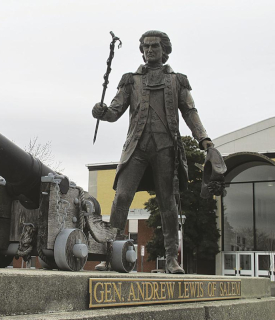
(Pictured: Statue of General Andrew Lewis outside the Salem Civic Center)
After the Battle of Pea Ridge, Kiernan insists on joining the fighting ranks, and in that capacity is seemingly appointed a Major in the 6th Missouri Volunteer Infantry. In May 1863 at Port Gibson, Mississippi, he is wounded in the left lung and left on the battlefield for dead. Recovered and imprisoned, he effects an escape back to Union forces and resigns his commission. On August 1, 1863, he is commissioned a Brigadier General of the United States Volunteers by President Abraham Lincoln, commanding a post at Miliken’s Bend on the Mississippi River. However, ill-health as a result of his battlefield wounds forces him to resign on February 3, 1864.
In May 1865 Kiernan gains a U.S. consular post at Chinkiang, China. He manages to make the trip there, but his health does not allow him to perform the duties. He returns to New York where he becomes an examining physician for the Bureau of Pensions, a position he holds until his death.
James Lawlor Kiernan dies on November 26, 1869. The official cause of death is “congestion of the lungs.” Perhaps he is killed by that Confederate ball that wounded him six years earlier. He is buried in Green-Wood Cemetery in Brooklyn, New York.





 seamus dubhghaill