seamus dubhghaill

Promoting Irish Culture and History from Little Rock, Arkansas, USA


Leave a comment

Birth of Mary McAleese, 8th President of Ireland

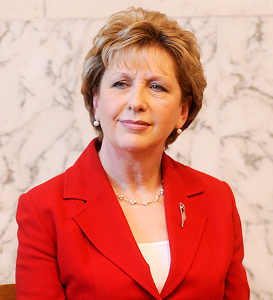
Mary Patricia McAleese, Irish Independent politician who serves as the 8th President of Ireland from November 1997 to November 2011, is born in Belfast, Northern Ireland on June 27, 1951. She is the second female president and is first elected in 1997 succeeding Mary Robinson, making McAleese the world’s first woman to succeed another as president. She is re-elected unopposed for a second term in office in 2004 and is the first President of Ireland to have come from either Northern Ireland or Ulster.

Born Mary Patricia Leneghan, McAleese is the eldest of nine children in a Roman Catholic family. Her family is forced to leave the area by loyalists when The Troubles break out. Educated at St. Dominic’s High School, she also spends some time when younger with the Poor Clares, Queen’s University Belfast, from which she graduates in 1973, and Trinity College, Dublin. She is called to the Bar of Northern Ireland in 1974 and remains a member of the Bar Council of Ireland. She opposes abortion and divorce.

In 1975, McAleese is appointed Professor of Criminal Law, Criminology and Penology at Trinity College, Dublin and in 1987, she returns to her Alma Mater, Queen’s, to become Director of the Institute of Professional Legal Studies. In 1994, she becomes the first female Pro-Vice-Chancellor of Queen’s University. She works as a barrister and also works as a journalist with RTÉ.

McAleese uses her time in office to address issues concerning justice, social equality, social inclusion, anti-sectarianism and reconciliation. She describes the theme of her Presidency as “Building Bridges.” This bridge-building materialises in her attempts to reach out to the unionist community in Northern Ireland. These steps include celebrating The Twelfth at Áras an Uachtaráin and she even incurs criticism from some of the Irish Catholic hierarchy by taking communion in a Church of Ireland cathedral in Dublin. Despite being a practising Roman Catholic, she holds liberal views regarding homosexuality and women priests. She is a member of the Council of Women World Leaders and is ranked the 64th most powerful woman in the world by Forbes. In spite of some minor controversies, McAleese remains popular, and her Presidency is regarded as successful.

McAleese receives awards and honorary doctorates throughout her career. On May 3, 2007, she is awarded The American Ireland Fund Humanitarian Award. On October 31, 2007, she is awarded an honorary Doctor of Laws from the University of Otago, New Zealand. On May 19, 2009, she becomes the third living person to be awarded the freedom of Kilkenny, succeeding Brian Cody and Séamus Pattison. The ceremony, at which she is presented with two hurleys, takes place at Kilkenny Castle. On May 24, 2009, she is awarded an honorary Doctor of Laws from Mount Holyoke College in South Hadley, Massachusetts. On May 22, 2010, she is awarded an honorary Doctor of Law from Fordham University, in the Bronx, New York City, where she delivers the commencement speech to the class of 2010. On November 8, she is awarded an honorary doctorate at University of Massachusetts Lowell in Lowell, Massachusetts.

On June 8, 2013, a ceremony is held to rename a bridge on the M1 motorway near Drogheda as the Mary McAleese Boyne Valley Bridge to honour McAleese’s contribution to the Northern Ireland peace process.


Leave a comment

Mary Robinson Elected First Woman President of the Republic

mary-robinson-1

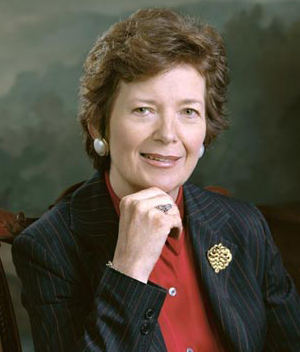
Mary Robinson becomes the first woman to be elected President of the Republic of Ireland on November 7, 1990. She becomes the first Labour Party candidate, the first woman, and the first non-Fianna Fáil candidate in the history of contested presidential elections to win the presidency.

Brian Lenihan, the Tánaiste and Minister for Defence is chosen by Fianna Fáil as their candidate, though he faces a late challenge for the party nomination from another senior minister, John P. Wilson, TD. Lenihan is popular and widely seen as humorous and intelligent. He has delivered liberal policy reform (relaxed censorship in the 1960s) and is seen as a near certainty to win the presidency.

Fine Gael, after trying and failing to get former Taoiseach Garret FitzGerald and former Tánaiste Peter Barry to run, ultimately nominate the former civil rights campaigner and Social Democratic and Labour Party (SDLP) member Austin Currie. Currie is elected to Dáil Éireann in the 1989 general election and has been a minister in Brian Faulkner‘s power-sharing executive in Northern Ireland from 1973–1974. However, Currie has little experience in the politics of the Republic and is widely seen as the party’s last choice, nominated only when no one else is available.

The Labour Party lets it be known that it would for the first time run a candidate. Along with the Workers’ Party, Labour nominates the independent candidate Mary Robinson, SC, a former Labour Party member and senator, and liberal campaigner. Robinson is a former Reid Professor of Law in the Trinity College, Dublin. She is previously involved in the Campaign for Homosexual Law Reform and the campaign to save Wood Quay.

Lenihan enters the race as odds-on favourite. No Fianna Fáil candidate has ever lost a presidential election. However, Lenihan is derailed when he confirms in an on-the-record interview with freelance journalist and academic researcher Jim Duffy that he has been involved in controversial attempts to pressurise the President, Patrick Hillery, over a controversial parliamentary dissolution in 1982. As a result of the contrast between his public denials during the campaign and his confirmation during an earlier interview recorded in May, he is dismissed from the Irish government.

At this point a cabinet colleague, Pádraig Flynn, launches a controversial personal attack on Mary Robinson “as a wife and mother,” an attack that is itself attacked in response as “disgraceful” on live radio by Michael McDowell, a senior member of the Progressive Democrats, then in coalition with Fianna Fáil and up to that point supporting Lenihan’s campaign. Flynn’s attack is a fatal blow to Lenihan’s campaign, causing many female supporters of Lenihan to vote for Robinson in a gesture of support.

Lenihan nonetheless receives a plurality of first-choice votes. Mary Robinson beats Austin Currie, forcing Fine Gael’s candidate into third place. Under Ireland’s system of single transferable vote, Robinson receives over 75% of the transfers when Austin Currie is eliminated, beating Lenihan into second place and becoming the seventh President of Ireland.

While the role of the presidency in day-to-day politics is a very limited one, the Robinson presidency is regarded by many observers as a watershed in Irish society, symbolising the shift away from the conservative ultra-Catholic male-dominated Ireland which existed up until the end of the 1980s to the more liberal society symbolised by Robinson.

Robinson is generally credited with raising the profile of the office of president, which has been considered little more than an honorary figurehead position under her predecessors. Prior to Mary Robinson’s presidency it was not unusual to hear commentators advocating the abolition of the office of president, a viewpoint that is almost never advanced nowadays.


Leave a comment

Seamus Heaney Awarded Nobel Prize in Literature

seamus-heaney

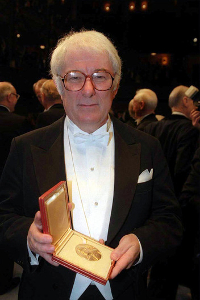
Seamus Heaney, poet, playwright, translator, and lecturer, is awarded the Nobel Prize in Literature on October 15, 1995.

Heaney is born in April 1939 near Castledawson, County Derry, Northern Ireland, where his family engages in farming and selling cattle. His education includes studies at Queen’s University Belfast, where he also serves as a lecturer in the late 1960s. He makes his debut as a poet then, but continues to divide his time between his own writing and academia. He works at Carysforth College in Dublin, at Harvard University in Cambridge, Massachusetts, and at Oxford University.

Heaney’s poetry is often down-to-earth. For him, poetry is like the earth – something that must be plowed and turned. Often he paints the gray and damp landscape from the British Isles. Peat moss has a special place in his poetry. The poems often are connected with daily experiences, but they also derive motifs from history, all the way back to prehistoric times. Heany’s profound interest in the Celtic and the pre-Christian as well as in Catholic literary tradition has found expression in a number of essays and translations.

Heaney is awarded the Nobel Prize in Literature in 1995 for what the Nobel committee describes as “works of lyrical beauty and ethical depth, which exalt everyday miracles and the living past.” He is on holiday in Greece with his wife, Marie, when the news breaks. No one, not even journalists or his own children, can locate him until he appears at Dublin Airport two days later, though an Irish television camera traces him to Kalamata. Asked how it feels having his name added to the Irish Nobel pantheon featuring William Butler Yeats, George Bernard Shaw, and Samuel Beckett, Heaney responds, “It’s like being a little foothill at the bottom of a mountain range. You hope you just live up to it. It’s extraordinary.” He and Marie are immediately whisked straight from the airport to Áras an Uachtaráin for champagne with President Mary Robinson.


Leave a comment

Mary Robinson Resigns as President of Ireland

mary-robinson

President Mary Robinson resigns on September 12, 1997, two months ahead of the end of her term, in order to take up appointment as United Nations High Commissioner for Human Rights.

On July 24, 1997, Robinson announces her intention to resign as President of Ireland. The Irish Government states that her announcement “was not unexpected” and wishes her “every success.” She resigns by addressing a message to the Ceann Comhairle of Dáil Éireann and it takes effect at 1:00 PM on September 12.

Upon her resignation as President, the role of President is transferred to the Presidential Commission, which is comprised of the Chief Justice, the Ceann Comhairle, and the Cathaoirleach of the Seanad Éireann, from September 12 until November 11, 1997, when Mary McAleese is sworn in as the new President.

Media reports suggest that Robinson has been head-hunted for the post by Secretary General of the United Nations Kofi Annan to assume an advocacy as opposed to administrative role, in other words to become a public campaigner outlining principles rather than the previous implementational and consensus-building model. The belief is that the post has ceased to be seen as the voice of general principles and has become largely bureaucratic. Robinson’s role is to set the human rights agenda within the organisation and internationally, refocusing its appeal.

Robinson is the first High Commissioner for Human Rights to visit Tibet, making her trip in 1998. During her tenure she criticises the Irish system of permits for non-EU immigrants as similar to “bonded labour” and criticises the United States’ use of capital punishment.

In 2001, Robinson chairs the Asia Regional Preparatory Meeting for the World Conference against Racism, Racial Discrimination, Xenophobia and related intolerances, which is held in Tehran, Iran. Representatives of the Simon Wiesenthal Centre, a Jewish group, and the Baha’i International Community are not permitted to attend. Robinson wears a headscarf at the meeting in conformance to the Iranians edict that all women attending the conference must wear a headscarf. Women who do not wear the headscarf are criticized, which Robinson says plays into the hands of religious conservatives.

She extends her intended single four-year term by a year following an appeal by Secretary General Annan to preside over the World Conference against Racism 2001 in Durban, South Africa. The conference proves controversial, and under continuing pressure from the United States, Robinson resigns her post in September 2002.


Leave a comment

Eighth Amendment of the Constitution of Ireland Approved

eighth-amendment

The Eighth Amendment of the Constitution of Ireland, which introduces a constitutional ban on abortion by recognizing a right to life of an unborn child, is approved by referendum on September 7, 1983, and signed into law on October 7 of the same year. It is often referred to as the Irish Pro-Life Amendment.

The amendment is adopted during the Fine GaelLabour Party coalition government led by Garret FitzGerald but is drafted and first suggested by the previous Fianna Fáil government of Charles Haughey. The amendment is supported by Fianna Fáil and some of Fine Gael and is generally opposed by the political left. Most of those opposed to the amendment, however, insist that they are not in favour of legalising abortion. The Roman Catholic hierarchy supports the amendment, but it is opposed by the other mainstream churches. After an acrimonious referendum campaign, the amendment is passed by 67% voting in favour to 33% voting against.

Under sections 58 and 59 of the Offences against the Person Act 1861, abortion is already illegal in Ireland. However, anti-abortion campaigners fear the possibility of a judicial ruling in favour of allowing abortion. In McGee v. Attorney General (1973), the Supreme Court of Ireland had ruled against provisions of the Criminal Law Amendment Act 1935 prohibiting the sale and importation of contraception on the grounds that the reference in Article 41 to the “imprescriptable rights, antecedent and superior to all positive law” of the family conferred upon spouses a broad right to privacy in marital affairs. In the same year, the Supreme Court of the United States ruled on similar grounds in Roe v. Wade to find a right to an abortion grounded on privacy.

The Pro-Life Amendment Campaign (PLAC) is founded in 1981 to campaign against a ruling in in Ireland similar to Roe. Prior to the 1981 general election, PLAC lobbies the major Irish political parties – Fianna Fáil, Fine Gael, and the Labour Party – to urge the introduction of a Bill to allow the amendment to the constitution to prevent the Irish Supreme Court so interpreting the constitution as giving a right to abortion. The leaders of the three parties – respectively Charles Haughey, Garret FitzGerald, and Frank Cluskey – agree although there is little consultation with any of their parties’ ordinary members. All three parties are in government over the following eighteen months, but it is only in late 1982, just before the collapse of a Fianna Fáil minority government, that a proposed wording for the amendment is produced.

The referendum is supported by PLAC, Fianna Fáil, some members of Fine Gael, and the Roman Catholic hierarchy and opposed by various groups under the umbrella name of the Anti-Amendment Campaign (AAC), including Labour senator, and future President of Ireland, Mary Robinson, feminist campaigners, and trade unions.

There is currently a campaign for repeal of the Eighth Amendment in Ireland. This is led by both a coalition of human rights and pro-choice groups and has widespread support from a number of legal academics and members of the medical profession. In the run up to the 2016 general election, a number of parties commit to a referendum to repeal the Eighth Amendment and a group of feminist law academics publish model legislation to show what a post-Eighth Amendment abortion law could look like. In June 2016, Minister for Health Simon Harris states his support for a referendum on repealing the 8th.

On July 27, 2016, the government appoints Supreme Court judge Mary Laffoy as chair of a Citizens’ Assembly to consider a number of topics, including the Eighth Amendment.


Leave a comment

Birth of Mary Robinson, 1st Female President of Ireland

mary-robinson

Mary Therese Winifred Robinson, seventh and first female President of Ireland (1990-1997), is born on May 21, 1944, in Ballina, County Mayo. Robinson also serves as the United Nations High Commissioner for Human Rights from 1997 until 2002.

Robinson first rises to prominence as an academic, barrister, campaigner, and member of the Irish Senate (1969–1989). Running as an Independent candidate nominated by the Labour Party, the Workers’ Party, and independent senators, Robinson defeats Fianna Fáil‘s Brian Lenihan and Fine Gael‘s Austin Currie in the 1990 presidential election becoming the first elected president in the office’s history not to have had the support of Fianna Fáil.

Robinson is widely regarded as a transformative figure for Ireland, and for the Irish presidency, revitalising and liberalising a previously conservative, low-profile political office. She resigns the presidency two months before the end of her term in office in order to take up her post in the United Nations. During her UN tenure, she visits Tibet in 1998, the first High Commissioner to do so. She criticises Ireland’s immigrant policy and criticises the use of capital punishment in the United States. She extends her intended single four-year term by a year to preside over the World Conference against Racism 2001 in Durban, South Africa. The conference proves controversial, and under continuing pressure from the United States, Robinson resigns her post in September 2002.

After leaving the UN in 2002, Robinson forms Realizing Rights: The Ethical Globalization Initiative, which comes to a planned end at the end of 2010. Its core activities are fostering equitable trade and decent work, promoting the right to health and more humane migration policies, and working to strengthen women’s leadership and encourage corporate social responsibility. The organisation also supports capacity building and good governance in developing countries. Robinson returns to live in Ireland at the end of 2010, and sets up The Mary Robinson Foundation – Climate Justice, which aims to be “a centre for thought leadership, education, and advocacy on the struggle to secure global justice for those many victims of climate change who are usually forgotten – the poor, the disempowered, and the marginalised across the world.”

Robinson is Chair of the Institute for Human Rights and Business and Chancellor of the University of Dublin. Since 2004, she has also been Professor of Practice in International Affairs at Columbia University, where she teaches international human rights. Robinson also visits other colleges and universities where she lectures on human rights. Robinson sits on the Board of the Mo Ibrahim Foundation, an organisation which supports good governance and great leadership in Africa and is a member of the Foundation’s Ibrahim Prize Committee. Robinson is an Extraordinary Professor in the Centre for Human Rights and the Centre for the Study of AIDS at the University of Pretoria. Robinson serves as Oxfam’s honorary president from 2002 until she steps down in 2012 and is the honorary president of the European Inter-University Centre for Human Rights and Democratisation EIUC since 2005. She is Chair of the International Institute for Environment and Development (IIED) and is also a founding member and Chair of the Council of Women World Leaders (2003-2009). Robinson was a member of the European members of the Trilateral Commission.

In 2004, she receives Amnesty International‘s Ambassador of Conscience Award for her work in promoting human rights.

In July 2009, Robinson is awarded the Presidential Medal of Freedom, the highest civilian honour awarded by the United States. In presenting the award to Robinson, U.S. President Barack Obama says, “Mary Robinson learned early on what it takes to make sure all voices are heard. As a crusader for women and those without a voice in Ireland, Mary Robinson was the first woman elected President of Ireland, before being appointed U.N. High Commissioner for Human Rights. When she traveled abroad as President, she would place a light in her window that would draw people of Irish descent to pass by below. Today, as an advocate for the hungry and the hunted, the forgotten and the ignored, Mary Robinson has not only shone a light on human suffering but illuminated a better future for our world.”


Leave a comment

Birth of Father Ted, Dermot John Morgan

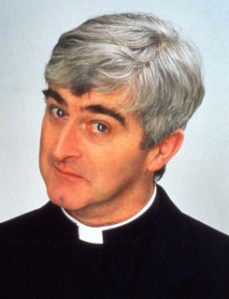
dermot-john-morganDermot John Morgan, Irish comedian and actor who achieves international renown for his role as Father Ted Crilly in the Channel 4 sitcom Father Ted, is born in Dublin on March 31, 1952.

Educated at Oatlands College, Stillorgan, and University College, Dublin (UCD), Morgan comes to prominence as part of the team behind the highly successful RTÉ television show The Live Mike. Morgan makes his debut in the media on the Morning Ireland radio show produced by Gene Martin. Between 1979 and 1982 Morgan, who has been a teacher at St. Michael’s College, Ailesbury Road, plays a range of comic characters who appear between segments of the show, including Father Trendy, an unctuous trying-to-be-cool Catholic priest given to drawing ludicrous parallels with non-religious life in two-minute ‘chats’ to camera.

Morgan’s success as Father Trendy and other characters leads him to leave teaching and become a full-time comedian.

Morgan’s biggest Irish broadcasting success occurs in the late 1980s on the Saturday morning radio comedy show Scrap Saturday, which mocks Ireland’s political, business, and media establishment. The show’s treatment of the relationship between the ever-controversial Taoiseach Charles Haughey and his press secretary P.J. Mara prove particularly popular. When RTÉ axes the show in the early 1990s a national outcry ensues. Morgan lashes the decision, calling it “a shameless act of broadcasting cowardice and political subservience.”

Already a celebrity in Ireland, Morgan’s big break comes in Channel 4‘s Irish sitcom Father Ted, which runs for three series from April 21, 1995 until May 1, 1998. Writers Graham Linehan and Arthur Mathews audition many actors for the title role, but Morgan’s enthusiasm wins him the part.

Father Ted centres on three disparate characters. Father Ted Crilly, played by Morgan, lives a frustrated life trapped on the fictional Craggy Island. Irish TV comedy actor Frank Kelly plays Father Jack Hackett, a foul-mouthed and apparently brain-damaged alcoholic, while child-minded Father Dougal McGuire is played by comedian Ardal O’Hanlon. The three priests are looked after by their housekeeper, Mrs. Doyle, played by Pauline McLynn, with whom Morgan had worked on Scrap Saturday. Father Ted enjoys widespread popularity and critical acclaim. In 1998, the show wins a BAFTA award for the best comedy, Morgan wins a BAFTA for best actor, and McLynn is named best actress.

On February 28, 1998, one day after recording the last episode of Father Ted, Morgan has a heart attack while hosting a dinner party at his home in southwest London. He is rushed to hospital but dies soon afterwards. Morgan’s Requiem Mass in St. Therese’s Church in Mount Merrion, south Dublin, is attended by the President of Ireland Mary McAleese, her predecessor, Mary Robinson, and by political and church leaders, many of whom had been the targets of his humour in Scrap Saturday. He is cremated at Glasnevin Cemetery and his ashes are buried in the family plot in Deansgrange Cemetery.