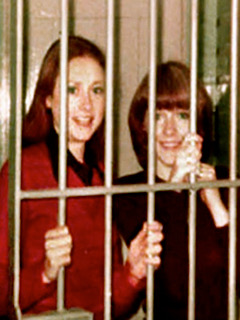
The two bombs are placed in London as part of the IRA’s “London bombing campaign.” One bomb explodes outside the criminal court, Old Bailey, injuring over 200 people. The second bomb explodes outside the Ministry of Agriculture near Whitehall, also injuring nearly 200 people. One man dies from a heart attack shortly after the Old Bailey blast, though the autopsy suggests the attack began before the explosion.
The 10‑week trial at Winchester Crown Court is one of the most heavily secured in British legal history, with plain‑clothes detectives, prison officers, and bolted doors. The jury deliberates for two days before convicting the eight defendants. A ninth defendant, Roisin McNearney, is acquitted, and a tenth, William McLarnon, pleads guilty on the first day.
The Price sisters, along with Hugh Feeney and Gerry Kelly, are considered the key conspirators. All eight convicted men and women are sentenced to life imprisonment.
The convicted IRA members immediately begin a hunger strike demanding transfer to prisons in Ireland. The four main leaders — the Price sisters, Feeney, and Kelly — continue the strike for months, are force‑fed, and are eventually transferred to Irish jails in 1975. Marian and Dolours Price are later released early on medical grounds due to anorexia nervosa.
This case remains one of the most high‑profile IRA trials in the United Kingdom, notable for its security, the scale of the attacks, and the prolonged hunger strike that follows.
On Monday, February 26, 2001, the Irish Government imposes a temporary ban on the country’s 120 livestock marts as the devastating foot-and-mouth disease spreads and threatens to become an epidemic in Great Britain. Strict procedures are also implemented in airports around Ireland to keep the disease out of the country. All marts along the border counties have been suspended since the previous Friday, February 23.
Joe Walsh, the Minister for Agriculture and Food, announces the emergency measure on Sunday night. The total suspension comes into force immediately and is intended to dramatically reduce the number of livestock movements. The ban is to remain in place for at least a fortnight.
In a related move, Central Statistics Office staff undertaking survey work are instructed not to enter farm premises until further notice.
The Government orders emergency staff to ports and airports on Sunday as the foot-and-mouth outbreak nears epidemic proportions in Britain and Continental countries begin the wholesale slaughter of thousands of animals imported from the United Kingdom.
In an atmosphere of mounting alarm, the Irish Farmers’ Association demands a ban on movement of all animals including racehorses to Britain and for the thorough disinfection of “every foot and tyre” entering Ireland from the UK. Horses and horseboxes arriving at British racecourses are already being disinfected and Sunday’s meeting at Newcastle is abandoned because of its proximity to one of the affected areas. Additional measures are expected to be announced.
Irish rugby fans are asked not to travel to Cardiff on Saturday, March 3, to minimise the risk of spreading the disease, and it seems likely the Government will urge punters to stay away from the Cheltenham Festival if, indeed, the festival goes ahead as scheduled. The Jockey Club says it will follow the Government’s request, but the decision angers the British government, which may order the meeting to be cancelled.
Five new cases of the disease are confirmed in Britain on Sunday, bringing the total to 12 confirmed cases with two suspected outbreaks. The suspected outbreak of most concern to Ireland is at Welsh Country Foods, an abattoir on Anglesey. It remains cordoned off.
British Ministry of Agriculture officials continue tests on the suspect sheep found at the plant over the weekend. Final results of the tests are not available until Monday morning.
A 10-mile exclusion zone is ordered around the Gaerwen plant, which is located adjacent to the Menai Suspension Bridge. However, both exporters and the Farmers’ Union of Wales believe the foot-and-mouth virus is, in fact, present in the plant, which is located less than 15 miles from Holyhead.
British veterinarians are alarmed at the increase in new cases. An epidemic is to be declared if the number of new cases reaches more than 30 per day.
(From: “All marts closed in threat of epidemic” by Ralph Riegel, Irish Independent, http://www.independent.ie, February 26, 2001)