The Cork Examiner, now known as the Irish Examiner, an Irish national daily newspaper, hits the streets for the first time on August 30, 1841. Today the newspaper primarily circulates in the Munster region surrounding its base in Cork, though it is available throughout Ireland. Its primary national rivals are The Irish Times and the Irish Independent.
The paper is founded by John Francis Maguire under the title The Cork Examiner in 1841 in support of the Catholic Emancipation and tenant rights work of Daniel O’Connell. The newspaper is originally published three times a week on Mondays, Wednesdays, and Fridays. In July 1861, it becomes a daily newspaper with editions Monday through Saturday.
In August 1922, during the Irish Civil War, The Cork Examiner’s printing presses are destroyed by Republican forces before the Free State army can arrive in Cork. During the Spanish Civil War, The Cork Examiner takes a strongly pro-Franco tone in its coverage of the conflict.
Though originally appearing under The Cork Examiner title, it has re-branded in recent years to The Examiner, and subsequently The Irish Examiner to appeal to a more national readership.
The newspaper was part of the Thomas Crosbie Holdings group. Thomas Crosbie Holdings went into receivership in March 2013. The newspaper has since been acquired by Landmark Media Investments. The newspaper is based on Academy Street in Cork for over a century before moving to new offices at Lapp’s Quay, Cork in early November 2006.
Historical copies of The Cork Examiner, dating back to 1841, are available to search and view in digitised form at The British Newspaper Archive.
Gerald FitzGerald becomes concerned that Ulick Burke’s attempt to gain supremacy in Connacht could simultaneously threaten the Crown’s interests in that province and his claim to be the paramount magnate in Ireland. He tries to persuade Ulick to acknowledge his authority by giving him his daughter Estacia in marriage. Ulick Burke, however, resists all attempts to have his power subordinated by the Earl of Kildare, forming an alliance with O’Brien of Thomond and the magnates of Munster. The Burkes of Mayo, on the other hand, join forces with Kildare with the aim of suppressing their dangerous neighbour.
In 1503, Ulick Burke attacks and destroys the castles of O’Kelly, Lord of Hymany, at Monivea, Garbally, and Castleblakeney. O’Kelly complains of this to the Lord Deputy.
For political and possibly for personal reasons, the Lord Deputy is eager to help O’Kelly weaken the prestige of Clanrickarde. Both sides gather a large contingent of lesser magnates and their armies. The Lord Deputy’s forces include contingents from Leinster, Ulster, and Connacht, among which are the armies of Red Hugh O’Donnell and Art Óg Ó Néill, the McDermotts and Morrisroes of Connacht, and a contingent provided by O’Kelly. Facing them are the forces of Burke and his allies – the O’Briens of Thomond, the McNamaras, the O’Kennedys, and the O’Carrolls.
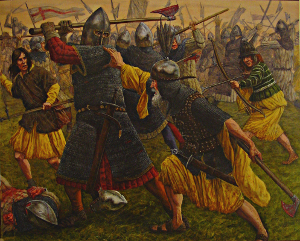
The armies meet on the slopes of Knockdoe, almost a mile to the north of Lackagh Parish Church, with heavily armed Gallowglass playing a large part on both sides. It is said that firearms are employed in the course of the battle, an early instance of their use in Ireland. The battle apparently lasts all day, with the heaviest fighting taking place along the River Clare in the townland of Ballybrone. The precise number of casualties is unknown, though contemporary observers are impressed by the extent of the slaughter. Around the summit of Knockdoe are many cairns where the dead are said to have been buried, with one in particular being pointed out as the resting place of the two sons of O’Brien of Thomond.
The Lord Deputy, though victorious, has many among the slain. His army remains the night on the field as a token of victory, then marches to Galway, looting Claregalway castle en route and taking as prisoners the two sons and daughter of Ulick Burke. They remain in Galway for a few days and then travel to Athenry.
The Clanrickarde Burkes fade into obscurity for some decades, with their rivals, the Mayo Burkes, gaining influence as a consequence.
The Second Battle of Athenry takes place on August 10, 1316. The English Colonists defeat the Irish in a very bloody battle. This is one of the most decisive battles of the Bruce campaign in Ireland (1315-1318).
The numbers involved are unknown and can only be estimated. The royal army is believed to have been as much as a few thousand, while that of Athenry is probably several hundred less. While it is doubtful that there are any more than seven thousand, the list of participants on the Irish side alone indicates that an overall figure of at least three to four thousand are involved. The English claim that they take some 1,100 heads from the Irish on that day.
Unlike the First Battle of Athenry in 1249, no account is given of the battle itself in any surviving account. Even the site of the battle itself is uncertain.
Although details of the battle are very sketchy at best, the Irish certainly meet with catastrophe. Fedlim Ó Conchobair and Tadhg Ó Cellaigh, King of Uí Maine, are among those who are killed along with numerous other kings and chieftains of the Gaels.
A Viking settlement that would later become the city of Dublin is founded on the banks of the River Liffey on July 10, 988.
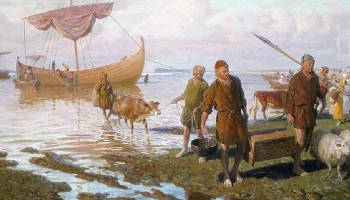
The first documented history of Dublin begins with the Viking raids in the 8th and 9th century. These lead to the establishment of a settlement on the south side of the mouth of the Liffey, named Dubh Linn (Black Pool) after the dark tidal pool where the River Poddle enters the Liffey which is where the Danes first moor their boats.
The Vikings, or Ostmen as they call themselves, rule Dublin for almost three centuries, although they are expelled in 902 only to return in 917 and notwithstanding their defeat by the Irish High KingBrian Boru at the Battle of Clontarf in 1014. From that date, the Norse are a minor political force in Ireland, firmly opting for a commercial life. Viking rule of Dublin ends completely in 1171 when the city is captured by King Dermot MacMurrough of Leinster, with the aid of Anglo-Normanmercenaries. An attempt is made by the last Norse King of Dublin, Ascall mac Ragnaill, to recapture the city with an army he raises among his relations in the Scottish Highlands, where he is forced to flee after the city is taken, but the attempted reconquest fails and Ascall is killed.
Dublin becomes the centre of English power in Ireland after the Norman invasion of the southern half of Ireland (Munster and Leinster) in 1169-1171, replacing Tara in Meath, seat of the Gaelic High Kings of Ireland, as the focal point of Ireland’s polity. On May 15, 1192, Dublin’s first written Charter of Liberties is granted by John, Lord of Ireland, and is addressed to all his “French, English, Irish and Welsh subjects and friends.” On June 15, 1229, his son Henry grants the citizens the right to elect a mayor who is to be assisted by two provosts. By 1400, however, many of the Anglo-Norman conquerors are absorbed into the Gaelic culture, adopting the Irish language and customs, leaving only a small area of Leinster around Dublin, known as the Pale, under direct English control.
In 484, Brendan is born in Tralee, County Kerry, in the province of Munster. He is born among the Altraige, a tribe originally centred around Tralee Bay, to parents called Finnlug and Cara. He is baptised at Tubrid, near Ardfert by Saint Erc, and is originally to be called “Mobhí” but signs and portents attending his birth and baptism lead to him being christened “Broen-finn” or “fair-drop.” For five years he is educated under Saint Ita, “the Brigid of Munster.” When he is six, he is sent to Saint Jarlath‘s monastery school at Tuam to further his education. Brendan is one of the “Twelve Apostles of Ireland,” one of those said to have been tutored by the great teacher, Finnian of Clonard.
At the age of twenty-six, Brendan is ordained a priest by Saint Erc. Afterwards, he founds a number of monasteries. Brendan’s first voyage takes him to the Aran Islands, where he founds a monastery. He also visits Hinba, an island off Scotland where he is said to meet Columcille. On the same voyage he travels to Wales, and finally to Brittany, on the northern coast of France. Between the years 512 and 530 Brendan builds monastic cells at Ardfert and, at the foot of Mount Brandon, Shanakeel— Seana Cill, usually translated as “the old church.” From here he supposedly sets out on his famous seven-year voyage for Paradise.
St. Brendan is chiefly renowned for his legendary journey to the Isle of the Blessed as described in the ninth century Voyage of St. Brendan the Navigator. Many versions exist that tell of how he sets out onto the Atlantic Ocean with sixteen pilgrims searching for the Garden of Eden. One of these companions is said to be Saint Malo, the namesake of Saint-Malo. This occurs sometime between 512 and 530 AD, before his travel to the island of Great Britain. On the trip, Brendan supposedly sees Saint Brendan’s Island, a blessed island covered with vegetation. He also encounters a sea monster, an adventure he shares with his contemporary, Saint Columba. The most commonly illustrated adventure is his landing on an island which turns out to be a giant sea monster called Jasconius or Jascon. This too, has its parallels in other stories, not only in Irish mythology but in other traditions, from Sinbad the Sailor to Pinocchio.
Brendan travels to Wales and the holy island of Iona, off the west coast of Scotland. Returning to Ireland, he founds a monastery at Annaghdown, where he spends the rest of his days. He also founds a convent at Annaghdown for his sister Briga. Having established the bishopric of Ardfert, St. Brendan proceeds to Thomond and founds a monastery at Inis-da-druim, in the present parish of Killadysert, County Clare, about the year 550. He then journeys to Wales and studies under Saint Gildas at Llancarfan, and then to Iona, for it is said that he leaves traces of his apostolic zeal at Kil-brandon and Kil-brennan Sound. After a three years’ mission in Britain, he returns to Ireland, and does more proselytising in various parts of Leinster, especially at Dysart, Killiney, and Brandon Hill. He establishes churches at Inchiquin, County Clare and at Inishglora, County Mayo, and founds Clonfert in County Galway around 557 AD.
Brendan dies on May 16, 577 at Annaghdown, while visiting his sister Briga. Fearing that after his death his devotees might take his remains as relics, Brendan arranges before his death to have his body secretly carried back to the monastery he founded at Clonfert concealed in a luggage cart. He is buried in Clonfert Cathedral.
The Battle of Clontarf takes place on Good Friday, April 23, 1014, at Clontarf, near Dublin, on the east coast of Ireland. The battle is the culmination of two centuries of strife, treachery, failed alliances and treaties that pits the forces of Brian Boru, high king of Ireland, against a Norse-Irish alliance comprised of the forces of Sigtrygg Silkbeard, king of Dublin, Máel Mórda mac Murchada, king of Leinster, and a Viking contingent led by Sigurd of Orkney and Brodir of Mann.
The first Norsemen, also known as Vikings, arrive in Ireland some two centuries earlier, initially plundering the gold, chalices, crosses, and manuscripts of the monasteries and the corn harvests of the settled communities. Gradually they establish Viking settlements around Ireland and engage in trade and commerce.
There is, however, significant opposition to their presence in Ireland, not least in Munster where King Brian Boru has defeated their armies on several occasions. Brian’s aim is to unite all the warring Celtic kingdoms under one rule and one High King.
In 1013, Máel Mórda, the king of Leinster goes into revolt after inter-marriage alliances with Brian have broken down and joins forces with the Vikings. Together, they initially attack the kingdom of Mael Sechlainn of Meath who summons the help of King Brian. Brian sets off toward Dublin with 4,900 troops. Opposing them are Máel Mórda’s army of 4,000 Leinster men allied to 3,000 Viking warriors.
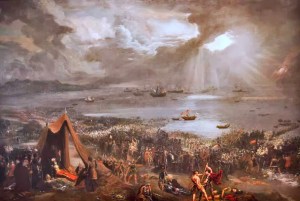
Although but a small segment of the battle is fought close to the seafront at Clontarf, the historic encounter of Good Friday 1014 enters the annals as the Battle of Clontarf. This is largely because some 2,000 Vikings had landed in longboats at Clontarf by sunrise on the morning of April 23.
As the two opposing armies face one another, the Vikings and the Leinster men are lined across the sloping plains bounded by the sea and the River Tolka, while King Brian’s army occupies the rising ground near Tomar’s Wood in Phibsborough.
The most ferocious part of the battle is fought at the “Battle of the Fishing Weir,” which approximates to the site of the former D.W.D. Whiskey Distillery on Richmond Road. Historic accounts of the battle also refer to the “savage encounters” fought on the “Bloody Fields of Marino” and what is today Phibsboro and Cross Guns.
The result of the bloodiest day in ancient Ireland is a rout for King Brian, although some 4,000 of his troops are killed on the battlefield. In contrast some 6,000 Leinster men and Vikings are slaughtered including every single Viking leader. King Brian’s army drives the fleeing Vikings back towards the sea at Clontarf.
Although Brian has won the greatest victory of his long career, he does not live long to enjoy it. As he kneels praying in his tent near Cross Guns, the Isle of Man Viking Leader, Brodir, who is hiding in the adjacent woods, runs into his tent and kills the 84-year-old Brian with his axe. Brodir is later captured and slaughtered by Ulf the Quarrelsome, the younger brother of King Brian.
The Battle of Clontarf is the watershed of all the hatred, division, and rivalries that have consumed Ireland for centuries. A period of relative peace follows where the Celtic chieftains and the Vikings live together in a spirit of harmony with the emphasis on greater integration, cooperation, and commerce.