seamus dubhghaill

Promoting Irish Culture and History from Little Rock, Arkansas, USA


Leave a comment

Death of Nathaniel Hone the Younger

Nathaniel Hone the Younger, Irish painter and great-grand-nephew of painter Nathaniel Hone the Elder, dies in Dublin on October 14, 1917.

Hone is born in Fitzwilliam Place, Dublin on October 26, 1831. He is the son of Brindley Hone, a merchant and director of the Midland Great Western Railway.

Though a member of a very artistic family, Hone’s initial training is as an engineer at Trinity College Dublin followed by a brief period of work for the Irish Railway before going to Paris in 1853 to study painting. He first studies under Adolphe Yvon, the French military painter, and later Thomas Couture, who is one of the earliest exponents of realism and from whom he learns principles which influence his work throughout his career.

Most of Hone’s later paintings are landscapes, very often enlivened with animals and occasionally with figures. In France he is influenced by the painter Gustav Courbet who is taking a new and quite revolutionary realistic approach. His closest painting tips are, however, from another French impressionist, Jean-Baptiste-Camille Corot. He becomes a close friend of one of Corot’s followers at the Barbizon school of landscape painting. At Barbizon he learns to appreciate colour, texture and tone in the landscape and applies it in strong and confident brushworks to the painting of Irish subjects on his return. In Paris he also works closely with artist Édouard Brandon, also a follower of Corot.

Hone’s paintings which are completed in France have many similarities to those that he completes at his country farm in County Dublin, but the finish is perhaps more polished and professional in the later Irish works.

From 1876, except for four years, Hone exhibits at the Royal Hibernian Academy (RHA). He is elected a full member in 1880 and in 1894 becomes Professor of Painting. His exhibition with John Butler Yeats in 1901 is one of the turning points for the history of Irish art as it is their paintings which convince Sir Hugh Lane that Dublin should have a gallery of modern art.

Nathaniel Hone dies in Dublin on October 14, 1917. After his death his widow bequeaths the contents of his studio to the National Gallery of Ireland. He rarely dates his work, so it is difficult to establish chronology. The similarity of many of his motifs and subjects often make it difficult to tell whether a view is Irish or French. Equally it is difficult to chart his developments on stylistic grounds alone.

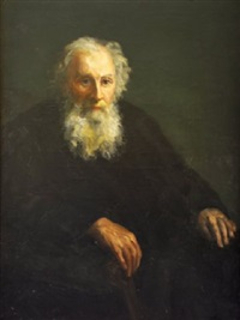
(Pictured: Nathaniel Hone, the younger, self-portrait as an old man)


4 Comments

Death of American-Born Painter Charles Brady

Charles Brady, American-born painter who spends most of his life in Ireland, dies in Dublin on August 1, 1997.

Brady is born on July 27, 1926, in New York City, the son of Arthur Brady, an industrial hardware merchant. He is best known for small-scale paintings of still life and landscape. At the end of World War II, while serving with the United States Navy, he suffers an accident which results in his discharge. As a result of this, he has the opportunity of pursuing further study. In 1948, he enrolls at the Art Students League of New York. Founded in 1875 and distinguished by its progressive approach to art education, it is one of the most important art schools in the United States in the early twentieth century.

Initially, Brady studies design and fashion before studying fine art under John Groth and Morris Kantor. In 1949, he becomes Groth’s assistant. In 1950, his work is included in the exhibition “American Painting 1950,” held at the Metropolitan Museum of Art, New York, where he is employed as a guard at the time. Around this time, he meets artists associated with abstract expressionism such as Franz Kline, Willem de Kooning, and Jackson Pollock, and exhibits with them in exhibitions such as the “9th Street Show” (1951). Four years later, his first solo exhibition is held at the Urban Gallery, New York. By this time, his father, mother, and a younger brother have all died. In 1956 he decides to leave New York and spend some time in Ireland.

On his arrival, Brady bases himself in Lismore, County Waterford, where the landscapes he begins to paint are in contrast to the abstract style he had developed in New York. In May 1956, he joins his aunt and uncle on a tour that include London and Paris. He remains in Ireland until early in 1958 and during this time becomes acquainted with such figures as Camille Souter, Frank Morris and Desmond McAvock. Though he spends the next year in the United States, he soon decides to return to Ireland. In 1959 he is living in Dublin, where, along with artists such as Noel Sheridan and Patrick Pye, he is involved in founding the Independent Artists group. His work is included in the group’s first exhibition in 1960.

Also in 1960, Brady marries Eelagh Noonan, and the couple go to live in Spain. On their return to Ireland in 1961, they settle in Dún Laoghaire, where he begins to produce still lifes of objects such as envelopes and boxes painted in muted tones. Though figurative, the painterly quality of these works and the way in which they assert the flat nature of the picture plane suggest something of his experience of postwar American abstract art. Soft, hazy light, another key characteristic of his work, can also be seen in his paintings of Sandymount Strand, which might be compared with the work of Nathaniel Hone the Younger, whose work Brady had seen on his first trip to Ireland. He also works in other media, producing lithographs and, from the mid-1980s, small bronzes of such mundane objects as discarded bus tickets.

From 1976 to 1983 Brady lectures in painting at the National College of Art and Design. In 1981 he becomes a member of Aosdána and in 1994 he is elected an honorary member of the Royal Hibernian Academy (RHA). He exhibits regularly in Ireland at venues such as the RHA. He receives a number of awards including the P. J. Carroll award at the Irish Exhibition of Living Art as well as the Douglas Hyde Gold Medal and the landscape award at the Oireachtas exhibitions of 1973 and 1989 respectively.

Brady dies of cancer at the age of 71 on August 1, 1997, in Dublin. He is buried in Shanganagh Cemetery, Shankill, County Dublin. His work can be found in collections such as those of the Arts Council of Ireland, Bank of Ireland, Ulster Museum, Allied Irish Bank, and Dublin City Gallery The Hugh Lane.

(From: “Brady, Charles” by Rebecca Minch, Dictionary of Irish Biography, http://www.dib.ie, October 2009 | Pictured: “Charles Brady, 1967,” oil on board by Koert Delmonte)


Leave a comment

Birth of Evie Hone, Painter & Stained Glass Artist

Eva Sydney Hone RHA, Irish painter and stained glass artist usually known as Evie, is born at Roebuck Grove, County Dublin, on April 22, 1894. She is considered to be an early pioneer of cubism, although her best known works are stained glass. Her most notable pieces are the East Window in the Chapel at Eton College, which depicts the Crucifixion, and My Four Green Fields, which is now in the Government Buildings in Dublin.

Hone is the youngest daughter of Joseph Hone, of the Hone family, and Eva Eleanor (née Robinson), daughter of Sir Henry Robinson and granddaughter of Arthur Annesley, 10th Viscount Valentia. Her mother dies two days after her birth. She is related to artists Nathaniel Hone and Nathaniel Hone the Younger.

Shortly before her twelfth birthday, Hone suffers from polio (infant paralysis), suffering a fall while helping to decorate the Taney parish church for Easter. Her resulting ill health leads to her seeking treatment in Harley Street, Marylebone, Central London. She is educated by a governess, continuing her education in Switzerland, and goes on tours to Spain and Italy before moving to London in 1913. Her three sisters all marry British Army officers, and all are widowed in World War I.

Hone studies at the Byam Shaw School of Art in London and then under Bernard Meninsky at the Central School of Arts and Crafts. She meets Mainie Jellett when both are studying under Walter Sickert at the Westminster Technical Institute. She works under André Lhote and Albert Gleizes in Paris before returning to become influential in the modern movement in Ireland and becoming one of the founders of the Irish Exhibition of Living Art. She is considered an early pioneer of Cubism but in the 1930s turns to stained glass, which she studies with Wilhelmina Geddes.

Hone is extremely devout. She spends time in an Anglican Convent in 1925 at Truro in Cornwall and converts to Catholicism in 1937. This possibly influences her decision to begin working in stained glass. Initially, she works as a member of the An Túr Gloine stained glass co-operative before setting up a studio of her own in Rathfarnham.

Hone’s most important works are probably the East Window, depicting the Crucifixion, for the Chapel at Eton College, Windsor (1949–1952) and My Four Green Fields, now located in Government Buildings, Dublin. This latter work, commissioned for the Irish Government’s Pavilion, wins first prize for stained glass in the 1939 New York World’s Fair. It graces CIÉ‘s Head Office in O’Connell Street from 1960 to about 1983. The East Window of Eton College is commissioned following the destruction of the building after a bomb is dropped in 1940 on the school during World War II. She is commissioned to design the East Window in 1949, and the new window is inserted in 1952. This work is featured on an Irish postage stamp in 1969. From December 2005 to June 2006, an exhibition of her work is on display at the National Gallery of Ireland. Saint Mary’s church in Clonsilla also features her stained glass windows.

Despite ill health, Hone continues to produce a huge number of small stained glass panels as well as oils, watercolours, and gouache landscapes. In 1953, she is represented at the Contemporary Irish Art exhibition at Aberystwyth, Wales, and at the Tate gallery in London, receiving as well an honorary LLD from Trinity College Dublin (TCD). In 1954, she is elected an honorary member of the Royal Hibernian Academy (RHA).

Unmarried, Hone dies on March 13, 1955, while entering her parish church at Rathfarnham. She is survived by two of her sisters. Over 20,000 people visit a memorial exhibition of her work at University College Dublin (UCD), Earlsfort Terrace, Dublin, in 1958.

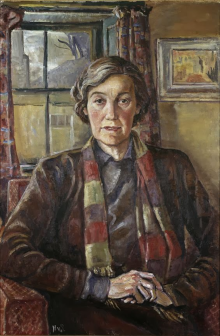
(Pictured: Portrait of Evie Hone by Hilda van Stockum)


Leave a comment

Death of Evie Hone, Painter & Stained Glass Artist

Eva Sydney Hone RHA, Irish painter and stained glass artist usually known as Evie, dies on March 13, 1955, in Rathfarnham, County Dublin. She is considered to be an early pioneer of cubism, although her best known works are stained glass. Her most notable pieces are the East Window in the Chapel at Eton College, which depicts the Crucifixion, and My Four Green Fields, which is now in the Government Buildings in Dublin.

Hone is born at Roebuck Grove, County Dublin, on April 22, 1894. She is the youngest daughter of Joseph Hone, of the Hone family, and Eva Eleanor, née Robinson, daughter of Sir Henry Robinson and granddaughter of Arthur Annesley, 10th Viscount Valentia. She is related to Nathaniel Hone and Nathaniel Hone the Younger. Shortly before her twelfth birthday she suffers from polio. She is educated by a governess, continuing her education in Switzerland, and goes on tours to Spain and Italy before moving to London in 1913. Her three sisters all marry British Army officers, and all are widowed in World War I.

Hone studies at the Byam Shaw School of Art in London and then under Bernard Meninsky at the Central School of Arts and Crafts. She meets Mainie Jellett when both are studying under Walter Sickert at the Westminster Technical Institute. She works under André Lhote and Albert Gleizes in Paris before returning to become influential in the modern movement in Ireland and become one of the founders of the Irish Exhibition of Living Art. She is considered an early pioneer of Cubism but in the 1930s turns to stained glass, which she studies with Wilhelmina Geddes.

Hone’s most important works are probably the East Window, depicting the Crucifixion, for the Chapel at Eton College, Windsor (1949–1952) and My Four Green Fields, now located in Government Buildings, Dublin. This latter work, commissioned for the Irish Government’s Pavilion, wins first prize for stained glass in the 1939 New York World’s Fair. It graces CIÉ‘s Head Office in O’Connell Street from 1960 to about 1983. The window is then taken into storage by Abbey Glass in Kilmainham, Dublin at the request of the Office of Public Works.

The East Window of Eton College is commissioned following the destruction of the building after a bomb is dropped on the school in 1940 during World War II. She is commissioned to design the East Window in 1949, and the new window is inserted in 1952. This work is featured on an Irish postage stamp in 1969. From December 2005 to June 2006, an exhibition of her work is on display at the National Gallery of Ireland. Saint Mary’s church in Clonsilla also features her stained glass windows.

Hone is extremely devout. She spends time in an Anglican Convent in 1925 at Truro in Cornwall and converts to Catholicism in 1937. This may have influenced her decision to begin working in stained glass. Initially she works as a member of the An Túr Gloine stained glass co-operative before setting up a studio of her own in Rathfarnham.

Hone is elected an honorary member of the Royal Hibernian Academy (RHA) in 1954.

Unmarried, Hone dies on March 13, 1955, while entering her parish church at Rathfarnham. She is survived by two of her sisters. Over 20,000 people visit a memorial exhibition of her work at University College Dublin (UCD), Earlsfort Terrace, Dublin, in 1958.

(Pictured: “My Four Green Fields” by Evie Hone, which depicts the four provinces of Ireland)


Leave a comment

Death of Nathaniel Hone The Elder

nathaniel-hone-the-elder

Nathaniel Hone the Elder, Irish-born portrait and miniature painter, and one of the founder members of the Royal Academy of Arts in 1768, dies in London on August 14, 1784.

Hone is born in Dublin on April 24, 1718, the son of a Dublin-based Dutch merchant. He moves to England as a young man and, after marrying Molly Earle, daughter of the John Campbell, 4th Duke of Argyll, in 1742, eventually settles in London, by which time he has acquired a reputation as a portrait painter. While his paintings are popular, his reputation is particularly enhanced by his skill at producing miniatures and enamels. He interrupts his time in London by spending two years (1750–52) studying in Italy.

As a portrait painter, several of Hone’s works are now held at the National Portrait Gallery in London. His sitters include magistrate Sir John Fielding and Methodist preacher John Wesley, and General Richard Wilford and Sir Levett Hanson in a double portrait. He often uses his son John Camillus Hone (1745-1836) in some of his works, including his unique portrait of “The Spartan Boy,” painted in 1774.

Hone courts controversy in 1775 when his satirical picture The Conjurer (National Gallery of Ireland, Dublin) is seen to attack the fashion for Italian Renaissance art and to ridicule Sir Joshua Reynolds, leading the Royal Academy to reject the painting. It also originally includes a nude caricature of fellow Academician Angelica Kauffman in the top left corner, which is painted out by Hone after Kauffman complains to the academy. The combination of a little girl and an old man has also been seen as symbolic of Kauffman and Reynolds’s closeness, age difference, and rumoured affair. To show that his reputation is undamaged, Hone organises a one-man retrospective in London, the first such solo exhibition of an artist’s work.

The Hone family is related to the old Dutch landed family the van Vianens, who hold the hereditary title of Vrijheer. His great-grand-nephew shares the same name and is also a notable Irish painter, known as Nathaniel Hone the Younger (1831–1917). He is also a relation to painter Evie Hone.

Nathaniel Hone the Elder dies in London at the age of 66 on August 14, 1784.

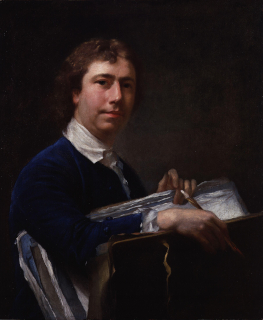
(Pictured: Oil on canvas self-portrait by Nathaniel Hone, circa 1760)


Leave a comment

Birth of Nathaniel Hone the Elder

nathaniel-hone-the-elder

Nathaniel Hone the Elder, Irish-born portrait and miniature painter, and one of the founder members of the Royal Academy of Arts in 1768, is born in Dublin on April 24, 1718.

The son of a Dublin-based Dutch merchant, Hone moves to England as a young man and, after marrying Molly Earle, daughter of the John Campbell, 4th Duke of Argyll, in 1742, eventually settles in London, by which time he has acquired a reputation as a portrait-painter. While his paintings are popular, his reputation is particularly enhanced by his skill at producing miniatures and enamels. He interrupts his time in London by spending two years (1750–52) studying in Italy.

As a portrait painter, several of Hone’s works are now held at the National Portrait Gallery in London. His sitters include magistrate Sir John Fielding and Methodist preacher John Wesley, and General Richard Wilford and Sir Levett Hanson in a double portrait. He often uses his son John Camillus Hone (1745-1836) in some of his works, including his unique portrait of “The Spartan Boy,” painted in 1774.

Hone courts controversy in 1775 when his satirical picture The Conjurer (National Gallery of Ireland, Dublin) is seen to attack the fashion for Italian Renaissance art and to ridicule Sir Joshua Reynolds, leading the Royal Academy to reject the painting. It also originally includes a nude caricature of fellow Academician Angelica Kauffman in the top left corner, which is painted out by Hone after Kauffman complains to the academy. The combination of a little girl and an old man has also been seen as symbolic of Kauffman and Reynolds’s closeness, age difference, and rumoured affair. To show that his reputation is undamaged, Hone organises a one-man retrospective in London, the first such solo exhibition of an artist’s work.

The Hone family is related to the old Dutch landed family the van Vianens, who hold the hereditary title of Vrijheer. His great-grand-nephew shares the same name and is also a notable Irish painter, known as Nathaniel Hone the Younger (1831–1917). He is also a relation to painter Evie Hone.

Nathaniel Hone the Elder dies on August 14, 1784.

(Pictured: Self-portrait by Nathaniel Hone, circa 1760)


Leave a comment

Birth of Painter Nathaniel Hone the Younger

nathaniel-hone-the-younger

Nathaniel Hone the Younger, Irish painter and great-grand-nephew of painter Nathaniel Hone the Elder, is born in Fitzwilliam Place, Dublin on October 26, 1831. He is the son of Brindley Hone, a merchant and director of the Midland Great Western Railway.

Though a member of a very artistic family, Hone’s initial training is as an engineer at Trinity College Dublin followed by a brief period of work for the Irish Railway before going to Paris in 1853 to study painting. He first studies under Adolphe Yvon, the French military painter, and later Thomas Couture, who is one of the earliest exponents of realism and from whom he learns principles which influence his work throughout his career.

Most of Hone’s later paintings are landscapes, very often enlivened with animals and occasionally with figures. In France he is influenced by the painter Gustav Courbet who is taking a new and quite revolutionary realistic approach. His closest painting tips are, however, from another French impressionist, Jean-Baptiste-Camille Corot. He becomes a close friend of one of Corot’s followers at the Barbizon school of landscape painting. At Barbizon he learns to appreciate colour, texture and tone in the landscape and applies it in strong and confident brushworks to the painting of Irish subjects on his return. In Paris he also works closely with artist Édouard Brandon, also a follower of Corot.

Hone’s paintings which are completed in France have many similarities to those that he completes at his country farm in County Dublin, but the finish is perhaps more polished and professional in the later Irish works.

From 1876, except for four years, Hone exhibits at the Royal Hibernian Academy (RHA). He is elected a full member in 1880 and in 1894 becomes Professor of Painting. His exhibition with John Butler Yeats in 1901 is one of the turning points for the history of Irish art as it is their paintings which convince Sir Hugh Lane that Dublin should have a gallery of modern art.

Nathaniel Hone dies in Dublin on October 14, 1917. After his death his widow bequeaths the contents of his studio to the National Gallery of Ireland. He rarely dates his work, so it is difficult to establish chronology. The similarity of many of his motifs and subjects often make it difficult to tell whether a view is Irish or French. Equally it is difficult to chart his developments on stylistic grounds alone.

(Pictured: Nathaniel Hone, the younger, self-portrait as an old man)