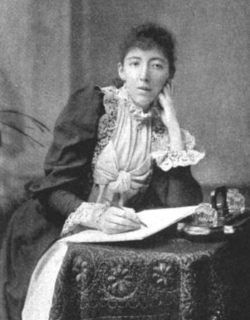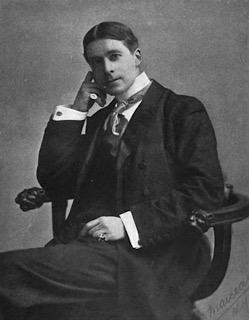
Justin Huntly McCarthy, writer and nationalist politician, is born in Liverpool, England, on September 30, 1856, son of the writer and politician Justin McCarthy and his wife, Charlotte, daughter of William George Allman of Bandon, County Cork.
McCarthy spends his childhood in Liverpool, London, and New York City, where his father works on the New York Independent from 1868 to 1871. He is educated at University College School and University College London. On graduating he travels extensively in Europe and the Middle East, adding oriental literature to the list of his interests, which included Greek and Irish mythology, Irish history, and contemporary politics.
McCarthy’s early career was meteoric: his first book, An outline of Irish history from the earliest times, appears in 1883 and is a fast-moving, strongly worded, nationalist sketch of Irish history. This is followed by a heavy-handed dramatic poem, Serapion (1883), about the early Christian era. In June of the following year he is returned as the Home Rule League MP for Athlone on the death of the sitting member, and also publishes, to excellent reviews, England under Gladstone, which runs to a second edition within a year. In November 1884, his first play, The Candidate, is an overnight success in the Criterion Theatre in London. Its plot is thin but the humour and political badinage ensures it a long run.
At the 1885 United Kingdom general election McCarthy is elected nationalist MP for Newry, and he holds this seat until 1892. In the two years after his election he writes a number of novels, translates works from Persian, and writes Ireland Since the Union (1887), which is well researched, nationalist and impassioned in tone, showing a flair for biographical sketches. During this period he is known for his good attendance in the House of Commons though he does not speak much – throughout his life he is more an observer than a participator – and he is said by William O’Brien to conceal “under the gentlest of exteriors the fire of the ‘Spirit of the Nation’ ballad” (New Ireland Review, 523). In London he is well known for his controversial drama reviews in The Gentleman’s Magazine and the Sunday Sun, and in Dublin for his numerous verse and prose contributions to United Ireland. Although he makes a name for himself as a brilliant young man, he never fulfills his early promise.
In later years McCarthy continues to publish prolifically but produces only ephemeral works, and his parliamentary attendance slackens off. His political commitment is soured possibly by the party’s split in 1890. He originally sides with Charles Stewart Parnell, emphasizing in a speech on December 1, 1890, that he believes in the old-fashioned theory of personal loyalty to a leader. However, five days later he causes a minor drama by rising at the last minute to follow his father and the forty-three other anti-Parnellites, claiming that he feels he must abide by the decision of the majority. Two years later he leaves politics for good without standing in the 1892 United Kingdom general election. A sympathetic profile of him in the New Ireland Review in 1894 remarks that “no man of equal talents made so slight an impression on the political world.”
Thereafter McCarthy has less involvement in Irish affairs and writes no more Irish history books, though his novels continue to have Irish themes. He lives in London in Putney Common, and continues to travel widely. In 1894, he marries in some haste a popular comic actress, Cecilia Loftus, and the event is widely reported in the English press. However, the marriage is dissolved in the United States five years later. In 1908, his second marriage is to Loullie, daughter of Henry Killick of Budapest. He continues to enjoy success as a dramatist and has five plays, four sketches, and three duologues performed in London in the 1890s. However, he concentrates increasingly on historical fiction, which he produces at breakneck speed. In the first decade of the twentieth century he writes over twelve novels based on periods in English, Italian, French, and Irish history. The Illustrious O’Hagan (1906), The O’Flynn (1910), and The King Over the Water (1911) pointedly contradict English stereotypes of the “stage Irishman.” The Fair Irish Maid (1911) is an allegory of the Irish Parliamentary Party‘s political marriage to the ordinary Irish people rather than to the Anglo-Irish ascendancy.
McCarthy dies at home in Putney on March 20, 1936 aged 79, although his obituaries all put his age at 75.
(From: “McCarthy, Justin Huntly” by Bridget Hourican, Dictionary of Irish Biography, http://www.dib.ie, October 2009)