seamus dubhghaill

Promoting Irish Culture and History from Little Rock, Arkansas, USA


1 Comment

Birth of Patrick Ford, Irish American Journalist & Land Reformer

Patrick Ford, Irish American journalist, Georgist land reformer and fund-raiser for Irish causes, is born in Galway, County Galway, on April 12, 1837.

Ford is the son of Edward Ford (1805-1880) and Anne Ford (1815-1893). He emigrates with his parents to Boston, Massachusetts, in 1845, never returning to Ireland. Although he devotes his life to Irish causes, he writes in The Irish World in 1886 that “I might as well have been born in Boston. I know nothing of England. I brought nothing with me from Ireland—nothing tangible to make me what I am. I had consciously at least, only what I found and grew up with in here.”

Ford is educated in Boston’s public schools and the Latin school of the parish of St. Mary in the North End. He leaves school at the age of thirteen and two years later is working as a printer’s devil for William Lloyd Garrison‘s abolitionist newspaper The Liberator. He begins writing for Boston newspapers in 1855 and by 1861 is editor and publisher of the Boston Tribune, also known as the Boston Sunday Tribune or Boston Sunday Times. He is an abolitionist and pro-union.

During the American Civil War, Ford serves in the Union Army with his father and brother. He serves in the 9th Massachusetts Infantry Regiment and sees action in the Northern Virginia campaign, including the Battle of Fredericksburg on December 13, 1862.

After the Civil War, Ford spends four years in Charleston, South Carolina, editing the South Carolina Leader which promotes the welfare of newly freed slaves. He later edits the Irish American Charleston Gazette. He settles in New York City in 1870 and founds the populist The Irish World, which promotes Irish and Catholic interests and becomes the principal newspaper of Irish America. It promises “more reading material than any other paper in America” and outsells John Boyle O’Reilly‘s Boston Pilot. In 1878, he re-titles his newspaper The Irish World and American Industrial Liberator. During the early 1880s, he promotes the writings of land reformer Henry George in his paper.

The American economic depression of 1873 convinces Ford that the Irish rural poor and the American urban poor share the same plight. He believes that the Homestead Act of 1862 is exploited by big business, especially the railroads, and by speculators who leave the poor without access to the western land meant for settlement. He calls for land reform with the belief that land monopoly is the cause of poverty and that a single tax based on land valuation is the solution. In the mid–1870s he leaves the Democratic Party. Critical of Tammany corruption and attracted to the fiscal policies of the Greenback Party, he is a member of the party’s New York State central committee as early as 1876 and backs the Greenback presidential candidates Peter Cooper and James B. Weaver in 1876 and 1880. Even the Greenbacks fail to offer the land reforms envisaged by Ford, so he forms the short-lived National Cooperative Democracy Party in 1879.

In 1880, Ford begins to solicit donations through The Irish World to support Land League activities in Ireland. Funds received are tabulated weekly under the heading “Land League Fund.” Between January and September 1881 alone, more than $100,000 is collected in donations. British Prime Minister William Ewart Gladstone later states that without the funds from The Irish World, “there would have been no agitation in Ireland.”

In the 1884 and 1888 elections, Ford turns to the Republican Party, encouraging Irish American voters to abandon their traditional loyalty to the Democrats for the Republican candidate James G. Blaine, whom he promotes in The Irish World as supportive of labour and of Ireland. The Republican patronage of the financially troubled The Irish World is a factor in the endorsement, but he believes Blaine’s promise to introduce high trade tariffs will protect American labour interests.

After the Irish Parliamentary Party split in 1891, Ford supports the Parnellite faction of John Redmond and endorses the terms of the Third Home Rule Bill of 1912.

Ford dies on September 23, 1913, at his home at 350 Clermont Street, Brooklyn. After an impressive funeral, he is buried in Brooklyn’s Holy Cross Cemetery.

In 1863, Ford marries Odele McDonald, who predeceases him. They have eleven children, three daughters and eight sons. At the time of his death, his son Patrick is managing editor of The Irish World, and his brother Augustine is business manager and publisher. He appears to have destroyed his personal papers. The files of The Irish World are the best record of his life and work.

Leave a comment

The Battle of Chantilly

The predominately Irish 6th Louisiana Infantry Regiment fights at the Battle of Chantilly (or Ox Hill, the Confederate name), which takes place on September 1, 1862, in Fairfax County, Virginia, as the concluding battle of the northern Virginia campaign of the American Civil War. Thomas J. “Stonewall” Jackson‘s corps of the Army of Northern Virginia attempts to cut off the line of retreat of the Union Army of Virginia following the Second Battle of Bull Run but is attacked by two Union divisions. During the ensuing battle, Union division commanders Isaac Stevens and Philip Kearny are both killed, but the Union attack halts Jackson’s advance.

On the morning of September 1, 1862, Union Maj. Gen. John Pope orders Maj. Gen. Edwin Vose Sumner of the II Corps, Army of the Potomac, to send a brigade north to reconnoiter. The army’s cavalry is too exhausted for the mission. But at the same time, he continues his movement in the direction of Washington, D.C., sending Maj. Gen. Irvin McDowell‘s III Corps to Germantown (on the western border of modern-day Fairfax, Virginia), where it can protect the important intersection of Warrenton Pike and Little River Turnpike that the army needs for the retreat. He also sends two brigades from Maj. Gen. Jesse L. Reno‘s IX Corps, under the command of Brig. Gen. Isaac Stevens, to block Jackson. Maj. Gen. Philip Kearny’s division from the III Corps follows later that afternoon.

Jackson resumes his march to the south, but his troops are tired and hungry and make poor progress as the rain continues. They march only three miles and occupy Ox Hill, southeast of Chantilly Plantation, and halt, while Jackson himself takes a nap. All during the morning, Confederate cavalry skirmish with Union infantry and cavalry. At about 3:00 PM, Stevens’s division arrives at Ox Hill. Despite being outnumbered, Stevens chooses to attack across a grassy field against Brig. Gen. Alexander Lawton‘s division in the Confederate center. The Union attack is initially successful, routing the brigade of Colonel Henry Strong and driving in the flank of Captain William Brown, with Brown killed during the fighting. The Union division is driven back following a counterattack by Brig. Gen. Jubal Early‘s brigade. Stevens is killed during this attack at about 5:00 PM by a shot through his temple.

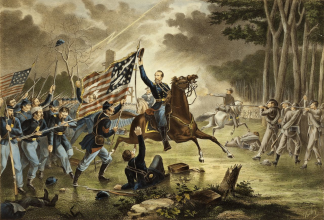
A severe thunderstorm erupts about this time, resulting in limited visibility and an increased dependence on the bayonet, as the rain soaks the ammunition of the infantry and makes it useless. Kearny arrives about this time with his division to find Stevens’s units disorganized. Perceiving a gap in the line he deploys Brig. Gen. David B. Birney‘s brigade on Stevens’s left, ordering it to attack across the field. Birney manages to maneuver close to the Confederate line but his attack stalls in hand-to-hand combat with Maj. Gen. A.P. Hill‘s division. Kearny mistakenly rides into the Confederate lines during the battle and is killed. As Kearny’s other two brigades arrive on the field, Birney uses the reinforcements as a rear guard as he withdraws the remainder of the Union force to the southern side of the farm fields, ending the battle.

That night, Maj. Gen. James Longstreet arrives to relieve Jackson’s troops and to renew the battle the following morning. The lines are so close that some soldiers accidentally stumble into the camps of the opposing army. The Union army withdraws to Germantown and Fairfax Court House that night, followed over the next few days by retreating to the defenses of Washington D.C. The Confederate cavalry attempts a pursuit but fails to cause significant damage to the Union army.

The fighting is tactically inconclusive. Although Jackson’s turning movement is foiled and he is unable to block the Union retreat or destroy Pope’s army, National Park Service historians count Chantilly as a strategic Confederate victory because it neutralizes any threat from Pope’s army and clears the way for Lee to begin his Maryland campaign. The Confederates claim a tactical victory as well because they hold the field after the battle. Two Union generals are killed, while one Confederate brigade commander is killed. Pope, recognizing the attack as an indication of continued danger to his army, continues his retreat to the fortifications around Washington, D.C. Lee begins the Maryland Campaign, which culminates in the Battle of Antietam, after Pope retreats from Virginia. The Army of the Potomac, under Maj. Gen. George B. McClellan, absorbs the forces of Pope’s Army of Virginia, which is disbanded as a separate army.

The site of the battle, once rural farmland, is now surrounded by suburban development in Fairfax County. A 4.8-acre (19,000 m²) memorial park, the Ox Hill Battlefield Park, is located off of State Route 608 (West Ox Road) and lies adjacent to the Fairfax Towne Center shopping area and includes most of the Gen. Isaac Stevens portion of the battle, about 1.5% of the total ground. The park is under the jurisdiction of the Fairfax County Park Authority. In January 2005, the Authority approves a General Management Plan and Conceptual Development Plan that sets forth a detailed history and future management framework for the site.

A small yard located within the nearby Fairfax Towne Center has been preserved to mark the area crossed by Confederate troops to get to the Ox Hill battlefield.

(Pictured: Color lithograph “General Kearney’s gallant charge,” published by John Smith, 804 Market St., Philadelphia. From the Library of Congress.)