Robbins advances to the finals in the 400 metres race at the 1908 Summer Olympics in London, winning his preliminary heat with a time of 50.4 seconds and his semifinal in 49.0 seconds. In the first running of the final race, he finishes in front. However, teammate John Carpenter is disqualified after being accused of obstructing British runner Wyndham Halswelle, and the race is ordered to be repeated without Carpenter. Robbins and fellow American John Taylor refuse to compete in the second final in protest of Carpenter’s disqualification. Halswelle runs the race alone and is presented with the Gold medal. This race is the only case of a walkover in Olympic history.
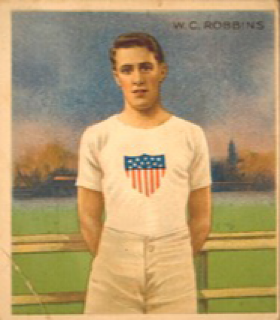
According to Robbins’ 1910 trading card, he is “one of the best quarter-milers in the United States. He was… (a) Cornell University student, and first came to prominence by the part he played in the 400-meter race held at London in 1908. ‘Yank,’ as he (was) called by his team mates, ran the first 300 yards at such a clip that it ‘pulled the great Halswell’s cork,’ the later finishing in third place. Robbins won the Metropolitan Amateur Athletic Union quarter-mile championship in September 1909, and two weeks later captured the Canadian quarter-mile title, running the distance in the great time of 48 4/5 seconds.”
At the Amateur Athletic Union metropolitan championships held at Travers Island in 1909, Robbins is part of the Irish American Athletic Club’s four-man relay team that breaks the world’s record for the one mile relay, with a time of 3 minutes 20 2/5 seconds. The other three men on the record-breaking team were C.S. Cassara, James Rosenberger, and Melvin Sheppard.
Robbins dies on July 30, 1962.
(Pictured: William C. Robbins, wearing the 1908 U.S. Olympic team shirt, from the 1910 Mecca Cigarettes Champion Athlete & Prize Fighter Series trading card)
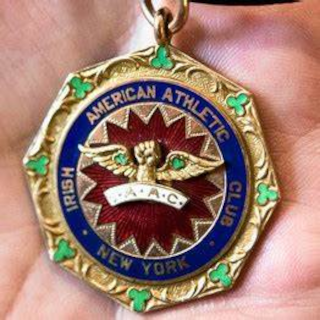
The Irish American Athletic Club, an amateur athletic organization based in Queens, New York, is established on January 30, 1898, originally as the Greater New York Irish Athletic Association. They shorten the name to the Irish American Athletic Club a few years later. They purchase a plot of land in what is then called Laurel Hill, Long Island, near Calvary Cemetery, Queens, and build a state-of-the-art athletic facility on what is farmland. The stadium, called Celtic Park, formally reopens after renovations on May 9, 1901, and until the facility is sold for housing in 1930, some of the greatest American athletes train or compete on Celtic Park’s track and field. The Irish American Athletic Club adopts a winged fist adorned with American flags and shamrocks as their emblem, with the Irish Gaelic motto “Láim Láidir Abú” or “A strong hand will be victorious,” and are often referred to as the “Winged Fists.” At one time they have clubs in Boston, Chicago, San Francisco and Yonkers, New York.
The Irish American Athletic Club is predominantly composed of Irish-born and first generation Irish American athletes, but many of the athletes who compete for the Winged Fist organization are neither.
The Irish American Athletic Club wins the Amateur Athletic Union national outdoor track and field team championship titles in 1904, 1906, 1907, 1908, 1910, 1911, 1912, 1913, 1914 and 1916. They also win the national indoor track and field team championship titles in 1906, 1908, 1909, 1911, 1913, 1914 and 1915. Individual athletes of the IAAC win 81 national outdoor championships titles and 36 individual national indoor championship titles.
In 1912–13, 1913–14, 1914–15 and 1916–17 the Irish American Athletic Club has a team, the New York Irish-Americans, represented in the American Amateur Hockey League. The team is coached by James C. “Jimmy” O’Brien and has on its roster for various seasons future NHL players Tom McCarthy and Moylan McDonnell. John McGrath and Patsy Séguin also play for the club.
Before the largest crowd that has ever assembled to see a track meet in the United States, on September 9, 1916, the Irish American Athletic Club defeats the New York Athletic Club at the Amateur Athletic Union’s National Championships, by a score of 38 to 27. Before a crowd of 30,000 spectators at Newark, New Jersey‘s Weequahic Park, the Irish American Athletic Club wins what is to be their last national championship title. The club disbands a year later when the United States becomes a combatant in World War I.
Peters is born on July 6, 1939, in Halewood, Lancashire, England, later living at 5 Mere Avenue in Alkrington, where she goes to primary school. She moves to Ballymena (and later Belfast) at the age of eleven when her father’s job is relocated to Northern Ireland. As a teenager, her father encourages her athletic career by building her home practice facilities as birthday gifts. She qualifies as a teacher and works while training.
After Ballymena, the family moves to Portadown where she attends Portadown College. The headmaster, Donald Woodman, and the PE teacher, Kenneth McClelland, introduce her to athletics, McClelland being her first coach. She is head girl of the school in 1956.
At the 1972 Summer Olympics in Munich, competing for Great Britain and Northern Ireland, Peters wins the gold medal in the women’s pentathlon. She had finished 4th in 1964 and 9th in 1968. To win the gold medal, she narrowly beats the local favourite, West Germany’s Heide Rosendahl, by 10 points, setting a world record score. After her victory, death threats are phoned into the BBC: “Mary Peters is a Protestant and has won a medal for Britain. An attempt will be made on her life, and it will be blamed on the IRA … Her home will be going up in the near future.” But Peters insists she will return home to Belfast. She is greeted by fans and a band at the airport and paraded through the city streets but is not allowed back in her flat for three months. Turning down jobs in the United States and Australia, where her father lives, she insists on remaining in Northern Ireland.
In 1972, Peters wins the BBC Sports Personality of the Year award: “Peters, a 33-year-old secretary from Belfast, won Britain’s only athletics gold at the Munich Olympics. The pentathlon competition was decided on the final event, the 200m, and Peters claimed the title by one-tenth of a second.”
She represents Northern Ireland at every Commonwealth Games between 1958 and 1974. In these games she wins two gold medals for the pentathlon, plus a gold and silver medal for the shot put.
In May 2001, following her athletic career, Peters becomes a Trustee of The Outward Bound Trust and is Vice-President of the Northern Ireland Outward Bound Association. She is also Patron of Springhill Hospice in Rochdale, Greater Manchester.
Peters is appointed a Member of the Order of the British Empire (MBE) for services to athletics in the 1973 New Year Honours. For services to sport, she is promoted in the same Order to Commander (CBE) in the 1990 Birthday Honours and again to Dame Commander (DBE) in the 2000 Birthday Honours. In the 2015 New Year Honours, she is awarded as Member of the Order of the Companions of Honour (CH), also for services to sport and the community in Northern Ireland, and in 2017, she is made a Dame of the Order of Saint John (DStJ). She is appointed a Lady Companion of the Order of the Garter (LG) on February 27, 2019, and therefore granted the title Lady. She represents the Order at the 2023 coronation.
Northern Ireland’s premier athletics track, on the outskirts of Belfast, is named after Peters. A statue of her stands within it.
In April 2009, Peters is named the Lord Lieutenant of the City of Belfast; she retires from the post in 2014, being succeeded by Fionnuala Jay-O’Boyle. She is a Freeman of the Cities of Lisburn and Belfast.
Boland is born on September 16, 1870, at 135 Capel Street, Dublin, to Patrick Boland, businessman, and Mary Donnelly. Following the death of his mother in 1882, he is placed with his six siblings under the guardianship of his uncle, Nicholas Donnelly, auxiliary bishop of Dublin.
Boland is educated at two private Catholic schools, the Catholic University School, Dublin, and Birmingham Oratory in Birmingham, England, where he becomes head boy. His secondary education at the two schools help give him the foundation and understanding to play an influential role in the politics of Great Britain and Ireland at the beginning of the 20th century, when he is a member of the Irish Parliamentary Party, which pursues constitutional Home Rule.
In 1892, Boland graduates with a BA from London University. He studies for a semester in Bonn, Germany, where he is a member of Bavaria Bonn, a student fraternity that is member of the Cartellverband. He studies law at Christ Church, Oxford, graduating with a BA in 1896 and MA in 1901. Although called to the Bar in 1897, he never practises.
Boland is the first Olympic champion in tennis for Great Britain and Ireland at the first modern Olympics, which take place in Athens in 1896. He visits his friend Thrasyvoulos Manos in Athens during the Olympics, and Manos, a member of the organising committee, enters Boland in the tennis tournament. He promptly wins the singles tournament, defeating Friedrich Traun of Germany in the first round, Evangelos Rallis of Greece in the second, Konstantinos Paspatis of Greece in the semifinals, and Dionysios Kasdaglis of Greece in the final.
Boland then enters the doubles event with Traun, the German runner whom he had defeated in the first round of the singles. Together, they win the doubles event. They defeat Aristidis and Konstantinos Akratopoulos of Greece in the first round, have a bye in the semifinals, and defeat Demetrios Petrokokkinos of Greece and Dimitrios Kasdaglis in the final. When the Union Jack and the German flag are run up the flagpole to honour Boland and Traun’s victory, Boland points out to the man hoisting the flags that he is Irish, adding “It [the Irish flag]’s a gold harp on a green ground, we hope.” The officials agreed to have an Irish flag prepared.
Following a visit to County Kerry, Boland becomes concerned about the lack of literacy among the native population. He also has a keen interest in the Irish Language.
Boland’s patriotic stand is well received in nationalist circles in Ireland. This and a lifelong friendship with John Redmond gain for him an invitation to stand as a candidate for the Irish Parliamentary Party in the safe seat of South Kerry, which he holds from 1900 to 1918. He is unopposed in the general elections of 1900 and 1906, and the first of 1910. In the second election of 1910 he is challenged by a local man, T. B. Cronin, who stands as an independent nationalist in the interest of William O’Brien. Boland stands down at the 1918 United Kingdom general election.
In 1908, Boland is appointed a member of the commission for the foundation of the National University of Ireland (NUI). From 1926 to 1947, he is General Secretary of the Catholic Truth Society. He receives a papal knighthood, becoming a Knight of St. Gregory in recognition for his work in education. In 1950, he is awarded an honorary Doctor of Law by the NUI.
Boland marries Eileen Moloney at SS Peter and Edward, Palace Street, Westminster, on October 22, 1902, the daughter of an Australian Dr. Patrick Moloney. They have one son and five daughters. His daughter Honor Crowley succeeds her husband Frederick Crowley upon his death sitting as Fianna FáilTD for South Kerry from 1945 until her death in 1966. His daughter Bridget Boland is a playwright who notably writes The Prisoner and co-writes the script for Gaslight, and, among other books, co-authors Old Wives’ Lore for Gardeners with her sister, Maureen Boland.



 seamus dubhghaill