seamus dubhghaill

Promoting Irish Culture and History from Little Rock, Arkansas, USA


Leave a comment

Demolition of HM Prison Maze Begins

maze-prison

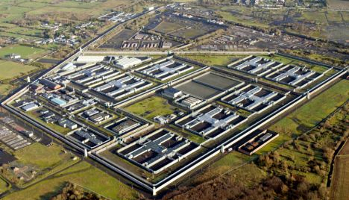
Bulldozers begin demolishing Northern Ireland‘s notorious HM Prison Maze, previously known as Long Kesh Detention Centre, on October 31, 2006. The prison once housed the most dangerous guerrillas from both sides of the province’s sectarian conflict.

Among the inmates at Maze are ten Irish nationalist hunger strikers who starved themselves to death in 1981. The prison has been empty since 2000, after the release of most guerrilla prisoners under the Good Friday Agreement, which ushered in relative peace after 30 years of fighting in which 3,600 people died.

A sports stadium, equestrian center, hotel, and shopping center are originally proposed for the 360-acre site in County Antrim. In January 2009, however, Sports Minister Gregory Campbell rules out the plan for a multi-sports stadium which has divided political and sporting opinion, opting instead to explore alternatives with the soccer, rugby, and Gaelic Athletic Association (GAA) authorities.

Northern Ireland first and deputy first ministers, Peter Robinson and Martin McGuinness, announce in 2010 that an agreement has been reached on building a peace and conflict resolution facility at the Maze site. It will also host the Royal Ulster Agricultural Society’s annual show. On February 2, 2012, European funding of £18m is approved for building the contentious conflict resolution centre.

Planning permission for the peace centre on the site of the former prison is granted on April 18, 2013. However, in June the Orange Order calls on unionist politicians to halt the peace centre plan, objecting to its location on the former prison site.

On August 15, 2013, Peter Robinson calls a halt to the peace centre plan. In a letter to Democratic Unionist Party (DUP) members, he says it would be wrong to proceed without a consensus about how it will operate. As a result, in October 2013 the European Union funding programme withdraws its £18m offer in financial support for the Maze peace centre.

That the Maze Prison development remains unrealised 16 years after the site’s closure testifies to the complexities involved. That the prospect of redevelopment has never been taken off the table affirms the ineluctable power ideas of profit still hold.


Leave a comment

The Battle of the Diamond

daniel-winter-homestead

The Battle of the Diamond, a planned confrontation between the Catholic Defenders and the Protestant Peep o’ Day Boys, takes place on September 21, 1795, near Loughgall, County Armagh. The Diamond, which is a predominantly Protestant area, is a minor crossroads in County Armagh, lying almost halfway between Loughgall and Portadown.

In the 1780s, County Armagh is the most populous county in Ireland, and the center of its linen industry. Its population is equally split between Protestants, who dominate in the northern part of the county, and Catholics, who dominate in the south. Sectarian tensions increase throughout the decade and are exacerbated by the relaxing of some of the Penal Laws, failure to enforce others, and the entry of Catholics into the linen industry at a time when land is scarce, and wages are decreasing due to pressure from the mechanised cotton industry.

By 1784, sectarian fighting breaks out between gangs of Protestants and Catholics. The Protestants re-organise themselves as the Peep o’ Day Boys, with the Catholics forming the Defenders. The next decade sees an escalation in the violence between the two and the local population as homes are raided and wrecked.

On the morning of September 21, the Defenders, numbering around 300, make their way downhill from their base, occupying Daniel Winter’s homestead, which lay to the northwest of The Diamond and directly in their line of advance. News of the advance reaches the Peep o’ Day Boys who quickly form at the brow of the hill where they have made their camp. From this position, they gain three crucial advantages: the ability to comfortably rest their muskets allowing for more accurate shooting, a steep uphill location which makes it hard for attackers to scale, and a direct line-of-sight to Winter’s cottage, which the Defenders have made their rallying point.

The shooting begins and, after Captain Joseph Atkinson gives his weapon and powder to the Peep o’ Day Boys, he rides to Charlemont Garrison for troops to quell the trouble. There is no effective unit stationed in the garrison at the time, despite the fact a detachment of the North-Mayo Militia is stationed in Dungannon and a detachment of the Queen’s County Militia is at Portadown.

The battle is short, and the Defenders suffer “not less than thirty” fatalities. James Verner, whose account of the battle is based on hearsay, gives the total as being nearly thirty, while other reports give the figure as being forty-eight, however this may be taking into account those that die afterwards from their wounds. A large number of Defenders are also claimed to have been wounded. One of those claimed to have been killed is “McGarry of Whiterock,” the leader of the Defenders. The Peep o’ Day Boys on the other hand, in the safety of the well-defended hilltop position, suffered no casualties.

In the aftermath of the battle, the Peep o’ Day Boys retire to James Sloan’s inn in Loughgall, and it is here that James Wilson, Dan Winter, and James Sloan found the Orange Order, a defensive association pledged to defend “the King and his heirs so long as he or they support the Protestant Ascendancy.” The first Orange lodge of this new organisation is established in Dyan, County Tyrone, founding place of the Orange Boys.

(Pictured: Daniel Winter’s home near Loughgall)


Leave a comment

Twelfth of July

the-twelfth

The Orange Order holds its first “Twelfth of July” marches in Portadown, Lurgan and Waringstown on July 12, 1796. The Twelfth marches celebrate the Glorious Revolution (1688) and victory of Protestant king William of Orange over Catholic king James II at the Battle of the Boyne (1690), which begins the Protestant Ascendancy in Ireland.

On and around the Twelfth, large parades are held by the Orange Order and Ulster loyalist marching bands, streets are bedecked with British flags and bunting, and large, towering bonfires are lit. Today the Twelfth is mainly celebrated in Northern Ireland, where it is a public holiday, but smaller celebrations are held in other parts of the world where Orange lodges have been set up, including the Canadian province of Newfoundland where it is a provincial holiday. The Twelfth involves thousands of participants and spectators, although not all Protestants celebrate it.

In Northern Ireland, where almost half the population is from an Irish Catholic background, The Twelfth is a tense time. Orange marches through Irish Catholic and Irish nationalist neighbourhoods are usually met with opposition from residents, sometimes leading to violence. Public disorder during The Twelfth parades of the early 19th century led to them being banned in the 1830s and 1840s.

Many Catholics and Irish nationalists see the Orange Order and its marches as sectarian, triumphalist, and supremacist. The Order is also politically a unionist/loyalist organization. Violence related to the Twelfth in Northern Ireland worsens during the 30-year ethno-political conflict known as The Troubles. The Drumcree conflict is the most well-known dispute involving Orange marches.

Attempts have recently been made to downplay the political aspects of the marches and present the Twelfth as a cultural, family-friendly event at which tourists are welcome. Although most events pass off peacefully, some continue to result in violence.


Leave a comment

Formation of the Independent Orange Order

independent-orange-orderThe Independent Orange Order, a Protestant fraternal organisation, is formed in Belfast on June 11, 1903 by Thomas Sloan and others associated with the Belfast Protestant Association, who have been expelled from the Orange Order because they voice opposition to it being used for party political ends by Ulster Unionists. Originally it is associated with the labour movement, but it soon realigns itself with traditional unionist politics.

It takes its name in memory of King William of Orange of the house of Orange who fights at the Battle of the Boyne, brings about the Glorious Revolution and the Bill of Rights giving the Westminster parliament ultimate power of the country rather than the Monarch. The Independent Order is small compared to the main organisation with 1,500 to 2,000 members. It is largely based around north County Antrim in Northern Ireland but has lodges around the world, including England, Scotland, and Australia. Its annual main Twelfth of July demonstration is held in a north Antrim town or village.

The first notable effect after the formation of the Independent Order is a more liberal interpretation of the rules of the “Old Order.” In the early years of the Institution, many suffer the full wrath of the “powers that be,” who are opposed to any splitting of the Orange Order. Jobs are lost, homes are burned, and their headquarters in Belfast is bombed.

Independent Orangeism today maintains that it is essential for the Orange Institution to be kept free from politics and to guard the principles of Reformation Protestantism. They often express alarm when they believe these principles are endangered by conciliatory politicians. They are opposed to ecumenism and, while being opposed to Orangeism being linked to the Ulster Unionist Party, they are not apolitical and tend to work alongside unionist politicians and parties.

The Institution also promotes Ulster Protestant history and proclaims the principle of “Liberty of Conscience.” They declare their right to think and act independently without direction from political or clerical masters, they seek to strengthen the position of Orangeism, and they often warn of the danger of the development of a social and cultural Orangeism devoid of Protestant principle.


Leave a comment

William Gladstone Introduces the First Home Rule Bill

gladstone-introduces-home-rule-bill-1886

William Gladstone introduces the Government of Ireland Bill 1886, commonly known as the First Home Rule Bill, in the Parliament of England on April 8, 1886. It is the first major attempt by a British government to enact a law creating home rule for part of the United Kingdom of Great Britain and Ireland. The bill proposes to create a devolved assembly for Ireland which will govern Ireland in specific areas. The Irish Parliamentary Party under Charles Stewart Parnell has been campaigning for home rule for Ireland since the 1870s.

The Bill, like his Landlord and Tenant (Ireland) Act 1870, is very much the work of Gladstone, who excludes both the Irish MPs and his own ministers from participation in the drafting.

If passed, the 1886 Bill would create a unicameral assembly consisting of two Orders which could meet either together or separately. The first Order would consist of the 28 Irish representative peers plus 75 members elected through a highly restricted franchise. It could delay the passage of legislation for up to 3 years. The second Order would consist of either 204 or 206 members. All Irish MPs would be excluded from Westminster altogether.

Executive power would be possessed by the Lord Lieutenant of Ireland whose executive would not be responsible to either Order.

Britain would still retain control over a range of issues including peace, war, defence, treaties with foreign states, trade, and coinage. No special provision would be made for Ulster. Britain would retain control of the Royal Irish Constabulary (RIC) until it deems it safe for control to pass to Dublin. The Dublin Metropolitan Police would pass to Irish control.

When the bill is introduced, Charles Stewart Parnell has mixed reactions. He says that it has great faults but is prepared to vote for it. In his famous Irish Home Rule speech, Gladstone beseeches Parliament to pass it and grant Home Rule to Ireland in honour rather than being compelled to one day in humiliation. Unionists and the Orange Order are fierce in their resistance. For them, any measure of Home Rule is denounced as nothing other than Rome Rule.

The vote on the Bill takes place on 8 June 1886, after two months of debate. The Government of Ireland Bill is defeated by a vote of 341-311. In the staunchly loyalist town of Portadown, the so-called “Orange Citadel” where the Orange Order is founded in 1795, Orangemen and their supporters celebrate the Bill’s defeat by “Storming the Tunnel.”

Parliament is dissolved on June 26 and the U.K. general election of 1886 is called. Historians have suggested that the 1886 Home Rule Bill was fatally flawed by the secretive manner of its drafting, with Gladstone alienating Liberal figures like Joseph Chamberlain who, along with a colleague, resigned in protest from the ministry, while producing a Bill viewed privately by the Irish as badly drafted and deeply flawed.


Leave a comment

The Beginning of the Williamite War

battle-of-the-boyne

The Williamite War in Ireland begins on March 12, 1688. It is a conflict between Jacobites, who support the English Catholic King James II, and Williamites, who support the Dutch Protestant Prince William of Orange, over who would be King of England, Scotland, and Ireland.

The cause of the war is the deposition of James II as King of the Three Kingdoms in the “Glorious Revolution” of 1688. James is supported by the mostly Catholic Jacobites in Ireland and hopes to use the country as a base to regain his Three Kingdoms. He is given military support by France. For this reason, the war becomes part of a wider European conflict known as the Nine Years’ War, or War of the Grand Alliance. Some Protestants of the established Church in Ireland also fight on the side of King James.

James is opposed in Ireland by the mostly Protestant Williamites, who are concentrated in the north of the country. William lands a multi-national force in Ireland, composed of English, Scottish, Dutch, Danish, and other troops, to put down Jacobite resistance. James leaves Ireland after a reverse at the Battle of the Boyne in 1690 and the Irish Jacobites are finally defeated after the Battle of Aughrim in 1691.

The Treaty of Limerick, signed on October 3, 1691, offers favourable terms to Jacobites willing to stay in Ireland and give an oath of loyalty to William III. Peace is concluded on these terms between Patrick Sarsfield and Godert de Ginkell, giving toleration to Catholicism and full legal rights to Catholics that swear an oath of loyalty to William and Mary. Part of the treaty agreed to Sarsfield’s demand that the Jacobite army be allowed to leave Ireland as a body and go to France. This event is popularly known in Ireland as the “Flight of the Wild Geese.” Around 14,000 men with around 10,000 women and children leave Ireland with Patrick Sarsfield in 1691.

The Williamite victory in the war in Ireland has two main long-term results. The first is that it ensures James II will not regain his thrones in England, Ireland, and Scotland by military means. The second is that it ensures closer British and Protestant dominance over Ireland. Until the 19th century, Ireland is ruled by what becomes known as the “Protestant Ascendancy,” the mostly Protestant ruling class. The majority of the Irish Catholic community and the Ulster-Scots Presbyterian community are systematically excluded from power, which is based on land ownership.

For over a century after the war, Irish Catholics maintain a sentimental attachment to the Jacobite cause, portraying James and the Stuarts as the rightful monarchs who would have given a just settlement to Ireland, including self-government, restoration of confiscated lands and tolerance for Catholicism. Thousands of Irish soldiers leave the country to serve the Stuart monarchs in the Irish Brigade (Spanish) and Irish Brigade of the French Army. Until 1766, France and the Papacy remain committed to restoring the Stuarts to their British Kingdoms. At least one composite Irish battalion drawn from Irish soldiers in the French service fight on the Jacobite side in the Scottish Jacobite uprisings leading up to the Battle of Culloden in 1746.

Protestants, on the other hand, portray the Williamite victory as a triumph for religious and civil liberty where triumphant murals of King William still controversially adorn the gable walls in Ulster. The defeat of the Catholics in the Williamite war is still commemorated by Protestant Unionists in Ulster on the Twelfth of July by the Orange Order.


Leave a comment

First Public Unveiling of the Irish Tricolour

irish-flag

At a meeting in his native Waterford on March 7, 1848, the Young Ireland leader Thomas Francis Meagher first publicly unveils the flag from a second-floor window of the Wolfe Tone Club.

Following the Irish Rebellion of 1798, which pits the “green” United Irishmen against the Orange Order who are traditionally loyal to the British Crown, the ideal of making peace between both traditions in a self-governed Ireland is first mooted.

The oldest known reference to the use of green, white, and orange as a nationalist emblem date from September 1830 when the colours are used for rosettes and badges. Since that historical period the use of the tricolour becomes the preferred mark of a republic in national flags. However, widespread recognition is not accorded to the flag until 1848.

Presented to Meagher as a gift in 1848 by a small group of French women symathetic to the Irish cause, the flag flies proudly as Meagher addresses the Waterford crowd gathered on the street below who are celebrating news of the French Revolution. Speeches made at that time by Meagher suggest that it is regarded as an innovation and not as the revival of an older flag.

From March 1848 Irish tricolours appear side-by-side with French “tricolores” at meetings held all over the country. John Mitchel, referring to the provisional Irish banner which Meagher had presented at a meeting in Dublin on April 15, 1848, says, “I hope to see that flag one day waving as our national banner.”

Although the tricolour is not forgotten as a symbol of a free Ireland, it is rarely used between 1848 and 1916. Even up to the eve of the 1916 Easter Rising, the green flag featuring a harp holds undisputed sway. Neither the colours nor the arrangement of the early tricolours are standardised. All of the 1848 tricolours show green, white, and orange, but orange is sometimes put next to the staff, and, in at least one flag, the order is orange, green and white.

In 1850, a flag of green for the Roman Catholics, orange for the Protestants of the Established Church, and blue for the Presbyterians is proposed.

In 1883, a Parnellite tricolour of yellow, white, and green, arranged horizontally, is proposed. Down to modern times, yellow has occasionally been used instead of orange but such substitution tarnish’s the tricolour’s fundamental symbolism.

The flag is adopted by the rebels in the 1916 Easter Rising rebels and raised above the General Post Office in Dublin. This marks the first time that the tricolour is regarded as the national flag. It is subsequently adopted by the Irish Republic during the Irish War of Independence (1919–1921). Its use is continued by the Irish Free State (1922–1937) and is later given constitutional status under the 1937 Constitution of Ireland. The tricolour is used by nationalists on both sides of the border as the national flag of the whole island of Ireland since 1916.