seamus dubhghaill

Promoting Irish Culture and History from Little Rock, Arkansas, USA


Leave a comment

The Founding of Cumann na mBan

cumann-na-mban

Cumann na mBan, an Irish republican women’s paramilitary organisation, is formed in Dublin on April 2, 1914.

In 1913, a number of women decide to hold a meeting in Wynn’s Hotel, Dublin, for the purpose of discussing the possibility of forming an organisation for women who would work in conjunction with the recently formed Irish Volunteers. A meeting led by Kathleen Lane-O’Kelly on April 2, 1914, marks the foundation of Cumann na mBan. Branches, which pledge to the Constitution of the organisation, are formed throughout the country and are directed by the Provisional Committee.

The primary aims of Cumann na mBan, as stated in its constitution, are to “advance the cause of Irish liberty and to organize Irishwomen in the furtherance of this object,” to “assist in arming and equipping a body of Irish men for the defence of Ireland” and to “form a fund for these purposes, to be called ‘The Defence of Ireland Fund.'”

Recruits come from diverse backgrounds, mainly white-collar workers and professional women, but with a significant proportion also from the working class. In September 1914, the Irish Volunteers split over John Redmond‘s appeal for its members to enlist in the British Army. The majority of Cumann na mBan members support the 10,000 to 14,000 volunteers who rejected this call and who retain the original name, the Irish Volunteers.

On April 23, 1916, when the Military Council of the Irish Republican Brotherhood finalises arrangements for the Easter Rising, it integrates Cumann na mBan, along with the Irish Volunteers and Irish Citizen Army, into the “Army of the Irish Republic.”

On the day of the Rising, Cumann na mBan members arrive armed with both a Webley revolver and a typewriter, entering the General Post Office (GPO) on O’Connell Street in Dublin with their male counterparts. By nightfall, women insurgents are established in all the major rebel strongholds throughout the city. The majority of the women work as Red Cross workers, are couriers, or procure rations for the men. Members also gather intelligence on scouting expeditions, carry despatches, and transfer arms from dumps across the city to insurgent strongholds. A number of Cumann na mBan members die during the Rising.

At the Four Courts, they help to organise the evacuation of buildings at the time of surrender and destroy incriminating papers. On April 29, the leaders at the GPO decide to negotiate surrender. Patrick Pearse, the overall Commandant-General, asks Cumann na mBan member Elizabeth O’Farrell to act as a go-between. Under British military supervision she brings Pearse’s surrender order to the rebel units still fighting in Dublin. Over 70 women, including many of the leading figures in Cumann na mBan, are arrested after the insurrection, and many of the women who are captured fighting are imprisoned in Kilmainham Gaol. All but twelve are released by May 8, 1916.

Revitalized after the Rising and led by Countess Markievicz, Cumann na mBan takes a leading role in popularising the memory of the 1916 leaders, organising prisoner relief agencies, opposing conscription, and canvassing for Sinn Féin in the 1918 general election, in which Markievicz is elected Teachta Dála.

Cumann na mBan supports the Provisional wing in the 1969-1970 split in the Irish Republican Army (IRA) and Sinn Féin. In Northern Ireland, Cumann na mBan is integrated into the mainstream IRA during the conflict, although they continue to exist as a separate organisation in the Republic of Ireland. In 1986, Cumann na mBan opposes the decision by the IRA and Sinn Féin to drop the policy of abstentionism and aligns itself with Republican Sinn Féin and the Continuity IRA.

In 2014, Cumann na mBan celebrates the Centenary of its foundation in Wynn’s Hotel, Dublin, the site of their founding in 1914. The U.K. Home Office in March 2015 lists Cumann na mBan as a group linked to Northern Ireland related terrorism. However, it is not so listed in 2008 by the U.S. State Department.

Leave a comment

Birth of Thomas James Clarke, Irish Revolutionary Leader

thomas-james-clarke

Thomas James “Tom” Clarke, Irish republican revolutionary leader and arguably the person most responsible for the 1916 Easter Rising, is born to Irish parents on March 11, 1858, at Hurst Castle, Milford-on-Sea, Hampshire, England opposite the Isle of Wight. Clarke’s father, a sergeant in the British Army, is transferred to Dungannon, County Tyrone, in 1865 and it is there that Tom grows up.

In 1878, following the visit to Dungannon of John Daly, Clarke joins the Irish Republican Brotherhood (IRB) and soon becomes head of the local IRB circle. In August, in retaliation to the killing of a man by a member of the Royal Irish Constabulary (RIC), Clarke and other IRB members attack some RIC men in Irish Street but are driven back. Fearing arrest, Clarke flees to the United States.

In 1883, Clarke is sent to London to blow up London Bridge as part of the Fenian dynamite campaign advocated by Jeremiah O’Donovan Rossa. He is arrested along with three others and tried and sentenced to penal servitude for life on May 28, 1883, at London’s Old Bailey. He subsequently serves 15 years in Pentonville and other British prisons. In 1896, a series of public meetings in Ireland call for the release of Clarke and the other four remaining Fenian prisoners.

Following his release in 1898, Clarke moves to Brooklyn, New York where he marries Kathleen Daly, 21 years his junior and niece of John Daly. Clarke works for the Clan na Gael under John Devoy. In 1906, the couple moves to a 30-acre farm in Manorville, New York and purchases another 30 acres in 1907 shortly before returning to Ireland.

In Ireland, Clarke opens a tobacconist shop in Dublin and immerses himself in the IRB which is undergoing a substantial rejuvenation under the guidance of younger men such as Bulmer Hobson and Denis McCullough.

Clarke takes a keen interest when the Irish Volunteers are formed in 1913 but takes no part in the organisation feeling that his criminal record would lend discredit to the Volunteers. With several IRB members taking important roles in the Volunteers, it becomes clear that the IRB will have substantial to total control of the Volunteers. This proves largely to be the case until John Redmond, leader of the Irish Parliamentary Party, demands the Provisional Committee accept 25 additional members of the Party’s choosing, giving IPP loyalists a majority stake. Though most of the hard-liners stand against this, Redmond’s decree is accepted, partially due to the support given by Bulmer Hobson. Clarke never forgives him for what he considers a treasonous act.

Following Clarke’s falling out with Hobson, Sean MacDermott and Clarke become almost inseparable. In 1915, Clarke and MacDermott establish the Military Committee of the IRB to plan what later becomes the Easter Rising. The members are Patrick PearseÉamonn Ceannt, and Joseph Plunkett, with Clarke and MacDermott adding themselves shortly thereafter. When Jeremiah O’Donovan Rossa dies in 1915, Clarke uses his funeral to mobilise the Volunteers and heighten expectation of imminent action. When an agreement was reached with James Connolly and the Irish Citizen Army in January 1916, Connolly is added to the committee. Thomas MacDonagh is added at the last minute in April. These seven men are the signatories of the Proclamation of the Irish Republic, with Clarke as the first signatory.

Clarke is stationed at headquarters in the General Post Office during the events of Easter Week of 1916, where rebel forces are largely composed of Irish Citizen Army members under the command of Connolly. Though he holds no formal military rank, Clarke is recognised by the garrison as one of the commanders and is active throughout the week in the direction of the fight. Following their surrender on April 29, Clarke is held in Kilmainham Gaol until his execution by firing squad on May 3 at the age of 59. He is the second person to be executed following Patrick Pearse.

Before his execution, Clarke asks his wife to give this message to the Irish People:

“I and my fellow signatories believe we have struck the first successful blow for Irish freedom. The next blow, which we have no doubt Ireland will strike, will win through. In this belief, we die happy.”


Leave a comment

Birth of Edward “Ned” Daly in Limerick

edward-ned-daly

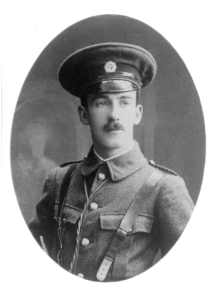
Edward “Ned” Daly, commandant of Dublin’s 1st battalion during the Easter Rising of 1916, is born on February 25, 1891, at 26 Frederick Street in Limerick.

Daly is the only son among the ten children born to Edward and Catherine Daly (née O’Mara). He is the younger brother of Kathleen Clarke whose husband, Tom Clarke, an active member of the Irish Republican Brotherhood. Daly’s father, Edward, a Fenian, dies five months before his son’s birth at the age of forty-one. His uncle, John Daly, is a prominent republican who had taken part in the Fenian Rising. It is through John Daly that Clarke meets his future wife.

Daly is educated by the Presentation Sisters at Sexton Street, the Congregation of Christian Brothers at Roxboro Road, and at Leamy’s commercial college. He spends a short time as an apprentice baker in Glasgow before returning to Limerick to work in Spaight’s timber yard. He later moves to Dublin where he eventually takes up a position with a wholesale chemist. He lives in Fairview with Kathleen and Tom Clarke.

Daly joins the membership of the Irish Republican Brotherhood, although the exact date is not known. In November 1913, Daly joins the newly founded Irish Volunteers and soon reaches the rank of captain. He is assiduous in his study of military manuals and the professionalism of his company gains the admiration of senior officers in actions such as the Howth gun-running of 1914. In March 1915, he is promoted to the rank of commandant of the 1st Battalion.

During the Easter Rising of 1916, Daly’s battalion is stationed in the Four Courts and areas to the west and north of the centre of Dublin. His battalion sees the most intense fighting of the rising. He surrenders his battalion on Saturday, April 29 after Patrick Pearse orders the surrender. He is held at Kilmainham Gaol.

Daly is given the same quick sham court-martial at Richmond Barracks as the other leaders of the Rising. In his trial, he claims that he was just following orders. Daly is convicted and is executed by firing squad on May 4, 1916, at the age of 25.

Bray railway station was renamed Bray Daly railway station in his honour in 1966.


Leave a comment

Birth of Constance Georgine Gore-Booth (Countess Markievicz)

countess-markievicz

Constance Georgine Gore-Booth is born on February 4, 1868, at Buckingham Gate, London, the eldest daughter of Arctic explorer and philanthropist Sir Henry Gore-Booth and Georgina May Hill.

The Gore-Booths are known as model landlords in County Sligo as they provide free food for the tenants on their estate. Perhaps being raised in this atmosphere of concern for the common man has something to do with the way Constance and her younger sister, Eva, conduct their later lives.

Gore-Booth decides to train as a painter and, in 1892, she enters the Slade School of Art in London because, at the time, only one art school in Dublin accepts female students. While in school in London Gore-Booth first becomes politically active and joins the National Union of Women’s Suffrage Societies.

She later moves to Paris and enrolls at the prestigious Académie Julian where she meets her future husband, Count Casimir Markievicz. They are married in London on September 29, 1900, making her Countess Markievicz. The Markieviczes relocate to Dublin in 1903 and move in artistic and literary circles, with Constance being instrumental in founding the United Artists Club.

In 1908, Markievicz becomes actively involved in nationalist politics in Ireland and joins Sinn Féin and Inghinidhe na hÉireann (Daughters of Ireland), a revolutionary women’s movement founded by Maud Gonne. In the same year, Markievicz plays a dramatic role in the women’s suffrage campaigners’ tactic of opposing Winston Churchill‘s election to Parliament during the Manchester North West by-election. Churchill ultimately loses the election to Conservative candidate William Joynson-Hicks.

In 1909, Markievicz founds Fianna Éireann, a para-military nationalist scouts organisation that instructs teenage boys and girls in the use of firearms. Patrick Pearse says that the creation of Fianna Éireann is as important as the creation of the Irish Volunteers in 1913. She is jailed for the first time in 1911 for speaking at an Irish Republican Brotherhood demonstration organised to protest against George V’s visit to Ireland.

Markievicz joins James Connolly‘s socialist Irish Citizen Army, a small volunteer force formed in response to the lock-out of 1913, to defend the demonstrating workers from the police. During the Howth gun-running on July 26, 1914, Irish Citizen Army members led by Markievicz, and including Thomas MacDonagh, Bulmer Hobson, Douglas Hyde and Darrell Figgis, unload arms from Erskine Childers‘ yacht Asgard in Howth harbour with hand carts and wheelbarrows.

As a member of the Irish Citizen Army, Markievicz takes part in the 1916 Easter Rising. Under Michael Mallin and Christopher Poole, she supervises the erection of barricades as the Rising begins and is in the middle of the fighting all around Stephen’s Green. Mallin and Poole and their men and women, including Markievicz, hold out for six days, ending the engagement when the British bring them a copy of Patrick Pearse’s surrender order.

They are taken to Dublin Castle and Markievicz is transported to Kilmainham Gaol, where she is the only one of 70 women prisoners who is put into solitary confinement. At her court martial on May 4, 1916, Markievicz is sentenced to death, but General Maxwell commutes this to life in prison on “account of the prisoner’s sex.” It is widely reported that she tells the court, “I do wish your lot had the decency to shoot me.” Markievicz is transferred to Mountjoy Prison and then to Aylesbury Prison in England in July 1916. She is released from prison in 1917, along with others involved in the Rising.

In the 1918 general election, Markievicz is elected for the constituency of Dublin St Patrick’s, making her the first woman elected to the British House of Commons. However, in line with Sinn Féin abstentionist policy, she does not take her seat in the House of Commons. She is re-elected to the Second Dáil in the elections of 1921. Markievicz serves as Minister for Labour from April 1919 to January 1922, holding cabinet rank from April to August 1919, becoming both the first Irish female Cabinet Minister and only the second female government minister in Europe.

Markievicz leaves government in January 1922 along with Éamon de Valera and others in opposition to the Anglo-Irish Treaty. She fights actively for the Republican cause in the Irish Civil War. She is returned in the 1923 general election for the Dublin South constituency but again, in common with other Republican candidates, she does not take her seat.

She joins Fianna Fáil on its foundation in 1926, chairing the inaugural meeting of the new party in La Scala Theatre. In the June 1927 general election, she is re-elected to the 5th Dáil as a candidate for the new Fianna Fáil party, which is pledged to return to Dáil Éireann.

Before she can take up her seat, Markievicz dies at the age of 59 on July 15, 1927, in a public ward “among the poor where she wanted to be” of complications related to appendicitis. One of the doctors attending her is her revolutionary colleague, Kathleen Lynn. Also at her bedside are Casimir and Stanislas Markievicz, Éamon de Valera, and Hanna Sheehy-Skeffington. Refused a state funeral by the Free State government, Markievicz is buried at Glasnevin Cemetery, Dublin, and de Valera gives the funeral oration.


Leave a comment

Birth of Revolutionary Leader Thomas MacDonagh

thomas-macdonagh

Thomas MacDonagh, political activist, poet, playwright, educationalist, revolutionary leader, and one of the seven leaders of the Easter Rising of 1916, is born in Cloughjordan, County Tipperary, on February 1, 1878.

MacDonagh grows up in a household filled with music, poetry, and learning and is instilled with a love of both English and Irish culture from a young age. He attends Rockwell College and spends several years in preparation for a missionary career but soon realizes that it isn’t the life for him and leaves the college. He teaches briefly at St. Kieran’s College in Kilkenny and, from 1903, is employed as a professor of French, English, and Latin at St. Colman’s College, Fermoy, County Cork, where he forms a branch of the Gaelic League. He moves to Dublin and establishes strong friendships with such men as Eoin MacNeill and Patrick Pearse.

In Dublin, MacDonagh joins the staff St. Enda’s School upon its establishment in 1908, as a French and English teacher and Assistant Headmaster. In January 1912 he marries Muriel Gifford and takes the position of lecturer in English at the National University, while continuing to support St Enda’s. MacDonagh remains devoted to the Irish language and, in 1910, he becomes tutor to a younger member of the Gaelic League, Joseph Plunkett.

In 1913, MacDonagh and Plunkett attend the inaugural meeting of the Irish Volunteers and join its Provisional Committee. MacDonagh is later appointed Commandant of Dublin’s 2nd battalion and eventually made commandant of the entire Dublin Brigade. MacDonagh develops strong republican beliefs and joins the Irish Republican Brotherhood (IRB) in the summer of 1915. Around this time, Tom Clarke asks MacDonagh to plan the grandiose funeral of Jeremiah O’Donovan Rossa, which is a resounding propaganda success largely due to the graveside oration delivered by Pearse.

MacDonagh joins the secret Military Council that is planning the rising in April 1916, just weeks before the rising takes place. Although joining the Council during the late stages of the planning process, MacDonagh is, nevertheless, a signatory of the Proclamation of the Irish Republic.

During the rising, MacDonagh’s battalion is stationed at the massive Jacob’s Biscuit Factory complex. On the way to this destination the battalion encounters veteran Fenian John MacBride, who joins the battalion as second-in-command.

Although MacDonagh’s battalion is one of the strongest, they see little fighting as the British Army avoids the factory and establishes positions in central Dublin. MacDonagh receives the order to surrender on April 30, although his entire battalion is fully prepared to continue the engagement. Following the surrender, MacDonagh is court martialled and executed by firing squad at Kilmainham Gaol in Dublin on May 3, 1916, at the age of thirty-eight.


Leave a comment

Death of Lily Kempson, Last Survivor of the Rising

lily-kempson

Lily Kempson, aged 99, the last surviving participant in the 1916 Easter Rising, dies in Seattle, Washington, on January 22, 1996. Born into the ranks of Dublin’s poor, Elizabeth Ann `Lily’ Kempson shares two rooms with her 92-year-old grandmother, her parents, and eight siblings.

Early on the morning of April 24, 1916, Lily dresses quietly so as to not disturb the other family members. Leaving undetected, Lily never returns home.

When Lily arrives at Liberty Hall, preparations for the Rising are already well underway. Weeks earlier Constance Markievicz and other women members of the Citizens Army, perhaps Lily amongst them, had stacked grenades and ammunition in the basement. Now this weaponry, already dispersed throughout the city, is to be used to defend the proclamation of an Irish Republic.

The initial plan for women to primarily take care of the wounded is scrapped. Attached to the Red Cross unit, Lily Kempson and her female comrades are swiftly incorporated within the main body of the fight. Lily is armed with a revolver. A handful of women, who have already played a key role in securing access to St. Stephens Green, set about evacuating civilians and guarding the gates. The insurgents dig in but they were unable to secure surrounding buildings because of a chronic shortage of personnel.

As dawn breaks on Tuesday morning, Lily is awakened by the rattle of machine gun fire. The British have occupied the Shelbourne, a hotel overlooking the park. The insurgents hold the Green for less than twenty hours. Throughout the week-long siege of Dublin, Kempson acts as a courier for Patrick Pearse and the other men inside the General Post Office (GPO).

The superior firepower of the British and the strategic advantage of the Shelbourne make evacuation of the park as inevitable as it is urgent. A line of retreat has been secured. In an advance party of three men and three women, Lily Kempson accompanies Constance Markievicz and Mary Hyland to seize the College of Surgeons, a sturdy building overlooking the north of the Green. It is here the Green’s contingent makes their heroic last stand, holding the ground for five days. They surrendered only after receiving a dispatch directly from the General Post Office. As their contingent prepares to surrender, Lily is chosen to carry the garrison’s last dispatches to addresses throughout the city.

In the immediate aftermath of The Rising, the Kempsons’ Dublin home is raided by the British army, but Lily is not to be found. Lily makes the decision to leave Ireland when her name appears on a British list of wanted suspects. Using her sister’s passport, she travels to England and boards a ship to New York. From New York, she then sails on to Seattle where she meets and marries a fellow Irishman, Matt McAlerney. They have seven children, 34 grandchildren, and 116 great-grandchildren by the time Lily passes away.

In her final years she attracts the attention of the local American press. Each Easter she briefly becomes a celebrity as her story of being the last survivor is retold.


Leave a comment

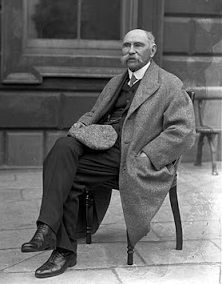
Birth of Dr. Douglas Hyde, First President of Ireland

douglas-hyde

Dr. Douglas Hyde, Gaelic scholar and the first President of Ireland, is born at Longford House in Castlerea, County Roscommon, on January 17, 1860. In 1867, his father is appointed prebendary and rector of Tibohine, and the family moves to neighbouring Frenchpark, in County Roscommon. He is home schooled by his father and his aunt due to a childhood illness. While a young man, he becomes fascinated with hearing the old people in the locality speak the Irish language.

Rejecting family pressure to follow previous generations with a career in the Church, Hyde instead becomes an academic. He enters Trinity College, Dublin, where he gains a great facility for languages, learning Latin, Greek, Hebrew, French, and German, but his great passion in life is the preservation of the Irish language.

After spending a year teaching modern languages in Canada, Hyde returns to Ireland. For much of the rest of his life he writes and collects hundreds of stories, poems, and folktales in Irish, and translates others. His work in Irish helps to inspire many other literary writers, such as W.B. Yeats and Lady Gregory.

In 1892, Hyde helps establish the Gaelic Journal and in November of that year writes a manifesto called The necessity for de-anglicising the Irish nation, arguing that Ireland should follow her own traditions in language, literature, and even in dress.

In 1893, Hyde founds the Gaelic League (Conradh na Gaeilge) along with Eoin MacNeill and Fr. Eugene O’Growney and serves as its first president. Many of the new generation of Irish leaders who play a central role in the fight for Irish independence in the early twentieth century, including Patrick Pearse, Éamon de Valera, Michael Collins, and Ernest Blythe first become politicised and passionate about Irish independence through their involvement in the Gaelic League. Hyde does not want the Gaelic League to be a political entity, so when the surge of Irish nationalism that the Gaelic League helps to foster begins to take control of many in the League and politicize it in 1915, Hyde resigns as president.

Hyde takes no active part in the armed upheaval of the 1910s and 1920s, but does serve in Seanad Éireann, the upper house of the Irish Free State’s Oireachtas, as a Free State senator in 1925-26. He then returns to academia, as Professor of Irish at University College Dublin, where one of his students is future Attorney General and President of Ireland Cearbhall Ó Dálaigh.

In 1938, Hyde is unanimously elected to the newly created position of President of Ireland, a post he holds until 1945. Hyde is inaugurated on June 26, 1938, in the first inaugural ceremony in the nation’s history. Despite being placed in a position to shape the office of the presidency via precedent, Hyde by and large opts for a quiet, conservative interpretation of the office. In April 1940 he suffers a massive stroke and plans are made for his lying-in-state and state funeral, but to the surprise of everyone he survives, albeit paralysed and confined to a wheelchair. One of Hyde’s last presidential acts is a visit to the German ambassador Eduard Hempel on May 3, 1945 to offer his condolences on the death of Adolf Hitler, a visit which remains a secret until 2005.

Hyde leaves office on June 25, 1945, opting not to nominate himself for a second term. He opts not return to his Roscommon home due to his ill-health, but rather moves into the former Secretary to the Lord Lieutenant’s residence in the grounds of Áras an Uachtaráin, where he lived out the remaining four years of his life.

Hyde dies in Dublin on July 12, 1949 at age 89. As a former President of Ireland he is accorded a state funeral which, as a member of the Church of Ireland, takes place in Dublin’s Church of Ireland St. Patrick’s Cathedral. Since contemporary rules of the Roman Catholic Church in Ireland at the time prohibit Roman Catholics from attending services in non-Catholic churches, all but one member of the Catholic cabinet remain outside the cathedral grounds while Hyde’s funeral takes place. Hyde is buried in Frenchpark, County Roscommon at Portahard Church.


Leave a comment

Birth of Thomas Patrick Ashe

thomas-patrick-ashe

Thomas Patrick Ashe, a member of the Gaelic League, the Irish Republican Brotherhood (IRB), and a founding member of the Irish Volunteers, is born in Lispole, County Kerry, on January 12, 1885. Ashe enters De La Salle Training College, Waterford, in 1905 and begins a teaching career as principal of Corduff National School, Lusk, County Dublin, in 1908.

Ashe plays a major part in the 1916 Easter Rising outside the capital city commanding the Fingal battalion of the Irish Volunteers. Ashe is commandant of the 5th battalion of the Dublin brigade, a force of 60–70 men engaging British forces around north County Dublin during the rising. They are armed only with a few rounds, about a dozen service rifles, a dozen Mausers, and a dozen Martini-Henry carbines. Some of Ashe’s men are armed only with a shotgun against the well-equipped army regulars.

Ashe’s battalion wins a major victory in Ashbourne, County Meath, where they engage a much larger force. They capture a significant quantity of arms and up to twenty Royal Irish Constabulary (RIC) vehicles. Eleven RIC members, including County Inspector Alexander Gray, and two volunteers are killed during the 5-1/2-hour battle. Twenty-four hours after the rising collapses, Ashe’s battalion surrenders on the orders of Patrick Pearse. On May 8, 1916, Ashe and Éamon de Valera are court-martialled and sentenced to death. The sentences are commuted to penal servitude for life. Ashe is imprisoned in Lewes Prison in Lewes, East Sussex, England.

De Valera, Ashe, and Thomas Hunter lead a prisoner hunger strike on May 28, 1917. With accounts of prison mistreatment appearing in the Irish press and mounting protests in Ireland, Ashe and the remaining prisoners are freed on June 18, 1917, by David Lloyd George as part of a general amnesty.

Upon his release, Ashe returns to Ireland and begins a series of speaking engagements. In August 1917, he is arrested and charged with sedition for a speech that he makes in Ballinalee, County Longford, where Michael Collins is also speaking. He is detained at the Curragh but is then transferred to Mountjoy Prison in Dublin. He is convicted and sentenced to two years hard labour. Ashe and other prisoners, including Austin Stack, demand prisoner of war status. On September 20, 1917, Ashe again goes on hunger strike. He dies at the Mater Hospital on September 25, 1917, after being force fed by prison authorities. At the inquest into his death, the jury condemns the staff at the prison for the “inhuman and dangerous operation performed on the prisoner, and other acts of unfeeling and barbaric conduct.” His body lies in state at Dublin City Hall and is buried in Glasnevin Cemetery in Dublin.

Ashe is a relative of Catherine Ashe, the paternal grandmother of American actor Gregory Peck, who emigrates to the United States in the 19th century. The Ashe Memorial Hall built in 1928, housing the Kerry County Museum, in Tralee, County Kerry, is named after him while Nelson Street, also in Tralee, is renamed Ashe Street.


Leave a comment

The Easter Rising Centennial

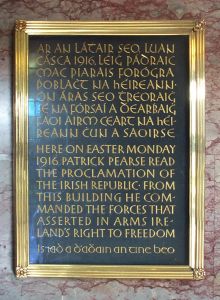
GPO_Easter_Rising_Plaque

I publish this site as we prepare to enter the year 2016, which will be an important year to Ireland and those of Irish heritage around the world. During the upcoming year, we mark the centennial of the Easter Rising of 1916 which began on Easter Monday, April 24, 1916, and lasted for six days.

Approximately 1,200 Volunteers and Citizen Army members, led by Patrick Pearse and James Connolly, took over strongpoints in Dublin with the General Post Office being their headquarters. The British army, which had vastly superior numbers and artillery, quickly suppressed the Rising. Pearse agreed to an unconditional surrender on Saturday, April 29, 1916.

Ninety people were sentenced to death in a series of courts martial, which began on May 2. Fifteen of those, including all seven signatories of the Proclamation, had their sentences confirmed by British General John Maxwell and were executed by firing squad at Kilmainham Gaol in Kilmainham, Dublin between May 3 and 12.

Although lasting but six days, the Rising succeeded in bringing physical force republicanism back to the forefront of Irish politics.

Annual commemorations, rather than taking place on April 24–29, are typically based on the date of Easter, which is a moveable feast. The official programme of centenary events in 2016 climaxes from March 26 (Good Friday) to April 3 (Easter Saturday) with other events earlier and later in the year taking place on the calendrical anniversaries.