seamus dubhghaill

Promoting Irish Culture and History from Little Rock, Arkansas, USA


Leave a comment

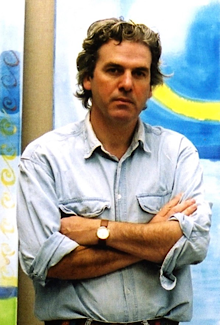
Birth of Jeremy Henderson, Anglo-Irish Artist & Painter

Jeremy Henderson, an Anglo-Irish artist and painter, is born at Lisbellaw, County Fermanagh, Northern Ireland, on December 25, 1952. He was Artist-in-Residence at Kingston University, with art exhibited at the Royal Academy of Arts and National Art Collections.

Henderson is born to James Douglas Alexander Henderson, who manages the family business of Henderson & Eadie, and Doris Josephine (née Watson). He attends Portora Royal School in Enniskillen, where the art master, Angus Bryson, spots him as an exceptional student.

From 1972 to 1973 Henderson studies an Arts Foundation course at Ulster University. From 1973 to 1976 he studies Fine Art at Kingston University, London, achieving a Bachelor of Arts first class honours degree under the tutelage of Terry Jones, returning in 1977 as Artist-in-Residence. In the same year he becomes the first recipient of the Stanley Picker Fellowship Award in Painting. Between 1978 and 1979 he completes a MA postgraduate in Fine Art at Chelsea School of Art under the tutelage of the artist John Hoyland.

In 1980, Henderson starts his professional artistic journey, developing abstract techniques, creating large canvases with complex layers of overlaid and inter-worked paint. He lives and paints in London for twenty years before relocating back to Ireland. In the mid-1980s he works in a studio adjacent to the house he shares with his partner, Jenni Stone, with whom he has a daughter named Emerald.

During the mid-1980s Henderson’s work becomes recognised by private and public collectors, including Bono, leader of the Irish rock band U2. During this period he sells his first work to the National Art Collection (1986). Cuilcagh Under A Renaissance Sky is purchased for Fermanagh County Museum with a grant from the Arts Council of Northern Ireland during his first solo exhibition “Around a Border” in Ireland. This is followed by three more acquisitions via the Arts Council during the 1980s, who continue to support his work into the new millennium acquiring If Hobbema had Seen Ireland (1989) in 2004 via Art Fund with support from the Esmée Fairbairn Foundation. His work is exhibited by Arts Council England.

In 1990 Henderson moves to the Cooperage Studio, Brick Lane, London, sharing the top floor with sculptor David Fusco and artist Bryan Benge, a friend from Kingston University. Benge says “Every summer the studios in the East End became part of the open studios programme. . . . . He was an intelligent and incredibly accomplished Painter.” It is here, separated from his partner and virtually penniless, he devotes himself entirely to his work, living in a tent, donated by Benge’s parents, inside the studio.

Henderson begins Palinurus in Soho in 1991, a series of twelve paintings depicting night time rooftop scenes across London, painted from an attic in Kingly Street. Exhibited at the Anna Bornholt Gallery in 1992, ten of the series are acquired by a single private collector.

Around 2000, Henderson becomes more influenced by Greek and Irish symbolism, in particular White Island, the Book of Kells and Sheela na gig, reflected in much of the art produced from this time onward. In 2001, he creates a set of enamel manuscripts for The Clinton Centre in Enniskillen, inaugurated by U.S. President Bill Clinton in 2002, in commemoration of the Remembrance Day bombing of 1987. He is interested in enameling because of the possibilities that it offers to him as a colourist and in the behaviour of gestural mark-making. The process is made possible when he is introduced to Andrew Morley, the authority on enamel sign making.

Henderson’s artistic influences include Hans HofmannBarnett NewmanMark Rothko, and John Hoyland. Frequently associated with Samuel Beckett and Jack Butler Yeats, he is influenced by his homeland; his early environment, growing up around weaving, yarns and dyeing, the regions political turmoil, symbolism, and in later life his chronic illness, expressed in his more sombre paintings.

John Hutchinson, critic and director of the Douglas Hyde Gallery writes in the Sunday Independent that Henderson’s paintings “demonstrate the fruitfulness of the no man’s land between abstraction and representation,” and “His images deliberately evoke the picturesque and romantic landscape conventions that originated in the late 18th century…..as well as the expressionist subjectivity of painters such as Jack B. Yeats.” Due to Henderson’s disinterest in the commercialisation of his work, he is sometimes referred to as Ireland’s Invisible Genius.

Henderson describes the evolution of his work, after returning to Ireland in 1993, saying, “Since returning to Ireland my work has become less concerned with resting landscape painting in a cultural context more appropriate to our times, but has come full circle towards an internalised organic abstraction which characterised my more intuitive approach until the early eighties.”

Henderson is married once, in 1995 to the actress Patricia Martinelli with whom he subsequently has a daughter in 1997, Bella-Lucia. He remains married, living in the remote village of Boho, County Fermanagh, Northern Ireland, until his death, brought on by a brain tumour, on April 28, 2009. He remains a prolific artist throughout his life.

Henderson’s work is held in the private collection of the entrepreneur Vincent Ferguson, owner of Fitzwilton and Independent News & Media PLC. His work is also held in the Smurfit Art Collection of Smurfit Kappa Group.


Leave a comment

The Milltown Cemetery Attack

The Milltown Cemetery attack takes place on March 16, 1988, at Milltown Cemetery in Belfast, Northern Ireland. During the large funeral of three Provisional Irish Republican Army members killed in Gibraltar, an Ulster Defence Association (UDA) member, Michael Stone, attacks the mourners with hand grenades and pistols.

On March 6, 1988, Provisional IRA members Daniel McCann, Seán Savage and Mairéad Farrell are shot dead by the Special Air Service (SAS) in Gibraltar, in Operation Flavius. The three had allegedly been preparing a bomb attack on British military personnel there, but the deaths outrage republicans as the three were unarmed and shot without warning. Their bodies arrive in Belfast on March 14 and are taken to their family homes. Tensions are high as the security forces flood the neighbourhoods where they had lived, to try to prevent public displays honouring the dead. For years, republicans have complained about heavy-handed policing of IRA funerals, which have led to violence. In a change from normal procedure, the security forces agree to stay away from the funeral in exchange for guarantees that there will be no three-volley salute by IRA gunmen. The British Army and Royal Ulster Constabulary (RUC) will instead keep watch from the sidelines. This decision is not made public.

Michael Stone is a loyalist, a member of the Ulster Defence Association (UDA) who had been involved in several killings and other attacks, and who describes himself as a “freelance loyalist paramilitary.” He learns that there will be little security force presence at the funerals, and plans “to take out the Sinn Féin and IRA leadership at the graveside.” He says his attack is retaliation for the Remembrance Day bombing four months earlier, when eleven Protestants had been killed by an IRA bomb at a Remembrance Sunday ceremony. He claims that he and other UDA members considered planting bombs in the graveyard but abandon the plan because the bombs might miss the republican leaders.

The funeral service and Requiem Mass go ahead as planned, and the cortege makes its way to Milltown Cemetery, off the Falls Road. Present are thousands of mourners and top members of the IRA and Sinn Féin, including Sinn Féin leader Gerry Adams and Martin McGuinness. Two RUC helicopters hover overhead. Stone claims that he entered the graveyard through the front gate with the mourners and mingled with the large crowd, although one witness claims to have seen him enter from the M1 motorway with three other people.

As the third coffin is about to be lowered into the ground, Stone throws two grenades, which have a seven-second delay, toward the republican plot and begins shooting. The first grenade explodes near the crowd and about 20 yards from the grave. There is panic and confusion, and people dive for cover behind gravestones. Stone begins jogging toward the motorway, several hundred yards away, chased by dozens of men and youths. He periodically stops to shoot and throw grenades at his pursuers.

Three people are killed while pursuing Stone – Catholic civilians Thomas McErlean (20) and John Murray (26), and IRA member Caoimhín Mac Brádaigh (30), also known as Kevin Brady. During the attack, about 60 people are wounded by bullets, grenade shrapnel and fragments of marble and stone from gravestones. Among those wounded is a pregnant mother of four, a 72-year-old grandmother and a ten-year-old boy. Some fellow loyalists say that Stone made the mistake of throwing his grenades too soon. The death toll would likely have been much higher had the grenades exploded in mid-air, “raining lethal shrapnel over a wide area.”

A white van that had been parked on the hard shoulder of the motorway suddenly drives off as Stone flees from the angry crowd. There is speculation that the van is part of the attack, but the RUC says it was part of a police patrol, and that the officers sped off because they feared for their lives. Stone says he had arranged for a getaway car, driven by a UDA member, to pick him up on the hard shoulder of the motorway, but the driver allegedly “panicked and left.” By the time he reaches the motorway, he has seemingly run out of ammunition. He runs out onto the road and tries to stop cars, but is caught by the crowd, beaten, and bundled into a hijacked vehicle. Armed RUC officers in Land Rovers quickly arrive, “almost certainly saving his life.” They arrest him and take him to Musgrave Park Hospital for treatment of his injuries. The whole event is recorded by television news cameras.

That evening, angry youths in republican districts burn hijacked vehicles and attack the RUC. Immediately after the attack, the two main loyalist paramilitary groups—the UDA and the Ulster Volunteer Force (UVF)—deny responsibility. Sinn Féin and others “claimed that there must have been collusion with the security forces, because only a small number of people knew in advance of the reduced police presence at the funerals.”

Three days later, during the funeral of one of Stone’s victims, Caoimhín Mac Brádaigh, two British Army corporals, Derek Wood and David Howes, in civilian clothes and in a civilian car drive into the path of the funeral cortège, apparently by mistake. Many of those present believe the soldiers are loyalists intent on repeating Stone’s attack. An angry crowd surrounds and attacks their car. Corporal Wood draws his service pistol and fires a shot into the air. The two men are then dragged from the car before being taken away, beaten and shot dead by the IRA. The incident is often referred to as the corporals killings and, like the attack at Milltown, much of it is filmed by television news cameras.

In March 1989, Stone is convicted for the three murders at Milltown, for three paramilitary murders before, and for other offences, receiving sentences totaling 682 years. Many hardline loyalists see him as a hero, and he becomes a loyalist icon. After his conviction, an issue of the UDA magazine Ulster is devoted to Stone, stating that he “stood bravely in the middle of rebel scum and let them have it.” Apart from time on remand spent in Crumlin Road Gaol, he spends all of his sentence in HM Prison Maze. He is released after serving 13 years as a result of the Good Friday Agreement.

In November 2006, Stone is charged with attempted murder of Martin McGuinness and Gerry Adams, having been arrested attempting to enter the Parliament Buildings at Stormont while armed. He is subsequently convicted and sentenced to a further 16 years imprisonment. He is released on parole in 2021.


Leave a comment

The Remembrance Day Bombing

remembrance-day-bombing

The Remembrance Day bombing, also known as the Enniskillen bombing or Poppy Day massacre, takes place on November 8, 1987, in Enniskillen, County Fermanagh, Northern Ireland. A Provisional Irish Republican Army (IRA) bomb explodes near the town’s war memorial during a Remembrance Sunday ceremony, which is being held to commemorate British military war dead. Eleven people, many of them old age pensioners, are killed and 63 are injured.

The bomb explodes as a parade of Ulster Defence Regiment (UDR) soldiers is making its way to the memorial and as people wait for the ceremony to begin. It blows out the wall of the Reading Rooms, where many of the victims are standing, burying them under rubble and hurling masonry towards the gathered crowd. Bystanders rush to free those trapped in the rubble.

Eleven people, all Protestant, are killed by the Provisional IRA that day, including three married couples. The dead are Wesley and Bertha Armstrong, Kitchener and Jessie Johnston, William and Agnes Mullan, John Megaw, Georgina Quinton, Marie Wilson, Samuel Gault, and Edward Armstrong. Armstrong is a serving Royal Ulster Constabulary (RUC) officer and Gault has recently left the force. Gordon Wilson, whose daughter Marie dies in the blast and who is himself injured, goes on to become a peace campaigner and member of Seanad Éireann. The twelfth fatality, Ronnie Hill, dies after spending 13 years in a coma. Sixty-three people are injured, including thirteen children. Ulster Unionist politicians Sam Foster and Jim Dixon are among the crowd. Dixon receives extensive head injuries but recovers. A local businessman captures the immediate aftermath of the bombing on video camera. His footage, showing the effects of the bombing, is broadcast on international television.

A few hours after the blast, the IRA calls a radio station and says it has abandoned a 150-pound bomb in Tullyhommon, twenty miles away, after it failed to detonate. That morning, a Remembrance Sunday parade, which includes many members of the Boys’ and Girls’ Brigades, has unwittingly gathered near the Tullyhommon bomb. Soldiers and RUC officers were also there, and the IRA says it attempted to trigger the bomb when soldiers were standing beside it. The bomb is defused by security forces and is found to have a command wire leading to a “firing point” across the border.

The IRA apologises, saying it had made a mistake and that the target had been the UDR soldiers who were parading to the memorial. The bombing leads to an outcry among politicians in the Republic of Ireland and the United Kingdom. British Prime Minister Margaret Thatcher says, “It’s really desecrating the dead and a blot on mankind.” The Secretary of State for Northern Ireland, Tom King, denounces the “outrage” in the House of Commons, as does the Irish Minister for Foreign Affairs, Brian Lenihan, in Dáil Éireann. Seanad Éireann Senator Maurice Manning speaks of people’s “total revulsion.” It also facilitates the passing of the Extradition Act, which makes it easier to extradite IRA suspects from the Republic of Ireland to the United Kingdom.

The bombing is seen by many Northern Irish Protestants as an attack on them, and loyalist paramilitaries ″retaliate″ with attacks on Catholic civilians. The day after the bombing, five Catholic teenagers are wounded in a shooting in Belfast, and a Protestant teenager is killed by the Ulster Defence Association after being mistaken for a Catholic. In the week after the bombing, there are fourteen gun and bomb attacks on Catholics in Belfast.

The Remembrance Day bombing has been described as a turning point in the Troubles and an incident that shook the IRA “to its core.”