
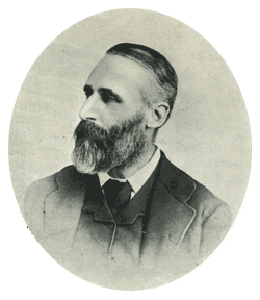
Augustus Joseph Nicholas Burke, artist and a member of the Royal Hibernian Academy (RHA), dies on December 28, 1891, at 22 Via La Marmora, Florence, Italy.
Burke is born on July 28, 1838, into the Galway Burkes of Glinsk and is the sixth son of William Burke of Knocknagur, Tuam, County Galway. He is born at Waterslade House in the town. One of his brothers is Theobald Hubert Burke, 13th Baronet of Glinsk, while another brother is Thomas Henry Burke, Permanent Under Secretary at the Irish Office.
Burke shows an early interest in drawing, displaying a love for depicting the people and land of Connemara. His career in the arts is initiated at the Royal Academy of Arts in London. He exhibits at the Royal Academy and the Royal Hibernian Academy, where he is also Professor of Painting, from 1863 until his death. From 1870 to 1872 he resides in the Netherlands where he illustrates a handful of Dutch scenes. One of the earliest Irish artists to travel to Brittany, Burke exhibits fifteen Breton scenes at the Royal Hibernian Academy between 1876 and 1878. He paints further in his native Ireland, as well as Scotland and England. The 1880s bring Burke to Walberswick in Suffolk to an artist’s colony created by Philip Wilson Steer. A student of Burke, Walter Osborne, paints with him here.
Burke, overcome with grief by his brother Thomas’ murder during the Phoenix Park Murders in 1882, leaves the Royal Hibernian Academy and his position as Professor of Painting. He moves with the remaining members of his family first to England and then to Italy.
Two of Burke’s most famous paintings, Connemara Girl and A Connemara Landscape, hang at the National Gallery of Ireland. His work is relatively rare, mainly because the contents of his studio are destroyed during the fire that engulfs the Abbey Street buildings of the RHA in 1916. Furthermore, many of the paintings lay hidden in a cellar for over ninety years until their recent discovery.

 seamus dubhghaill