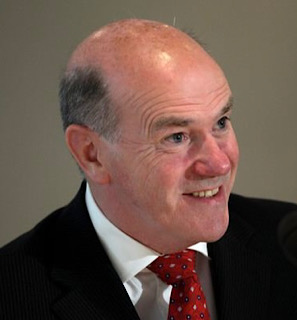
In 1992, Flanagan returns to duty with the RUC as Assistant Chief Constable of Operations, later taking on the responsibilities of Operational Commander for Belfast. He is appointed as head of Special Branch in 1994 and is promoted to Acting Deputy Chief Constable the following year. He becomes the Deputy Chief Constable proper in 1996, and when Chief Constable Hugh Annesley retires later that year, he succeeds him. When the PSNI is established in 2001, he serves as Chief Constable until his retirement the following year. He is replaced by Hugh Orde.
Since then Flanagan has served in Her Majesty’s Inspectorate of Constabulary and is appointed as HM Chief Inspector of Constabulary in 2005. He is tasked to review the police arrangements in Iraq in December 2005 as part of the British involvement there. Following his retirement in December 2008, Denis O’Connor succeeds him as Her Majesty’s Acting Chief Inspector of Constabulary.
Flanagan denies any wrongdoing or acting with any knowledge of the events in question. He agrees that these events had taken place. In the aftermath of the ombudsman’s report, Irish nationalist politicians say he should be forced to resign from his job as Chief Inspector of Constabulary.
The Police Ombudsman criticises Flanagan’s role in the RUC inquiry into the Omagh Bombing of August 15, 1998, in a report published in 2001, to which his response is that he would “publicly commit suicide” if he believed her report was correct, though he later apologises for the form of words he used.
In July 2010, Flanagan appears before the Iraq Inquiry into the UK’s role in the Iraq War. In 2005, he had conducted a review into the UK’s contribution to policing reform in Iraq. As he gives evidence, he has to apologise for the amount of acronyms in his report on Iraq, which is presented to the government in January 2006:
“In my view, and I would like to almost apologise for the number of acronyms in this report – but it wasn’t written with a view to being read publicly. It was written for the people who invented the acronyms…”
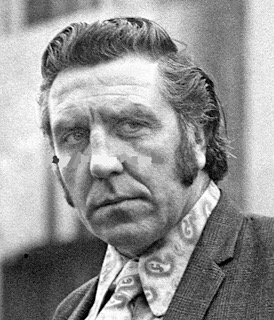
Charles Harding Smith, a Northern Irish loyalist and the first effective leader of the Ulster Defence Association (UDA), is born in Belfast, Northern Ireland, on January 24, 1931. An important figure in the Belfast-based “defence associations” that form the basis of the UDA on its formation in 1971, he later becomes embroiled in feuds with other UDA leaders and is eventually driven out of Northern Ireland by his opponents.
A former soldier in the British Army, Smith, at the time residing in Rosebank Street on the Shankill Road, calls a meeting of other locals at the Leopold Street Pigeon Fanciers Club to develop a response to attacks by republicans from the neighboring Ardoyne area. The location is chosen because Smith is himself a pigeon fancier and a member of the club. At the meeting, it is agreed to establish a vigilante group, the Woodvale Defence Association (WDA), with Smith in command and assisted by Davy Fogel, who organises military drilling for the forty or so recruits, and Ernie Elliott.
The WDA gains widespread notoriety and is blamed for a series of bomb attacks and shootings, most of which have been carried out by the Ulster Volunteer Force (UVF). Nevertheless, Smith’s reputation as a hardline loyalist is boosted as a result and when his group merges with other similar vigilante movements to form the Ulster Defence Association (UDA) in late 1971, he is chosen as chairman of the new group’s thirteen-member Security Council ahead of the other leading candidates, Tommy Herron and Jim Anderson. According to journalist Martin Dillon, Smith is heavily influenced by William Craig and William McGrath, both of whom see a need for a group to replace the Ulster Special Constabulary (USC) and feel that they can easily influence Smith to their way of thinking.
Smith soon takes charge of procuring arms for the UDA. In early 1972, working in tandem with Belfast businessman John Campbell who agrees to bankroll the purchases, he is put in contact with a Scottish arms dealer from whom he is to purchase £50,000 worth of weapons. He sends three WDA associates, John White, Bobby Dalzell, and Robert Lusty (who is also a serving officer in the Royal Ulster Constabulary (RUC)), to meet the arms dealer in a London hotel, following them without attending the actual meeting. The “arms dealer” is actually an RUC Special Branch agent and, after recording the conversation with the WDA men, arrests all three. Smith goes to Scotland Yard the same day to inquire about his friends only to be arrested himself.
Smith remains in custody in England until December 1972 when his case comes to trial. Campbell claims that the deal had been organised for the RUC to entrap the arms dealer, whom they believe to be a Provisional Irish Republican Army member and a series of mistakes by the prosecution helps to ensure that the case collapses with Smith acquitted. The trial is used as part of early arguments regarding collusion between the RUC and loyalists as a list of RUC Special Branch suspects is uncovered in Smith’s house while he attempts to call Chief ConstableGraham Shillington as a character witness.
By the time Smith returns to Belfast in December 1972 there has been changes in the UDA with Tommy Herron in effective control of the organisation and Davy Fogel the dominant figure amongst the WDA. He immediately takes back control of his west Belfast stronghold, threatening Fogel with death if he does not fall into line. Fogel, a close ally of Ernie Elliott, who was killed in circumstances that Smith had been rumoured to be involved in, although it is later determined that Elliott was shot dead after a drunken brawl on Sandy Row had descended into a gunfight, decides it is best not to go up against Smith and stands down.
However, Smith is not satisfied and, after putting out intelligence that Fogel has been taking UDA funds for himself, arrests Fogel and holds him captive for three hours in a Shankill social club where he is told to leave the area. Fogel briefly leaves for east Belfast but when the UDA there makes it clear he is not welcome either he leaves to live in England, from where he controversially gives an interview about his time in the UDA to The Sunday Times. Among claims made by Fogel in this interview is one that Smith was attempting to take control of the UDA with the help of the UVF. Smith is a strong admirer of the UVF’s military structure and hopes to replicate it in the UDA but he has a deep dislike of UVF leader Gusty Spence. As part of his remit to instill military discipline, Smith moves against a culture of racketeering that has become endemic in the west Belfast UDA during his absence. It is this initiative that leads to the rumours concerning his involvement in the death of Elliott, who had been named by some of his rivals in the UDA as a gangster.
Despite Smith’s show of strength following his return to Belfast his public persona remains low-key, with Herron fast emerging as the public face of the UDA. Much of this is down to the fact that Smith is inarticulate and unable to project a good image, unlike Herron who is a good talker and fairly charismatic. The emergence of these two leaders at the same time however is to bring the fledgling movement into near civil war.
Following a period of marginalisation Jim Anderson, who is serving as caretaker leader of the UDA, resigns as chairman of the UDA and as a result a meeting is called of the group’s leaders in March 1973 to determine who will succeed him. By this time Smith and Herron are recognised as the undisputed leaders of the Belfast UDA. There is a fear that whichever of the two is chosen as chairman, the other one will automatically feel obliged to challenge his leadership. As a result, it is determined that someone else should be appointed chairman as a compromise candidate and as Highfield-based activist Andy Tyrie, a man noted for his skill as an organiser, is chairing the conference it is decided that he will be acceptable to both men as chairman of the UDA. Tyrie soon proves to be a powerful rival to the two leaders. In September 1973, Herron is kidnapped and shot dead. His murder remains unsolved.
Tyrie had not proven to be the puppet Smith had hoped and had consolidated his power through his close involvement with Glenn Barr and the Ulster Workers’ Council during the strike of May 1974, an event that had helped to give real credence to Tyrie’s leadership abilities. Fearing the growing power of Tyrie, Smith criticises the UDA leader for sending a delegation to Libya to meet Muammar Gaddafi, who is a hated figure for many loyalists due to his providing arms to the Provisional Irish Republican Army. Smith, who had known about the trip in advance but had raised no objections, verbally attacks Tyrie over the Libya debacle in a meeting of the Inner Council in December 1974 before declaring the following January that he intends to split his West Belfast Brigade from the rest of the UDA.
Two weeks after announcing the schism, Smith is attending a meeting at the West Belfast UDA’s headquarters with Tommy Lyttle when he notices a sniper on a nearby roof. Smith, who is wearing a bulletproof vest, opens his coat as if to challenge the sniper to fire but is seriously wounded when the sniper shoots twice, hitting him both times with armour-piercing bullets. With Smith in hospital, Tyrie calls a meeting of the leading figures in the Shankill UDA and manages to convince Lyttle and other leading figures that Smith is too divisive a figure to remain in charge.
Smith is out of the hospital after only two weeks and declares himself back in charge, but before long he has fallen foul of a number of important people. Two Shankill UDA members are interned on the basis of evidence that rumours suggest had come from Smith, while he also clashed with the local UVF after suggesting that they merge but only on the basis that he will be in control. He begins to make threats against Barr and Chicken, two popular members who are leading figures on the UDA’s political side. Smith calls a meeting of his commanders, but, on February 6, 1975, in an attack arranged in advance by his opponents within the UDA, a gunman bursts in and shoots him twice in the chest. The gunman walks up to the injured Smith and prepares to shoot him in the head but the gun jams and he again survives an attempt on his life.
Smith spends another week in hospital after which he again returns to his Belfast home. Loyalist Davy Payne is sent to his house with another hitman and the two order Smith to leave Northern Ireland. He is taken to the airport the following day and leaves for England, leaving Tyrie as sole leader of the UDA. He settles in Southowram, West Yorkshire, where he works as a lorry driver before his death in 1997. During Dáil Éireann debates in 2005 he is named as a “self-confessed British intelligence agent.”
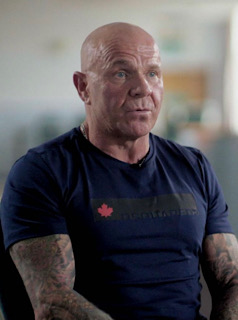
Johnny Adair, leader of “C Company” of the Ulster Loyalistparamilitary organisation Ulster Freedom Fighters (UFF), a cover name of the Ulster Defence Association, is born in Belfast, Northern Ireland, on October 27, 1963. He is known as Mad Dog. He is expelled from the organisation in 2002 following a violent power struggle. Since 2003, he, his family and a number of supporters have been forced to leave Northern Ireland by other loyalists.
Adair is born into a working class loyalist background and raised in Belfast. He grows up in the Lower Oldpark area, a site of many sectarian clashes during “The Troubles.” By all accounts, he has little parental supervision, and does not attend school regularly. He takes to the streets, forming a skinheadstreet gang with a group of young loyalist friends, who “got involved initially in petty, then increasingly violent crime.” Eventually, he starts a rock band called Offensive Weapon, which during performances espouses support for the British National Front.
While still in his teens, Adair joins the Ulster Young Militants (UYM), and later the Ulster Defence Association, a loyalist paramilitary organisation which also calls itself the Ulster Freedom Fighters.
By the early 1990s, Adair has established himself as head of the UDA/UFF’s “C Company” based on the Shankill Road. When he is charged with terrorist offences in 1995, he admits that he had been a UDA commander for three years up to 1994. During this time, he and his colleagues are involved in multiple and random murders of Catholic civilians. At his trial in 1995, the prosecuting lawyer says he is dedicated to his cause against those whom he “regarded as militant republicans – among whom he had lumped almost the entire Roman Catholic population.” Royal Ulster Constabulary (RUC) detectives believe his unit killed up to 40 people during this period.
Adair once remarks to a Catholic journalist from the Republic of Ireland upon the discovery of her being Catholic, that normally Catholics travel in the boot of his car. According to a press report in 2003, he is handed details of republican suspects by British Army intelligence, and is even invited for dinner in the early 1990s. In his autobiography, he claims he was frequently passed information by sympathetic British Army members, while his own whereabouts were passed to republican paramilitaries by the RUC Special Branch, who, he claims, hated him.
The Provisional Irish Republican Army (IRA) bombing of a fish shop on the Shankill Road in October 1993 is an attempt to assassinate Adair and the rest of the UDA’s Belfast leadership in reprisal for attacks on Catholics. The IRA claims that the office above the shop is regularly used by the UDA for meetings and one is due to take place shortly after the bomb is set to explode. The bomb goes off early, killing one IRA man, Thomas Begley, and nine Protestant civilians. The UFF retaliates with a random attack on the Rising Sun bar in Greysteel, County Londonderry, which kills eight civilians, two of whom are Protestants. Adair survives 13 assassination attempts, most of which are carried out by the IRA and Irish National Liberation Army (INLA).
During this time, undercover officers from the Royal Ulster Constabulary record months of discussions with Adair, in which he boasts of his activities, producing enough evidence to charge him with directing terrorism. He is convicted and sentenced to 16 years in HM Prison Maze. In prison, according to some reports, he sells drugs such as cannabis, ecstasy tablets and amphetamines to other loyalist prisoners, earning him an income of £5000 a week.
In January 1998, Adair is one of five loyalist prisoners visited in the prison by British Secretary of State for Northern Ireland, Mo Mowlam. She persuades them to drop their objection to their political representatives continuing the talks that leads to the Good Friday Agreement in April. In 1999, he is released early as part of a general amnesty for political prisoners after the Agreement.
Following his release, much of Adair’s activities are bound up with violent internecine feuds within the UDA and between the UDA and other loyalist paramilitary groupings. The motivation for such violence is sometimes difficult to piece together. It involves a combination of political differences over the loyalist ceasefires, rivalry between loyalists over control of territory and competition over the proceeds of organised crime.
In 1999, shortly after his release from prison, Adair is shot at and grazed in the head by a bullet at a UB40 concert in Belfast. He blames the shooting on republicans, but it is thought that rival loyalists are to blame.
In August 2000, Adair is again mildly injured by a pipe bomb he is transporting in a car. He again attempts to blame the incident on an attack by republicans, but this claim is widely discounted. A feud breaks out at the time between the UDA and the Ulster Volunteer Force (UVF) leaving several loyalists dead. As a result of Adair’s involvement in the violence, the then Secretary of State for Northern Ireland, Peter Mandelson, revokes his early release and returns him to prison.
In May 2002, Adair is released from prison again. Once free, he is a key part of an effort to forge stronger ties between the UDA/UFF and the Loyalist Volunteer Force (LVF), a small breakaway faction of the UVF loyalist paramilitary organization in Northern Ireland. The most open declaration of this is a joint mural depicting Adair’s UDA “C company” and the LVF. Other elements in the UDA/UFF strongly resist these movements, which they see as an attempt by Adair to win external support in a bid to take over the leadership of the UDA. Some UDA members dislike his overt association with the drugs trade, with which the LVF are even more heavily involved. A loyalist feud begins, and ends with several men dead and scores evicted from their homes.
On September 25, 2002, Adair is expelled from the UDA/UFF along with close associate John White, and the organisation almost splits as Adair tries to woo influential leaders such as Andre Shoukri, who are initially sympathetic to him. There are attempts on Adair’s and White’s lives.
Adair returns to prison in January 2003, when his early release licence is revoked by Secretary of State for Northern Ireland, Paul Murphy, on grounds of engaging in unlawful activity. On February 1, 2003, UDA divisional leader John Gregg is shot dead along with another UDA member, Rab Carson, on returning from a Rangers F.C. match in Glasgow. The killing is widely blamed on Adair’s C Company as Gregg is one of those who organised his expulsion from the UDA. Five days later, on February 6, about twenty Adair supporters, including White, flee their homes for Scotland, widely seen as a response to severe intimidation.
Adair is released from prison again on January 10, 2005. He immediately leaves Northern Ireland and joins his family in Bolton, Lancashire, where it is claimed he stays with supporters of Combat 18 and the Racial Volunteer Force.
The police in Bolton question Adair’s wife, Gina, about her involvement in the drugs trade, and his son, nicknamed both “Mad Pup” and “Daft Dog,” is charged with selling crack cocaine and heroin. Adair is arrested and fined for assault and threatening behaviour in September 2005. He had married Gina Crossan, his partner for many years and the mother of his four children, at HM Prison Maze on February 21, 1997. She is three years Adair’s junior and grew up in the same Lower Oldpark neighbourhood.
After being released, Adair is almost immediately arrested again for violently assaulting Gina, who suffers from ovarian cancer. Since this episode he reportedly moves to Scotland, living in Troon in Ayrshire.
In May 2006, Adair reportedly receives £100,000 from John Blake publishers for a ghost-written autobiography.
In November 2006, the UK’s Five television channel transmits an observational documentary on Adair made by Dare Films.
Adair appears in a documentary made by Donal MacIntyre and screened in 2007. The focus of the film centers around Adair and another supposedly reformed character, a Neo-Nazi from Germany called Nick Greger, and their trip to Uganda to build an orphanage. Adair is seen to fire rifles, stating it is the first time he has done so without wearing gloves. He also admits to being “worried sick” and “pure sick with worry” after Greger disappears in Uganda for days on end. It turns out that he had gone off and married a Ugandan lady. Adair confesses via telephone that he “thought something might have happened to Nick.”
On July 20, 2015, three Irish republicans, Antoin Duffy, Martin Hughes and Paul Sands, are found guilty of planning to murder Adair and Sam McCrory. Charges against one of the accused in the trial are dropped on July 1.
On September 10, 2016, Adair’s son, Jonathan Jr., is found dead in Troon, aged 32. He dies from an accidental overdose while celebrating the day after his release from prison for motoring offences. He had been in and out of prison since the family fled Northern Ireland. He served a five-year sentence for dealing heroin and crack cocaine. The year before, he had been cleared of a gun raid at a party and in 2012 is the target of a failed bomb plot. He was also facing trial later that year on drugs charges.
In December 2023, while recording a podcast with far-right activist Tommy Robinson, Adair surprisingly expresses a grudging respect for the IRA hunger strikers, describing the manner of their deaths as “dedication at the highest level” for a political cause and admitting that he would not have volunteered to do the same if asked.
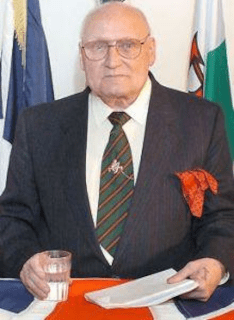
Spence, the sixth of seven children, is born and raised in the Shankill Road area of West Belfast in Northern Ireland, the son of William Edward Spence, a member of the Ulster Volunteers who fought in World War I, and Isabella “Bella” Hayes. The family home is 66 Joseph Street in an area of the lower Shankill known colloquially as “the Hammer.” He is educated at the Riddel School on Malvern Street and the Hemsworth Square school, finishing his education at the age of fourteen. He is also a member of the Church Lads’ Brigade, a Church of Ireland group, and the Junior Orange Order. His family has a long tradition of Orange Order membership.
Spence takes various manual jobs in the area until joining the British Army in 1957 as a member of the Royal Ulster Rifles. He rises to the rank of Provost Sergeant (battalion police). He is stationed in Cyprus and sees action fighting against the forces of Colonel Georgios Grivas. He serves until 1961 when ill-health forces him to leave. He then finds employment at the Harland & Wolff shipyard in Belfast, where he works as a stager (builder of the scaffolding in which the ships are constructed), a skilled job that commands respect among working class Protestants and ensures for him a higher status within the Shankill.
From an early age Spence is a member of the Prince Albert Temperance Loyal Orange Lodge, where fellow members include John McQuade. He is also a member of the Royal Black Institution and the Apprentice Boys of Derry. Due to his later involvement in a murder, he is expelled from the Orange Order and the Royal Black Institution. The Reverend Martin Smyth is influential in his being thrown out of the Orange Order.
Spence’s older brother Billy is a founding member of Ulster Protestant Action (UPA) in 1956, and he is also a member of the group. He is frequently involved in street fights with republicans and garners a reputation as a “hard man.” He is also associated loosely with prominent loyalists such as Ian Paisley and Desmond Boal and is advised by both men in 1959 when he launches a protest against Gerry Fitt at Belfast City Hall after Fitt had described Spence’s regiment as “murderers” over allegations that they had killed civilians in Cyprus. He, along with other Shankill Road loyalists, break from Paisley in 1965 when they side with James Kilfedder in a row that follows the latter’s campaigns in Belfast West. Paisley intimates that Kilfedder, a rival for the leadership of dissident unionism, is close to Fine Gael after learning that he had attended party meetings while a student at Trinity College Dublin (TCD). The Shankill loyalists support Kilfedder and following his election as MP send a letter to Paisley accusing him of treachery during the entire affair.
Spence claims that he is approached in 1965 by two men, one of whom was an Ulster Unionist Party MP, who tells him that the Ulster Volunteer Force is to be re-established and that he is to have responsibility for the Shankill. He is sworn in soon afterward in a ceremony held in secret near Pomeroy, County Tyrone. Because of his military experience, he is chosen as the military commander and public face of the UVF when the group is established. However, RUC Special Branch believes that his brother Billy, who keeps a much lower public profile, is the real leader of the group. Whatever the truth of this intelligence, Spence’s Shankill UVF team is made up of only around 12 men on its formation. Their base of operations is the Standard Bar, a pub on the Shankill Road frequented by Spence and his allies.
On May 7, 1966, a group of UVF men led by Spence petrol bomb a Catholic-owned pub on the Shankill Road. Fire also engulfs the house next door, killing the elderly Protestant widow, Matilda Gould (77), who lives there. On May 27, he orders four UVF men to kill an Irish Republican Army (IRA) member, Leo Martin, who lives on the Falls Road. Unable to find their target, the men drive around in search of any Catholic instead. They shoot dead John Scullion (28), a Catholic civilian, as he walks home. Spence later writes “at the time, the attitude was that if you couldn’t get an IRA man you should shoot a Taig, he’s your last resort.” On June 26, the same gang shoots dead Catholic civilian Peter Ward (18) and wounds two others as they leave a pub on Malvern Street in the lower Shankill. Two days later, the government of Northern Ireland uses the Special Powers Act to declare the UVF illegal. Shortly after, Spence and three others are arrested.
In October 1966, Spence is sentenced to life imprisonment for the murder of Ward, although he has always claimed his innocence. He is sent to Crumlin Road Prison. During its July 12, 1967, march, the Orange lodge to which he belongs stops outside the prison in tribute to him. This occurs despite him having been officially expelled from the Orange Order following his conviction. His involvement in the killings gives him legendary status among many young loyalists and he is claimed as an inspiration by the likes of Michael Stone. Tim Pat Coogan describes Spence as a “loyalist folk hero.” The murder of Ward is, however, repudiated by Paisley and condemned in his Protestant Telegraph, sealing the split between the two.
Spence appeals against his conviction and is the subject of a release petition organised by the Ulster Constitution Defence Committee, although nothing comes of either initiative. Despite the fact that control of the UVF lay with his closest ally, Samuel “Bo” McClelland, from prison he is often at odds with the group’s leadership, in particular with regards to the 1971 McGurk’s Bar bombing. Spence now argues that UVF members are soldiers and soldiers should not kill civilians, as had been the case at McGurk’s Bar. He respects some Irish republican paramilitaries, who he feels also live as soldiers, and to this end he writes a sympathetic letter to the widow of Official IRA leader Joe McCann after he is killed in 1972.
Spence is granted two days leave in early July 1972 to attend the wedding of his daughter Elizabeth to Winston Churchill “Winkie” Rea. The latter had formally asked Spence for his daughter’s hand in marriage during a prison visit. Met by two members of the Red Hand Commando upon his release, Spence is informed of the need for a restructuring within the UVF and told not to return to prison. He initially refuses and goes on to attend his daughter’s wedding. Afterward a plot is concocted where Jim Curry, a Red Hand Commando member, will drive Spence back to prison but the car is to be stopped and Spence “kidnapped.” As arranged, the car in which he is a passenger is stopped in Springmartin and he is taken away by UVF members. He remains at large for four months and during that time gives an interview to ITV‘s World in Action in which he calls for the UVF to take an increased role in the Northern Ireland conflict against the Provisional IRA. At the same time, he distances himself from any policy of random murders of Catholics. He also takes on responsibility for the restructuring, returning the UVF to the same command structure and organisational base that Edward Carson had utilised for the original UVF, with brigades, battalions, companies, platoons and sections. He also directs a significant restocking of the group’s arsenal, with guns mostly taken from the security forces. He gives his permission for UVF brigadier Billy Hanna to establish the UVF’s Mid-Ulster Brigade in Lurgan. His fugitive status earns him the short-lived nickname the “Orange Pimpernel.” He is arrested along with around thirty other men at a UVF drinking club in Brennan Street, but after giving a false name, he is released.
Spence’s time on the outside comes to an end on November 4 when he is captured by Colonel Derek Wilford of the Parachute Regiment, who identifies him by tattoos on his hands. He is sent directly to Long Kesh Detention Centre soon afterward, where he shares a cell with William “Plum” Smith, one of the Red Hand Commandos whom he had met upon his initial release and who had since been jailed for attempted murder.
Spence soon becomes the UVF commander within the Long Kesh Detention Centre. He runs his part of Long Kesh along military lines, drilling inmates and training them in weapons use while also expecting a maintenance of discipline. As the loyalist Long Kesh commander, he initially also has jurisdiction over the imprisoned members of the Ulster Defence Association (UDA), although this comes to an end in 1973 when, following a deterioration in relations between the two groups outside the prison walls, James Craig becomes the UDA’s Maze commander. By this time Spence polarises opinion within the UVF, with some members fiercely loyal to a man they see as a folk hero and others resenting his draconian leadership and increasing emphasis on politics, with one anonymous member even labelling him “a cunt in a cravat.”
Spence begins to move toward a position of using political means to advance one’s aims, and he persuades the UVF leadership to declare a temporary ceasefire in 1973. Following Merlyn Rees‘ decision to legalise the UVF in 1974, Spence encourages them to enter politics and support the establishment of the Volunteer Political Party (VPP). However, his ideas are abandoned as the UVF ceasefire falls apart that same year following the Ulster Workers’ Council strike and the Dublin and Monaghan bombings. The carnage of the latter shocks and horrifies Spence. Furthermore, the VPP suffers a heavy defeat in West Belfast in the October 1974 United Kingdom general election, when the DUP candidate, John McQuade, captures six times as many votes as the VPP’s Ken Gibson.
Spence is increasingly disillusioned with the UVF, and he imparts these views to fellow inmates at Long Kesh. According to Billy Mitchell, Spence quizzes him and others sent to Long Kesh about why they are there, seeking an ideological answer to his question. When the prisoner is unable to provide one, Spence then seeks to convince them of the wisdom of his more politicised path, something that he accomplishes with Mitchell. David Ervine and Billy Hutchinson are among the other UVF men imprisoned in the mid-1970s to become disciples of Spence. In 1977, he publicly condemns the use of violence for political gain, on the grounds that it is counterproductive. In 1978, he leaves the UVF altogether. His brother Bobby, also a UVF member, dies in October 1980 inside the Maze, a few months after the death of their brother Billy.
Released from prison in 1984, Spence soon becomes a leading member of the UVF-linked Progressive Unionist Party (PUP) and a central figure in the Northern Ireland peace process. He initially works solely for the PUP but eventually also sets up the Shankill Activity Centre, a government-supported scheme to provide training and leisure opportunities for unemployed youths.
Spence is entrusted by the Combined Loyalist Military Command (CLMC) to read out their October 13, 1994, statement that announces the loyalist ceasefire. Flanked by his PUP colleagues Jim McDonald and William Plum Smith, as well as Ulster Democratic Party (UDP) members Gary McMichael, John White and David Adams, he reads the statement from Fernhill, a former Cunningham family home on their former Glencairn estate in Belfast’s Glencairn area. This building had been an important training centre for members of Edward Carson’s original UVF. A few days after the announcement, he makes a trip to the United States along with the PUP’s David Ervine and Billy Hutchinson and the UDP’s McMichael, Adams and Joe English. Among their engagements is one as guests of honour of the National Committee on American Foreign Policy. He goes on to become a leading advocate for the Good Friday Agreement.
In August 2000, Spence is caught up in moves by Johnny Adair‘s “C” Company of the UDA to take control of the Shankill by forcing out the UVF and other opponents. Due to his involvement in the peace process and the eventual Good Friday Agreement, the authorities insist against his wishes to install additional security measures to the doors and windows. As a result, when Adair’s men try to force their way into Spence’s Shankill home, they only manage to push a long stick through a partially open window of the bungalow and dislodge a few of his military frames off the opposite wall. There is no other damage and other than that small disruption no one is able to gain any physical entry into the property. When Spence’s wife dies three years later, he says that C Company is responsible for her death, as the events had taken on her health.
On May 3, 2007, Spence reads out the statement by the UVF announcing that it will keep its weapons but put them beyond the reach of ordinary members. The statement also includes a warning that activities could “provoke another generation of loyalists toward armed resistance.” He does not specify what activities or what is being resisted.
Spence marries Louie Donaldson, a native of the city’s Grosvenor Road, on June 20, 1953, at Wellwood Street Mission, Sandy Row. The couple has three daughters, Elizabeth (born 1954), Sandra (1956) and Catherine (1960). Louie dies in 2003. Spence, a talented footballer in his youth with Old Lodge F.C., is a lifelong supporter of Linfield F.C.
Spence dies in a Belfast hospital at the age of 78 on September 25, 2011. He had been suffering from a long-term illness and was admitted to hospital 12 days prior to his death. He is praised by, among others, PUP leader Brian Ervine, who states that “his contribution to the peace is incalculable.” Sinn Féin‘s Gerry Kelly claims that while Spence had been central to the development of loyalist paramilitarism, “he will also be remembered as a major influence in drawing loyalism away from sectarian strife.”
However, a granddaughter of Matilda Gould, a 74-year-old Protestant widow who had died from burns sustained in the UVF’s attempted bombing of a Catholic bar next door to her home, objects to Spence being called a “peacemaker” and describes him as a “bad evil man.” The unnamed woman states, “When you go out and throw a petrol bomb through a widow’s window, you’re no peacemaker.”
Spence’s funeral service is held in St. Michael’s Church of Ireland on the Shankill Road. Notable mourners include Unionist politicians Dawn Purvis, Mike Nesbitt, Michael McGimpsey, Hugh Smyth and Brian Ervine, UVF chief John “Bunter” Graham and UDA South Belfast brigadier Jackie McDonald. In accordance with his wishes, there are no paramilitary trappings at the funeral or reference to his time in the UVF. Instead, his coffin is adorned with the beret and regimental flag of the Royal Ulster Rifles, his former regiment. He is buried in Bangor, County Down.
The start of 1992 witnesses an intensification in the campaign of violence being carried out by the Ulster Defence Association (UDA) under their UFF covername. However, the Inner Council of the UDA, which contains the six brigadiers that control the organisation, feel that one-off killings are not sending a strong enough message to republicans and so it sanctions a higher-profile attack in which a number of people will be killed at once. On this basis the go-ahead is given to attack Sean Graham bookmaker’s shop on the Irish nationalist Lower Ormeau Road, which is near the UDA stronghold of Annadale Flats. The bookmaker’s shop is chosen by West Belfast Brigadier and Inner Council member Johnny Adair because he has strong personal ties with the commanders of the Annadale UDA. A 1993 report commissioned by the Royal Ulster Constabulary (RUC) Special Branch also claims that Adair is the driving force behind the attack.
The attack occurs at 2:20 in the afternoon. A car parks on University Avenue facing the bookmakers and two men, wearing boilersuits and balaclavas, leave the car and cross the Ormeau Road to the shop. One is armed with a vz.58 Czechoslovak assault rifle and the other with a 9mm pistol. They enter the shop and unleash a total of 44 shots on the fifteen customers. Five Catholic men and boys are killed and nine others are wounded, one critically.
In a separate incident, a unit of the Ulster Volunteer Force (UVF) travels to the area at the time of the attack with the intention of killing a local Sinn Féin activist based on intelligence they had received that he returns home about that time every day. The attack is abandoned, however, when the car carrying the UVF members is passed by speeding RUC vehicles and ambulances. The UVF members, who had already retrieved their weapons for the attack, are said to be livid with the UDA for not coordinating with them beforehand and effectively spoiling their chance to kill a leading local republican.
A UDA statement in the aftermath of the attack claims that the killings are justified as the Lower Ormeau is “one of the IRA’s most active areas.” The statement also includes the phrase “remember Teebane”, suggesting that the killings are in retaliation for the Teebane bombing in County Tyrone less than three weeks earlier. In that attack, the IRA had killed eight Protestant men who were repairing a British Army base. The same statement had also been yelled by the gunmen as they ran from the betting shop.
On February 5, 2002 a plaque is erected on the side of the bookmaker’s shop in Hatfield Street carrying the names of the five victims and the Irish language inscription Go ndéana Dia trócaire ar a n-anamacha (“May God have mercy on their souls”). A small memorial garden is later added. The unveiling ceremony, which takes place on the tenth anniversary of the attack, is accompanied by a two-minute silence and is attended by relatives of the dead and survivors of the attack. A new memorial stone is laid on February 5, 2012 to coincide with the publication of a booklet calling for justice for the killings.
William Stephen “Billy” Wright, named after his grandfather, is born in Wolverhampton, England on July 7, 1960, to David Wright and Sarah McKinley, Ulster Protestants from Portadown, Northern Ireland. The family returns to Northern Ireland in 1964. While attending Markethill High School, Wright takes a part-time job as a farm labourer where he comes into contact with a number of staunchly unionist and loyalist farmers who serve with the Royal Ulster Constabulary (RUC) Reserve or the Ulster Defence Regiment (UDR). The conflict known as the Troubles has been raging across Northern Ireland for about five years by this stage, and many young men such as Wright are swept up in the maelstrom of violence as the Provisional Irish Republican Army ramps up its bombing campaign and sectarian killings of Catholics by loyalists continue to escalate. During this time his opinions move towards loyalism and soon he gets into trouble for writing the initials “UVF” on a local Catholic primary school wall. When he refuses to clean off the vandalism, he is transferred from the area and sent to live with an aunt in Portadown.
Wright joins the Ulster Volunteer Force (UVF) in 1975. After spending several years in prison and becoming a born-again Christian, he resumes his UVF activities and becomes commander of its Mid-Ulster Brigade in the early 1990s, taking over from Robin “the Jackal” Jackson. According to the Royal Ulster Constabulary, he is involved in the sectarian killings of up to 20 Catholics, although he is never convicted for any. It is alleged that Wright, like his predecessor, is an agent of the RUC Special Branch.
Wright attracts considerable media attention during the Drumcree standoff, when he supports the ProtestantOrange Order‘s desire to march its traditional route through the Catholic/Irish nationalist area of his hometown of Portadown. In 1994, the UVF and other paramilitary groups call ceasefires. However, in July 1996, Wright’s unit breaks the ceasefire and carries out a number of attacks, including a sectarian killing. For this, Wright and his Portadown unit of the Mid-Ulster Brigade are stood down by the UVF leadership. He is expelled from the UVF and threatened with execution if he does not leave Northern Ireland. He ignores the threats and, along with many of his followers, defiantly forms the breakaway Loyalist Volunteer Force (LVF), becoming its leader.
The LVF carries out a string of killings of Catholic civilians. In March 1997 Wright is sent to the HM Prison Maze for having threatened the life of a woman. While imprisoned, Wright continues to direct the LVF’s activities. On the morning of December 27, 1997, he is assassinated inside the prison by three INLA volunteers – Christopher “Crip” McWilliams, John “Sonny” Glennon and John Kennaway – armed with two smuggled pistols, a FEG PA-63 semi-automatic and a .22 Derringer. The LVF carries out a wave of sectarian attacks in retaliation. There is speculation that the authorities collude in his killing as he is a threat to the peace process. An inquiry finds no evidence of this but concludes there are serious failings by the prison authorities.
Owing to his uncompromising stance as an upholder of Ulster loyalism and opposition to the Northern Ireland peace process, Wright is regarded as a cult hero, icon, and martyr by hardline loyalists. His image adorns murals in loyalist housing estates and many of his devotees have tattoos bearing his likeness. His death is greeted with relief and no little satisfaction, however, from the Irish nationalist community.
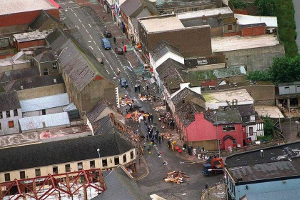
On the day of the bombing, the bombers drive a car, loaded with 230 kilograms (510 lb) of fertiliser-based explosives, across the Irish border. At approximately 2:19 PM they park the vehicle outside S.D. Kells’ clothes shop in Omagh’s Lower Market Street, on the southern side of the town centre, near the crossroads with Dublin Road. They are unable to find a parking space near the intended target, the Omagh courthouse. The two male occupants arm the bomb and, upon exiting the car, walk east down Market Street towards Campsie Road.
Three telephone calls are made warning of a bomb in Omagh, using the same codeword that had been used in the Real IRA’s bomb attack in Banbridge two weeks earlier. At 2:32 PM, a warning is telephoned to Ulster Television saying, “There’s a bomb, courthouse, Omagh, Main Street, 500 lb., explosion 30 minutes.” One minute later, the office receives a second warning saying, “Martha Pope (which is the RIRA’s code word), bomb, Omagh town, 15 minutes.” The caller claims the warning on behalf of “Óglaigh na hÉireann.” One minute later, the Coleraine office of the Samaritans receives a call stating that a bomb will go off on “Main Street” about 200 yards (180 m) from the courthouse. The recipients pass the information on to the Royal Ulster Constabulary (RUC) but are claimed to be inaccurate and police inadvertently move people towards the bomb.
The car bomb detonates at 3:10 PM in the crowded shopping area. The bombing kills 29 people, including a woman pregnant with twins, and injures some 220 others. Twenty-one people who are in the vicinity of the vehicle die at the scene. Eight more people die on the way to or in the hospital. The death toll is higher than that of any single incident during what are considered “the Troubles.”
The bombing causes outrage both locally and internationally, spurs on the Northern Ireland peace process, and deals a severe blow to the Dissident republican campaign. The Real IRA apologises and declares a ceasefire shortly afterwards. The victims include people from many backgrounds: Protestants, Catholics, a Mormon teenager, five other teenagers, six children, a mother pregnant with twins, two Spanish tourists, and others on a day trip from the Republic of Ireland. Both unionists and Irish nationalists are killed and injured.
It is alleged that the British, Irish and U.S. intelligence agencies have information which could have prevented the bombing, most of which comes from double agents inside the Real IRA. This information is not given to the local police, the Royal Ulster Constabulary (RUC). In 2008 it is revealed that British intelligence agency, Government Communications Headquarters, was monitoring conversations between the bombers as the bomb was being driven into Omagh.
A 2001 report by the Police Ombudsman says that the RUC Special Branch failed to act on prior warnings and slammed the RUC’s investigation of the bombing. The RUC has obtained circumstantial and coincidental evidence against some suspects, but it has not come up with anything to convict anyone of the bombing. Colm Murphy is tried, convicted, and then released after it is revealed that Garda Síochána forged interview notes used in the case. Murphy’s nephew, Sean Hoey, is also tried and found not guilty.
In June 2009, the victims’ families win a GB£1.6 million civil action against four defendants. In April 2014, Seamus Daly is charged with the murders of those killed, however, the case against him is withdrawn in February 2016.



 seamus dubhghaill