seamus dubhghaill

Promoting Irish Culture and History from Little Rock, Arkansas, USA


Leave a comment

Execution of Thomas Wentworth, 1st Earl of Stafford

Thomas Wentworth, 1st Earl of Stafford and Lord Deputy of Ireland, is beheaded on Tower Hill near the Tower of London on May 12, 1641.

Wentworth is born in London on April 13, 1593, the eldest surviving son of Sir William Wentworth, a Yorkshire landowner. Educated at St. John’s College, Cambridge, and at the Inner Temple, he is knighted by James I in 1611. His marriage to Lady Margaret Clifford, daughter of the impoverished Francis Clifford, 4th Earl of Cumberland, establishes a link with an ancient and noble family still influential in the north.

Wentworth represents Yorkshire in the parliaments of 1614 and 1621 and Pontefract in 1624. His wife dies childless in 1622, and in February 1625 he marries Arabella Holles, daughter of John Holles, 1st Earl of Clare, a peer out of favour at court who brings Wentworth into touch with the critics of the King’s expensive and inefficient policy of war against Spain and, from 1627, against France. Along with other critics of the court he is prevented from sitting in the Parliament of 1626, and later in the year he refuses to subscribe to the forced loan imposed to pay for the war and is for some time under arrest. Despite his record of opposition to the King’s policy, he is approached by the crown — anxious to strengthen its position in the north — with the offer of a barony in 1628. He is appointed lord president of the Council of the North and in 1629 is given a seat on the Privy Council of the United Kingdom.

Wentworth’s return to the service of the court, coming so soon after his vehement opposition to it in Parliament, startles even some of his closest friends. His conduct is no doubt partly inspired by personal ambition, though he has logical reasons for his change of front since in the summer of 1628 the King gradually abandons his war policy.

On the Privy Council Wentworth seems to advocate the paternalist government that distinguishes the early years of the King’s personal rule. As President of the Council of the North he quells all defiance of his authority and makes many enemies by his insistence on the honour due to him as the King’s representative, but his administration is on the whole just and efficient. In 1631 he is deeply distressed by the death of his much-loved wife, though he provokes scandalous rumours not long afterward by secretly marrying Elizabeth Rodes, the young daughter of a neighbouring squire, in October 1632.

The King meanwhile has appointed Wentworth Lord Deputy of Ireland. Taking up his office in the summer of 1633, he immediately sets himself to consolidate the royal authority, break the power of the dominant clique of “new English” landowners, extend English settlement, improve methods of agriculture, increase the productivity of the land, and stimulate industry and trade. His ultimate goal is to assimilate Irish law and customs to the English system and to make a prosperous Protestant Ireland into a source of revenue to the English crown.

Wentworth continues his effective and firm-handed administration of Ireland until 1639, when he is recalled to England by King Charles I. The King needs advice and support in handling a Scottish revolt precipitated by an ill-conceived attempt to enforce episcopacy on the Scots. He is created Earl of Strafford in 1640 and is expected to resolve the crisis. But his policy of making war on Scotland proves disastrous for both him and the King. The English Parliament, called especially to vote money for the war, prove recalcitrant, and Strafford, in command of the English army, fails to prevent the Scots from overrunning the northern counties. The King, unable to pay his own troops or to buy off the Scots, is compelled by joint English and Scottish action to call a new Parliament in November 1640.

Wentworth is the chief target of attack from both nations. He is advised to leave the country, but the King relies on his help and assures him that he should not suffer in life or fortune. Detained by illness, he reaches Westminster on November 10 with the intention of impeaching the King’s opponents in Parliament for treasonable correspondence with the Scots. The leader of the House of Commons, John Pym, acts first by impeaching Wentworth before he can take his seat in the House of Lords.

Wentworth’s trial begins in March 1641. The basic accusation is that of subverting the laws and is supported by a charge that he had offered to bring over the Irish army to subdue the King’s opponents in England. More detailed charges rest on his administration in Ireland and the north. He conducts his defense with great skill, and it looks at one point as though he might be acquitted. Pym therefore introduces a bill of attainder. The Commons passes it by a large majority. The Lords, intimidated by popular rioting, pass it as well, but by a much smaller majority.

While an angry mob surges around Whitehall, Wentworth writes to the King releasing him from his promise of protection, and Charles, afraid for the safety of the Queen, gives his consent to the bill. He is executed before a crowd estimated, probably with some exaggeration, at 300,000 on May 12, 1641 (as this number is roughly the population of London at the time, the crowd is likely to have been a good deal smaller). In his last speech he once more professes his faith in “the joint and individual prosperity of the king and his people,” for which, in his view, he has always worked.

Wentworth remains an enigmatic figure in English history: ambitious, greedy for power and wealth, ruthless, and sometimes dishonest, but with a vision of benevolent authoritarian government and efficient administration to which he often gave persuasive expression. He made innumerable enemies, but his few close friends were deeply attached to him. In the last weeks of his life his dignity, eloquence, and loyalty to the King made a deep impression even on some of his enemies.

Leave a comment

Death of Isabella Tod, Women’s Rights Activist

Isabella Maria Susan Tod, Irish women’s rights activist, dies at her home at 71 Botanic Avenue in Belfast on December 8, 1896. She is a formidable lady who uses her political skills to great advantage in order to further many causes.

Tod is born on May 18, 1836, in Edinburgh into a well-known Irish Presbyterian family, her uncle being the Rev. Hope Masterton Waddell, one of the earliest Irish Presbyterian missionaries who served with the Scottish Missionary Society in Jamaica and whose great grandfather is the Rev. Charles Masterton, one of the most distinguished minsters of the General Synod of Ulster who ministers at Connor and Rosemary Street, Belfast. She is very proud of her Presbyterian heritage and of her Scottish ancestry.

The daughter of James Banks Tod, an Edinburgh merchant, Tod spends her early years in Edinburgh. She is educated at home by her mother, Maria Isabella Waddell, who comes from County Monaghan. The family moves to Belfast in the 1850s following the death of her father. She and her mother join Elmwood Presbyterian Church. Her Presbyterian background no doubt contributes to her radical views on social issues and women’s rights. She earns her living from writing and journalism, contributing, for example, to the Dublin University Magazine, an independent literary, cultural and political magazine, and to the Banner of Ulster, a Presbyterian newspaper.

Tod becomes one of the leading pioneers in the fight to improve the position of women. She is the only woman called to give evidence to a Select Committee of Enquiry on the reform of the married women’s property law in 1868 and serves on the executive of the Married Women’s Property Committee in London from 1873 to 1874. She successfully campaigns for the repeal of the Contagious Diseases Acts of 1864, 1866 and 1869 which enacted that a woman suspected of being a prostitute could be arrested and forced to undergo medical examination for venereal disease. She sees this legislation as an infringement of a woman’s civil liberties.

Tod is also a strong supporter of the temperance movement and, along with her friend Margaret Byers, forms the Belfast Women’s Temperance Association in 1874. Perhaps she is best known for her tireless campaign to extend the educational provision for middle-class women. For example, in 1878 she organises a delegation to London to put pressure on the Government to include girls in the Intermediate Education Act of 1878. The Ladies’ Collegiate School in Belfast, Alexandra College in Dublin and the Belfast Ladies Institute owe their existence largely to her. She writes a paper entitled “An Advanced Education for Girls in the Upper and Middle Classes” which is presented in 1867 at a meeting of the National Association for the Promotion of Social Science and is among the pamphlets held in the Presbyterian Historical Society of Ireland library.

Tod is also an active campaigner for women’s right to vote, embarking on her first campaign in 1872 and addressing meetings in Belfast, Carrickfergus, Coleraine and Londonderry. Following a meeting in Dublin a suffrage committee is established that later becomes the Dublin Women’s Suffrage Society and in 1873 she forms the North of Ireland Women’s Suffrage Society. She extends her meetings to London, Glasgow and Edinburgh and is a frequent visitor to London to lobby politicians during the parliamentary session.

Tod is very much a staunch opponent of Home Rule, establishing a branch of the London-based Women’s Liberal Federation in Belfast and the Liberal Women’s Unionist Association. She sees unionism as the way to progress. “I knew that all the social work in which I had taken so prominent a part for 20 years was in danger and most of it could not exist a day under a petty legislature of the character which would be inevitable,” she says. “What we dread is the complete dislocation of all society, especially in regard to commercial affairs and organised freedom of action.”

Tod suffers from ill-health in her later days and dies in Belfast of pulmonary illness on December 8, 1896. She is buried in Balmoral Cemetery in South Belfast.


Leave a comment

Birth of George Clinton, Soldier & Statesman

george-clinton

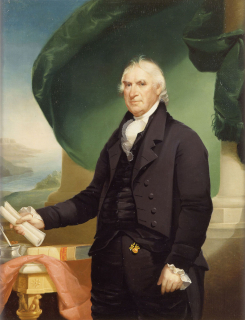
George Clinton, American soldier and statesman considered one of the Founding Fathers of the United States, is born in Little Britain, Province of New York, British America on July 26, 1739. A prominent member of the Democratic-Republican Party, he serves as the fourth Vice President of the United States from 1805 until his death in 1812. He also serves as Governor of New York from 1777 to 1795 and from 1801 to 1804. Along with John C. Calhoun, he is one of only two vice presidents to hold office under two presidents.

Clinton’s parents are Colonel Charles Clinton and Elizabeth Denniston Clinton, Presbyterian immigrants who had left County Longford in Ireland in 1729 to escape an Anglo-Irish regime that imposed severe disabilities on religious dissenters. His political interests are inspired by his father, who is a farmer, surveyor, and land speculator, and serves as a member of the New York colonial assembly. He is the brother of General James Clinton and the uncle of New York’s future governor, DeWitt Clinton. He is tutored by a local Scottish clergyman.

Clinton serves in the French and Indian War, rising to the rank of lieutenant in the colonial militia. He begins a legal practice after the war and serves as a district attorney for New York City. He becomes Governor of New York in 1777 and remains in that office until 1795. He supports the cause of independence during the American Revolutionary War and serves in the Continental Army despite his gubernatorial position. During and after the war, he is a major opponent of Vermont‘s entrance into the union due to disputes over land claims.

Opposed to the ratification of the Constitution of the United States, Clinton becomes a prominent Anti-Federalist and advocates for the addition of the United States Bill of Rights. In the early 1790s, he emerges as a leader of the incipient Democratic-Republican Party and serves as the party’s vice-presidential candidate in the 1792 presidential election. He receives the third most electoral votes in the election, as President George Washington and Vice President John Adams both win re-election. He does not seek re-election in 1795 but serves as governor again from 1801 to 1804. He is the longest-serving governor in U.S. history until Terry Branstad surpasses his record in 2015.

Clinton is again tapped as the Democratic-Republican vice-presidential nominee in the 1804 presidential election, as President Thomas Jefferson dumps Aaron Burr from the ticket. Clinton seeks his party’s presidential nomination in the 1808 presidential election, but the party’s congressional nominating caucus instead nominates James Madison. Despite his opposition to Madison, Clinton is re-elected as vice president.

George Clinton dies in Washington, D.C. on April 20, 1812, leaving the office of vice president vacant for the first time in U.S history. He is buried in the Old Dutch Churchyard in Kingston, New York. His nephew, DeWitt Clinton, continues the Clinton New York political dynasty after his uncle’s death.

(Pictured: Portrait of George Clinton by Ezra Ames, 1814)


Leave a comment

Birth of Elizabeth Hamilton, Poet & Novelist

LEAD Technologies Inc. V1.01

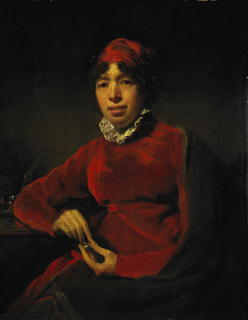
Elizabeth Hamilton, essayist, poet, satirist and novelist, is born in Belfast on July 25, 1756, though the date is often given as 1758.

Hamilton is born to Charles Hamilton (d.1759), a Scottish merchant, and his wife Katherine Mackay (d.1767). She lives most of her life in Scotland, moving there in 1762 to live with a Mrs. Marshall, her paternal aunt, near Stirling and spending much of her later life in Edinburgh.

Hamilton’s first literary efforts are directed in supporting her brother Charles in his orientalist and linguistic studies. After his death in 1792 she continues to publish orientalist scholarship, as well as historical, educationalist and theoretical works. She writes The Cottagers of Glenburnie (1808), a tale which has much popularity in the day, and perhaps has some effect in the improvement of certain aspects of humble domestic life in Scotland. She also writes the anti-Jacobin novel Memoirs of Modern Philosophers (1800), and the satirical Translation of the Letters of a Hindoo Rajah in 1796, a work in the tradition of Montesquieu and Oliver Goldsmith. Her most important pedagogical works are Letters on Education (1801), Letters on the Elementary Principles of Education (1801), Letters addressed to the Daughter of a Nobleman, on the Formation of Religious and Moral Principle (1806), and Hints addressed to the Patrons and Directors of Schools (1815).

Elizabeth Hamilton dies in Harrogate, North Yorkshire, England on July 23, 1816, following a short illness.

(Pictured: Portrait of Elizabeth Hamilton, 1812, by Sir Henry Raeburn)


6 Comments

Murder of Shane “the Proud” O’Neill

Shane O’Neill, Irish patriot known by the nickname “Shane the Proud,” is murdered in what is now Cushendum, County Antrim, Northern Ireland on June 2, 1567. He is among the most famous of all the O’Neills.

O’Neill, the eldest legitimate son of Conn O’Neill, 1st Earl of Tyrone, is a chieftain whose support the English consider worth gaining. However, he rejects overtures from Thomas Radclyffe, 3rd Earl of Sussex, the Lord Deputy of Ireland, and refuses to help the English against the Scottish settlers on the coast of Antrim. He allies himself instead with the MacDonnells, the most powerful of these immigrants. Nevertheless, Queen Elizabeth I of England is disposed to come to terms with O’Neill who, after his father’s death, is de facto chief of the O’Neill clan. She recognizes his claims to the chieftainship, thus throwing over a kinsman, Brian O’Neill. O’Neill, however, refuses to put himself in the power of Sussex without a guarantee for his safety and his claims are so exacting that Elizabeth determines to restore Brian. An attempt to incite the O’Donnells against him, however, is frustrated.

Elizabeth, who is not prepared to undertake the subjugation of the Irish chieftain, urgently desires peace with O’Neill, especially when the devastation of his territory by Sussex brings him no nearer to submission. Sussex is not supported by the queen, who sends Gerald FitzGerald, 11th Earl of Kildare to arrange terms with O’Neill. The latter agrees to present himself before Elizabeth. Accompanied by Thomas Butler, 10th Earl of Ormond and Kildare, he reaches London on January 4, 1562. Elizabeth temporizes but, finding that O’Neill is in danger of becoming a tool in the hands of Spanish intriguers, permits him to return to Ireland, recognizing him as “the O’Neill,” and chieftain of Tyrone.

There are at this time three powerful contemporary members of the O’Neill family in Ireland — O’Neill, Turlough Lynagh O’Neill, and Matthew Ó Néill, 1st Baron Dungannon. Turlough had schemed to supplant O’Neill during his absence in London. The feud does not long survive O’Neill’s return to Ireland, where he reestablishes his authority and renews his turbulent tribal warfare. Elizabeth at last authorizes Sussex to take the field against O’Neill, but two expeditions fail. O’Neill then lays the entire blame for his lawless conduct on the lord deputy’s repeated alleged attempts on his life. Elizabeth consents to negotiate, and practically all of O’Neill’s demands are conceded.

O’Neill then turns his hand against the MacDonnells, claiming that he is serving the Queen of England in harrying the Scots. He fights an indecisive battle with Sorley Boy MacDonnell near Coleraine in 1564, and in 1565 he routs the MacDonnells and takes Sorley Boy prisoner near Ballycastle. This victory strengthens O’Neill’s position, but the English make preparations for his subjugation.

Failing in an attempt to arrange terms, and also in obtaining the help which he solicited from France, O’Neill is utterly routed by the O’Donnells at the Battle of Farsetmore near Letterkenny and, seeking safety in flight, throws himself on the mercy of his enemies, the MacDonnells. Attended by a small body of gallowglass, and taking his prisoner Sorley Boy with him, he presents himself among the MacDonnells near Cushendun, on the Antrim coast, hoping to propose an alliance. Here, on June 2, 1567, he is killed by the MacDonnells and his headless body is buried at Crosskern Church at Ballyterrim above Cushendun. His body is possibly later moved to Glenarm Abbey. Unbeknownst to O’Neill, The Scots had already come to an agreement with Henry Sidney and William Piers, Seneschal of Clandeboye, commander of the English garrison at Carrickfergus. The English Government tries to pass this off as a “drunken brawl” turned savage. Piers travels to Cushendun to take O’Neill’s head and send it to Dublin Castle.


Leave a comment

Birth of Peter Sutherland, Barrister & Politician

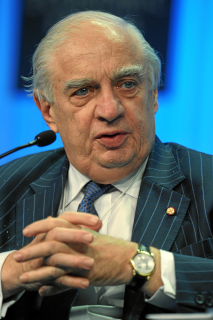
File source: http://commons.wikimedia.org/wiki/File:Peter-Sutherland-2011.jpg

Peter Denis Sutherland, businessman, barrister and politician, is born in Foxrock, Dublin on April 25, 1946. He is a barrister by profession and a Senior Counsel of the Bar Council of Ireland. He is known for serving in a variety of international organisations, political and business roles.

Sutherland is educated at Gonzaga College, Ranelagh, Dublin. He is of partial Scottish ancestry. He graduates in Civil Law at University College Dublin and practices at the Irish Bar between 1969 and 1980. He marries Maruja Sutherland, a Spaniard, in 1974.

Sutherland makes his entry into politics when he is appointed Attorney General of Ireland in June 1981. He resigns in March 1982 only to take the post again between December 1982 and December 1984.

Sutherland is appointed to the European Commission in 1985. He is Chairman of the Committee that produces The Sutherland Report on the completion of the Internal Market of the European Economic Community (EEC), commissioned by the European Commission and presented to the European Council at its Edinburgh meeting in 1992.

Sutherland serves as United Nations Special Representative of the Secretary-General for International Migration from January 2006 until March 2017. He is responsible for the creation of the Global Forum on Migration and Development (GFMD). He also serves as President of the International Catholic Migration Commission, as well as member of the Migration Advisory Board of the International Organisation for Migration.

In 1993, Sutherland becomes Director-General of the General Agreement on Tariffs and Trade, now the World Trade Organization. He serves as Chairman of Allied Irish Banks (AIB) from 1989 to 1993 and as Chairman of Goldman Sachs from 1995 to 2015.

In September 2016, Sutherland suffers a heart attack while on his way to Mass at a Catholic Church in London. Six months later, he resigns from his post as United Nations Special Representative of the Secretary-General for International Migration because of poor health. After a long illness, he dies at St. James’s Hospital in Dublin on January 7, 2018, of complications from an infection, at the age of 71. He is buried in Kilternan Cemetery Park in Dublin.

Peter Sutherland received numerous awards including European Person of the Year Award (1988).

(Pictured: Peter D. Sutherland, Chairman, Goldman Sachs International, United Kingdom; Member of the Foundation Board of the World Economic Forum, speaks during the session ‘China’s Impact on Global Trade and Growth’ at the Annual Meeting 2011 of the World Economic Forum in Davos, Switzerland, January 27, 2011. Copyright by World Economic Forum swiss-image.ch/Photo by Michael Wuertenberg)


Leave a comment

The Rathlin Island Massacre

bruces-castle-ruins

The Rathlin Island massacre takes place on Rathlin Island, off the coast of what is now Northern Ireland, on July 26, 1575. More than 600 Scots and Irish are killed.

Rathlin Island is used as a sanctuary because of its natural defences and rocky shores. In earlier times, when the wind blows from the west it is almost impossible to land a boat. It is also respected as a hiding place, as it is the one-time abode of Saint Columba. Installing themselves in Rathlin Castle (also known as Bruce’s Castle), the MacDonnells of Antrim make Rathlin their base for resistance to the Enterprise of Ulster. Their military leader, Sorley Boy MacDonnell (Scottish Gaelic: Somhairle Buidhe Mac Domhnaill) and other Scots have thought it prudent to send their wives, children, elderly, and sick to Rathlin Island for safety.

Acting on the instructions of Sir Henry Sidney and the Walter Devereux, 1st Earl of Essex, Sir Francis Drake and Sir John Norreys take the castle by storm. Drake uses two cannons to batter the castle and when the walls give in, Norreys orders direct attack on July 25, and the Garrison surrenders. Norreys sets the terms of surrender, whereupon the constable, his family, and one of the hostages are given safe passage and all other defending soldiers are killed. On July 26, 1575, Norreys’ forces hunt the old, sick, very young and women who are hiding in the caves. Despite the surrender, they kill all the 200 defenders and more than 400 civilian men, women and children. Sir Francis Drake is also charged with the task of preventing any Scottish reinforcement vessels from reaching the island.

The entire family of Sorley Boy MacDonnell perishes in the massacre. Essex, who orders the killings, boasts in a letter to Francis Walsingham, the Queen’s secretary and spymaster, that Sorley Boy MacDonnell watched the massacre from the mainland helplessly and was “like to run mad from sorrow.”

Norreys stays on the island and tries to rebuild the walls of the castle so that the English might use the structure as a fortress. As Drake is not paid to defend the island, he departs with his ships. Norreys realises that it is not possible to defend the island without intercepting Scottish galleys and he returns to Carrickfergus in September 1575.

(Pictured: the ruins of Rathlin Castle)


Leave a comment

Birth of John Robert Gregg, Inventor of Gregg Shorthand

john-robert-gregg

John Robert Gregg, educator, publisher, humanitarian, and the inventor of the eponymous shorthand system Gregg shorthand, is born in Shantonagh, County Monaghan on June 17, 1867.

Gregg is the youngest child of Robert and Margaret Gregg. They move to Rockcorry in 1872. Robert Gregg, who is of Scottish ancestry, is stationmaster at the Bushford railway station in Rockcorry. He and his wife raise their children as strict Presbyterians and send their children to the village school in Rockcorry. On Gregg’s second day of class, he is caught whispering to a schoolmate, which prompts the schoolmaster to hit the two children’s heads together. This incident profoundly damages Gregg’s hearing for the rest of his life, rendering him unable to participate fully in school, unable to understand his teacher. This ultimately leads to him unnecessarily being perceived as dull or mentally challenged by his peers, teachers, and family.

In 1877, one of Robert Gregg’s friends, a journalist named Annesley, visits the village for a weekend. He is versed in Pitman Shorthand and takes verbatim notes of the sermon at the village church. This causes the preacher to sweat and stutter out of fear that his sermon, which he has plagiarized from a famous preacher, would be made public through Annesley’s notes. That day, Robert Gregg sees the shorthand skill as a powerful asset, so he makes it mandatory for his children to learn Pitman shorthand, with the exception of John, who is considered by his family too “simple” to learn it. None of the children succeed in fully learning the system. On his own, John Robert learns a different shorthand system, that of Samuel Taylor, published in a small book by Odell. He teaches himself the system fully since he does not require the ability to hear in order to learn from the book.

Due to hardships on the family, Gregg has to leave school before the age of 13 in order to support his family’s income. He works in a law office, earning five shillings a week.

Gregg professes he initially set out to improve the English adaptation by John Matthew Sloan of the French Prévost Duployan shorthand, while working with one of Sloan’s sales agents, Thomas Malone. Malone publishes a system called Script Phonography, of which Gregg asserts a share in authorship is owed to him. Angered by Malone, Gregg resigns from working with him and encouraged by his older brother Samuel, publishes and copyrights his own system of shorthand in 1888. It is put forth in a brochure entitled Light-Line Phonography: The Phonetic Handwriting which he publishes in Liverpool, England.

In 1893, he emigrates to the United States, where he publishes in the same year Gregg Shorthand. The method meets with great success in the new country, and Gregg settles in Chicago where he authors numerous books for the Gregg Publishing Company on the subjects of shorthand and contemporary business practices.

John Robert Gregg dies in New York City, at the age of 80, on February 23, 1948.