seamus dubhghaill

Promoting Irish Culture and History from Little Rock, Arkansas, USA


Leave a comment

Founding of the Gaelic League

conradh-na-gaeilge-logo

The Gaelic League (Irish: Conradh na Gaeilge), a social and cultural organisation which promotes the Irish language in Ireland and worldwide is founded in Dublin on July 31, 1893.

Conradh na Gaeilge is founded by Douglas Hyde, the son of a Church of Ireland rector from Frenchpark, County Roscommon, with the aid of Eugene O’Growney, Eoin MacNeill, Thomas O’Neill Russell, and others. The organisation develops from Ulick Bourke‘s earlier Gaelic Union and becomes the leading institution promoting the Gaelic Revival, carrying on efforts like the publishing of the Gaelic Journal. The League’s first newspaper is An Claidheamh Soluis (The Sword of Light) and its most noted editor is Patrick Pearse. The motto of the League is Sinn Féin, Sinn Féin amháin (Ourselves, Ourselves alone).

The League encourages female participation from the start and a number of women play a prominent role. They are not restricted to subordinate roles, but play an active part in leadership, although males are in the overwhelming majority. Local notables, such as Lady Gregory in Galway, Lady Esmonde in County Wexford, and Mary Spring Rice in County Limerick, and others such as Norma Borthwick, found and lead branches in their communities. At the annual national convention in 1906 women are elected to seven of the forty-five positions on the Gaelic League executive. Executive members include Máire Ní Chinnéide, Úna Ní Fhaircheallaigh (who writes pamphlets on behalf of the League), Bean an Doc Uí Choisdealbha, Máire Ní hAodáin, Máire de Buitléir, Nellie O’Brien, Eibhlín Ní Dhonnabháin, and Eibhlín Nic Néill.

Though apolitical, the organisation attracts many Irish nationalists of different persuasions, much like the Gaelic Athletic Association. It is through the League that many future political leaders and rebels first meet, laying the foundation for groups such as the Irish Volunteers. However, Conradh na Gaeilge does not commit itself entirely to the national movement until 1915, causing the resignation of Douglas Hyde, who feels that the culture of language should be above politics. Most of the signatories of the 1916 Proclamation are members. It still continues to attract many Irish Republicans. Seán Mac Stíofáin, the first chief of staff of the Provisional IRA was a prominent member in his later life.

After the foundation of the Irish Free State in 1922, the organisation has a less prominent role in public life as Irish is made a compulsory subject in state-funded schools. It does unexpectedly bad in the Irish Seanad election of 1925, when all the candidates it endorses are defeated, including Hyde.


Leave a comment

Bloody Friday in Belfast

bloody-friday-1972

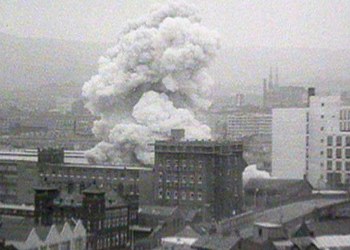
At least twenty Provisional Irish Republican Army (IRA) bombs explode in Belfast on July 21, 1972, during the Troubles in what has become known as “Bloody Friday.” Most of the bombs are car bombs and most target infrastructure, especially the transport network. Nine people are killed, including two British soldiers and five civilians, while 130 are injured.

In late June and early July 1972, a British government delegation led by William Whitelaw holds secret talks with the Provisional IRA leadership. As part of the talks, the IRA agrees to a temporary ceasefire beginning on June 26. The IRA leaders seek a peace settlement that includes a British withdrawal from Northern Ireland by 1975 and the release of republican prisoners. However, the British refuse and the talks break down. The ceasefire comes to an end on July 9.

Bloody Friday is the IRA’s response to the breakdown of the talks. According to the IRA’s Chief of Staff, Seán Mac Stíofáin, the main goal of the bombing operation is to wreak financial harm. It is a “message to the British government that the IRA could and would make a commercial desert of the city unless its demands were met.” Some also see it as a reprisal for Bloody Sunday in Derry six months earlier. The attack is carried out by the IRA’s Belfast Brigade and the main organiser is Brendan Hughes, the brigade’s Officer Commanding.

The bombings occur during an 80-minute period on the afternoon of Friday, July 21. At least 24 bombs are planted. At least 20 explode and the rest fail to detonate or are defused. At the height of the bombing, the middle of Belfast “resembled a city under artillery fire; clouds of suffocating smoke enveloped buildings as one explosion followed another, almost drowning out the hysterical screams of panicked shoppers.” According to The Guardian, “for much of the afternoon, Belfast was reduced to near total chaos and panic. Thousands streamed out of the stricken city…and huge traffic jams built up. All bus services were cancelled, and on some roads, hitchhikers frantically trying to get away lined the pavements.”

Nine people are killed and 130 are injured, some of them horrifically mutilated. Of those injured, 77 are women and children. All of the deaths are caused by two of the bombs – at Oxford Street bus depot and at Cavehill Road. The Oxford Street bomb kills two British soldiers and four Ulsterbus employees. One employee is a Royal Ulster Constabulary (RUC) reservist, one is an Ulster loyalist paramilitary, and the other two are civilians. The Cavehill Road bomb kills three civilians.

The IRA’s Belfast Brigade claims responsibility for the bombings and says that it had given warnings to the security forces before the bombs exploded. It says that the Public Protection Agency, the Samaritans and the press “were informed of bomb positions at least 30 minutes to one hour before each explosion.” Mac Stíofáin says, “It required only one man with a loud hailer to clear each target area in no time” and alleged that the warnings for the two bombs that claim lives are deliberately ignored by the British for “strategic policy reasons.”


Leave a comment

Sinn Féin Splits in 1970

sinn-fein

On January 11, 1970, at Sinn Féin‘s Ard Fheis at the Intercontinental Hotel in Ballsbridge, Dublin, the proposal to end abstentionism and take seats, if elected, in the Dáil, the Northern Ireland Parliament, and the Parliament of the United Kingdom is put before the members. A similar motion had been adopted at an Irish Republican Army (IRA) convention the previous month, leading to the formation of a Provisional Army Council by Seán Mac Stíofáin and other members opposed to the leadership.

There are allegations of malpractice and that some supporters cast votes to which they are not entitled. In addition, the leadership has also refused voting rights to a number of Sinn Féin cumainn (branches) known to be in opposition, particularly in the north and in County Kerry. The motion is debated all of the second day, and when it was put to a vote at 5:30 PM the result is 153:104 in favour of the motion, failing to achieve the necessary two-thirds majority.

The Executive attempts to circumvent this by introducing a motion in support of the IRA Army Council, led by Tomás Mac Giolla, which only requires a simple majority. In protest of the motion, Ruairí Ó Brádaigh and his minority group walks out of the meeting. These members reconvene at a hall in 44 Parnell Square, which they had already booked in anticipation of the move by the leadership. They appoint a Caretaker Executive, and pledged allegiance to the Provisional Army Council.

irish-republican-army

The Caretaker Executive declares itself in opposition to the ending of abstentionism, the drift towards Marxism, the failure of the leadership to defend the nationalist people of Belfast during the 1969 Northern Ireland riots, and the expulsion of traditional republicans by the leadership during the 1960s. At the October 1970 Ard Fheis, it is announced that an IRA convention has been held and has regularised its structure, bringing the “provisional” period to an end.

At the end of 1970 the terms “Official IRA” and “Regular IRA” are introduced by the press to differentiate the two factions. During 1971, the rival factions play out their conflict in the press with the Officials referring to their rivals as the Provisional Alliance, while the Provisionals refer to the Officials (IRA and Sinn Féin) as the National Liberation Front (NLF).

The Falls Road Curfew, coupled with internment in August 1971, and Bloody Sunday in Derry in January 1972, boosts the Provisionals in Belfast. These events produce an influx into the Provisionals on the military side, making them the dominant force and finally eclipsing the Officials everywhere. Despite becoming the dominant group and the dropping of the word “provisional” at the convention of the IRA Army Council in September 1970, they are still known to the mild irritation of senior members as Provisionals, Provos, or Provies.