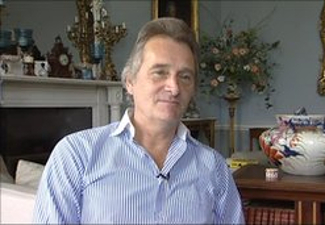
Styled Viscount Slane until 1974 and Earl of Mount Charles from 1974 until 2009, he succeeds his father in the marquessate and other titles in 2009. However, in the Republic of Ireland frequently, and erroneously, he remains referred to as Lord Mountcharles, his former courtesy title. He also inherits the U.K. peerage title Baron Minster, of Minster Abbey in the County of Kent, created in 1821 for his ancestor, the 1st marquess thereby giving the Marquesses Conyngham the automatic right to sit in the British House of Lords until 1999.
Lord and Lady Conyngham divide their time between Beauparc House and Slane Castle in County Meath. The latter is the family’s principal ancestral seat until it is badly damaged by fire in 1992. The castle has now been restored.
The Marquess Conyngham enjoys a high profile in Ireland as the author of a weekly column in the Daily Mirror. He has been dubbed the rock and roll aristocrat or the rock and roll peer owing to the very successful series of rock concerts he has hosted since 1981, held in the natural amphitheatre on the grounds of Slane Castle. These concerts have included performances by The Rolling Stones, Thin Lizzy, Queen, U2, Bob Dylan, Bruce Springsteen, David Bowie, Guns N’ Roses, Oasis, and Madonna. Lord Conyngham receives the Industry Award at the 2010 Meteor Awards. In his autobiography Public Space–Private Life: A Decade at Slane Castle, he describes his business career and the challenges of being an Anglo-Irish peer in modern Ireland, and how being Anglo-Irish has gradually become more accepted there.
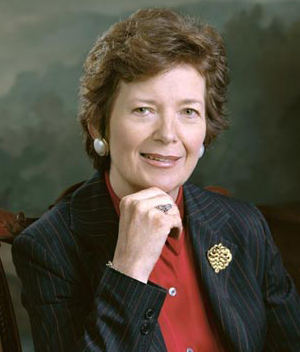
Robinson first rises to prominence as an academic, barrister, campaigner, and member of the Irish Senate (1969–1989). Running as an Independent candidate nominated by the Labour Party, the Workers’ Party, and independent senators, Robinson defeats Fianna Fáil‘s Brian Lenihan and Fine Gael‘s Austin Currie in the 1990 presidential election becoming the first elected president in the office’s history not to have had the support of Fianna Fáil.
Robinson is widely regarded as a transformative figure for Ireland, and for the Irish presidency, revitalising and liberalising a previously conservative, low-profile political office. She resigns the presidency two months before the end of her term in office in order to take up her post in the United Nations. During her UN tenure, she visits Tibet in 1998, the first High Commissioner to do so. She criticises Ireland’s immigrant policy and criticises the use of capital punishment in the United States. She extends her intended single four-year term by a year to preside over the World Conference against Racism 2001 in Durban, South Africa. The conference proves controversial, and under continuing pressure from the United States, Robinson resigns her post in September 2002.
After leaving the UN in 2002, Robinson forms Realizing Rights: The Ethical Globalization Initiative, which comes to a planned end at the end of 2010. Its core activities are fostering equitable trade and decent work, promoting the right to health and more humane migration policies, and working to strengthen women’s leadership and encourage corporate social responsibility. The organisation also supports capacity building and good governance in developing countries. Robinson returns to live in Ireland at the end of 2010, and sets up The Mary Robinson Foundation – Climate Justice, which aims to be “a centre for thought leadership, education, and advocacy on the struggle to secure global justice for those many victims of climate change who are usually forgotten – the poor, the disempowered, and the marginalised across the world.”
In July 2009, Robinson is awarded the Presidential Medal of Freedom, the highest civilian honour awarded by the United States. In presenting the award to Robinson, U.S. President Barack Obama says, “Mary Robinson learned early on what it takes to make sure all voices are heard. As a crusader for women and those without a voice in Ireland, Mary Robinson was the first woman elected President of Ireland, before being appointed U.N. High Commissioner for Human Rights. When she traveled abroad as President, she would place a light in her window that would draw people of Irish descent to pass by below. Today, as an advocate for the hungry and the hunted, the forgotten and the ignored, Mary Robinson has not only shone a light on human suffering but illuminated a better future for our world.”
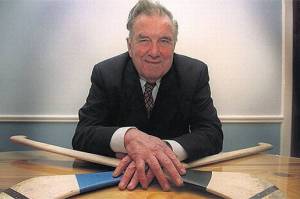
John Doyle, Irish sportsperson and politician, hailed as one of the best defenders in hurling and his county’s most iconic player upon his death, is born in Holycross, County Tipperary, on February 12, 1930.
Doyle first excels at hurling while at school in Thurles CBS. Regarded as too good for CBS Primary School team, he is drafted into the secondary school’s under-15 Croke Cup team in 1942. Doyle plays at wing-forward as Thurles CBS wins the championship that year.
Doyle arrives on the inter-county scene at the age of sixteen when he first links up with the Tipperary minor team. He makes his senior debut in the 1947-48 National League. A 5-6 to 4-2 defeat of Cork in the provincial decider gives him his first Munster medal. Tipperary retains their provincial crown in 1947, with Doyle collecting a second Munster medal following a 2-4 to 1-2 defeat of Waterford. Doyle goes on to play a key role for Tipperary during a hugely successful era for the team, winning eight All-Ireland medals, ten Munster medals, and ten National Hurling League medals.
On June 26, 1949, Doyle makes his senior championship debut in a Munster quarter-final replay against Cork. As a member of the Munster inter-provincial team for fifteen years, Doyle wins six Railway Cup medals. At club level he wins three championship medals with Holycross-Ballycahill.
After surrendering their provincial crown in 1966, Tipperary bounces back the following year, with Doyle winning a record tenth Munster medal following a 4-12 to 2-6 defeat of Clare. On September 3, 1967, Tipperary faces Kilkenny in the All-Ireland decider, a game which presents Doyle win the opportunity of making history by winning a record-breaking ninth All-Ireland medal. Despite leading at halftime 2-6 to 1-3, Kilkenny goalkeeper Ollie Walsh makes a series of spectacular saves in the second half and Kilkenny is victorious 3-8 to 2-7 and lays to rest a bogey that Tipperary has had over the team since 1922. The defeat brings the curtain down on Doyle’s inter-county career.
For almost fifty years Doyle, together with Christy Ring, hold a unique record as the only players to win eight All-Ireland medals on the field of play. This record is subsequently surpassed by Henry Shefflin on September 30, 2012. His record of National League medals has yet to be equalled. Throughout his career, Doyle makes 54 championship appearances, a Tipperary record which stands until August 9, 2009 when it is surpassed by Brendan Cummins.
In retirement from inter-county hurling, Doyle continues to work on his farm in Holycross. In later years he enters politics. He stands unsuccessfully as a Fianna Fáil candidate at the 1969 general election for the Tipperary North constituency, but is subsequently elected to Seanad Éireann on the Agricultural Panel. He serves until 1973 when he loses his seat.
Doyle is widely regarded as one of the greatest hurlers in the history of the game. During his playing days he wins two Cú Chulainn awards, and is named Texaco Hurler of the Year in 1964. He is repeatedly voted onto teams made up of the sport’s greats, including as left corner-back on the Hurling Team of the Century in 1984 and the Hurling Team of the Millennium in 2000.
John Doyle dies on December 29, 2010. Taoiseach Brian Cowen is among those who pay tribute saying “He was an immense hurler and an incredibly decent man, his love of the GAA was matched by his concern for his country and his own community, he was a Tipperary legend and a proud Irishman.” Doyle is buried at Holy Cross Abbey outside Thurles on December 31, 2010.
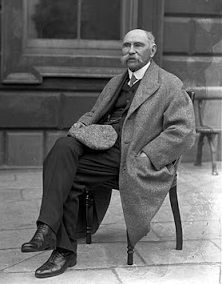
Dr. Douglas Hyde, Gaelic scholar and the first President of Ireland, is born at Longford House in Castlerea, County Roscommon, on January 17, 1860. In 1867, his father is appointed prebendary and rector of Tibohine, and the family moves to neighbouring Frenchpark, in County Roscommon. He is home schooled by his father and his aunt due to a childhood illness. While a young man, he becomes fascinated with hearing the old people in the locality speak the Irish language.
Rejecting family pressure to follow previous generations with a career in the Church, Hyde instead becomes an academic. He enters Trinity College, Dublin, where he gains a great facility for languages, learning Latin, Greek, Hebrew, French, and German, but his great passion in life is the preservation of the Irish language.
After spending a year teaching modern languages in Canada, Hyde returns to Ireland. For much of the rest of his life he writes and collects hundreds of stories, poems, and folktales in Irish, and translates others. His work in Irish helps to inspire many other literary writers, such as W.B. Yeats and Lady Gregory.
In 1892, Hyde helps establish the Gaelic Journal and in November of that year writes a manifesto called The necessity for de-anglicising the Irish nation, arguing that Ireland should follow her own traditions in language, literature, and even in dress.
In 1893, Hyde founds the Gaelic League (Conradh na Gaeilge) along with Eoin MacNeill and Fr. Eugene O’Growney and serves as its first president. Many of the new generation of Irish leaders who play a central role in the fight for Irish independence in the early twentieth century, including Patrick Pearse, Éamon de Valera, Michael Collins, and Ernest Blythe first become politicised and passionate about Irish independence through their involvement in the Gaelic League. Hyde does not want the Gaelic League to be a political entity, so when the surge of Irish nationalism that the Gaelic League helps to foster begins to take control of many in the League and politicize it in 1915, Hyde resigns as president.
Hyde takes no active part in the armed upheaval of the 1910s and 1920s, but does serve in Seanad Éireann, the upper house of the Irish Free State’s Oireachtas, as a Free State senator in 1925-26. He then returns to academia, as Professor of Irish at University College Dublin, where one of his students is future Attorney General and President of Ireland Cearbhall Ó Dálaigh.
In 1938, Hyde is unanimously elected to the newly created position of President of Ireland, a post he holds until 1945. Hyde is inaugurated on June 26, 1938, in the first inaugural ceremony in the nation’s history. Despite being placed in a position to shape the office of the presidency via precedent, Hyde by and large opts for a quiet, conservative interpretation of the office. In April 1940 he suffers a massive stroke and plans are made for his lying-in-state and state funeral, but to the surprise of everyone he survives, albeit paralysed and confined to a wheelchair. One of Hyde’s last presidential acts is a visit to the German ambassador Eduard Hempel on May 3, 1945 to offer his condolences on the death of Adolf Hitler, a visit which remains a secret until 2005.
Hyde leaves office on June 25, 1945, opting not to nominate himself for a second term. He opts not return to his Roscommon home due to his ill-health, but rather moves into the former Secretary to the Lord Lieutenant’s residence in the grounds of Áras an Uachtaráin, where he lived out the remaining four years of his life.
Hyde dies in Dublin on July 12, 1949 at age 89. As a former President of Ireland he is accorded a state funeral which, as a member of the Church of Ireland, takes place in Dublin’s Church of Ireland St. Patrick’s Cathedral. Since contemporary rules of the Roman Catholic Church in Ireland at the time prohibit Roman Catholics from attending services in non-Catholic churches, all but one member of the Catholic cabinet remain outside the cathedral grounds while Hyde’s funeral takes place. Hyde is buried in Frenchpark, County Roscommon at Portahard Church.