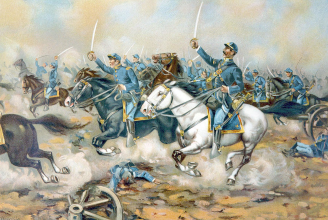
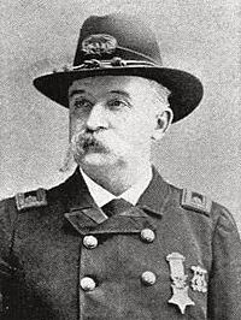
Quinlan receives America’s highest military decoration, the Medal of Honor, on February 18, 1891, for his actions at the Battle of Savage’s Station in Henrico County, Virginia, the fourth of the Seven Days Battles (Peninsula Campaign). His citation states he “led his regiment on the enemy’s battery, silenced the guns, held the position against overwhelming numbers, and covered the retreat of the Second Army Corps.”
James Joseph Quinlan dies on August 29, 1906, in Queens, New York and is buried at Calvary Cemetery, Woodside, Queens County, New York City.
The regiment’s 916 men are organized into 10 companies designated with the letters A–I and K. Most of the companies are organized in Orleans Parish, although Company D is from Tensas Parish, Company C from St. Landry Parish, and Company A from Union Parish and Sabine Parish. The unit’s first colonel is Isaac Seymour, its first lieutenant colonel is Louis Lay, and its first major is Samuel L. James. Over half of the unit’s men with known places of birth are born outside of the United States, primarily from Ireland. In its early days, the unit has a reputation for being disorderly and hard to control. Seymour has to publicly rebuke several officers in late 1861 for drunkenness.
On May 23, 1862, the regiment sees action in the Battle of Front Royal and captures two Union battle flags in a skirmish at Middletown the next day. May 25 sees the regiment engage in the First Battle of Winchester, where MacArthur is killed, and on June 9 it fights in the Battle of Port Republic, in which 66 of its men are killed or wounded. MacArthur’s role as major is then filled by Nathaniel G. Offutt. After Port Republic, Jackson’s men are transferred to the Virginia Peninsula to take part in the Seven Days Battles, and the 6th Louisiana skirmishes at Hundley’s Corner on June 26 before fighting in the Battle of Gaines’ Mill the next day. Seymour leads the brigade at Gaines’ Mill, since Richard Taylor is ill. The Louisianans, known as the Louisiana Tigers, become bogged down in Boatswain’s Swamp, are repulsed with loss, and withdraw from the battle. Seymour is killed during the charge and is replaced by Strong. Offutt takes over Strong’s position as lieutenant colonel, and William Monaghan becomes colonel.
Moving north with Jackson in August, the regiment fights in the Manassas Station Operations at Bristoe Station, Virginia on August 26 and Kettle Run, Virginia the following day. At Kettle Run, the regiment holds off a Union advance while the 8th Louisiana burns a bridge, and then the two regiments, joined by the 60th Georgia Infantry Regiment and the 5th Louisiana Infantry Regiment, fight against the Union Army‘s Excelsior Brigade and the brigade of Colonel Joseph Bradford Carr. It then fights in the Second Battle of Bull Run on August 29-30, 1862. At Second Bull Run, it is part of the brigade of Colonel Henry Forno. On the first day of the battle, Forno’s brigade helps repulse James Nagle‘s Union brigade. On the morning on 30 August 30, it is sent to the rear for supplies and does not rejoin the fighting that day.
After Second Bull Run, the 6th Louisiana fights in the Battle of Chantilly on September 1, 1862, where the Louisiana brigade is routed with the 5th, 6th, 8th, and 14th Louisiana regiments suffering the heaviest casualties in the Confederate army, and on September 17 sees action in the Battle of Antietam. At Antietam, the regiment is part of Harry T. Hays‘s brigade. During the fighting, Hays’s brigade charges toward the Miller’s Cornfield and is cut to pieces, with the brigade suffering 61 percent casualties. The 6th Louisiana loses 52 men killed or wounded, including Colonel Strong, who is killed and replaced with Offutt. All 12 officers of the 6th Louisiana that see action at Antietam are killed or wounded. Monaghan becomes lieutenant colonel and is replaced as major by Joseph Hanlon. Offutt in turn resigns on November 7 and is replaced by Monaghan. Hanlon becomes lieutenant colonel, and Manning is promoted to major. The regiment is held in reserve at the Battle of Fredericksburg on December 13, 1862, and is not directly engaged, although it does come under Union artillery fire.
An inspection in January 1863 rates the 6th Louisiana as having “poor” discipline and moderately good at performance in drills. Along with the 5th Louisiana Infantry, the regiment contests a Union crossing of the Rappahannock River on April 29, 1863. Union troops are able to force a crossing, and the 6th Louisiana has 7 men killed, 12 wounded, and 78 captured. It then fights in the Second Battle of Fredericksburg on May 3, 1863, where 27 of the unit’s men are captured. While part of the regiment is captured, most of the unit is able to withdraw from the field in better condition than the other Confederate units positioned near it. It then fights at the Battle of Salem Church the next day. Altogether, the 6th Louisiana Infantry sustains losses of 14 killed, 68 wounded, and 99 captured at the Battle of Chancellorsville. It next sees combat on June 14, 1863, in the Second Battle of Winchester, where it joins its brigade of other Louisiana units in capturing a Union fort.,
At the Battle of Gettysburg on July 1-3, 1863, the 6th Louisiana is still in Hays’ brigade. On July 1, the brigade is part of a Confederate charge that sweeps the Union XI Corps from the field, although it is less heavily engaged than some of the other participating Confederate brigades. Entering the town of Gettysburg, the brigade captures large numbers of disorganized Union troops. On the evening of the following day, the brigade is part of a failed attack against the Union position on Cemetery Hill. It then spends July 3, the final day of the battle, skirmishing. The Confederates, who are defeated at Gettysburg, withdraw from the field on July 4. The regiment takes 232 men into the fighting at Gettysburg and suffers 61 casualties.
Back in Virginia, the 6th Louisiana fights in the Bristoe campaign in October 1863 and is overrun in the Second Battle of Rappahannock Station on November 7, losing 89 men captured. In the spring of 1864, it fights in Ulysses S. Grant‘s Overland Campaign. On May 5, 1864, in the Battle of the Wilderness, the regiment helps repulse a Union attack, after Hays’ brigade had been repulsed and badly bloodied earlier in the battle. It then fights in the Battle of Spotsylvania Court House on May 9-19, 1864. On May 12, the regiment is part of its brigade’s fighting at the Mule Shoe. The brigade is badly wrecked at the Mule Shoe, and only 60 men are present at the 6th Louisiana’s roll call the next morning. From June through October, it is detached as part of Jubal Early‘s command to fight in the Valley campaigns of 1864. Monaghan is killed in battle in late August and is not replaced as colonel. At the Battle of Cedar Creek in October 1864, one company of the 6th Louisiana sees both men present shot. After the battle, the 5th, 6th, and 7th are consolidated into a single company when the brigade is reorganized due to severe losses. Taking part in the Siege of Petersburg, the 6th Louisiana’s survivors fight at the Battle of Hatcher’s Run on February 6, 1865, and at the Battle of Fort Stedman on March 25.
The 6th Louisiana’s remnants end their military service when Robert E. Lee‘s Confederate army surrenders on April 9, after the Battle of Appomattox Court House. At the time of the surrender, the 6th Louisiana has been reduced to 52 officers and men. Over the course of its existence, 1,146 men serve in the unit. Of that total, 219 are combat deaths, 104 die of disease, one man drowns, five die accidentally, one man is executed, and at least 232 desert. Desertions are particularly heavy in three companies that primary consist of men born outside of the United States.
(Pictured: National colors of the “Orleans Rifles” or Company H, Sixth Louisiana Infantry Regiment during the American Civil War)
Following the inconclusive Battle of Beaver Dam Creek (Mechanicsville) the previous day, ConfederateGeneralRobert E. Lee renews his attacks against the right flank of the Union Army, relatively isolated on the northern side of the Chickahominy River. There, Brigadier GeneralFitz John Porter‘s V Corps establishes a strong defensive line behind Boatswain’s Swamp. Lee’s force is destined to launch the largest Confederate attack of the war, about 57,000 men in six divisions.
Porter’s reinforced V Corps holds fast for the afternoon as the Confederates attack in a disjointed manner, first with the division of Major GeneralA. P. Hill, then Major General Richard S. Ewell, suffering heavy casualties. Put into an exposed, forward position near the bridge over Powhite Creek, the 9th Massachusetts sustains heavy casualties while delaying the advance of A.P. Hill’s division, allowing other Federal forces to improve their defenses. Among the Confederates attacking the 9th’s position are the Irishmen of Company K, 1st South Carolina Rifle Regiment.
After pulling back to the main Federal line, the 9th Massachusetts regiment is hotly engaged again later in the day. Numerous attacks by Hill’s Confederates are repulsed through the day, and the 9th also helps cover the retreat of their brigade. The 9th Massachusetts is one of the last regiments of the V Corps remaining on the field as General Thomas Francis Meagher and his Irish Brigade rush into line to relieve the beleaguered remnant of the brave Massachusetts regiment. The arrival of Major General Stonewall Jackson‘s command is delayed, preventing the full concentration of Confederate force before Porter receives some reinforcements from the VI Corps.
Seeing the green flags of the Irish Brigade coming to the aid of the 9th Massachusetts, Lieutenant Colonel Patrick Guiney, who had been watching his regiment shrink in number all day, shakes the hand of Meagher and exclaims, “Thank God, we are saved.”
At dusk, the Confederates finally mount a coordinated assault that breaks Porter’s line and drives his men back toward the Chickahominy River. The Federals retreat across the river during the night. The Confederates are too disorganized to pursue the main Union force. Gaines’ Mill saves Richmond for the Confederacy in 1862. The tactical defeat there convinces Army of the Potomac commander Major General George B. McClellan to abandon his advance on Richmond and begin a retreat to the James River. The 9th Massachusetts’ loses for the day are 82 killed and 167 wounded.
The battle occurs in almost the same location as the Battle of Cold Harbor nearly two years later.
During the night of June 8–9, 1862, Brig. Gen.Charles S. Winder‘s Stonewall Brigade is withdrawn from its forward position near Bogota, a large house owned by Gabriel Jones, and rejoins Jackson’s division at Port Republic. Winder’s brigade is assigned the task of spearheading the assault against Union Army forces east of the river. Brig. Gen. Isaac R. Trimble‘s brigade and elements of Col. John M. Patton, Jr.’s, are left to delay Maj. Gen. John C. Frémont‘s Union forces at Cross Keys, while the rest of Maj. Gen. Richard S. Ewell‘s division march to Port Republic to be in position to support Winder’s attack.
Brig. Gen. Erastus B. Tyler‘s brigade joins Col. Samuel S. Carroll‘s brigade north of Lewiston on the Luray Road. The rest of Brig. Gen. James Shields‘s (a native of County Tyrone) division is strung out along the muddy roads back to Luray. General Tyler, in command on the field, advances at dawn on June 9 to the vicinity of Lewiston. He anchors the left of his line on a battery positioned on the Lewiston Coaling, extending his infantry west along Lewiston Lane to the South Fork near the site of Lewis’s Mill. The right and center are supported by artillery, 16 guns in all.
Winder’s brigade crosses the river by 5:00 AM and deploys to attack east across the bottomland. He sends two regiments, the 2nd Virginia Infantry and 4th Virginia Infantry, into the woods to flank the Union line and assault the Coaling. When the main Confederate battle line advances, it comes under heavy fire from the Union artillery and is soon pinned down. Confederate batteries are brought forward onto the plain but are outgunned and forced to seek safer positions. Ewell’s brigades are hurried forward to cross the river. Seeing the strength of the Union artillery at the Coaling, Jackson sends Richard Taylor‘s brigade, including the famed Louisiana Tigers, to the right into the woods to support the flanking column that is attempting to advance through the thick underbrush.
Winder’s brigade renews its assault on the Union right and center, taking heavy casualties. General Tyler moves two regiments from the Coaling to his right and launches a counterattack, driving Confederate forces back nearly half a mile. While this is occurring, the first Confederate regiments probe the defenses of the Coaling but are repulsed.
Finding resistance fiercer than anticipated, Jackson orders the last of Ewell’s forces still north of Port Republic to cross the rivers and burn the North Fork bridge. These reinforcements begin to reach Winder, strengthening his line and stopping the Union counterattack. Taylor’s brigade reaches a position in the woods across from the Coaling and launches a fierce attack, which carries the hill, capturing five guns. Tyler immediately responds with a counterattack, using his reserves. These regiments, in hand-to-hand fighting, retake the position. Taylor shifts a regiment to the far right to outflank the Union battle line. The Confederate attack again surges forward to capture the Coaling. Five captured guns are turned against the rest of the Union line. With the loss of the Coaling, the Union position along Lewiston Lane becomes untenable, and Tyler orders a withdrawal about 10:30 AM. Jackson orders a general advance.
William B. Taliaferro‘s fresh Confederate brigade arrives from Port Republic and presses the retreating Federals for several miles north along the Luray Road, taking several hundred prisoners. The Confederate army is left in possession of the field. Shortly after noon, Frémont’s army begins to deploy on the west bank of the South Fork, too late to aid Tyler’s defeated command, and watches helplessly from across the rain-swollen river. Frémont deploys artillery on the high bluffs to harass the Confederate forces. Jackson gradually withdraws along a narrow road through the woods and concentrates his army in the vicinity of Mt. Vernon Furnace. Jackson expects Frémont to cross the river and attack him on the following day, but during the night Frémont withdraws toward Harrisonburg.
The Civil War Trust, a division of the American Battlefield Trust, and its partners have acquired and preserved 947 acres of the Port Republic battlefield in seven transactions since 1988. The battlefield is located about three miles east of Port Republic at U.S. Route 340 and Ore Bank Road. It retains its wartime agrarian appearance. The Port Republic Battle Monument is on Ore Bank Road beside the site of The Coaling, a key battlefield feature. The Coaling is the first land acquisition of the modern Civil War battlefield preservation movement. The 8.55-acre site is donated to the Trust’s forerunner, the Association for the Preservation of Civil War Sites by the Lee-Jackson Foundation in 1988.
The Seven Days Battles are the climax of the Peninsula Campaign, during which McClellan’s Army of the Potomac sails around the Confederate lines, lands at the tip of the Virginia Peninsula, southeast of Richmond, and strikes inland towards the Confederate capital. Confederate commander-in-chiefJoseph E. Johnston fends off McClellan’s repeated attempts to take the city, slowing Union progress on the peninsula to a crawl. When Johnston is wounded, Lee takes command and launches a series of counterattacks, collectively called the Seven Days Battles. These attacks culminate in the action on Malvern Hill.
The Union’s V Corps, commanded by Brigadier GeneralFitz John Porter, takes up positions on the hill on June 30. McClellan is not present for the initial exchanges of the battle, having boarded the ironcladUSS Galena and sailed down the James River to inspect Harrison’s Landing, where he intends to locate the base for his army. Confederate preparations are hindered by several mishaps. Bad maps and faulty guides cause Confederate Major General John B. Magruder to be late for the battle, an excess of caution delays Major General Benjamin Huger, and Major General Stonewall Jackson has problems collecting the Confederate artillery.
The battle occurs in stages: an initial exchange of artillery fire, a minor charge by Confederate Brigadier General Lewis Armistead, and three successive waves of Confederate infantry charges triggered by unclear orders from Lee and the actions of Major Generals Magruder and Daniel Harvey Hill, respectively. In each phase, the effectiveness of the Federal artillery is the deciding factor, repulsing attack after attack, resulting in a tactical Union victory.
After the battle, McClellan and his forces withdraw from Malvern Hill to Harrison’s Landing, where he remains until August 16. His plan to capture Richmond has been thwarted. In the course of four hours, a series of blunders in planning and communication had caused Lee’s forces to launch three failed frontal infantry assaults across hundreds of yards of open ground, unsupported by Confederate artillery, charging toward firmly entrenched Union infantry and artillery defenses. These errors provide Union forces with an opportunity to inflict heavy casualties.
The human toll of the Battle of Malvern Hill and the Seven Days Battles is shown clearly as both capitals, Washington and Richmond, set up numerous provisional hospitals to care for the dead and wounded. Ships sails from the Peninsula to Washington carrying the wounded. Richmond is nearest to the battlefields of the Seven Days, and the immense number of casualties overwhelms hospitals and doctors. People from about the Confederacy descend upon Richmond to care for the conflict’s casualties. Graves cannot be dug quickly enough. In total, the Confederacy counts some 5,650 casualties while the Union Army estimates approximately 3,000 casualties.
In the aftermath of the battle the Confederate press heralds Lee as the savior of Richmond. In stark contrast, McClellan is accused of being absent from the battlefield, a harsh criticism that haunts him when he runs for president in 1864.
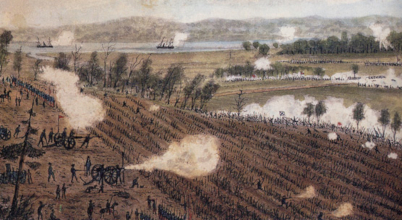
(Pictured: A watercolor painting of the Battle of Malvern Hill, made by Robert Sneden during the American Civil War at Malvern Hill in Henrico County, Virginia. Sneden was the mapmaker for Samuel P. Heintzelman’s III Corps.)
The Irish Brigade of the Union Army fights in the Battle of Antietam, one of the most famous battles of the American Civil War, on September 17, 1862. The battle has the sad distinction of being the bloodiest single day of fighting in America’s bloodiest war. Combined casualties at the Battle of Antietam are 26,134. Few regiments suffered more than the Irish Brigade.
The Irish Brigade is the brainchild of their commanding officer Thomas Francis Meagher. The former Young Ireland rebel, creator of the Irish Tricolor of green, white and orange, escaped political prisoner, lawyer, newspaper editor and politician forms the brigade with the twin objectives of gaining respect for the Irish by their patriotism for their adopted country and developing a nucleus for a future fight for Ireland’s freedom. The Brigade is formed of the almost exclusively Irish American69th, 63rd and 88th New York and the “honorary Irish” of the 29th Massachusetts. The regiments of the Irish Brigade had already earned a formidable reputation as a crack unit, having distinguished themselves in every battle of the earlier Seven Days Battles. It is small wonder, many in the Brigade’s ranks had already distinguished themselves in the Mexican-American War or in fighting with the Papal forces in Italy against Giuseppe Garibaldi.
The Union Army is already heavily engaged, when the Irish Brigade is ordered to advance through an open field to take an area of high ground. Subjected to accurate Confederate rifle fire as they cross the field, the Brigade marches on in disciplined order, the National and the famed Green Regimental Colors (flags) fluttering overhead. When they encounter a fence across their line of march, eighty volunteers rush forward to knock it down, rather than see the whole Brigade slowed by the obstacle and exposed to fire. Over half of these volunteers are killed. Seeing the Irish continue to press forward, the Confederates fall back as the Irish advance up the hill.
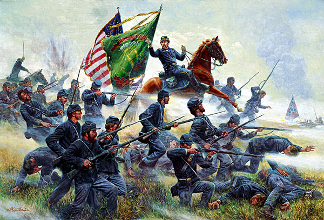
What no one on the Union side knows is that on the other side of the hill is a farmer’s dirt road that years of rain has eroded into a ditch five feet below the surrounding ground level. The sunken road is a perfect rifle pit and is filled with Colonel John Brown Gordon’s Georgians. As the Irish crest the hill, they are met with a volley that decimates the Brigade, including killing or wounding every single standard-bearer. Seeing the flags fall from across the field, an aide to Union General George B. McClellan exclaims, “The battles lost, the Irish are fleeing!” only for McClellan to respond, “No, the flags are raised again, they are advancing.” Eight successive standard-bearers of the 69th New York alone fall that day as men pick up the flags from fallen comrades. Captain Patrick Clooney, though wounded himself, snatches up the colors from the 88th’s fallen standard-bearer only to be killed by multiple shots, the Green Flag wrapping around him like a shroud befitting a hero. Another standard-bearer, the staff of his Irish Brigade flag snapped in two by a rifle shot, drapes the flag over his shoulder like a sash and continues to move forward, personifying the Gaelic phrase on the flag he is carrying “Riamh Nar Dhruid O Spairn lann”, “Who never retreated from the clash of spears.”
The fire of the Confederates is so intense that the Irish Brigade cannot advance, but they do not flee either. Despite the failure of promised reinforcements that never materialize, the Brigade pours “Buck and Ball” (a 69-caliber ball and three 30 caliber buckshot) into the enemy at 300 paces, turning the “Sunken Road” into “Bloody Lane.” When their ammunition is depleted, the remnants of the Brigade, with drill ground precision, form and march back to the Union lines. The Irish Brigade never “ran” from the enemy. Another Union unit takes the “Bloody Lane,” but most credit the punishment that the Irish Brigade inflicted on the enemy, at a terrible cost to themselves, with making it possible. The New York Regiments take over 50% casualties. The Irish Brigade is now no bigger than a single regiment. As the depleted ranks of the 88th march passed, Union Major GeneralIsrael Bush Richardson salutes as it passes with the words “Bravo 88th, I shall never forget you!”
During the course of the War, the Irish Brigade suffers over 4,000 casualties, more men than the Brigade ever had at any one time. The Fighting 69th loses more men than any other New York regiment. The Battle of Antietam is remembered as the Union victory that allows President Abraham Lincoln to issue the Emancipation Proclamation, which frees the slaves in the Confederate states. It is all too often forgotten that this emancipation was secured in no small part with the blood of Irish immigrants, immigrants who were denied civil rights in their own country and faced discrimination in their adopted county before and after the Civil War.
In thinking of the Civil War, all Americans should remember the words of a defeated Confederate Officer to his Union counterpart at Appomattox, “You only won as you had more Irish than we did.”
(Credit: “The Irish Brigade at Antietam” by Neil F. Cosgrove, October 17, 2009)



 seamus dubhghaill