Three years after moving to the United States, Moloney co-founds Green Fields of America, an ensemble of Irish musicians, singers, and dancers which tour across the country on several occasions. He also serves as the artistic director for several major arts tours. One of these is the 1985 festival in Manhattan titled “Cherish the Ladies” to highlight female musicians in the area of Irish traditional music, which had been dominated by men until that decade. He produces an album for the female group by the same name titled Irish Women Musicians in America. The group’s leader, Joanie Madden, is one of several future fellows of the National Endowment for the Arts (NEA) to be mentored by Moloney. He produces and performs on over 70 albums and serves as advisor for numerous festivals and concerts across America, with ethnomusicologist and musician Daniel T. Neely putting the figure as high as 125 albums.
In addition to music performance, Moloney writes Far from the Shamrock Shore: The Story of Irish American History Through Song, which is published by Crown Publications in February 2002 with a supplementary CD on Shanachie Records. He hosts three nationally syndicated series covering folk music on American Public Television (APT). He works as a consultant, performer, and interviewee on the RTÉ special Bringing It All Back Home, and is also a participant, consultant, and music arranger for Out of Ireland, a documentary film by PBS. He performs on the PBS special The Irish in America: Long Journey Home.
Moloney is married three times over the course of his life. His first marriage is to Miriam Murphy. His second marriage is to Philomena Murray. Together, they have one child but eventually divorce. His third marriage to Judy Sherman also ends in divorce. He is in a domestic partnership with Sangjan Chailungka at the time of his death. During his later years, he divides his time between Bangkok, where he resides with Chailungka, and his apartment in Greenwich Village. In Bangkok, he volunteers as a music therapist and teacher for abandoned children with HIV at the Mercy Center in the Khlong Toei district, which is founded by the Redemptorist priest Joseph H. Maier.
Moloney dies at the age of 77 on July 27, 2022, at his home in Manhattan, having played at the Maine Celtic Festival less than a week before. The cause of death is not announced.
D’Arcy is born to a Russian-Jewish mother and an Irish Catholic father. She works in small theatres in Dublin from the age of fifteen and later becomes an actress.
D’Arcy is married in 1957 to English playwright and author John Arden. They write several plays together which are highly critical of the British presence in Ireland. They settle in Galway in 1971 and establish the Galway Theatre Workshop in 1976. The couple has five sons, one of whom predeceases his mother.
The couple writes a number of stage pieces and improvisational works for amateur and student players, including The Happy Haven (1960) and The Workhouse Donkey (1964). She writes and produces many plays, including The Non-Stop Connolly Show (1977).
D’Arcy has also written a number of books, including Tell Them Everything (1981), Awkward Corners (with John Arden, 1988), and Galway’s Pirate Women: A Global Trawl (1996).
As an activist, in 1961, D’Arcy joins the anti-nuclear Committee of 100, led by Bertrand Russell. In 1981, her peace-activism results in her incarceration in Armagh Jail, after defacing a wall at the Ulster Museum. Her book Tell Them Everything (Pluto Press, 1981) tells the story of her time during the Armagh and H-Blockdirty protests and is one of the earliest accounts about the Armagh women, their republicanism and imprisonment.
D’Arcy also directs Yellow Gate Women (2007), a film about the attempts by women of Greenham Common Women’s Peace Camp to outwit the British and United States military at RAF Greenham Common with bolt cutters and legal challenges. Challenging censorship since 1987, she runs a women’s kitchen pirate radio from her home in Galway.
In 2011, D’Arcy refuses to stand for a minute’s silence to honour Police Service of Northern Ireland (PSNI) officer Ronan Kerr, killed by dissident republicans, at an Aosdána meeting. Her actions are deliberate, she tells the media afterwards, which attracts fierce criticism of her perceived support for armed republican groups in Northern Ireland.
Along with Niall Farrell, D’Arcy is arrested in October 2012 for scaling the perimeter fence of Shannon Airport, in protest at the use of the airport as a stopover for U.S. military flights. As a consequence of her trespassing on airport property, she is imprisoned in 2014 after she refuses to sign a bond saying that she will not trespass on non-public parts of Shannon Airport.
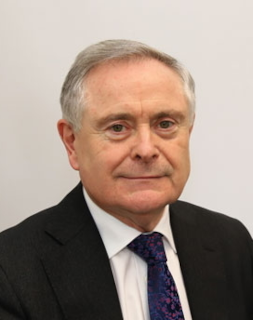
Born into a political family in Wexford, Howlin is the son of John and Molly Howlin (née Dunbar), and named after Brendan Corish, the local Labour TD and later leader of the Labour Party. His father is a trade union official who serves as secretary of the Irish Transport and General Workers’ Union (ITGWU) in Wexford for 40 years. He also secures election as a Labour member of Wexford Corporation, where he serves for eighteen years, and is also election agent to Brendan Corish. His mother is also strongly involved in local Labour politics. His brother Ted is a former member of Wexford County Council and Lord Mayor of Wexford. He is raised on William Street in Wexford with his three siblings.
Howlin grows up in Wexford town and is educated locally in the Faythe and at Wexford CBS. He later attends St. Patrick’s College, Dublin, and qualifies as a primary school teacher. During his career as a teacher, he is active in the Irish National Teachers’ Organisation (INTO), before embarking on a career in full-time politics.
Howlin credits his introduction to politics to his involvement in the Irish anti-nuclear movement. The chair of Nuclear Opposition Wexford (NOW), he is involved in the organisation of a protest against the building of a nuclear power plant in Carnsore Point, which draws 40,000 protestors. In 1979, he is asked to run for Wexford Corporation and is selected in his absence but declines to run in order to continue as chair of NOW.
Howlin contests his first general election at the November 1982 Irish general election. He runs as a Labour candidate in the Wexford constituency, but despite the existence of a large left-wing vote in the area, he is not elected. In spite of this setback, a Fine Gael-Labour Party coalition government comes to power, and he is nominated by the Taoiseach, Garret FitzGerald, to serve in Seanad Éireann as a Senator. He secures election to Wexford County Council in 1985 and serves as Mayor of Wexford in 1986.
In 1987, the Labour Party withdraws from the coalition government and a general election is called. Howlin once again contests a seat in Wexford and is elected to Dáil Éireann. Labour are out of office as a Fianna Fáil government takes office. In spite of his recent entry to the Dáil, he is subsequently named Chief Whip of the Labour Party, a position he holds until 1993.
The 1992 Irish general election results in a hung Dáil once again. However, the Labour Party enjoys their best result to date at the time. After negotiations, a Fianna Fáil-Labour Party coalition government comes to office. Howlin joins the cabinet of Taoiseach Albert Reynolds as Minister for Health. During his tenure the development of a four-year health strategy, the identifying of HIV/AIDS prevention as a priority and the securing of a £35 million investment in childcare are advanced. He, however, is also targeted by anti-abortion groups after introducing an act which would allow information regarding abortion.
In 1994, the Labour Party withdraws from government after a disagreement over the appointment of Attorney GeneralHarry Whelehan as a Judge of the High Court and President of the High Court. However, no general election is called and, while it is hoped that the coalition could be revived under the new Fianna Fáil leader Bertie Ahern, the arithmetic of the Dáil now allows the Labour Party to open discussions with other opposition parties. After negotiations a Rainbow Coalition comes to power involving Fine Gael, Labour and Democratic Left. In John Bruton‘s cabinet, he becomes Minister for the Environment.
Following the 1997 Irish general election, a Fianna Fáil-Progressive Democrats coalition government comes to power and the Labour Party returns to the opposition benches. In the announcement of the party’s new front bench, Howlin retains responsibility for the Environment.
In late 1997, Dick Spring resigns as leader of the Labour Party and Howlin immediately throws his hat into the ring in the subsequent leadership election. In a choice between Howlin and Ruairi Quinn, the former gains some early support; however, the leadership eventually goes to Quinn by a significant majority. As a show of unity, Howlin is later named deputy leader of the party and retains his brief as Spokesperson for the Environment and Local Government.
In 2002, following Quinn’s resignation as party leader after Labour’s relatively unsuccessful 2002 Irish general election campaign, Howlin again stands for the party leadership. For the second time in five years, he is defeated for the leadership of the party, this time by Pat Rabbitte, who is formerly a leading figure in Democratic Left. He is succeeded as deputy leader by Liz McManus.
While having been publicly supportive of Rabbitte’s leadership, Howlin is perceived as being the leader of the wing of the party which is sceptical of Rabbitte’s policy with regard to future coalition with Fianna Fáil. Rabbitte explicitly rules out any future coalition with Fianna Fáil, instead forming a formal alliance with Fine Gael in the run-up to the 2007 Irish general election (the so-called Mullingar Accord).
On June 26, 2007, Howlin is appointed the Leas-Cheann Comhairle (deputy chairperson) of Dáil Éireann.
After the 2011 Irish general election, Fine Gael and the Labour Party form a government, and Howlin is appointed to the new office of Minister for Public Expenditure and Reform. In May 2011, he says that over the next 20 years the number of people in Ireland over 65 is set to increase by almost half a million, a situation that could see the annual health budget soar – rising by €12.5 billion in the next decade alone. While reform is a major part of government attempts “to regain full sovereignty over economic policy,” he tells a meeting of the Association of Chief Executives of State Agencies they will in any event face key “imperatives” in coming years. He says a new public spending review, on which he has briefed the cabinet in recent days, will not be a simple assessment of where to make cuts, but will also consider the way public sector services are delivered. He reiterates the government’s commitment not to cut public sector pay, “if the Croke Park Agreement works.” “These are just some of the challenges that our society is facing in the coming decade – crisis or no crisis. In the good times, tackling them was going to be difficult. Today, in these difficult times, tackling them is going to be imperative.” He says Ireland is facing a profound and complex economic crisis “where we are fighting a battle on three fronts – mass unemployment, a major failure in banking, and a fiscal crisis.”
Howlin retains his seat in the Dáil following the 2016 Irish general election, though only six of his Labour colleagues do likewise and the party returns to the opposition benches. Following the resignation of Joan Burton, he contests the 2016 Labour Party leadership election unopposed and is elected Leader of the Labour Party on May 20, 2016.
In March 2018, Howlin criticises Taoiseach Leo Varadkar for failing to personally invite him to accompany him as he meets ambulance crews in Howlin’s constituency of Wexford. Varadkar replies that he has been far too busy dealing with the recent weather crisis and Brexit “to organise invitations to Deputies personally in order that they felt included.” It is separately said of Howlin’s complaint, “It appears that the Taoiseach, the chief executive of the State, needs the imprimatur of local politicians when he enters their bailiwick, and needs to be accompanied and monitored by those same politicians while he is in their realm.”
Alan Kelly challenges Howlin for the party leadership in 2018, stating that he has failed to “turn the ship around.” He states that Kelly’s comments are a disappointing and unnecessary distraction. He also says that there is not a single parliamentary party member that supports the challenge, and that Kelly has the backing of a minority of councillors.
In September 2018, Howlin states that winning 14 seats in the 33rd Dáil is a realistic goal. During the campaign in 2020, he states his wish to end the United States‘s use of Shannon Airport for military related activities. In the 2020 Irish general election, party first preference vote drops to 4.4% of first preference votes and returns 6 seats – a record low. Howlin announces his intention to step down as leader on February 12, 2020. He also says that the Labour Party should not formally enter government, a view that is backed by the parliamentary party. He also states that he will not back any candidate in the following contest. On February 15, 2020, he rules himself out as a candidate for Ceann Comhairle of the 33rd Dáil, with the polling day to elect his successor set for April 3, 2020.
In 2020, Howlin’s legislation (Harassment, Harmful Communications and Related Offences Bill) is passed and signed into law by Michael D. Higgins. This bill makes the distribution of intimate images or “revenge porn” a criminal offense and makes other forms of cyberbullying and harassment punishable.
Howlin is a single man. He has spoken publicly of receiving hate mail relating to his private life and questioning his sexual orientation. In an interview with The Star during the 2002 Labour Party leadership contest, in response to repeated speculation, he announces he is “not gay.”
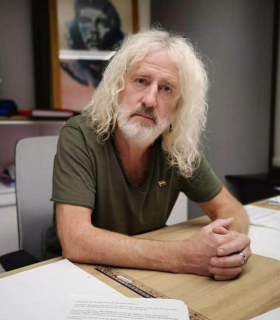
Wallace is born into a family of twelve children. He graduates from University College Dublin (UCD) with a teaching qualification. He marries Mary Murphy from Duncormick, County Wexford, in 1979. The couple has two sons, but the marriage ends when the children are young. He has two more children from another relationship in the 1990s.
Prior to entering politics, Wallace owns a property development and construction company completing developments such as the Italian Quarter in the Ormond Quay area of the Dublin quays. The company later collapses into liquidation, with him finally being declared bankrupt on December 19, 2016.
On December 15, 2011, Wallace helps to launch a nationwide campaign against the household charge which is introduced as part of the 2012 Budget.
Wallace is the listed officer of the Independents 4 Change, which is registered to stand for elections in March 2014 and, along with Clare Daly, is one of two MEPs which represent the party in the European parliament. During their time in the Dáil, Wallace and Daly, the Dublin North TD, become friends and political allies, and work together on many campaigns, including opposition to austerity and highlighting revelations of alleged Garda malpractices, including harassment, improper cancellation of penalty points and involvement of officers in the drug trade. They are partially active in protesting the Garda whistleblower scandal, which eventually leads to the resignation of Minister for JusticeFrances Fitzgerald, although she is later cleared of wrongdoing by the Charleton Tribunal.
In July 2014, Wallace and Daly are arrested at Shannon Airport while trying to board a U.S. military aircraft. He says the airport is being used as a U.S. military base and that the government should be searching the planes to ensure that they are not involved in military operations or that there are no weapons on board. He is fined €2,000 for being in an airside area without permission and chooses not to pay. He is sentenced to 30 days in prison in default, and in December 2015 is arrested for non-payment of the fine.
In December 2015, Wallace and independent TDs Clare Daly and Maureen O’Sullivan each put forward offers of a €5,000 surety for a man charged with membership of an unlawful organisation and with possession of a component part of an improvised explosive device.
At the 2016 Irish general election, Wallace stands as an Independents 4 Change candidate and is re-elected, finishing third on the first-preference count with 7,917 votes.
In 2017, Wallace calls on Ireland to join the Boycott, Divestment and Sanctions movement against Israel and “condemn the illegal expansion of Israeli settlements on Palestinian lands as well as the ongoing human rights abuses against Palestinians.”
Wallace is criticised for supporting Venezuela, Ecuador, China, Russia, Belarus and Syria during his period as an MEP. In November 2020, he refers to Belarusian opposition presidential candidate Svetlana Tikhanovskaya as a “pawn of western neoliberalism.” In February 2021, he is reprimanded for using a swear word during a session of the European Parliament. He has referred to Venezuelan opposition leader Juan Guaidó as being an “unelected gobshite.”
In April 2021, Wallace and Daly are called “embarrassments to Ireland” by Fianna Fáil‘s Malcolm Byrne after the two MEPs had travelled to Iraq and visited the headquarters of the Popular Mobilization Forces, an Iraqi militia supported by Iran.
Wallace questions the director general of the Organisation for the Prohibition of Chemical Weapons (OPCW), Fernando Arias, in the European Parliament in April 2021. He accuses the OPCW of falsely blaming the government of Bashar al-Assad for the 2018 Douma chemical attack. He says that, while he does not know what had happened in Douma, the White Helmets were “paid for by the U.S. and UK to carry out regime change in Syria.” Fianna Fáil’s Barry Andrews calls his accusation against the White Helmets a conspiracy theory and disinformation. French MEP Nathalie Loiseau describes his comments as “fake news” and apologises on his behalf to NGO groups in Syria.
In June 2021, Wallace and Daly are among the MEPs censured by the European Parliament’s Democracy Support and Election Coordination Group for acting as unofficial election-monitors in the December 2020 Venezuelan parliamentary election and April 2021 Ecuadorian general election without a mandate or permission from the EU. They are barred from making any election missions until the end of 2021. They are warned that any further such action may result in their ejection from the European parliament under the end of their terms in 2024.
Wallace has stated his opposition to vaccination certificates. He says, “I’m not anti-vax but we’re going down a dangerous path with COVID pass” and expresses concerns about civil liberties. Both Wallace and Daly have refused to present vaccination certs upon entering the European Parliament, resulting in them being reprimanded by the European Parliament.
In April 2022, Wallace and Daly initiate defamation proceedings against RTÉ.
In November 2022, Wallace criticises protests in Iran following the death of Mahsa Amini, accusing some protestors of violence and destruction and saying it “would not be tolerated anywhere.”
In February 2023, Wallace claims on social media that he has “three wine bars in Dublin.” This arouses alarm from his European parliamentary group, as no such assets were listed on his mandatory declaration of financial interests. After the chair of his parliamentary group calls any omission from the declaration “unacceptable” and not “worthy of our political group,” he amends his declaration to state that he is an “advisor” to the three wine bars and receives up to €500 a month in income for this role.
The couple are welcomed at NUI Galway by the Tánaiste (Deputy Prime Minister) Joan Burton, among the guests are Gerry Adams and Martin McGuinness.The highlight of Tuesday’s engagements is the historic handshake between the Prince and Gerry Adams. This is the first time a member of the British royal family and the Sinn Féin President have formerly engaged. They shake hands and speak briefly at a reception in NUI Galway, where the prince makes the first of two scheduled speeches.
Charles and Camilla then go on to visit the Burren in County Clare, fulfilling one of Charles’ life-long goals, by exploring the karst landscape for almost an hour.
They conclude their first day by dining with the President of Ireland, Michael D. Higgins, and his wife Sabina, at Lough Cutra Castle in south County Galway. They dine on blanched Highgrove asparagus to start, followed by pan-seared halibut, with panna cotta and poached Highgrove rhubarb for dessert.
Their packed itinerary for Wednesday begins with a trip to Lissadell House with a civic reception and a viewing of the Niland Collection at The Model contemporary arts centre in Sligo. Mayor of Sligo, Seán MacManus, formerly of Sinn Féin, attends the reception. MacManus’ son was killed in a gun battle with security forces in Northern Ireland in 1992.
The prince then visits the Institute of Technology, Sligo, and the couple has lunch at Lissadell. They then visit the grave of W. B. Yeats and attend a service at St. Columba’s Church, in Drumcliff. The royal couple takes part in a tree-planting and unveil a plaque. The theme of this service and the tree-planting is peace and reconciliation.
The prince then visits Mullaghmore Harbour on Wednesday afternoon. On August 27, 1979, his great-uncle, Lord Louis Mountbatten, is killed in a bomb attack executed by the Irish Republican Army (IRA). Mountbatten holidayed every summer at Classiebawn Castle near the harbor. He had, along with family and friends, embarked on a lobster-potting and angling expedition when a bomb on board was detonated just a few hundred yards from the harbor. He died of his injuries, along with his grandson Nicholas Knatchbull (14), Paul Maxwell (15), from County Fermanagh, and Lady Brabourne (83), his eldest daughter’s mother-in-law.
Charles and Camilla conclude their Wednesday itinerary with a trip to the Sligo races.
On Thursday and Friday, Charles and Camilla travel to Northern Ireland. Their engagements include a reception and a concert featuring a selection of local performers at Hillsborough Castle. They make a trip to Mount Stewart House and gardens to mark the completion of a three-year restoration programme. They also visit the Corrymeela Community, Northern Ireland’s oldest peace and reconciliation centre, which is celebrating its 50th anniversary in 2015.
(From: “History is made as Prince Charles fulfills life-long dream in Ireland” by Cathy Hayes, IrishCentral, http://www.irishcentral.com, May 20, 2015 | Pictured: The Prince of Wales and the Duchess of Cornwall at Mullaghmore pier on May 20, 2015)
The United States and the UK are forced to push back their plans for a second UN resolution on military action as more countries come out against the use of force in Iraq. Mary Robinson, the former United Nations High Commissioner for Human Rights, says she is fearful of the consequences of a war without UN backing.
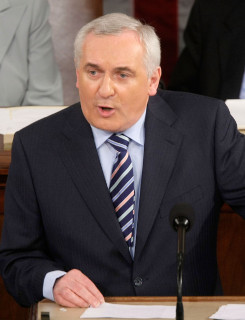
In an interview with RTÉ News Ahern says the most important issue for this country is the primacy of the United Nations. He disagrees with the United States on whether or not they legally needed another UN Resolution before launching an attack on Iraq. He says other countries, including Ireland, have another point of view.
The Fianna Fáil parliamentary party unanimously passes a motion calling for a second resolution from the United Nations Security Council prior to the consideration of military action against Iraq. The motion also expresses “full confidence” in the efforts of the Taoiseach and the Minister for Foreign Affairs, Brian Cowen, to reach a peaceful outcome to the crisis.
The leading United States Congressman, Jim Walsh, welcomes the support that the Taoiseach has given to the United States in relation to Iraq. After a meeting with Sinn Féin in Belfast earlier in the day, he says that he recognises that it is a difficult time for the Irish people.
In the meantime, the UK has told its nationals in Iraq to leave the country immediately. In a statement the British Foreign & Commonwealth Office (FCO) says it has issued the alert because of increasing tension in the region and the risk of terrorist action. The office says anyone considering going to Iraq should remember that UK nationals were held hostage by the Baghdad government in the run-up to the 1991 Gulf War.
The British embassy in Kuwait City advises its citizens to leave Kuwait unless their presence in the emirate is essential. It also orders dependants of embassy staff to leave. “We advise you not to make any non-essential travel including holiday travel to Kuwait and, if already in Kuwait, to leave unless you consider your presence there is essential,” the embassy says in an advisory note.
An estimated 4,000 British nationals are resident in Kuwait. Britain has no diplomatic relations with President Saddam Hussein’s regime, and therefore cannot give consular assistance to British nationals inside Iraq. The current travel advisory for Israel warns against “any non-essential travel including holiday travel.”
(From: “More countries call for second UN Resolution” by RTÉ News, originally published Wednesday, February 19, 2003)
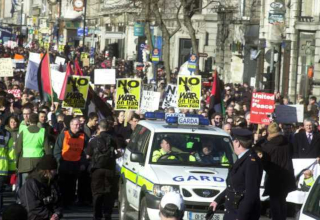
On the evening of March 20, 2003, up to 2,000 people take part in a protest outside the United States Embassy at Ballsbridge in Dublin to voice their opposition to the war in Iraq. This is one of numerous protests held in response to the Irish Anti-War Movement‘s call on Irish citizens to mount mass protests against the U.S.-led war in Iraq. The group says thousands of workers, students and school pupils had taken part in stoppages and walk-outs throughout the day.
Richard Boyd Barrett, the chairman of the IAWM, says, “The complicity of the Irish government in this murderous war through providing facilities for the U.S. military at Shannon Airport is an absolute disgrace. “This war has little support among ordinary people and has provoked a wave of anger and revulsion. We call on the people of Ireland to come out in their thousands at 6:00 PM tonight to their town centre demonstrations to show this carnage is not being mounted in our names.”
Earlier in the day, several hundred protesters gather outside Dáil Éireann to protest the Irish Government‘s decision to continue allowing U.S. military aircraft use Shannon Airport. The Dáil is holding a six-hour debate on a Government motion which, among other topics, contains a clause permitting U.S. forces continued use of Irish airspace and facilities.
The NGO Peace Alliance says it is “extremely disappointed” at the Government’s refusal to condemn the attack on Iraq. “We call upon thousands of Irish people to reject this shameful position by thronging the streets of Dublin and other cities and towns next Saturday” said the alliance’s co-ordinator, Brendan Butler.
SIPTU‘s National Executive Council also interrupts their monthly meeting. “This war is not only unnecessary but illegitimate in the context of international law”, says Joe O’Flynn, SIPTU General Secretary.
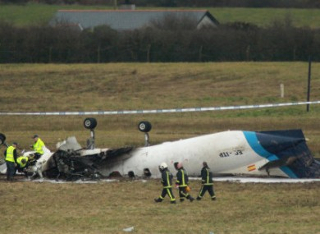
Manx2 Flight 7100 (NM7100/FLT400C), a scheduled commercial flight from George Best Belfast City Airport in Belfast, Northern Ireland, to Cork Airport in Cork, County Cork, crashes on February 10, 2011 on its third attempt to land at Cork Airport, which is experiencing dense fog at the time. The aircraft is carrying ten passengers and two crew. Six people, including both pilots, perish in the crash. Six passengers survive, four receiving serious injuries, while two are described as walking wounded.
After two aborted landing attempts, the flight crew enters a holding pattern and maintains an altitude of 3,000 feet. During the hold the flight crew requests weather conditions for Waterford Airport which are below minima. The flight crew nominates Shannon Airport as their alternate and requests the latest weather. Again the weather there is below minima. Weather for Dublin Airport is passed on to the flight crew and is also below minima. Cork Approach informs the flight crew about weather conditions at Kerry Airport which are “good” with 10 km visibility. The decision is made to make a third attempt at Cork Airport.
The approach is continued beyond the Outer Marker (OM), the commander takes over operation of the Power Levers. Descent is continued below the Decision Height (DH). A significant reduction in power and significant roll to the left follows, just below 100 feet, a third go-around is called by the commander which the co-pilot acknowledges. Coincident with the application of go-around power by the commander, control of the aircraft is lost. The aircraft rolls rapidly to the right beyond the vertical which brings the right wingtip into contact with the runway surface. The aircraft continues to roll and impacts the runway inverted. The stall warning sounds continuously during the final seven seconds of the Cockpit Voice Recorder (CVR) recording.
At 09:50:34 following both initial impacts the aircraft continues inverted for an additional 207 yards and comes to a rest in soft ground to the right of the runway. During this time the Emergency Locator Transmitter (ELT) begins to sound in the control tower at Cork Airport. Post impact fires ensue in both engines and from fuel leaking from the outboard right fuel tank. The fires are put out by the Airfield Fire Service (AFS) before they reach the fuselage. A witness inside the airport terminal building states that the fog is so thick that the crashed aircraft could not be seen. The Airport Fire Service extinguish both post impact fires within ten minutes of the accident and begin to remove the casualties from the wreckage. The injured are taken to Cork University Hospital for treatment. As a result of the accident, Cork Airport is closed until the evening of February 11 and all flights are diverted.
The final report on the incident is sent to the bereaved families and the six survivors over a week in advance of its official release on January 28, 2014, almost three years after the crash. The report states that the probable cause of the accident is loss of control during an attempted go-around below decision height in instrument meteorological conditions. It notes that there is an inappropriate pairing of flight crews, inadequate command training and checking and inadequate oversight of the chartered operation by the operator and the operator’s state as contributory factors in the accident.
In 1957 the Government of Ireland agrees in principle to the building of an airport for Cork. After considering many sites in the area, it is agreed that the airport should be built at Ballygarvan. Tenders are invited for the construction of the airport in 1959 at an estimated cost of £1 million. The airport is officially opened on October 16, 1961, following proving flights four days earlier by Aer Lingus and Cambrian Airways. Vincent Fanning is the first manager at the airport. In its first year the airport handles 10,172 passengers – close to the average number of passengers handled each day at the airport in 2007. Throughout the 1960s the airport expands with the arrival of more advanced aircraft and more destinations. The first jet, a British Overseas Airways Corporationde Havilland DH 106 Comet, lands at Cork Airport on March 29, 1964. By 1969 Aer Lingus is operating to London‘s Heathrow Airport, Manchester Airport and Bristol Airport.
In 1975 Aer Rianta, the then state airports authority, undertakes a passenger terminal study aimed at improving the terminal facilities. The findings result in the provision, over the next two years, of new departure and arrival halls, a new check-in area, office complex, information desk, duty office and executive lounge. The new extensions and facilities are opened in 1978.
The 1980s begin with an extension of the main apron. New services to London Gatwick begin, while Aer Lingus’ commuter division starts a new domestic service to Dublin Airport. In 1985 following significant growth, Aer Rianta carries out a survey of the terminal facilities with a view to carrying out a major expansion and development programme. On June 8, 1987, Ryanair commences services at Cork Airport. Phase I of the Terminal Expansion and Development Plan is completed in 1988. The following year the main runway extension of 1,000 feet is opened.
The 1990s begin with the completion of Phase II of the terminal expansion in 1991 and Phase III being completed in 1992 with the plan being brought to completion in 1994.
In 2001 plans are drawn up for the construction of a new terminal building and ancillary capital investment works at an estimated cost of €140 million. Along with the construction of the terminal, roads are upgraded from single to dual carriageway and re-aligned, and a new short term multistorey car park is constructed. The new terminal opens on August 15, 2006. Designed by HOK and Jacobs Engineering Group, the new terminal is the first built in Ireland in the 21st century.
In June 2008, the Irish Aviation Authority completes a new control tower 1 km from the old terminal to the west of the main runway. However, it takes until mid-October 2009 to get all the new systems tested and working. The new control tower officially opens on 20 October 20, 2009.
In 2013, Cork Airport is placed first for overall customer satisfaction in a global survey of passengers carried out by Airports Council International Europe. The survey measures customer satisfaction across eight categories in 61 regional airports worldwide, with Cork Airport scoring highest.
In June 2017, the airport is named as “Best Airport in Europe under 5 million passengers” at the 27th Airports Council International (ACI) Europe General Assembly.
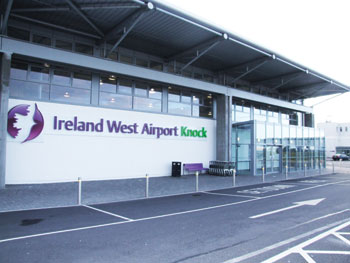
Ireland West Airport, officially known as Ireland West Airport Knock, at Knock, County Mayo, and now named Horan International Airport, is officially opened by TaoiseachCharles Haughey on May 30, 1986. The airport is located 5.6 km (3.5 miles) southwest of Charlestown, County Mayo. The village of Knock is 20 km (12.5 miles) away.
The airport opens on October 25, 1985 with three Aer Lingus charter flights to Rome however the official opening is on May 30, 1986. The site, on a hill in boggy terrain, is thought by many to be unrealistic but the airport is built following a long and controversial campaign by MonsignorJames Horan, the story of which has even spawned a musical.
At the time of construction, the primary motivation is for pilgrims to Knock Shrine. Despite criticisms that the site is too boggy and too foggy, Monsignor Horan delivers an airport within five years, primarily financed by a Government grant of £9.8 million. Monsignor Horan dies shortly after the opening of the airport, and his funeral is held at the then named Horan International Airport. In recent times, Monsignor Horan has been celebrated with a bronze statue erected at the airport.
By 1988, over 100,000 passengers have passed through the airport. In 1995 Aer Lingus commences flights to Birmingham Airport. On June 1, 2003, hundreds of people gather to view an Air Atlanta IcelandicBoeing 747 land with 500 returning pilgrims from Lourdes.
In 2016, 735,869 passengers use the airport, making it the fourth busiest in the Republic of Ireland after Dublin Airport, Cork Airport and Shannon Airport. It is announced in November 2017 that €15 million will be invested in improving and upgrading the airport in 2018 and 2019, to coincide with strong passenger growth. These plans include upgrading of car parks, passenger facilities, the terminal and resurfacing of the runway.




 seamus dubhghaill