seamus dubhghaill

Promoting Irish Culture and History from Little Rock, Arkansas, USA


Leave a comment

The Scramoge Ambush

The Scramoge ambush is an ambush carried out by the Irish Republican Army (IRA) on March 23, 1921, during the Irish War of Independence (1919-21). The IRA ambush a lorry carrying British Army troops and Royal Irish Constabulary (RIC) officers at Scramoge (also spelled Scramogue), near Strokestown in County Roscommon. Three British soldiers and an RIC officer are killed, while two RIC “Black and Tans” are captured and shot dead shortly thereafter.

Following the ambush, the British carry out a sweep in which they capture three of the IRA volunteers involved and kill another who had not taken part.

County Roscommon is not one of the more violent areas of Ireland during the conflict. The local IRA argues to their GHQ that it is very difficult to conduct guerrilla warfare in the flat open countryside there. Prior to the action at Scramogue, the biggest previous incident had been in October 1920, when four RIC officers were killed in an ambush near Ballinderry.

Sean Connolly is sent by IRA GHQ from Longford to re-organise the Roscommon IRA and chooses the ambush site at Scramoge. However, he is killed twelve days before the action, at the Selton Hill ambush in neighbouring County Leitrim.

Both the North and South Roscommon brigades of the IRA take part and are commanded by Patrick Madden. There are 39 volunteers in the flying column, but only 14 take part in the actual attack. The remainder are tasked with blocking roads to keep the IRA’s line of retreat open. The IRA party is armed with thirteen rifles (eleven Lee–Enfields, one Winchester and one sporting rifle), twenty shotguns (though some are in bad condition) and two or three Webley revolvers. This is the largest collection of arms that the IRA assembles in Roscommon during the war and some of them have been borrowed from IRA units in Longford.

Among the volunteers who take part are Martin Fallon, ‘Cushy’ Hughes, Frank Simons, Luke Duffy, Peter Casey, Peter Collins, Patrick Gallagher and Tom Compton. Several of the IRA men, including Hughes, had served in the Irish Guards (IG) in World War I, but had been persuaded by Pat Madden to join the IRA upon their return.

The ambush site is carefully prepared. It is located at a sharp bend on the Strokestown–Longford road. A farmhouse and barn at the bend have been taken over and loopholed, and a trench is dug behind a hedge alongside the road. Only a mile from the IRA’s position, the British 9th Queen’s Royal Lancers regiment is garrisoned in Strokestown House.

The IRA waits in their position all day for British forces to come from Strokestown. Just as a troop lorry finally appears, two civilians came up the road in a pony and trap and have to be frantically waved out of the way.

The lorry carries a nine-man British Army and Royal Irish Constabulary (RIC) patrol traveling on the Strokestown–Longford road. The British inquiry into the incident is to question why the lorry is unescorted, as their practice is not to travel in lone vehicles.

The IRA opens fire from very close range, killing the driver and halting the lorry in its tracks. Several of the soldiers and policemen are hit and they scrambled for cover behind a wall along the road. The lorry has a Hotchkiss machine gun bolted onto it, but its gunner gets off only one burst before being badly wounded and the gun is put out of action. The commander of the patrol, Captain Roger Grenville Peek, is hit in the lorry but tries to run to safety, only to be hit again and killed 400 yards down the road. The other officer with the party, Lieutenant Tennant, is also killed by a shotgun blast. After the death of the two officers, the surviving British, several of whom are wounded, surrender.

Just as the firing is dying down, another lorry, an RIC/Black and Tan patrol, approaches the ambush site but turns back after coming under fire.

Four of the British force are killed – this includes two British Army officers (Roger Grenville Peek and John Harold Anthony Tennant), a Royal Army Service Corps (RASC) driver, and one RIC man (Constable Edward Leslie).

Two men in civilian clothes are also found in the lorry. They turn out to be Black and Tans, Constable Buchanan and Constable Evans, who had been placed under arrest by the soldiers. They are made prisoners by the IRA. The ambush party takes the British arms, including the Hotchkiss gun, burn the lorry and make their escape over the hill of Slieve Bawn.

The IRA leaders, Pat Madden, Luke Duffy and Frank Simons, decide to murder the two Black and Tans, despite their offering to show the IRA how to use the captured machine gun. The IRA officers’ reason that if the prisoners identify the IRA men who had taken part in the ambush, the volunteers will be at risk of being executed if captured. The two are taken to remote locations and shot over the next two days.

The British garrison in Roscommon town mounts a sweep directly after the ambush with eight lorries and one Whippet tank. Three volunteers who had taken part are arrested afterward. Pat Mullooly and Brian Nagle of the North Roscommon Brigade are arrested as they try to get away from the scene of the ambush, as is “Cushy” Hughes, who is picked up when he is drawing his soldier’s pension in Roscommon. Mullooly and Nagle are badly beaten by their captors on the road to Roscommon. The next day, another volunteer, Michael Mullooly, brother of Pat Mullooly, is shot dead in his home by the RIC.


Leave a comment

The Coolavokig Ambush

The Coolavokig ambush (Irish: Luíochán Chúil an Bhuacaigh) is carried out by the Irish Republican Army (IRA) on February 25, 1921, during the Irish War of Independence. It takes place at Coolavokig, on the road between Macroom and Ballyvourney, County Cork. A 60-man flying column of the IRA’s 1st Cork Brigade under Seán O’Hegarty, ambushes a 70-man convoy of the Auxiliary Division under Major Seafield Grant, sparking a four-hour battle. Ten Auxiliaries are killed, including Major Grant, and others wounded. The IRA column leaves the area when British reinforcements arrive. After the ambush, British forces stop carrying out raids and patrols in the area.

The IRA flying column had been attempting to ambush the Auxiliaries for two weeks but had always missed them. As they occupy the ambush position over a few days, their position becomes known and a force of seventy Auxiliaries and seven Royal Irish Constabulary (RIC) constables move against them, heavily armed with rifles, machine guns and grenades. The sixty-two IRA volunteers include units from the 1st, 7th, and 8th battalions of the 1st Cork Brigade, and are divided into four sections. Apart from commander Seán O’Hegarty, the main IRA officers are Dan “Sandow” O’Donovan and Dan Corkery. The IRA is armed with sixty rifles, several shotguns and revolvers, and two Lewis guns, but significantly, no grenades. The British forces, traveling in eight lorries and two cars, also carry four Irish hostages with them.

Around 8:00 a.m. on February 25, IRA scouts signal the approach of the British force. The British are forewarned about the IRA position however, and approach with caution, when a republican leaving his post turns to run back and is seen from the leading lorry. When half of the lorries come into the ambush position the IRA opens fire. According to An Cosantóir, one lorry immediately turns around and speeds back to Macroom.

Rifles and a Lewis machine gun from the IRA’s No. 1 section, and ten rifles from the No. 4 section, open fire, as they are the only republican units that have a field of fire on the lorries. They then drop to the ground to avoid return fire. Sections No. 2 and No. 3 swing around to the east, on a hillside, in an attempt to encircle the British northern flank, but they can get no closer than 500 yards.

The Auxiliaries are quickly losing ground and taking casualties. Major Grant is killed while rallying his forces. The British forces retreat into two nearby cottages. The IRA closes in and as they are preparing to bomb the cottages, large numbers of RIC reinforcements approach and begin encircling the area. After fighting a half-hour rear guard action, the IRA flying column retreats toward the northwest. The engagement at Coolavokig lasts four hours, until soldiers of the Manchester Regiment arrive.

It later transpires that the Auxiliary forces are just part of a large round-up operation planned for that day which includes 600 British Army troops from Cork, Ballincollig, Bandon, Clonakilty, Skibbereen, Bantry, Dunmanway, Millstreet, Macroom, and Killarney. After the ambush, British forces cease raiding and patrolling the area west of Macroom, effectively handing it over to IRA control. They are reluctant to enter the area and only do so later with a strong force of 2,000 men.

The IRA suffers no casualties. However, the number of British casualties has been disputed to this day. The British claim that only Major (Auxiliary Commandant) James Seafield-Grant was killed during the ambush, and that two other Auxiliaries later died of their wounds. The IRA claims that between 14 and 16 members of the British force were killed. The Digest of Service for the 1st Battalion, Manchester Regiment, records that on March 18, 1921, a party proceeds to Coolavokig to destroy houses believed to have been used by the IRA.


Leave a comment

The Holywell Ambush

The Holywell Ambush is an ambush on the Ballyhaunis to Claremorris road near Holywell in the early hours of Monday, August 2, 1920, carried out by the Irish Republican Army (IRA) during the Irish War of Independence. Approximately 20 local IRA volunteers commanded by Patrick Kenny attack a British Military outpost that is guarding a broken down lorry.

A large lorry transporting petrol which is part of a British military convoy travelling from Claremorris towards Ballyhaunis comes off the road on the Claremorris-Ballyhaunis road near Holywell on Saturday, July 31, 1920. The driver of the lorry loses control and crashes off the road into the bog below. The lorry sinks somewhat and is stuck in the bog. A military guard of between 12-20 British soldiers from the 2nd Battalion Argyll and Sutherland Highlanders, who are garrisoned in the old workhouse in Claremorris, is placed on the lorry while the rest of the convoy continues on their journey.

The soldiers set up camp in a little old, abandoned house nearby, throwing a large tarpaulin over the roof of the house for shelter. They place two sentries on the road while the rest of the guard retires to the abandoned house where they light a fire in the ruin’s fireplace. Martin Forkhan, a local IRA volunteer, happens upon the scene of the crashed lorry and immediately notifies the Ballyhaunis Battalion Commandant, Patrick Kenny, of the situation. Kenny issues instructions to mobilise all officers in the Ballyhaunis Battalion area.

On that same night, a train leaving Ballyhaunis towards Westport is held up by armed and masked men not far from the military encampment. A unit of 25 IRA men under the command of Capt. Martin Forde take control of the train after firing a number of warning shots. The IRA then removes steel shutters destined for Westport Royal Irish Constabulary (RIC) Barracks and bury them in the bog nearby. The steel shutters are part of a program of fortification of RIC Barracks country-wide. Some of these men then mobilise with the other IRA officers gathering at Holywell Wood, where arrangements are made for an attempt to overpower and disarm the soldiers guarding the crashed lorry.

The assembled IRA, approximately 40 strong, march to the site of the military encampment where they take up positions. The volunteers are unsure of the size of the British force guarding the lorry, as all they can see is one sentry. An IRA officer approaches the sentry and asks for a light for a cigarette. The sentry sends him into the camp. As he lights his cigarette from the camp fire he looks around and counts 18 rifles present. It is then presumed that there are roughly 18 soldiers at the encampment. Cmdt. Kenny mades a plan and orders an attack, but as the IRA volunteers are crawling through the fields toward their assigned positions to surround the encampment, a line of motorcars appears on the Claremorris road. The headlights from the motorcars would have exposed the positions taken up by the IRA, so due to their poor positions, the delay in organising a plan and the coming dawn, it is decided that the attack is to be postponed until the following night.

The next day, Sunday, August 1, 1920, a section of men under the command of Capt. Patrick McNieve is positioned near the site of the encampment to keep it under observation while the officers mobilise the entire battalion. On this day, there are sports taking place in Aghamore and many of the battalions volunteers gather in that area so are easily located. Back at Holywell, scouts are posted on the surrounding roads to notify of any advancing British reinforcements and a trench has been dug across the road to delay any traffic from getting by. During the day, members of Cumann na mBán assist in transferring ammunition from arms dumps to the ambush site. That night, with all available men in the battalion area mobilised, the IRA assembles once more and organises a plan of attack. Orders are issued, they manoeuvre into their assigned positions and wait. D Coy (Brackloon) proceeds to their positions between Ballyhaunis and Holywell where they are on outpost duty guarding the road about half a mile from the ambush site. The IRA officers decide that while the soldiers in the camp sleep, some volunteers will attempt to sneak into the camp and take their weapons. Cmdt. Patrick Kenny leads a small ambush party of about 20 men and creeps into the camp at approximately 3:00 a.m. They are armed with shotguns and revolvers. A further 188 IRA men, many of them unarmed, from the Battalion are on scouting, road trenching, sentry and outpost duties in the surrounding district.

The ambush party successfully infiltrates the camp without alerting the sentries and Cmdt. Kenny manages to gather up five or six rifles that are stacked together. But as he is leaving the camp, the alarm is raised and the British soldiers begin to awaken. The IRA shouts a demand for the British military guard to surrender but when no surrender comes, the IRA opens fire. Three British soldiers are badly wounded in the opening salvo. One takes a full shotgun blast to his back, another has a portion of his arm blown off and the third is badly wounded in the leg. With three of their men knocked out, the British soldiers organise their defence and return fire on the IRA. The IRA ambush party retreats to positions behind a fence where they maintain constant fire on the camp. A fierce gun battle ensues. In the darkness, as Cmdt. Kenny retreats with the rifles in his arms, he is caught in the crossfire and severely wounded in the left arm and face by a shotgun blast from one of his own men. He falls from his wounds and drops the rifles he had been carrying. Capt. Martin Forde and several other officers run to Kenny’s aid. Forde and his comrades are able to carry Kenny to safety. The battle continues on for about an hour and before dawn, just as the military guard seems about to surrender, two lorries of British reinforcements come from Claremorris to their assistance. The British reinforcements open fire from their lorries on the outposts as they encounter those who return fire with their shotguns. With the IRA running low on ammunition and now out-gunned, Cmdt. Kenny issues an order for the IRA to retreat under fire. There are varied accounts of the length of time the ambush lasts. Some accounts state the attack on the camp lasts 15 minutes, with other accounts indicating that from beginning to end, the ambush lasts for between one and two hours. Dawn is breaking just as the engagement ends.

The IRA operation is deemed unsuccessful as they did not achieved their primary objective of disarming the British soldiers and their commanding officer is badly wounded in the attack. The inability to capture the British soldiers’ weapons will hamper the battalion and the wider East Mayo Brigade’s ability to conduct large ambushes in an area that is already in very short supply of rifles and ammunition. There are varying accounts of casualties from both sides. The IRA inflicts a minimum of three casualties on the British side and the ambush gives many volunteers their first experience of battle. Some of the volunteers who take part in the ambush claim that five and upwards of ten on the British side are wounded. The British claim that they killed one IRA man and wounded several others. They also admit that three of their soldiers are wounded. The following day, British police and military carry out an exhaustive search in the intervening districts. It is reported in the Western People, that in the search that follows, the police and military from Claremorris and Ballyhaunis find blood stains over the ground covered by the IRA and two shotguns, a loaded revolver and two overcoats. In reality the IRA suffers only one casualty, that of their Cmdt. Patrick Kenny. In the military drive that follows, the number of private houses raided totals one hundred and fifty, however nothing incriminating is found.

After Cmdt. Kenny is safely extracted from the engagement; he is carried by Volunteers Jack and William Caulfield along with others to a house nearby and then on to Pat Healy’s house. The British military’s account reports that the soldiers witness a body being carried into a house nearby. From there he is taken to be treated first by Dr. A Smyth, Ballyhaunis, who is the battalion’s Medical Officer. He is moved to Mayo County infirmary and treated by Dr. McBride, however, it is deemed unsafe for him to stay there so after 24 hours he has to leave and is treated by Dr. Hopkins Castlebar in Union hospital for ten days. Members of Cumann na mBan employed in the Union hospital had established an IRA ward in a disused portion of the hospital where numerous wounded volunteers are treated throughout the war. When Kenny has recovered sufficiently, he is taken to Surgeon M Ó Máille in Galway, where he receives treatment for five weeks. He then goes on to recuperate in the home of Pádraic Ó Máille TD near Maum in Connemara for four months. Ó Máille’s home is used as a safe house by the West Connemara, West Mayo and South Mayo IRA Brigades. Kenny returns to the Ballyhaunis area in April 1921.

(Pictured: Ballyhaunis IRA September 1921: Back L-R:Capt. Pat McNieve (Logboy Coy), Capt Austin Tarpey (Holywell Coy), Bn Cmdt. Patrick Kenny, Vol Joe Taylor (Aghamore Coy), Vol John Forde (Bekan Coy), Capt. Luke Taylor (Aghamore Coy), Vol Sonny Biesty (Holywell Coy), Bn Vice Cmdt. Dom Byrne, Front L-R: Vol Jack Kilduff (Bekan Coy), Bn Adjt. Austin Kenny, Capt. Michael Devaney (Brackloon Coy), Capt. Jim Kilkenny (Crossard Coy), Lt Michael Nolan (Knock Coy). Nearly all of the men photographed played some part in the Holywell Ambush)


Leave a comment

The Greysteel Massacre

The Greysteel massacre is a mass shooting that takes place on the evening of October 30, 1993 in Greysteel, County Londonderry, Northern Ireland.

On October 23, 1993, an Irish Republican Army (IRA) bomb prematurely explodes as the bombers carry it into a fishmongers on the Shankill Road in Belfast. The IRA’s intended target is a meeting of Ulster Defence Association (UDA) leaders, including brigadier Johnny Adair, which is to take place in a room above the shop. Unknown to the IRA, the meeting had been rescheduled. Eight Protestant civilians, a UDA member and one of the IRA bombers are killed in the blast. This became known as the Shankill Road bombing.

The UDA launches a number of “revenge attacks” for the bombing. Later that day, it fatally shoots a Catholic delivery driver after luring him to a bogus call at Vernon Court, Belfast. On October 26, the UDA shoots dead another two Catholic civilians and wounds five in an attack at the Council Depot at Kennedy Way, Belfast.

The massacre is carefully planned. The order for the attack comes from the UDA leadership and it is believed Greysteel is chosen partly because it is well away from Belfast, where security force activity is intense after the Shankill bombing. Those involved in planning and organising it include Billy McFarland, ‘Brigadier’ of the UDA’s North Antrim & Londonderry Brigade. Stephen Irwin, Geoffrey Deeney and Torrens Knight, all members of the brigade, are to carry out the shooting. The gunmen are first briefed on the plans for the massacre on October 27 in an office owned by the Ulster Democratic Party at Bond’s Place, Londonderry. Before the massacre, the gunmen go to the pub to familiarise themselves with the layout and choose the best positions to shoot from.

On Saturday, October 30, the gunmen drive to the pub in an Opel Kadett, with UDA member Brian McNeill driving a ‘scout car’ in front. Just before 10:00 PM the three gunmen, wearing blue boilersuits and balaclavas, enter the “Rising Sun Bar” in Greysteel. There are at least 70 people inside attending a Halloween party and at first some believe the men are playing a Halloween prank. Stephen Irwin yells “trick or treat” as he opens fire with a vz. 58 assault rifle on the packed crowd in the lounge. He keeps shooting until the magazine empties, quickly reloads and continues shooting. Geoffrey Deeney opens fire with a 9mm handgun at a fleeing woman, but it jams after one shot. Torrens Knight, armed with a shotgun, guards the entrance while the shooting is taking place. There is panic and screaming as people scramble for cover and women plead for mercy. The scene in the Rising Sun is described as “hell-like”; bodies lay everywhere and the lounge and dancefloor are covered with blood and broken glass. The gunmen, laughing, then make their escape in the Opel Kadett driven by Knight. While driving away from Greysteel, the getaway car’s wing mirror is hit by a police car speeding towards the scene. The gunmen drive the Kadett to a pick-up point near Eglinton, where they meet McNeill and burn the car.

Seven people are killed outright and nineteen are wounded, with another later dying of his wounds. The dead are Karen Thompson (19), Steven Mullan (20), Moira Duddy (59), Joseph McDermott (60), James Moore (81), John Moyne (50), John Burns (54) and Victor Montgomery (76). Six of those killed are Catholic civilians and two are Protestant civilians.

The following day, the UDA claims responsibility for the attack using the cover name “Ulster Freedom Fighters” (UFF). Its statement says that the “Greysteel raid” is “the continuation of our threats against the nationalist electorate that they would pay a heavy price for last Saturday’s slaughter of nine Protestants.” A UDA West Belfast Brigade member claims that his organisation “had information that senior IRA men drank in the Rising Sun… Unfortunately they were not there on Halloween but our boys acted on the briefing they had been given.” Afterwards, the gunmen are said to have boasted about the killings.

The UDA members involved are arrested shortly after the massacre. During their first court appearance, Knight is filmed laughing, taunting and shouting abuse at the victims’ relatives as he is led from the building. In February 1995, Irwin, Deeney, Knight and McNeill are sentenced to life imprisonment for their involvement in the attack. Knight is also convicted for the Castlerock killings. In 2000, they are released early, along with other paramilitary prisoners, under the terms of the Good Friday Agreement.

The pub is still open in Greysteel. There is a memorial to the victims outside the building that says: “May their sacrifice be our path to peace.”


Leave a comment

Death of Vincent “Mad Dog” Coll, Mob Hitman

vincent-mad-dog-coll

Vincent “Mad Dog” Coll, born Uinseann Ó Colla, Irish American mob hitman in the 1920s and early 1930s in New York City, dies on February 8, 1932.

Coll is born in Gweedore, County Donegal, on July 20, 1908. When he is not quite one year old, the Coll family emigrates to New York in search of a better life. At age 12, he is sent to a reform school. After being expelled from multiple Catholic reform schools, he joins The Gophers street gang. He joins up with Dutch Schultz‘s gang and quickly rises through the ranks. By the late 1920s he is working as an armed guard for the illegal beer delivery trucks of Schultz’s mob.

Coll is a loose cannon, and Schultz soon grows tired of his reckless behavior. In 1929, Coll robs a dairy in the Bronx of $17,000 without Schultz’s permission. When Schultz confronts him about the robbery, rather than being apologetic, Coll demands he be made an equal partner.

By January 1930 Coll has formed his own gang and is engaged in a shooting war with Schultz. One of the earliest victims is Peter Coll, shot dead on May 30, 1931, while driving down a Harlem street. Coll goes into a rage of grief and vengeance. Over the next three weeks he guns down four of Schultz’s men. In all, around 20 men are killed in the bloodletting. The exact figure is hard to pin down as New York is also in the midst of the vicious Castellammarese War at the same time. It is mayhem on the streets of Manhattan and the police often have difficulty in deciding which corpse belongs to which war.

On July 28, 1931, Coll allegedly participates in a kidnapping attempt that results in the shooting death of a child. His target is bootlegger Joseph Rao, a Schultz underling who is lounging in front of a social club. Several children are playing outside a nearby apartment house. A large touring car pulls up to the curb, and several men point shotguns and submachine guns towards Rao and start shooting. Rao throws himself to the sidewalk, however, and four young children are wounded in the attack. One of them, five-year-old Michael Vengalli, later dies at Beth David Hospital. After the Vengalli killing, New York City Mayor Jimmy Walker dubs Coll a “Mad Dog”.

On October 4, 1931, after an extensive manhunt, New York police arrest Coll at a hotel in the Bronx. He surrenders peacefully. On October 5, a grand jury in New York city indicts Coll in the Vengalli murder. The trial begins in December 1931. He retains famed defense lawyer Samuel Leibowitz. The prosecution case soon falls apart. At the end of December, the judge issues a directed verdict of not guilty.

It was said that both Dutch Schultz and Owney Madden put a $50,000 bounty on Coll’s head. On February 1, 1932, four or five gunmen invade a Bronx apartment which Coll is rumored to frequent and open fire with pistols and submachine guns. Three people, Coll gangsters Patsy Del Greco and Fiorio Basile and bystander Emily Tanzillo, are killed. Three others are wounded. Coll himself does not show up until 30 minutes after the shooting.

At 12:30 AM on February 8, one week after the Bronx shootings, Coll is using a phone booth at a drug store at Eighth Avenue and 23rd Street in Manhattan. He is reportedly talking to Madden, demanding $50,000 from the gangster under the threat of kidnapping his brother-in-law. Madden keeps Coll on the line while it is traced. Three men in a dark limousine soon arrive at the drug store. While one waits in the car, two others step out. One man waits outside while the other walks inside the store. The gunman tells the cashier to stay calm, draws a Thompson submachine gun from under his overcoat and opens fire on Coll in the glass phone booth. He dies instantly. The killers take off in their car and are chased unsuccessfully up Eighth Avenue.

A total of 15 bullets are removed from Coll’s body at the morgue and even more may have passed through him. He is buried next to his brother Peter at Saint Raymond’s Cemetery in the Bronx. Dutch Schultz sends a floral wreath bearing a banner with the message, “From the boys.”


Leave a comment

Catherine Nevin Found Guilty of Murder

catherine-nevin

On April 11, 2000, Catherine Nevin (née Scully), in a dramatic end to the two-month trial, is found guilty by a jury at the Central Criminal Court of all four charges against her arising out of the 1996 shooting death of her husband, Tom Nevin, at Jack White’s Inn, a pub owned by the couple in County Wicklow. The jury also finds her guilty on three charges of soliciting others to kill him after five days of deliberation, then the longest period of deliberation in the history of the Republic of Ireland. She is subsequentlty dubbed the “Black Widow” by the press. She is the subject of significant coverage by the tabloid press and Justice Mella Carroll orders a ban on the press commenting on Nevin’s appearance or demeanour during the trial.

Catherine Scully meets Tom Nevin in Dublin in 1970 and they are married in Rome in 1976. Within ten years, they own two houses and manage a pub in Finglas, Dublin. In 1986 they open Jack White’s Inn near Brittas Bay in County Wicklow.

On March 19, 1996, Tom Nevin is killed with a shot from a nine pellet shotgun while counting the day’s takings in Jack White’s Inn. According to Catherine Nevin, she is awakened by someone pressing her face into a pillow. She claims it was a man shouting profanities and holding a knife in his left hand. IR£13,000 is taken from the pub, and the Nevins’ car is stolen. It is later found abandoned in Dublin.

After her conviction, Nevin serves her sentence at the Dóchas Centre, Dublin. She loses an appeal in 2003 and, in 2010, also loses an application to have her conviction declared a miscarriage of justice.

Catherine Nevin is diagnosed with a brain tumor in 2016 and given only months to live by doctors at Dublin’s Mater Private Hospital. She receives compassionate release in late 2017 and dies on February 19, 2018. She denies any involvement in her husband’s murder to the very end.


Leave a comment

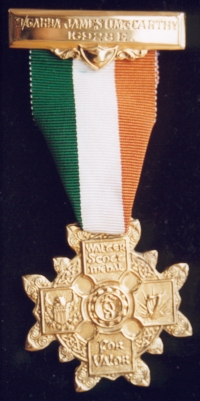
James Mulroy Awarded the First Walter Scott Medal for Valour

The first Walter Scott Medal for Valour, a medal awarded annually for bravery in the Garda Síochána, is awarded to Garda James Mulroy on August 18, 1924. The award is presented by Colonel Scott himself at the Depot, Phoenix Park. It is not a state award, being in the gift of the commissioner, but the medals are awarded by the Minister for Justice and Equality.

The Garda medal is instituted at the behest of Colonel Walter Scott, a New York City philanthropist who took an interest in policing. In 1923 he gives a one thousand dollar gold Bond which pays for in perpetuity a gold medal. The award is to be presented under the following condition: No action, however heroic, will merit the award of the Scott medal unless it takes the shape of an act of most exceptional bravery and heroism involving the risk of life in the execution of duty, and armed with full previous knowledge of the risk involved.

Guard Mulroy is accosted by two armed men who tell him he has five minutes to live. He waits for his opportunity, springs upon the man with the revolver, tackles him and holds him, but is shot and seriously wounded by the other man who fires his single barreled shotgun and then proceeds to beat Guard Mulroy on the head with the shotgun. The struggle ends when the stock of the shotgun separates from the barrel and Guard Mulroy grabs the barrel with one hand while still holding the other man with the loaded revolver with the other. Guard Mulroy disarms the man with the revolver while the other runs off. He then tells the remaining man to go home. Guard Mulroy falls unconscious and later awakes to find himself in the ditch with the revolver in one hand and the barrel in the other. He returns to his station at 5:00 AM, gets his wounds dressed, and then goes out with another Guard and arrests one of the men.


Leave a comment

Birth of Thomas Patrick Ashe

thomas-patrick-ashe

Thomas Patrick Ashe, a member of the Gaelic League, the Irish Republican Brotherhood (IRB), and a founding member of the Irish Volunteers, is born in Lispole, County Kerry, on January 12, 1885. Ashe enters De La Salle Training College, Waterford, in 1905 and begins a teaching career as principal of Corduff National School, Lusk, County Dublin, in 1908.

Ashe plays a major part in the 1916 Easter Rising outside the capital city commanding the Fingal battalion of the Irish Volunteers. Ashe is commandant of the 5th battalion of the Dublin brigade, a force of 60–70 men engaging British forces around north County Dublin during the rising. They are armed only with a few rounds, about a dozen service rifles, a dozen Mausers, and a dozen Martini-Henry carbines. Some of Ashe’s men are armed only with a shotgun against the well-equipped army regulars.

Ashe’s battalion wins a major victory in Ashbourne, County Meath, where they engage a much larger force. They capture a significant quantity of arms and up to twenty Royal Irish Constabulary (RIC) vehicles. Eleven RIC members, including County Inspector Alexander Gray, and two volunteers are killed during the 5-1/2-hour battle. Twenty-four hours after the rising collapses, Ashe’s battalion surrenders on the orders of Patrick Pearse. On May 8, 1916, Ashe and Éamon de Valera are court-martialled and sentenced to death. The sentences are commuted to penal servitude for life. Ashe is imprisoned in Lewes Prison in Lewes, East Sussex, England.

De Valera, Ashe, and Thomas Hunter lead a prisoner hunger strike on May 28, 1917. With accounts of prison mistreatment appearing in the Irish press and mounting protests in Ireland, Ashe and the remaining prisoners are freed on June 18, 1917, by David Lloyd George as part of a general amnesty.

Upon his release, Ashe returns to Ireland and begins a series of speaking engagements. In August 1917, he is arrested and charged with sedition for a speech that he makes in Ballinalee, County Longford, where Michael Collins is also speaking. He is detained at the Curragh but is then transferred to Mountjoy Prison in Dublin. He is convicted and sentenced to two years hard labour. Ashe and other prisoners, including Austin Stack, demand prisoner of war status. On September 20, 1917, Ashe again goes on hunger strike. He dies at the Mater Hospital on September 25, 1917, after being force fed by prison authorities. At the inquest into his death, the jury condemns the staff at the prison for the “inhuman and dangerous operation performed on the prisoner, and other acts of unfeeling and barbaric conduct.” His body lies in state at Dublin City Hall and is buried in Glasnevin Cemetery in Dublin.

Ashe is a relative of Catherine Ashe, the paternal grandmother of American actor Gregory Peck, who emigrates to the United States in the 19th century. The Ashe Memorial Hall built in 1928, housing the Kerry County Museum, in Tralee, County Kerry, is named after him while Nelson Street, also in Tralee, is renamed Ashe Street.