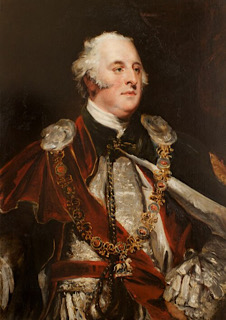
In 1786, Pratt’s father is created Earl Camden, at which point he becomes known by one of his father’s subsidiary titles as Viscount Bayham.
In 1793, Pratt is sworn of the Privy Council. In 1794 he succeeds his father as 2nd Earl Camden, and the following year he is appointed Lord Lieutenant of Ireland by Pitt.
Pratt resigns from office in June 1798, to be replaced with Charles Cornwallis, 1st Marquess Cornwallis, who oversees the military defeat of the rebellion. In 1804, Pratt becomes Secretary of State for War and the Colonies under Pitt, and in 1805 Lord President of the Council, an office he retains until 1806. He is again Lord President from 1807 to 1812, after which date he remains for some time in the cabinet without office. In 1812 he is created Earl of Brecknock and Marquess Camden.
The enforced resignation from the Cabinet of Robert Stewart, Viscount Castlereagh, the stepson of his sister Frances (Lady Londonderry), to whom he has always been personally close, in September 1809, leads to a series of bitter family quarrels, when it becomes clear that Pratt has known for months of the plan to dismiss Stewart, but has given him no warning. Stewart himself regards Pratt as “a weak friend,” not an enemy, and they are eventually reconciled. Other members of the Stewart family, however, never forgive Pratt for what they regard as his disloyalty.
Pratt marries Frances, daughter of William Molesworth, in 1785. She dies at Bayham Abbey, Sussex, in July 1829. He survives her by eleven years and dies at Seal, Kent, on October 8, 1840, aged 81. He is succeeded by his only son, George.
After spending a year on the continent, Rynne returns to Ireland in 1957 to join the antiquities division of the National Museum of Ireland (NMI) in Kildare Street. One of his first assignments is to participate in the excavations at the Hill of Tara, previously headed by his old mentor at UCD, the recently deceased Professor Seán P. Ó Ríordáin. Already an expert on the Iron Age, he expands his expertise to cover Irish Celtic and early Christian art. He becomes an influential figure at the museum, remaining until 1967 and gaining much valuable experience in archaeological research, cataloguing and display, and is once described as the “true master of the Kildare Street crypt.” Intimately acquainted with the museum’s early Christian artefacts, he is particularly drawn to the eighth-century Ardagh chalice, on which he compiles extensive research notes relating to its dismantling and conservation. Although he is recognised as a leading authority on the chalice, his workload at the NMI and various academic commitments, not least his thirty-five years as editor of the North Munster Antiquarian Journal (NMAJ), prevent publication of his great work on the treasure.
During Rynne’s time at the NMI, he develops a close friendship with its director, Dr. Anthony T. Lucas, and on April 1, 1967 marries his daughter Aideen in the Church of the Miraculous Medal, Clonskeagh, Dublin. That year, he leaves the museum to take up a lectureship in archaeology at University College Galway (UCG), remaining there for thirty-one years until his retirement as professor of Celtic archaeology in 1998. During his professorship, he introduces many innovative changes at UCG, placing great emphasis on the value of well-planned field trips to historical monuments and archaeological sites around Connacht and north Clare, including Poulnabrone in his beloved Burren and Dún Aonghasa on Inishmore, which in 1991 he is first to suggest was built for ceremonial rather than defensive purposes. He often ventures further afield to sites such as the Jorvik Viking Centre, York, and the West Kennet Long Barrow in Wiltshire. Many local expeditions include small excavations, which he continues to conduct on behalf of the NMI.
Despite his heavy workload, Rynne writes close to one hundred academic papers in local and international journals, his expansive subject matter including not only archaeology but also folklore and Irish War of Independence history, the latter interest stemming from his father’s involvement in the formation of the Irish state (1917–23). His editorial tenure at the NMAJ includes the publication in 1975 and 1978 of dedicated issues on Edward MacLysaght and John Hunt respectively, and he is editor of Figures from the Past (1987), the Festschrift for Helen Maybury Roe. He also uses the national press to express his sometimes-eccentric views on various subjects, such as Irish neutrality, the American justice system and running the M3 motorway through Tara. A highly engaging and entertaining speaker, he thrives in front of an audience, be it a small group of students standing in a muddy field or an official address to the Royal Society of Antiquaries of Ireland, of which he serves as president from 1985 to 1989. His lectures are marked by his erudite and characteristically passionate delivery, complete with subtle intonation, and he is as comfortable speaking French as he is English or Irish.
Rynne’s legacy cannot be fairly assessed without reference to his largely unpopular stance in the Wood Quay controversy of the late 1970s. When Dublin’s original Viking settlement at Wood Quay is unearthed by archaeologists, he sides with the NMI, which, under the directorship of Joseph Raftery, decides to excavate only a small section of the site before handing it over to developers. This results in the destruction of much unexcavated archaeology. The NMI’s decision results in serious damage to its reputation, with Rynne one of the few archaeologists publicly supporting its unpopular stance. His loyalty to the NMI administration, which includes his father-in-law Lucas, alienates many fellow archaeologists, and is described by Patrick Wallace, then director of excavations at Wood Quay and among the many scholars who campaign to save the site, as “excessive, unnecessary and so unquestioning that it led to his being on the … wrong side during the Wood Quay court case.”
Rynne’s contribution to the history and heritage of his adopted province of Connacht and city of Galway is, however, widely acknowledged as immense. Once settled in UCG, he makes his home in the medieval town of Athenry, where he engages enthusiastically with the local community via lectures, walks and talks on the town’s famous walls and castle. Although Dublin-born, he becomes firmly entrenched in Galway’s colourful past and is instrumental in the founding of the city’s first municipal museum in Comerford House, adjacent to the Spanish Arch, in 1971. Drawing on his considerable NMI experience, he acts as honorary curator for the Galway museum for over a decade, before its move to the present purpose-built building in 2007. Ever willing to disseminate the story of Galway’s past beyond the twin towers of its university, to its citizens and the wider public, he compiles the Tourist Trail of Old Galway (1977). This signposted walking tour of Galway communicates the city’s importance in the medieval world, not only from an Irish, but also from a European and global perspective, and represents an enduring legacy to the self-styled promoter and protector of the city’s heritage.
In the summer of 2012 Rynne suffers a stroke and dies at the age of 79 on June 22, 2012, at University Hospital Galway. He is survived by Aideen, his wife of forty-five years, and their four sons and one daughter. A fifth son pre-deceases him. He is buried in the New Cemetery, Athenry.
(From: “Rynne, Etienne Andrew” by Frank Cullen, Dictionary of Irish Biography, http://www.dib.ie, June 2018)


 seamus dubhghaill