seamus dubhghaill

Promoting Irish Culture and History from Little Rock, Arkansas, USA


Leave a comment

Founding of the Society of United Irishmen

society-of-united-irishmen

The Society of United Irishmen, a liberal political organisation that initially seeks Parliamentary reform, is founded in Belfast on October 14, 1791. It evolves into a revolutionary republican organisation, inspired by the American Revolution and allied with Revolutionary France. It launches the Irish Rebellion of 1798 with the objective of ending British monarchical rule over Ireland and founding a sovereign, independent Irish republic.

The enthusiasm for the French Revolution sees great Irish interest in Thomas Paine‘s The Rights of Man released in May 1791. A couple of months later the Belfast Volunteer company gathers to celebrate the second anniversary of the fall of the Bastille. It is intended that a new radical society is to be announced during the celebrations which William Drennan, who is to give a declaration, asks to add in resolutions. Drennan refuses due to the short notice of the request and suggests that Theobald Wolfe Tone be asked.

Tone’s reformist radicalism has advanced beyond that of the Whigs, and he proposes three resolutions for the new society, which he names the Society of United Irishmen. The first resolution is for the denouncing of the continuing interference of the British establishment in Irish affairs. The second is for the full reform of the Irish parliament and its representation. The last resolution calls for a union of religious faiths in Ireland to “abolish the differences that had long divided Irishmen” and seeks to give Catholics political rights. This last proposal, however, is quietly dropped by the Belfast Volunteers to ensure unanimity for the proposals amongst the people.

This seems to delay the launch of the new society and by August 1791 Tone, in response to the rebuff of his third resolution, publishes the popular and robust An Argument on Behalf of the Catholics of Ireland, which argues why they should be included in attempts at reform. That October, Tone is invited to a debate on the creation of a new society by a group of people including Samuel Neilson. Here he finds that his resolutions are now found a few months later to be “too tame.” A new set of resolutions is drafted and agreed upon on October 14, which the Belfast branch of the Society of United Irishmen adopts on October 18, and the Dublin branch on November 9. The main problem they identify for Ireland is the issue of national sovereignty.

All attendees at the first meeting of the Belfast branch are Protestant. Two, Theobald Wolfe Tone and Thomas Russell, are Anglicans and the remainder are Presbyterian, most of whom are involved in the linen trade in Belfast. Along with Tone and Russell, the men involved are William Sinclair, Henry Joy McCracken, Samuel Neilson, Henry Haslett, Gilbert McIlveen, William Simms, Robert Simms, Thomas McCabe, and Thomas Pearce. After forming, the Society names chandler Samuel McTier as its first President.

Leave a comment

The Races of Castlebar

races-of-castlebar

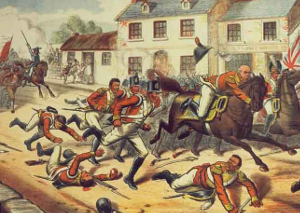
The Battle of Castlebar occurs on August 27, 1798, near the town of Castlebar, County Mayo, during the Irish Rebellion of 1798. A combined force of 2,000 French troops and Irish rebels rout a force of 6,000 British militia in what later becomes known as the “Castlebar Races” or “Races of Castlebar.”

The long-awaited French landing to assist the Irish revolution begun by Theobald Wolfe Tone‘s Society of United Irishmen takes place five days previously on August 22, when almost 1,100 troops under the command of General Jean Joseph Amable Humbert land at Cill Chuimín Strand, County Mayo. The nearby town of Killala is quickly captured after a brief resistance by local yeomen. Following the news of the French landing, Irish volunteers began to trickle into the French camp from all over Mayo.

On August 26, leaving about 200 French regulars behind in Killala to cover his rear and line of withdrawal, Humbert takes a combined force of about 2,000 French and Irish to march on and take Castlebar. In order to avoid a head-on attack, locals advise the French of an alternative route to Castlebar through the wilds along the west of Lough Conn, which the British believe to be impassable for a modern army with attendant artillery train. When General Gerald Lake’s scouts spot the approaching enemy, the surprised British have to hurriedly change the deployment of their entire force to face the threat from this unanticipated direction.

The British have barely completed their new deployment when the Franco-Irish army appears outside the town at about 6:00 AM. The newly sited British artillery opens up on the advancing French and Irish and cut them down in droves. French officers, however, quickly identify an area of scrub and undergrowth in a defile facing the centre of the artillery line which provides some cover from the British line of fire. The French launch a bayonet charge, the ferocity and determination of which unnerve the units stationed behind the artillery. The British units begin to waver before the French reach their lines and eventually turn in panic and flee the battlefield, abandoning the gunners and artillery. A unit of cavalry and British regular infantry attempt to stand and stem the tide of panic but are quickly overwhelmed.

In the headlong flight of thousands of British militias, large quantities of guns and equipment are abandoned, among which is General Lake’s personal luggage. Although not pursued a mile or two beyond Castlebar, the British do not stop until they reach Tuam, with some units fleeing as far as Athlone in the panic. The panic is such that only the arrival of Cornwallis at Athlone prevents further flight across the River Shannon.

Although achieving a decisive victory, the losses of the French and Irish are high, with about 150 men killed, mostly to the cannonade at the start of the battle. About 80 British are killed and some 270 wounded, captured, or deserted. Following the victory, thousands of volunteers flock to join the French who also send a request to France for reinforcements and formally declare a Republic of Connacht, which lasts 3 days and collapses when the French depart.

On September 5, the British forces are again defeated at Collooney however, after that, the rebellion quickly folds. More troops gather and by the Battle of Ballinamuck on September 8, their strength is over 15,000. Ballinamuck is the end for General Humbert, who hands in his surrender. The Irish rebels fight on briefly until scattered. Killala is re-taken on September 12. More French warships sail for Ireland but are decisively defeated by the Royal Navy near Tory Island. With that the 1798 rebellion ends. The captured French soldiers are transferred to England and eventually repatriated. The French officers of Irish origin are hanged in Dublin with the Irish rebels.


Leave a comment

Birth of the Liberator, Daniel O’Connell

daniel-oconnell

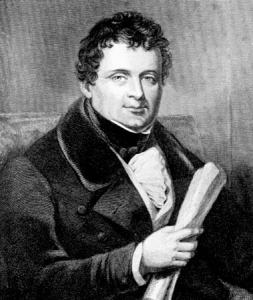
Daniel O’Connell, Irish political leader often referred to as The Liberator or The Emancipator, is born on August 6, 1775, at Carhan near Cahersiveen, County Kerry, to the O’Connells of Derrynane, a once-wealthy Roman Catholic family, that has been dispossessed of its lands.

Raised by his uncle, Daniel learns the Irish language and Irish lore in Kerry. O’Connell does part of his schooling in France during the revolution. On May 19, 1798, O’Connell is called to the Irish Bar and becomes a barrister. Four days later, the United Irishmen stage their rebellion which is put down by the British with great bloodshed. O’Connell does not support the rebellion. He believes that the Irish need to assert themselves politically rather than by force. The violent excesses he witnesses in France, the slaughter of the 1798 Rising, and finally his own killing of a man in a duel in 1815 leads him to renounce violence forever.

Moving into politics, O’Connell founds the Catholic Association in 1823, creating one of the first massive political movements in Europe or the Americas. The Catholic Association embraces other aims to better Irish Catholics, such as electoral reform, reform of the Church of Ireland, tenants’ rights, and economic development.

When he is elected to Parliament in 1828, he is unable to take his seat as members of parliament have to take the Oath of Supremacy, which is incompatible with Catholicism.  Fear of the reaction of his millions of followers leads to the passage of the Roman Catholic Relief Act 1829. O’Connell works for Home Rule for Ireland for the rest of his days but never achieves it. The British ban his mass Repeal of the Union rallies in 1843 and jail him for a time. The movement loses momentum at that point and the long years of hard work wear “The Liberator” down.

O’Connell dies at the age of 71 of cerebral softening on May15, 1847, in Genoa, Italy, while on a pilgrimage to Rome. His time in prison seriously weakens him and the appallingly cold weather he has to endure on his journey is likely the final blow. According to his dying wish, his heart is buried in Rome at Sant’Agata dei Goti, then the chapel of the Irish College, and the remainder of his body in Glasnevin Cemetery in Dublin, beneath a round tower.


Leave a comment

Death of Daniel O’Connell in Genoa, Italy

daniel-oconnell

Daniel O’Connell, lawyer who becomes the first great 19th-century Irish nationalist leader and is known as “The Liberator,” dies in Genoa, Italy on May 15, 1847. Throughout his life, he campaigns for Catholic emancipation, including the right for Catholics to sit in the Westminster Parliament and the repeal of the Act of Union which combines Great Britain and Ireland.

Compelled to leave the Roman Catholic college at Douai, France, when the French Revolution breaks out, O’Connell goes to London to study law, and in 1798 he is called to the Irish bar. His forensic skill enables him to use the courts as nationalist forums. Although he has joined the Society of United Irishmen, a revolutionary society, as early as 1797, he refuses to participate in the Irish Rebellion of the following year. When the Act of Union takes effect on January 1, 1801, and abolishes the Irish Parliament, he insists that the British Parliament repeal the anti-Catholic laws in order to justify its claim to represent the people of Ireland. From 1813 he opposes various Catholic relief proposals because the government, with the acquiescence of the papacy, has the right to veto nominations to Catholic bishoprics in Great Britain and Ireland. Although permanent political organizations of Catholics are illegal, O’Connell sets up a nationwide series of mass meetings to petition for Catholic emancipation.

On May 12, 1823, O’Connell and Richard Lalor Sheil found the Catholic Association, which quickly attracts the support of the Irish priesthood and of lawyers and other educated Catholic laymen and which eventually comprises so many members that the government cannot suppress it. In 1826, when it is reorganized as the New Catholic Association, it causes the defeat of several parliamentary candidates sponsored by large landowners. In County Clare in July 1828, O’Connell himself, although as a Catholic ineligible to sit in the House of Commons, defeats a man who tries to support both the British government and Catholic emancipation. This result impresses on the British prime minister, Arthur Wellesley, 1st Duke of Wellington, the need for making a major concession to the Irish Catholics. Following the passage of the Catholic Emancipation Act of 1829, O’Connell, after going through the formality of an uncontested reelection, takes his seat at Westminster.

In April 1835, he helps to overthrow Sir Robert Peel’s Conservative ministry. In the same year, he enters into the “Lichfield House compact,” whereby he promises the Whig Party leaders a period of “perfect calm” in Ireland while the government enacts reform measures. O’Connell and his Irish adherents, known collectively as “O’Connell’s tail,” then aid in keeping the weak Whig administration of William Lamb, 2nd Viscount Melbourne, in office from 1835 to 1841. By 1839, however, O’Connell realizes that the Whigs will do little more than the Conservatives for Ireland, and in 1840 he founds the Repeal Association to dissolve the Anglo-Irish legislative union. A series of mass meetings in all parts of Ireland culminate in O’Connell’s arrest for seditious conspiracy, but he is released on appeal in September 1844 after three months’ imprisonment. Afterward his health fails rapidly, and the nationalist leadership falls to the radical Young Ireland group.

O’Connell dies at the age of 71 of cerebral softening in 1847 in Genoa, Italy, while on a pilgrimage to Rome. His time in prison has seriously weakened him, and the appallingly cold weather he has to endure on his journey is probably the final blow. According to his dying wish, his heart is buried at Sant’Agata dei Goti, then the chapel of the Irish College, in Rome and the remainder of his body in Glasnevin Cemetery in Dublin, beneath a round tower.


Leave a comment

The Acts of Union 1800

On January 1, 1801, the Acts of Union 1800 goes into effect uniting the Kingdom of Great Britain and the Kingdom of Ireland to create the United Kingdom of Great Britain and Ireland. The Acts of Union 1800 consists of two acts with the same long title, An Act for the Union of Great Britain and Ireland. Both are passed in 1800.

Before these Acts, Ireland had been in personal union with England since 1541, when the Parliament of Ireland had passed the Crown of Ireland Act 1542 proclaiming King Henry VIII of England to be King of Ireland. Both Ireland and England had come in personal union with Scotland with the Union of the Crowns in 1603.

In 1707, the Kingdom of England and the Kingdom of Scotland were united into a single kingdom named the Kingdom of Great Britain. The Irish parliament at that time was subject to a number of restrictions that placed it subservient to the Parliament of England and, following the union of England and Scotland, the Parliament of Great Britain.

In the century that followed the union of England and Scotland, Ireland gained effective legislative independence from Great Britain through the Constitution of 1782. However, access to institutional power in Ireland was restricted to a small minority, the so-called Anglo-Irish of the Protestant Ascendancy. Frustration at the lack of reform eventually led to a rebellion in 1798, involving a French invasion of Ireland and seeking complete independence from Great Britain. The rebellion was crushed with much bloodshed and the subsequent drive for union between Great Britain and Ireland that passed in 1800 was motivated at least in part by the belief that the rebellion was caused as much by loyalist brutality as by the United Irishmen.

Each Act had to be passed in the Parliament of Great Britain and the Parliament of Ireland. The final passage of the Act in the Irish Parliament was achieved with substantial majorities, achieved in part according to contemporary documents through bribery, namely the awarding of peerages and honours to critics to get their votes.

Both Acts, though since amended, still remain in force in the United Kingdom but have been repealed in the Republic of Ireland.