seamus dubhghaill

Promoting Irish Culture and History from Little Rock, Arkansas, USA


Leave a comment

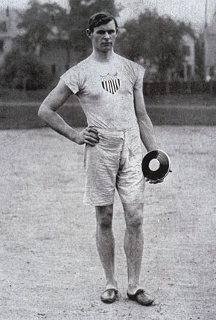
Death of Olympic Gold Medalist Martin John Sheridan

martin-john-sheridan

Martin John Sheridan, “one of the greatest athletes the United States has ever known” according to his obituary in The New York Times, dies in St. Vincent’s Hospital in Manhattan, New York City on March 27, 1918, the day before his 37th birthday.

Sheridan is born in Bohola, County Mayo on March 28, 1881. At 6’3″ and 194 lbs., Sheridan is the best all-around athlete of the Irish American Athletic Club, and like many of his teammates, serves with the New York City Police Department from 1906 until his death. He is so well respected in the NYPD, that he serves as the Governor’s personal bodyguard when the governor is in New York City.

A five-time Olympic gold medalist, with a total of nine Olympic medals, Sheridan is called “one of the greatest figures that ever represented this country in international sport, as well as being one of the most popular who ever attained the championship honor.” He wins the discus throw event at the 1904, 1906, and 1908 Summer Olympic Games as well as the shot put at the 1906 Olympics and the Greek discus in 1908. At the 1906 Intercalated Games in Athens, Greece he also wins silver medals in the standing high jump, standing long jump and the stone throw.

In 1907, Sheridan wins the National Amateur Athletic Union discus championship and the Canadian championship, and in 1908 he wins the Metropolitan, National and Canadian championships as well as two gold medals in the discus throw and bronze in the standing long jump at the 1908 Olympic Games.

Two of Sheridan’s gold medals from the 1904 Summer Olympic Games in St. Louis, Missouri, and one of his medals from the 1906 Intercalated Games in Athens, Greece, are currently located in the USA Track & Field‘s Hall of Fame History Gallery, in Washington Heights, Manhattan.

There are claims that Sheridan fuels a controversy in London in 1908, when flagbearer Ralph Rose refuses to dip the flag to King Edward VII. Sheridan supports Rose by explaining “This flag dips to no earthly king,” and it is claimed that his statement exemplifies both Irish and American defiance of the British monarchy. However, careful research has shown that this is first reported in 1952. Sheridan himself makes no mention of it in his published reports on the Games and neither does his obituary.

Martin Sheridan dies in Manhattan, New York City on March 27, 1918, a very early casualty of the 1918 flu pandemic. He is buried in Calvary Cemetery, Queens, New York. The inscription on the granite Celtic Cross monument marking his grave says in part: “Devoted to the Institutions of his Country, and the Ideals and Aspirations of his Race. Athlete. Patriot.” He is part of a group of Irish American athletes known as the “Irish Whales.”

Leave a comment

Birth of Brian Coffey, Poet & Publisher

Brian Coffey, Irish poet and publisher, is born in Dún LaoghaireCounty Dublin on June 8, 1905. His work is informed by his Catholicism and by his background in science and philosophy, and his connection to surrealism. For these reasons, he is seen as being closer to an intellectual European Catholic tradition than to mainstream Irish Catholic culture.

Coffey attends the Mount St. Benedict boarding school in GoreyCounty Wexford from 1917 to 1919 and then Clongowes Wood College, in ClaneCounty Kildare from 1919 until 1922. In 1923, he goes to France to study for the Bachelor’s degree in Classical Studies at the Institution St. Vincent, SenlisOise. While still at college, Coffey begins writing poetry. He publishes his first poems in University College Dublin‘s The National Student under the pseudonym Coeuvre.

In the early 1930s, Coffey moves to Paris where he studies Physical Chemistry under Jean Baptiste Perrin, who won the Nobel Prize for Physics in 1926. He completes these studies in 1933, and his Three Poems is printed in Paris by Jeanette Monnier that same year. In 1934 he enters the Institut Catholique de Paris to work with the noted French philosopher Jacques Maritain, taking his licentiate examination in 1936. He then moves to London for a time and contributes reviews and a poem to T.S. Eliot‘s The Criterion magazine. He returns to Paris in 1937 as an exchange student to work on his doctoral thesis on the idea of order in the work of Thomas Aquinas. In 1938, Coffey’s second volume of poetry, Third Person, is published by George Reavey‘s Europa Press.

During the war, Coffey teaches in schools in London and Yorkshire, leaving his young family in Dublin. After the war, he returns to Paris and completes his doctoral thesis. The family then moves so that Coffey can take up a teaching post at the Jesuit Saint Louis University.

By the early 1950s, Coffey becomes uncomfortable for a number of reasons, including the nature of his work, his distance from Ireland and the pressures that inevitably come to bear on an academic who has previously associated with well-known left-wing writers in Paris. For these reasons, he resigns in 1952.

In 1952, Coffey returns to live in London and, from 1973, Southampton. He begins again to publish his poetry and translations, mainly of French poetry. The first work in English to appear after this period of silence is Missouri Sequence, apparently begun in St. Louis but first appearing in the University Review, later known as the Irish University Review, in 1962.

Over the next decade or so, he publishes regularly in the University Review. He also sets up his own publishing enterprise, Advent Press, which publishes work by himself and by younger writers he wants to support.

Brian Coffey dies at the age of 89 on April 14, 1995, and is buried in Southampton, England.


Leave a comment

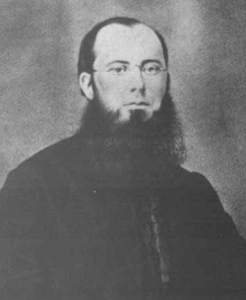
Birth of John B. Bannon, Irish Catholic Jesuit Priest

john-bannon

John B. Bannon, Irish Catholic Jesuit priest who serves as a Confederate chaplain during the American Civil War, is born in Roosky, County Roscommon, on December 29, 1829. He is also renowned as an orator.

Bannon is born to James Bannon, a Dublin grain dealer, and Fanny Bannon (née O’Farrell). He goes to the vincentian Castleknock College in Dublin. In 1846 he goes to study for the priesthood at St. Patrick’s Pontifical University, Maynooth, in the minor seminary until 1850 and completing his theology course in 1853. He is ordained on June 16, 1853, by Archbishop Paul Cullen for the Dublin Diocese. He soon applies to move to America.

Shortly after ordination he moves to the Archdiocese of St. Louis, Missouri. He becomes pastor to St. John the Apostle and Evangelist Church which he builds in 1858. He serves in the First Missouri Confederate Brigade, during the American Civil War. He ministers at the battles of Corinth, Fort Gibson, and at Big Black River Bridge, Vicksburg.

He is detained on July 4, 1863, when Vicksburg surrenders. After being released by Union forces, he goes to Richmond, Virginia in August 1863, where Jefferson Davis and Secretary of State Judah Benjamin ask him to go to Ireland to discourage recruitment for the Federal forces and try to get international help for the Confederacy.

In November 1863, Bannon returns to Ireland, writing and pamphleting to discourage people from emigrating and joining the Union side of the civil war. He makes two trips to Rome to try, unsuccessfully, to get the Vatican to side with the Confederacy. Following the American Civil War, he is banned from preaching in St. Louis, and stays in Ireland, becoming a Jesuit in 1865, spending some time in Milltown Park, Tullabeg College, and in Gardiner Street.

Bannon dies on July 14, 1913, in Upper Gardiner Street, and is buried in the Jesuit plot at Glasnevin Cemetery, Dublin.


Leave a comment

Death of Patrick Sarsfield Gilmore, Composer & Bandmaster

patrick-sarsfield-gilmore

Patrick Sarsfield Gilmore, Irish-born American composer and bandmaster, dies in St. Louis, Missouri, on September 24, 1892. He lives and works in the United States after 1848. While serving in the Union Army during the American Civil War, Gilmore writes the lyrics to the song When Johnny Comes Marching Home, the tune taken from the old Irish antiwar folk song, Johnny I Hardly Knew Ye. This is published under the name Louis Lambert.

Gilmore is born in Ballygar, County Galway, on December 25, 1829. He starts his music career at age fifteen and spends time in Canada with an English band. Already a fine cornet player, he settles in Boston, Massachusetts in 1848, becoming leader of the Suffolk, Boston Brigade, and Salem bands in swift succession. He also works in the Boston music store of John P. Ordway and founds Ordway’s Aeolians, a group of blackface minstrels. With the Salem Band, Gilmore performs at the 1857 inauguration of President James Buchanan.

In 1858, Gilmore founds “Gilmore’s Band,” and at the outset of the American Civil War the band enlists with the 24th Massachusetts Volunteers, accompanying General Ambrose Burnside to North Carolina. After the temporary discharge of bands from the field, Governor John Albion Andrew of Massachusetts entrusts Gilmore with the task of re-organizing military music-making. General Nathaniel P. Banks creates him Bandmaster-general.

When the war ends, Gilmore is asked to organize a celebration, which takes place in New Orleans. That success emboldens him to undertake two major music festivals in Boston, the National Peace Jubilee in 1869 and the World’s Peace Jubilee and International Musical Festival in 1872. These feature monster orchestras of massed bands with the finest singers and instrumentalists, including the only American appearance by “waltz king” Johann Strauss II, and cements Gilmore’s reputation as the leading musical figure of the age. Coliseums are erected for the occasions, holding 60- and 120,000 persons. Grateful Bostonians present Gilmore with medals and cash, but in 1873 he moves to New York City, as bandmaster of the 22nd Regiment. Gilmore takes this band on acclaimed tours of Europe.

On September 24, 1892, back in the United States preparing an 1892 musical celebration of the quadricentennial anniversary of Christopher Columbus‘ voyage of discovery, Gilmore collapses and dies in St. Louis. He is buried in Calvary Cemetery, Queens, New York, where his wife is later interred.

In many ways Gilmore can be seen as the principal figure in 19th-century American music. He holds the first “Promenade Concert in America” in 1855, the forerunner to today’s Boston Pops. He sets up “Gilmore’s Concert Garden,” which becomes Madison Square Garden. He is the Musical Director of the Nation in effect, leading the festivities for the 1876 Centennial celebrations in Philadelphia and the dedication of the Statue of Liberty in 1886. In 1888 he starts the tradition of seeing in the New Year in Times Square.

Patrick Sarsfield Gilmore is inducted into the Songwriters Hall of Fame in 1970.