seamus dubhghaill

Promoting Irish Culture and History from Little Rock, Arkansas, USA


Leave a comment

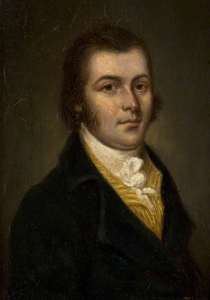
Death of Samuel Nielson, Society of United Irishmen Founder Member

Samuel Neilson, one of the founder members of the Society of United Irishmen and the founder of its newspaper the Northern Star, dies in Poughkeepsie, New York on August 29, 1803.

Neilson is born in Ballyroney, County Down, the son of Presbyterian minister Alexander, and Agnes Neilson. He is educated locally. He is the second son in a family of eight sons and five daughters. At the age of 16, he is apprenticed to his elder brother, John, in the business of woolen drapery in Belfast. Eight years later he establishes his own business.

Despite his commercial success, Neilson is naturally drawn to politics and is early on a member of the reformist Irish Volunteers movement. In 1791, inspired by the French Revolution, he suggests to Henry Joy McCracken the idea of a political society of Irishmen of every religious persuasion. He establishes the Society of United Irishmen in Belfast. The following year he launches the newspaper of the United Irishmen, the Northern Star, which effectively throws away his fortune. As its editor he is a high-profile target for the authorities and is prosecuted for libel several times, being twice imprisoned between 1796 and 1798.

Along with several other state prisoners, Neilson is released in February 1798 following several petitions by influential friends, on grounds of bad health. Upon release he immediately involves himself in the United Irishmen aligning with the radicals among the leadership who are pressing for immediate rebellion and oppose the moderates who wish to wait for French assistance before acting.

The United Irishmen are however, severely penetrated by informants who keep Dublin Castle abreast of their plans and discussions. In March 1798, information of a meeting of the United Irish executive at the house of Oliver Bond leads to the arrest of most of the leadership, leaving Neilson and Lord Edward FitzGerald as the only figures of national importance still at liberty. They decide to press ahead as soon as possible and settled on May 23 as the date for the rebellion to begin.

As the date looms closer, the authorities go into overdrive to sweep up the rump leadership and on May 18 Lord Edward is betrayed in his hiding place and critically wounded while resisting capture. Neilson, now with responsibility for finalising plans for the looming rebellion, decides that Fitzgerald is too valuable to do without, and decides to try and rescue him from Newgate Prison in Dublin. Wary of confiding his plans too early for fear of betrayal, Neilson goes on a reconnaissance of the prison but is spotted by chance by one of his former jailers and after a fierce struggle, he is overpowered and dragged into the prison.

Neilson is indicted for high treason and held in Kilmainham Gaol with other state prisoners for the duration of the doomed rebellion outside. After the execution of Oliver Bond, and the brothers John and Henry Sheares, Neilson and the remaining prisoners agree to provide the authorities with details of the organisation of the United Irishmen, plans for the rebellion, etc. in return for exile.

Following the suppression of the rebellion, Neilson is transferred to Fort George in Inverness-shire, Scotland, and in 1802 he is deported to the Netherlands. From there he makes his way to the United States, arriving in December 1802, and settling in Poughkeepsie, New York.  He has little time to enjoy his liberty before his sudden death on August 29, 1803, of yellow fever, or possibly a stroke.

Nielson is not idle during his short life in America as he completes plans to start a new evening newspaper in Poughkeepsie and also has plans in the works to establish a version of the Society of United Irishmen in the United States. Since his death, his remains have been moved to three different cemeteries before coming to rest in the Poughkeepsie Rural Cemetery in 1880.

(Photograph: (c) National Museums Northern Ireland; Supplied by The Public Catalogue Foundation)


1 Comment

Birth of Michael James O’Hehir, Commentator & Journalist

michael-james-ohehirMichael James O’Hehir, hurling, Gaelic football and horse racing commentator and journalist, is born on June 2, 1920, in Glasnevin, County Dublin. Between 1938 and 1985 his enthusiasm and a memorable turn of phrase endears him to many. He is credited with being the “Voice of the Gaelic Athletic Association.”

His father, Jim O’Hehir, is active in Gaelic games, having trained his native county to win the 1914 All-Ireland Senior Hurling Championship title in hurling. He subsequently trains the Leitrim football team that secures the Connacht Senior Football Championship title in 1927 and he also serves as an official with the Dublin Junior Board.

O’Hehir is educated at St. Patrick’s National School in Drumcondra before later attending the O’Connell School. He later studies electrical engineering at University College Dublin, however, he abandons his studies after just one year to pursue a full-time career in broadcasting.

At the age of eighteen O’Hehir writes to Radio Éireann asking to do a test commentary. He is accepted and is asked to do a five-minute microphone test for a National Football League game between Wexford and Louth. His microphone test impresses the director of broadcasting so much that he is invited to commentate on the entire second half of the match.

Two months later, in August 1938, O’Hehir makes his first broadcast – the All-Ireland football semi-final between Monaghan and Galway. The following year he covers his first hurling final – the famous “thunder and lightning final” between Cork and Kilkenny.

By the mid-1940s O’Hehir is recognised as one of Ireland’s leading sports broadcasters. In 1947 he faces his most challenging broadcast to date when he has to commentate on the All-Ireland Football Final from the Polo Grounds in New York City with over 1,000,000 people listening to the broadcast back in Ireland.

In 1944 O’Hehir joins the staff of Independent Newspapers as a sports sub-editor, before beginning a seventeen-year career as racing correspondent in 1947.

In 1961 Ireland’s first national television station, Telefís Éireann, is founded and O’Hehir is appointed head of sports programmes. In addition to his new role O’Hehir continues to keep up a hectic schedule of commentaries.

O’Hehir’s skills do not just confine him to sports broadcasting and, in November 1963, he faces his toughest broadcast. By coincidence he is on holidays with his wife Molly in New York City when U.S. President John F. Kennedy is assassinated. O’Hehir is asked by Telefís Éireann to provide the commentary for the funeral. The live five-hour broadcast proves a huge challenge for him, as he has had no association with political or current affairs broadcasting up to that point and lacks the resources available to more established television stations. O’Hehir’s commentary, however, wins widespread acclaim in Ireland and shows a different side of his nature.

In August 1985 O’Hehir is preparing to commentate on the All-Ireland hurling final between Offaly and Galway. It would be a special occasion as it would mark his 100th commentary on an All-Ireland final. Two weeks before the game he suffers a stroke which leaves him in a wheelchair and with some speaking difficulties. This denies him the chance to reach the century milestone. He hopes to return to broadcasting one day to complete his 100th final, however, this never happens.

In 1987, the centenary All-Ireland football final takes place Croke Park. The biggest cheer of the day is reserved for O’Hehir when he is pushed onto the field in a wheelchair by his son Peter. Nobody expects the standing ovation and the huge outpouring of emotion from the thousands of fans present and from O’Hehir himself.

Over the next few years O’Hehir withdraws from public life. He returns briefly in 1996 when his autobiography, My Life and Times, is published. Michael O’Hehir dies in Dublin on November 24, 1996.