seamus dubhghaill

Promoting Irish Culture and History from Little Rock, Arkansas, USA


Leave a comment

Death of Theobald Walter, the First Chief Butler of Ireland

Theobald Walter, sometimes Theobald FitzWalter, Theobald Butler, or Theobald Walter le Boteler, the first Chief Butler of Ireland, dies on February 4, 1206, at Arklow Castle at Wicklow, in present day County Wicklow. He also holds the office of Chief Butler of England and is the High Sheriff of Lancashire for 1194. He is the first to use the surname Butler of the Butler family of Ireland. He is involved in the Irish campaigns of King Henry II of England and John of England. His eldest brother, Hubert Walter, becomes the Archbishop of Canterbury and justiciar and Lord Chancellor of England.

Walter is born in Norfolk, England, in 1165, the son of Hervey Walter and his wife, Matilda de Valoignes, who is one of the daughters of Theobald de Valoignes. Their children were Theobald, Hubert, Bartholomew, Roger, and Hamon. He and his brother Hubert are brought up by their uncle Ranulf de Glanvill, the great justiciar of Henry II of England who had married his mother’s sister Bertha.

On April 25, 1185, Prince John, in his new capacity as Lord of Ireland, lands at Waterford and around this time grants the hereditary office of butler of Ireland to Walter, whereby he and his successors are to attend the Kings of England at their coronation, and on that day present them with the first cup of wine. His father had been the hereditary holder of the office of butler of England. Sometime after, King Henry II of England grants him the prisage of wines, to enable him and his heirs, the better to support the dignity of that office. By this grant, he has two barrels of wine out of every ship, which breaks bulk in any trading port of Ireland, and is loaded with 20 tons of that commodity, and one ton from 9 to 20. He accompanies John on his progress through Munster and Leinster. At this time, he is also granted a large section of the north-eastern part of the Kingdom of Limerick. The grant of five and a half cantreds is bounded by:

“…the borough of Killaloe and the half cantred of Trucheked Maleth in which it lay, and the cantreds of Elykarval, Elyochgardi, Euermond, Aros and Wedene, and Woedeneoccadelon and Wodeneoidernan.”

These are the modern baronies of Tullough (in County Clare), Clonlisk and Ballybritt (in County Offaly), Eliogarty, Ormond Upper, Ormond Lower, Owney and Arra (in County Tipperary), Owneybeg, Clanwilliam and Coonagh (in County Limerick).

Walter is active in the war that takes place when Rory O’Connor attempts to regain his throne after retiring to the monastery of Cong (present day County Mayo), as his men are involved in the death of Donal Mor McCarthy during a parley in 1185 near Cork. In 1194, he supports his brother during Hubert’s actions against Prince John, with him receiving the surrender of John’s supporters in Lancaster. He is rewarded with the office of sheriff of Lancaster, which he holds until Christmas of 1198. He is again sheriff after John takes the throne in 1199.

In early 1200, however, John deprives Walter of all his offices and lands because of his irregularities as sheriff. His lands are not restored until January 1202. A manuscript in the National Library of Ireland points to William de Braose, 4th Lord of Bramber, as the agent of his restoration:

“Grant by William de Braosa, (senior) to Theobald Walter (le Botiller) the burgh of Kildelon (Killaloe) … the cantred of Elykaruel (the baronies of Clonlisk and Ballybrit, County Offaly), Eliogarty, Ormond, Ara and Oioney, etc. 1201.”

“Elykaruel” refers to the Gaelic túath of “Ely O’Carroll”, which straddles the southern part of County Offaly and the northern part of Tipperary (at Ikerrin). The other cantreds named are probably the modern baronies of Eliogarty, Ormond Upper, Ormond Lower and Owney and Arra in County Tipperary.

Walter founds the Abbey of Woney, of which nothing now remains, in the townland of Abington, near the modern village of Murroe in County Limerick around 1200. He also founds the Cockersand Abbey in Lancaster, Abbey of Nenagh in County Tipperary, and a monastic house at Arklow in County Wicklow.

Walter marries Maud le Vavasour (1176–1226), heiress of Robert le Vavasour, a baron of Yorkshire. John Lodge in the Peerage of Ireland in 1789 gives the year as 1189, but on no apparent authority, as no other author follows him on this. Their children are Theobald le Botiller, 2nd Chief Butler of Ireland, and Maud (1192–1244), who marries three times yet only has two surviving children, Ralph and Marie.

Walter dies on February 4, 1206, at Arklow Castle, County Wicklow, and is buried at Wotheney Abbey.

Leave a comment

Death of Brian O’Neill, High King of Ireland

Brian O’Neill (Irish: Brian Chatha an Dúna Ó Néill), the High King of Ireland from 1258 to 1260, is defeated and killed by the forces of Roger des Auters at the Battle of Down on May 14, 1260.

O’Neill is the son of Niall Roe O’Neill, and grandson of Áed in Macáem Tóinlesc. His wife is Nuala O’Connor (Ní Conchobair), a daughter of Rory O’Connor (Irish: Ruaidrí Ua Conchobair), the last High King of Ireland before the Norman invasion. Therefore, through his mother, he is descended from Brian Boru (Irish: Brian Bóramha).

In 1230, Hugh O’Neill (Irish: Aedh Ó Néill), king of Tyrone, dies and is succeeded by Donnell MacLaughlin. MacLaughlin, however, is removed in 1238 by the Justiciar of Ireland, Maurice FitzGerald, 2nd Lord of Offaly, and Hugh de Lacy, 1st Earl of Ulster, who install “the son of O’Neill”, presumed to have been Brian, and take the hostages of the Cenel Owen and Cenel Connell. However, it may have been Brian’s cousin Donnell, who afterwards is killed by MacLaughlin. After this, O’Neill claims the kingship of the O’Neill dynasty as well as Tyrone, possibly with the aid of Hugh de Lacy, 1st Earl of Ulster.

In revenge, O’Neill with the aid of Melaghlin O’Donnell, king of Tyrconnell, defeat MacLoughlin and ten of his closest kinsmen at the Battle of Camergi, somewhere within Tyrone north of Omagh, in 1241. This ends the long rivalry between the MacLoughlin’s and O’Neill’s, with the MacLoughlin’s afterwards excluded from the kingship of Tyrone and Ailech.

In 1244, Henry III of England sends letters to various Gaelic Irish lords, including O’Neill, requesting their aid in a military campaign against the Kingdom of Scotland. In the end the issue is sorted out diplomatically. Copies of the letter are also distributed to O’Neill’s sub-chiefs including his tánaiste, Hugh Boy O’Neill.

A consequence of this infighting between the rival factions of the Cenél Eoghain allows the Normans to advance deeper into Gaelic Ulster, however, in 1243 de Lacy dies. Thus the Earldom of Ulster reverts to the English Crown and is taken over by royal administrators. John FitzGeoffrey, the king’s chief governor in Ireland, erects a bridge across the River Bann and builds castles at Coleraine and Ballyroney in Iveagh. From here FitzGeoffrey is able to penetrate deeper into Tyrone.

Despite ending MacLoughlin aspirations to the kingship, O’Neill forms a marriage alliance with them, however, this results in a war with the O’Donnells of Tyrconnell. Subsequently in 1248 O’Neill backs the king of Tyrconnell, Rory O’Cannon (Irish: Ruaidri Ua Canannáin), against the claims of O’Donnell. O’Cannon had been set up in the kingship by FitzGerald, however, rather than backing him, enters Tyrconnell and removes him in favour of Gofraid O’Donnell.

O’Cannon, who had been expelled to Tyrone, and O’Neill once again lead their forces into Tyrconnell to confront O’Donnell, however they are defeated and O’Cannon is killed.

That same year, John FitzGeoffrey, who replaced FitzGerald as Justiciar in 1246, enters Tyrone and takes the submission and hostages of O’Neill. A resolution had been adopted at a meeting of the Cenel Owen that “since the power of the Foreigners was over the Gaeidhel of Erinn, to give hostages to the Foreigners, and to make peace with them, for the sake of their country.”

In 1249, the king of Connacht, Felim O’Connor, is given refuge from the Normans by O’Neill. In 1252, O’Neill and his brother give their submissions to the Justiciar of Ireland, who had marched to Armagh with a large force. A Rory O’Neill is given as hostage.

In 1253, as a sign of defiance against his vassal status with the Earldom of Ulster, O’Neill withholds his tribute to it and raids Iveagh, destroying the castle at Ballyroney. He also launches an offensive against the Normans in Leinster. That same year, the son of Maurice FitzGerald leads his forces into Tyrone to attack O’Neill, however he fails to take his submission or hostages and after battle suffers a heavy defeat at the hands of O’Neill.

In 1255, O’Neill makes a pact with Felim O’Connor’s son Hugh, whereby allowing Hugh free rein in the Kingdom of Breifne, he would aid O’Neill against the Normans of the earldom who are eroding his territory.

In 1257, the king of Tyrconnell, Gofraid O’Donnell, is mortally wounded in battle against the FitzGeralds and O’Neill uses this opportunity to try to exact Tyrconnell’s submission. As the Cenel Connell discuss what to do, Gofraid’s youngest brother, Donnell Óg, returns from fosterage and is conferred the chieftainship of Tyrconnell. He refuses to submit O’Neill stating the Scottish proverb “Every man should have his own world.”

FitzGerald in 1252 had built a castle at Caoluisce, on the banks of Lough Erne, near modern day Belleek, County Fermanagh, Northern Ireland, however, in 1258 it is the site where O’Neill, in the presence of his ally O’Connor, is inaugurated as “King of the Gael of Erin.” While he receives hostages from O’Connor and from O’Brien of Thomond, along with several other minor Kings from Meath and Munster, his claim is not recognised by those of the Irish closest to him including the other O’Neill factions, the O’Donnell’s of Tyrconnell, the MacMahon’s of Airgíalla, and the O’Rourkes of Breifne. The following year O’Donnell leads an attack into Tyrone.

In 1260, O’Neill, along with his O’Connor allies, launch an attack on the Normans of the Earldom of Ulster at Drumderg, near its capital at Downpatrick in modern County Down, Northern Ireland. The Normans levy the town, and with the aid of forces brought by Sir Roger des Auters, O’Neill and his allies are decisively defeated at the subsequent Battle of Down. The Annals of Inisfallen state that the forces recruited by the Normans consist mostly of native Irish and that the Normans play only a minor role.

In the battle, O’Neill is killed along with many other Irish nobles including over a dozen members of the O’Cahans. O’Neill’s head is cut off by the Normans and sent to King Henry III of England, a sign of how dangerous his coalition is believed to be.

After this battle, O’Neill becomes known in Irish as Brian Chatha an Dúna, meaning “Brian of the Battle of Down.”

After O’Neill’s death, the kingship of the Cenel Owen, and with it Tyrone, is taken by his cousin’s son, Hugh Boy O’Neill, ancestor of the Clandeboye O’Neill’s, who also has the support of the earldom of Ulster. Upon Hugh’s death in 1283 O’Neill’s son Donnell seizes the kingship, which until 1295 is highly contested between him and his second-cousin Niall Culanach O’Neill and Hugh Boy’s son Brian, until he wins outright control by killing his opponents.


Leave a comment

Death of Cathal Crobhdearg Ua Conchobair, the King of Connacht

Cathal Crobhdearg Ua Conchobair, the King of Connacht and youngest son of the Irish High King Tairrdelbach mac Ruaidri Ua Conchobair, dies on May 27, 1224. This finally opens the way for the Norman occupation of Connacht.

Ua Conchobair is born in 1153 and serves as King of Connacht from 1189 to 1199, and is re-inaugurated on the stone at Clonalis about 1201, reigning until 1224. He first succeeds his elder half brother Ruaidri‘s son Conchobar Máenmaige Ua Conchobair as ruler of Connacht. Conchobar Máenmaige’s son Cathal Carrach Ua Conchobair then rules from 1199 to 1202, with Cathal Crobhdearg back in power from then.

From his base west of the River Shannon he is forced to deal with the Norman invaders. He is a competent leader despite problems, avoiding major conflicts and winning minor skirmishes. Ua Conchobair attempts to make the best of the new situation with Ireland divided between Norman and Gaelic rulers. His long reign is perhaps a sign of relative success. He is the subject, as Cáhal Mór of the Wine Red Hand, of the poem A Vision of Connaught in the Thirteenth Century by the 19th-century Irish nationalist James Clarence Mangan.

Ua Conchobair founds Ballintubber Abbey in 1216, and is succeeded by his son, Aedh Ua Conchobair. His wife, Mor Ní Briain, is a daughter of King Domnall Mór Ua Briain of Thomond, dies in 1218.

In 1224 Ua Conchobair writes to Henry III as Lord of Ireland, asking that his son and heir Od (Aedh) be granted all of Connacht, in particular those parts, Kingdom of Breifne, owned by William Gorm de Lacy.

An account of Ua Conchobair’s inauguration has been preserved, written down by Donogh Bacach Ó Maolconaire, the son of O’Connor’s very inaugurator Tanaide Ó Maolconaire, who is also his historian.

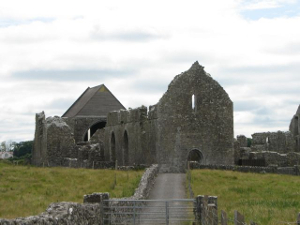
(Pictured: Ruins of the 12th century Cistercian Knockmoy Abbey which contains the burial site of King Cathal Crobhdearg Ua Conchobair)


Leave a comment

Death of Brendan the Navigator

brendan-the-navigator

Saint Brendan of Clonfert, called “the Navigator” and one of the early Irish monastic saints, dies on May 16, 577, in Annaghdown, County Galway.

In 484, Brendan is born in Tralee, County Kerry, in the province of Munster. He is born among the Altraige, a tribe originally centred around Tralee Bay, to parents called Finnlug and Cara. He is baptised at Tubrid, near Ardfert by Saint Erc, and is originally to be called “Mobhí” but signs and portents attending his birth and baptism lead to him being christened “Broen-finn” or “fair-drop.” For five years he is educated under Saint Ita, “the Brigid of Munster.” When he is six, he is sent to Saint Jarlath‘s monastery school at Tuam to further his education. Brendan is one of the “Twelve Apostles of Ireland,” one of those said to have been tutored by the great teacher, Finnian of Clonard.

At the age of twenty-six, Brendan is ordained a priest by Saint Erc. Afterwards, he founds a number of monasteries. Brendan’s first voyage takes him to the Aran Islands, where he founds a monastery. He also visits Hinba, an island off Scotland where he is said to meet Columcille. On the same voyage he travels to Wales, and finally to Brittany, on the northern coast of France. Between the years 512 and 530 Brendan builds monastic cells at Ardfert and, at the foot of Mount Brandon, Shanakeel— Seana Cill, usually translated as “the old church.” From here he supposedly sets out on his famous seven-year voyage for Paradise.

St. Brendan is chiefly renowned for his legendary journey to the Isle of the Blessed as described in the ninth century Voyage of St. Brendan the Navigator. Many versions exist that tell of how he sets out onto the Atlantic Ocean with sixteen pilgrims searching for the Garden of Eden. One of these companions is said to be Saint Malo, the namesake of Saint-Malo. This occurs sometime between 512 and 530 AD, before his travel to the island of Great Britain. On the trip, Brendan supposedly sees Saint Brendan’s Island, a blessed island covered with vegetation. He also encounters a sea monster, an adventure he shares with his contemporary, Saint Columba. The most commonly illustrated adventure is his landing on an island which turns out to be a giant sea monster called Jasconius or Jascon. This too, has its parallels in other stories, not only in Irish mythology but in other traditions, from Sinbad the Sailor to Pinocchio.

Brendan travels to Wales and the holy island of Iona, off the west coast of Scotland. Returning to Ireland, he founds a monastery at Annaghdown, where he spends the rest of his days. He also founds a convent at Annaghdown for his sister Briga. Having established the bishopric of Ardfert, St. Brendan proceeds to Thomond and founds a monastery at Inis-da-druim, in the present parish of Killadysert, County Clare, about the year 550. He then journeys to Wales and studies under Saint Gildas at Llancarfan, and then to Iona, for it is said that he leaves traces of his apostolic zeal at Kil-brandon and Kil-brennan Sound. After a three years’ mission in Britain, he returns to Ireland, and does more proselytising in various parts of Leinster, especially at Dysart, Killiney, and Brandon Hill. He establishes churches at Inchiquin, County Clare and at Inishglora, County Mayo, and founds Clonfert in County Galway around 557 AD.

Brendan dies on May 16, 577 at Annaghdown, while visiting his sister Briga. Fearing that after his death his devotees might take his remains as relics, Brendan arranges before his death to have his body secretly carried back to the monastery he founded at Clonfert concealed in a luggage cart. He is buried in Clonfert Cathedral.