
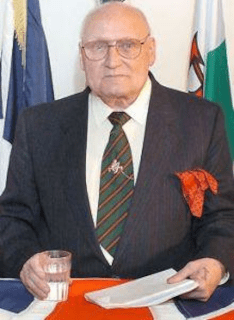
Augustus Andrew Spence, a leader of the paramilitary Ulster Volunteer Force (UVF) and a leading loyalist politician in Northern Ireland, dies in a Belfast hospital on September 25, 2011. One of the first UVF members to be convicted of murder, he is a senior figure in the organisation for over a decade.
Spence, the sixth of seven children, is born and raised in the Shankill Road area of West Belfast in Northern Ireland, the son of William Edward Spence, a member of the Ulster Volunteers who fought in World War I, and Isabella “Bella” Hayes. The family home is 66 Joseph Street in an area of the lower Shankill known colloquially as “the Hammer.” He is educated at the Riddel School on Malvern Street and the Hemsworth Square school, finishing his education at the age of fourteen. He is also a member of the Church Lads’ Brigade, a Church of Ireland group, and the Junior Orange Order. His family has a long tradition of Orange Order membership.
Spence takes various manual jobs in the area until joining the British Army in 1957 as a member of the Royal Ulster Rifles. He rises to the rank of Provost Sergeant (battalion police). He is stationed in Cyprus and sees action fighting against the forces of Colonel Georgios Grivas. He serves until 1961 when ill-health forces him to leave. He then finds employment at the Harland & Wolff shipyard in Belfast, where he works as a stager (builder of the scaffolding in which the ships are constructed), a skilled job that commands respect among working class Protestants and ensures for him a higher status within the Shankill.
From an early age Spence is a member of the Prince Albert Temperance Loyal Orange Lodge, where fellow members include John McQuade. He is also a member of the Royal Black Institution and the Apprentice Boys of Derry. Due to his later involvement in a murder, he is expelled from the Orange Order and the Royal Black Institution. The Reverend Martin Smyth is influential in his being thrown out of the Orange Order.
Spence’s older brother Billy is a founding member of Ulster Protestant Action (UPA) in 1956, and he is also a member of the group. He is frequently involved in street fights with republicans and garners a reputation as a “hard man.” He is also associated loosely with prominent loyalists such as Ian Paisley and Desmond Boal and is advised by both men in 1959 when he launches a protest against Gerry Fitt at Belfast City Hall after Fitt had described Spence’s regiment as “murderers” over allegations that they had killed civilians in Cyprus. He, along with other Shankill Road loyalists, break from Paisley in 1965 when they side with James Kilfedder in a row that follows the latter’s campaigns in Belfast West. Paisley intimates that Kilfedder, a rival for the leadership of dissident unionism, is close to Fine Gael after learning that he had attended party meetings while a student at Trinity College Dublin (TCD). The Shankill loyalists support Kilfedder and following his election as MP send a letter to Paisley accusing him of treachery during the entire affair.
Spence claims that he is approached in 1965 by two men, one of whom was an Ulster Unionist Party MP, who tells him that the Ulster Volunteer Force is to be re-established and that he is to have responsibility for the Shankill. He is sworn in soon afterward in a ceremony held in secret near Pomeroy, County Tyrone. Because of his military experience, he is chosen as the military commander and public face of the UVF when the group is established. However, RUC Special Branch believes that his brother Billy, who keeps a much lower public profile, is the real leader of the group. Whatever the truth of this intelligence, Spence’s Shankill UVF team is made up of only around 12 men on its formation. Their base of operations is the Standard Bar, a pub on the Shankill Road frequented by Spence and his allies.
On May 7, 1966, a group of UVF men led by Spence petrol bomb a Catholic-owned pub on the Shankill Road. Fire also engulfs the house next door, killing the elderly Protestant widow, Matilda Gould (77), who lives there. On May 27, he orders four UVF men to kill an Irish Republican Army (IRA) member, Leo Martin, who lives on the Falls Road. Unable to find their target, the men drive around in search of any Catholic instead. They shoot dead John Scullion (28), a Catholic civilian, as he walks home. Spence later writes “at the time, the attitude was that if you couldn’t get an IRA man you should shoot a Taig, he’s your last resort.” On June 26, the same gang shoots dead Catholic civilian Peter Ward (18) and wounds two others as they leave a pub on Malvern Street in the lower Shankill. Two days later, the government of Northern Ireland uses the Special Powers Act to declare the UVF illegal. Shortly after, Spence and three others are arrested.
In October 1966, Spence is sentenced to life imprisonment for the murder of Ward, although he has always claimed his innocence. He is sent to Crumlin Road Prison. During its July 12, 1967, march, the Orange lodge to which he belongs stops outside the prison in tribute to him. This occurs despite him having been officially expelled from the Orange Order following his conviction. His involvement in the killings gives him legendary status among many young loyalists and he is claimed as an inspiration by the likes of Michael Stone. Tim Pat Coogan describes Spence as a “loyalist folk hero.” The murder of Ward is, however, repudiated by Paisley and condemned in his Protestant Telegraph, sealing the split between the two.
Spence appeals against his conviction and is the subject of a release petition organised by the Ulster Constitution Defence Committee, although nothing comes of either initiative. Despite the fact that control of the UVF lay with his closest ally, Samuel “Bo” McClelland, from prison he is often at odds with the group’s leadership, in particular with regards to the 1971 McGurk’s Bar bombing. Spence now argues that UVF members are soldiers and soldiers should not kill civilians, as had been the case at McGurk’s Bar. He respects some Irish republican paramilitaries, who he feels also live as soldiers, and to this end he writes a sympathetic letter to the widow of Official IRA leader Joe McCann after he is killed in 1972.
Spence is granted two days leave in early July 1972 to attend the wedding of his daughter Elizabeth to Winston Churchill “Winkie” Rea. The latter had formally asked Spence for his daughter’s hand in marriage during a prison visit. Met by two members of the Red Hand Commando upon his release, Spence is informed of the need for a restructuring within the UVF and told not to return to prison. He initially refuses and goes on to attend his daughter’s wedding. Afterward a plot is concocted where Jim Curry, a Red Hand Commando member, will drive Spence back to prison but the car is to be stopped and Spence “kidnapped.” As arranged, the car in which he is a passenger is stopped in Springmartin and he is taken away by UVF members. He remains at large for four months and during that time gives an interview to ITV‘s World in Action in which he calls for the UVF to take an increased role in the Northern Ireland conflict against the Provisional IRA. At the same time, he distances himself from any policy of random murders of Catholics. He also takes on responsibility for the restructuring, returning the UVF to the same command structure and organisational base that Edward Carson had utilised for the original UVF, with brigades, battalions, companies, platoons and sections. He also directs a significant restocking of the group’s arsenal, with guns mostly taken from the security forces. He gives his permission for UVF brigadier Billy Hanna to establish the UVF’s Mid-Ulster Brigade in Lurgan. His fugitive status earns him the short-lived nickname the “Orange Pimpernel.” He is arrested along with around thirty other men at a UVF drinking club in Brennan Street, but after giving a false name, he is released.
Spence’s time on the outside comes to an end on November 4 when he is captured by Colonel Derek Wilford of the Parachute Regiment, who identifies him by tattoos on his hands. He is sent directly to Long Kesh Detention Centre soon afterward, where he shares a cell with William “Plum” Smith, one of the Red Hand Commandos whom he had met upon his initial release and who had since been jailed for attempted murder.
Spence soon becomes the UVF commander within the Long Kesh Detention Centre. He runs his part of Long Kesh along military lines, drilling inmates and training them in weapons use while also expecting a maintenance of discipline. As the loyalist Long Kesh commander, he initially also has jurisdiction over the imprisoned members of the Ulster Defence Association (UDA), although this comes to an end in 1973 when, following a deterioration in relations between the two groups outside the prison walls, James Craig becomes the UDA’s Maze commander. By this time Spence polarises opinion within the UVF, with some members fiercely loyal to a man they see as a folk hero and others resenting his draconian leadership and increasing emphasis on politics, with one anonymous member even labelling him “a cunt in a cravat.”
Spence begins to move toward a position of using political means to advance one’s aims, and he persuades the UVF leadership to declare a temporary ceasefire in 1973. Following Merlyn Rees‘ decision to legalise the UVF in 1974, Spence encourages them to enter politics and support the establishment of the Volunteer Political Party (VPP). However, his ideas are abandoned as the UVF ceasefire falls apart that same year following the Ulster Workers’ Council strike and the Dublin and Monaghan bombings. The carnage of the latter shocks and horrifies Spence. Furthermore, the VPP suffers a heavy defeat in West Belfast in the October 1974 United Kingdom general election, when the DUP candidate, John McQuade, captures six times as many votes as the VPP’s Ken Gibson.
Spence is increasingly disillusioned with the UVF, and he imparts these views to fellow inmates at Long Kesh. According to Billy Mitchell, Spence quizzes him and others sent to Long Kesh about why they are there, seeking an ideological answer to his question. When the prisoner is unable to provide one, Spence then seeks to convince them of the wisdom of his more politicised path, something that he accomplishes with Mitchell. David Ervine and Billy Hutchinson are among the other UVF men imprisoned in the mid-1970s to become disciples of Spence. In 1977, he publicly condemns the use of violence for political gain, on the grounds that it is counterproductive. In 1978, he leaves the UVF altogether. His brother Bobby, also a UVF member, dies in October 1980 inside the Maze, a few months after the death of their brother Billy.
Released from prison in 1984, Spence soon becomes a leading member of the UVF-linked Progressive Unionist Party (PUP) and a central figure in the Northern Ireland peace process. He initially works solely for the PUP but eventually also sets up the Shankill Activity Centre, a government-supported scheme to provide training and leisure opportunities for unemployed youths.
Spence is entrusted by the Combined Loyalist Military Command (CLMC) to read out their October 13, 1994, statement that announces the loyalist ceasefire. Flanked by his PUP colleagues Jim McDonald and William Plum Smith, as well as Ulster Democratic Party (UDP) members Gary McMichael, John White and David Adams, he reads the statement from Fernhill, a former Cunningham family home on their former Glencairn estate in Belfast’s Glencairn area. This building had been an important training centre for members of Edward Carson’s original UVF. A few days after the announcement, he makes a trip to the United States along with the PUP’s David Ervine and Billy Hutchinson and the UDP’s McMichael, Adams and Joe English. Among their engagements is one as guests of honour of the National Committee on American Foreign Policy. He goes on to become a leading advocate for the Good Friday Agreement.
In August 2000, Spence is caught up in moves by Johnny Adair‘s “C” Company of the UDA to take control of the Shankill by forcing out the UVF and other opponents. Due to his involvement in the peace process and the eventual Good Friday Agreement, the authorities insist against his wishes to install additional security measures to the doors and windows. As a result, when Adair’s men try to force their way into Spence’s Shankill home, they only manage to push a long stick through a partially open window of the bungalow and dislodge a few of his military frames off the opposite wall. There is no other damage and other than that small disruption no one is able to gain any physical entry into the property. When Spence’s wife dies three years later, he says that C Company is responsible for her death, as the events had taken on her health.
On May 3, 2007, Spence reads out the statement by the UVF announcing that it will keep its weapons but put them beyond the reach of ordinary members. The statement also includes a warning that activities could “provoke another generation of loyalists toward armed resistance.” He does not specify what activities or what is being resisted.
Spence marries Louie Donaldson, a native of the city’s Grosvenor Road, on June 20, 1953, at Wellwood Street Mission, Sandy Row. The couple has three daughters, Elizabeth (born 1954), Sandra (1956) and Catherine (1960). Louie dies in 2003. Spence, a talented footballer in his youth with Old Lodge F.C., is a lifelong supporter of Linfield F.C.
Spence dies in a Belfast hospital at the age of 78 on September 25, 2011. He had been suffering from a long-term illness and was admitted to hospital 12 days prior to his death. He is praised by, among others, PUP leader Brian Ervine, who states that “his contribution to the peace is incalculable.” Sinn Féin‘s Gerry Kelly claims that while Spence had been central to the development of loyalist paramilitarism, “he will also be remembered as a major influence in drawing loyalism away from sectarian strife.”
However, a granddaughter of Matilda Gould, a 74-year-old Protestant widow who had died from burns sustained in the UVF’s attempted bombing of a Catholic bar next door to her home, objects to Spence being called a “peacemaker” and describes him as a “bad evil man.” The unnamed woman states, “When you go out and throw a petrol bomb through a widow’s window, you’re no peacemaker.”
Spence’s funeral service is held in St. Michael’s Church of Ireland on the Shankill Road. Notable mourners include Unionist politicians Dawn Purvis, Mike Nesbitt, Michael McGimpsey, Hugh Smyth and Brian Ervine, UVF chief John “Bunter” Graham and UDA South Belfast brigadier Jackie McDonald. In accordance with his wishes, there are no paramilitary trappings at the funeral or reference to his time in the UVF. Instead, his coffin is adorned with the beret and regimental flag of the Royal Ulster Rifles, his former regiment. He is buried in Bangor, County Down.

 seamus dubhghaill