Atherton is born in 1598 in Somerset, England. He studies at Oxford University and joins the ranks of the Anglican clergy. In 1634 he becomes Bishop of Waterford and Lismore in the Church of Ireland. In 1640 he is accused of buggery with a man, John Childe, his steward and titheproctor. They are tried under a law that Atherton himself had helped to institute. They are both condemned to death, and Atherton is executed in St. Stephen’s Green, Dublin. Reportedly, he confesses to the crime immediately before his execution, although he had proclaimed his innocence before that.
More recently, some historical evidence has been developed that shows Atherton might have been a victim of a conspiracy to discredit him and his patrons. This is attributable to Atherton’s status as an astute lawyer, who seeks to recover lost land for the relatively weak Protestant Church of Ireland during the 1630s. Unfortunately for Atherton, this alienates him from large landowners, who then allegedly use his sexuality to discredit him.
English Puritan, Congregationalist and Independent activists, as well as English and Scottish Presbyterian activists, contemporaneously campaign to abolish Episcopacy (bishops) within the embattled Church of England, Church of Scotland and Church of Ireland, notionally expediting the political interest in Atherton’s downfall.
Posthumous accusations of sexual wrongdoing also include allegations of “incest” with his sister-in-law, and infanticide of the resultant child, as well as zoophilia with cattle. However, these allegations begin to be circulated several months after his death in an anonymous pamphlet, and may have been intended to further discredit the bishop’s campaign to restore the finances of the Church of Ireland.
(Pictured: Anonymous pamphlet of the hangings of John Atherton and John Childe, 1641)
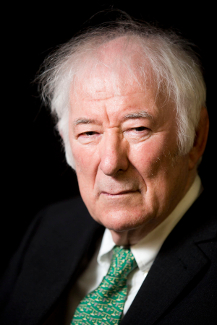
Heaney is born near Castledawson, County Londonderry, in Northern Ireland. The family moves to nearby Bellaghy when he is a boy. After attending Queen’s University Belfast, Heaney becomes a lecturer at St. Joseph’s College in Belfast in the early 1960s and begins to publish poetry. He lives in Sandymount, Dublin from 1976 until his death. He also lives part-time in the United States from 1981 to 2006. Heaney is recognised as one of the principal contributors to poetry during his lifetime.
American poet Robert Lowell describes Heaney as “the most important Irish poet since Yeats,” and many others, including the academic John Sutherland, have said that he is “the greatest poet of our age.” Robert Pinsky has stated that “with his wonderful gift of eye and ear Heaney has the gift of the storyteller.” Upon his death in 2013, The Independent describes him as “probably the best-known poet in the world.” One of his best-known works is Death of a Naturalist, published in 1966.
Seamus Heaney dies in the Blackrock Clinic in Dublin on August 30, 2013, aged 74, following a short illness. After a fall outside a restaurant in Dublin, he enters the hospital for a medical procedure, but dies at 7:30 the following morning before it takes place. His funeral is held in Donnybrook, Dublin, on the morning of September 2, 2013, and he is buried in the evening in the Cemetery of St. Mary’s Church, Bellaghy, County Londonderry, Northern Ireland, in the same graveyard as his parents, young brother, and other family members. His son Michael reveals at the funeral mass that his father texted his final words, “Noli timere” (Latin: “Do not be afraid”), to his wife, Marie, minutes before he died. Shortly after Heaney’s death, graffiti artist Maser paints a mural in Dublin referencing this message.
On September 1, the day after his death, a crowd of 81,553 spectators applaud Heaney for three minutes at a semi-final match of the 2013 All-Ireland Senior Football Championship. His funeral is broadcast live the following day on RTÉ television and radio and is streamed internationally at RTÉ’s website. RTÉ Radio 1 Extra transmits a continuous broadcast, from 8:00 AM until 9:15 PM on the day of the funeral, of his Collected Poems album, recorded in 2009. His poetry collections sell out rapidly in Irish bookshops immediately following his death.
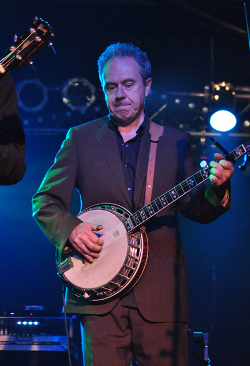
After college at Keele University, Finer travels around Europe and spends some time working on a barge in France. He settles in London and becomes the bass player in a group called The Petals and lives in 32 Burton Street, a house which he sometimes shares with Spider Stacey and Shane MacGowan. Together with James Fearnley they found The Pogues. Primarily a banjoist, he also plays other instruments, including mandola, saxophone, hurdy-gurdy, and the guitar. Apart from Shane MacGowan, Finer is the most prolific composer for the band.
Finer appears on all the band’s albums until their breakup in 1996. He continues working as a musician and composer after leaving The Pogues.
On January 1, 2000, the Finer-composed Longplayer piece of music is started and is designed to last 1,000 years without ever repeating itself. It currently exists in both computer-generated and live versions. Longplayer represents a convergence of many of his concerns, particularly those relating to systems, long-durational processes, and extremes of scale in both time and space.
Finer serves as “Artist in Residence” at the Astrophysics Sub-department of the University of Oxford between October 2003 and June 2005. Finer and Hamburg-based swamp pop legend DM Bob begin recording and performing together in 2005, releasing their album Bum Steer in August of that year and co-producing the debut album by experimental pop band Marseille Figs. In July 2005, Finer wins the PRS Foundation New Music Award on the basis of his proposal to build a device that will automatically “compose” a song of indeterminate length by harnessing the creative force of the weather.
In March 2012, Mobile Sinfonia, a global composition for ringtones is launched, developed during a year Finer spends as a non-resident artist at the University of Bath. This piece concerns mutual invasion of soundscape via ringtones.
Finer is currently working on a number of new projects continuing his interest in long-term sustainability and the reconfiguring of older technologies, including Spiegelei, a spherical camera obscura featuring Finer’s innovative 360-degree projection system and the Supercomputer in Cambridge, a 5-bit mechanical sculpture which will compute minimal musical scores.
Day-Lewis is the son of Frank Day-Lewis, Church of Ireland Rector of the parish, and Kathleen Blake. His father takes the surname “Day-Lewis” as a combination of the surnames of his own birth father (Day) and his adoptive father (Lewis). After the death of his mother in 1906, Day-Lewis is brought up in London by his father, with assistance of an aunt, spending summer holidays with relatives in County Wexford. He is educated at Sherborne School and at Wadham College, Oxford. In Oxford, Day-Lewis becomes part of the circle gathered around W. H. Auden and helps him to edit Oxford Poetry 1927. His first collection of poems, Beechen Vigil, appears in 1925.
In 1928, Day-Lewis marries Constance Mary King, the daughter of a Sherborne teacher, and works as a schoolmaster in three schools, including Larchfield School in Helensburgh, Scotland. During the 1940s he has a long and troubled love affair with the novelist Rosamond Lehmann. His first marriage is dissolved in 1951, and he marries actress Jill Balcon, daughter of Michael Balcon.
During World War II he works as a publications editor in the Ministry of Information, an institution satirised by George Orwell in his dystopian Nineteen Eighty-Four. During this time his work is now no longer as heavily influenced by Auden, and he develops a more traditional style of lyricism. Some critics believe that he reaches his full stature as a poet in Word Over All (1943), when he finally distances himself from Auden. After the war he joins the publisher Chatto & Windus as a director and senior editor.



 seamus dubhghaill