seamus dubhghaill

Promoting Irish Culture and History from Little Rock, Arkansas, USA


Leave a comment

Death of Paddy Daly, IRA Volunteer & National Army Officer

Paddy Daly, sometimes referred to as Paddy O’Daly, dies at his home in County Dublin on January 16, 1957. He serves in the Irish Republican Army (IRA) during the Irish War of Independence (1919–1921) and subsequently holds the rank of major general in the Irish National Army from 1922 to 1924.

Daly is born in Dublin in 1888. He fights in the 1916 Easter Rising under the command of his namesake Edward Daly, leading the unsuccessful attempt to destroy the Magazine Fort in the Phoenix Park. He is later wounded in the particularly vicious fighting near the Linenhall. He is subsequently interned in Frongoch internment camp for his part in the rebellion until 1918, when he is released as part of a general amnesty for Irish prisoners.

During the Irish War of Independence, Daly serves as leader of the “Squad,” Michael Collins‘ assassination unit.

On December 19, 1919, Daly along with Dan Breen lead an abortive ambush, at Ashtown railway station near the Phoenix Park, on the British Viceroy, Lord Lieutenant of Ireland and Supreme Commander of the British Army in Ireland, Lord French, as he returns from a private party which he had hosted the previous evening at his country residence in Frenchpark, County Roscommon. Lord French escapes the ambush, but Martin Savage is shot dead.

Daly and the men under his command are responsible for the killing of many British intelligence officers, in particular District Inspector Redmond, who had been putting increasing pressure on the Squad. Daly himself personally kills several people, including Frank Brooke, director of Great Southern and Eastern Railway, who serves on an advisory council to the British military, in June 1920. He does not directly lead any of the attacks on Bloody Sunday but is on standby in one of the Squad’s safe houses. In the aftermath, November 23, 1920, he is arrested and interned in Abercorn Barracks in Ballykinler, County Down.

Daly is released on parole from Ballykinler in March 1921, the British apparently being unaware of his senior position within the Dublin Brigade of the IRA. After his release, he, along with Emmet Dalton, is also involved in the attempt to free Seán Mac Eoin from Mountjoy Prison on May 14, 1921. He and his men hijack a British Army Peerless armoured car in Clontarf at the corporation abattoir, while it is escorting a consignment of meat to a barracks and shoot dead two soldiers in the process. The plan involves Dalton and Joe Leonard impersonating two British army officers and using forged documents to “transfer” MacEoin to Dublin Castle. They gain entry to Mountjoy but are discovered before they can free MacEoin and have to shoot their way out. They later abandon the armoured car after removing the Hotchkiss machine guns and setting fire to what they can. Toward the end of the war, in May 1921, the two principal fighting units of the IRA’s Dublin Brigade, the “Squad” and the “Active Service Unit” are amalgamated after losses suffered in the burning of the Custom House. Daly is named Officer Commanding (OC) of this new unit, which is named the Dublin Guard.

Daly’s own account of his activities during the Irish War of Independence is held at the Bureau of Military History in Cathal Brugha Barracks.

After the Anglo-Irish Treaty splits the IRA, Daly and most of his men side with the pro-treaty party, who go on to found the Irish Free State. He is appointed to the rank of brigadier in the newly created Irish National Army, which is inaugurated in January 1922. When the Irish Civil War breaks out in June 1922, he commands the Free State’s troops who secure Dublin, after a week of fighting.

In August 1922, during the Irish Free State offensive that re-takes most of the major towns in Ireland, Daly commands a landing of 450 troops of the Dublin Guard at Fenit, County Kerry, which goes on to capture Tralee from the anti-treaty forces. Acting with severe brutality in Kerry, he comments that, “nobody had asked me to take kid-gloves to Kerry, so I didn’t.” As the Civil War develops into a vicious guerrilla conflict, he and his men are implicated in a series of atrocities against anti-treaty prisoners, culminating in a series of killings with land mines in March 1923. Daly, and others under his command, claim that those killed were accidentally blown up by their own mines. Statements by the Garda Síochána, two Free State lieutenants on duty, W. McCarthy and Niall Harrington, and one survivor, Stephen Fuller, maintain the claims are fabricated.

Daly resigns from the Free State army in 1924 after an incident in Kenmare, County Kerry, concerning the daughters of a doctor. A court martial is held but collapses as no one is prepared to give evidence. He volunteers his services for the Irish Army again in 1940 and is appointed as a Captain to the non-combatant Construction Corps.

Daly is a carpenter by trade. He marries Daisy Gillies in 1910. His brother James (Seamus) marries Daisy’s sister Nora, a Cumann na mBan activist, in a joint wedding ceremony. After Daisy’s death in 1919, Daly marries Bridget Murtagh, also a Cumann na mBan activist, in 1921. Murtagh and Nora O’Daly carry out intelligence gathering for the planned attack on the Magazine Fort in 1916. She is a sister of Elizabeth Murtagh, the first wife of Commandant Michael Love who serves with Daly in the Collins Squad of the IRA, in the Irish Free State Army of the 1920s and during the Emergency period. Murtagh dies in childbirth in 1930. Daly subsequently marries Norah Gillies, his first wife’s niece.

On his death on January 16, 1957, Daly is buried with full military honours in Mount Jerome Cemetery. He is survived by his brothers, Comdt Seamus O’Daly and Capt Frank O’Daly, his sons Patrick and Colbert, and his daughters Brede and Philomena.

Leave a comment

Birth of Valentine Browne Lawless, 2nd Baron Cloncurry

Valentine Browne Lawless, 2nd Baron Cloncurry, Irish peer, politician and landowner, is born in Merrion Square in Dublin on August 19, 1773.

Lawless is the only surviving son of Nicholas Lawless, wool merchant, brewer, and banker, who becomes 1st Baron Cloncurry in 1789, and Margaret Lawless (née Browne), only daughter and heiress of Valentine Browne of Mount Browne, County Limerick. He is educated privately at Portarlington, Queen’s County (now County Laois), and at Blackrock, County Dublin. He enters Trinity College Dublin (TCD) in 1789, graduating BA in 1792. After completing a tour of Europe (1792–95) he returns to Ireland, where he joins the Society of United Irishmen and the loyalist yeomanry. Pressurized by his father, he decides to study law, and is at Middle Temple from 1795 to 1798. He later claims that at a dinner party in the spring of 1797 he hears the prime minister, William Pitt, discuss his plans for a legislative union with Ireland, prompting him to write an anti-union pamphlet in response. Like many of the claims in his published recollections, the story is unreliable.

During 1797 Lawless helps Arthur O’Connor form his United Irishman newspaper The Press, and Leonard McNally informs Dublin Castle that Lawless is its principal shareholder. In October 1797 Lawless attends a meeting of the executive directory of the United Irishmen, of which he is elected a member. Throughout this period and after his return to London he is carefully watched by the British secret service. His friendship with O’Connor, and the fact that he provides funds for Fr. James Coigly, arouse deep suspicion. After the outbreak of open rebellion in Ireland he is arrested at his lodgings in Pall Mall on May 31, 1798, on suspicion of high treason, and imprisoned for six weeks in the Tower of London. Arabella Jefferyes, sister of the Earl of Clare, apparently tries to extort money from Lawless in return for pleading his case to the Duke of Portland. He refuses the offer. On his release he tours England on horseback but is rearrested on April 14, 1799, and held until March 1801. His father votes for the Act of Union, hoping to secure his son’s release, and dies on August 28, 1799. Lawless succeeds him as 2nd Baron Cloncurry. His grandfather and his fiancée, Mary Ryal, also die while he is imprisoned.

Embittered by his experience, Lawless tours the Continent from 1801 to 1805 before returning to his family estate at Lyons Hill, Ardclough, County Kildare. Throwing himself into improving his estates and into local concerns, he founds the County Kildare Farming Society in 1814. He is also involved in canal developments and agricultural improvements in the country. Opposed to the rural constabulary bill of 1822, he supports Catholic emancipation and the attempts of Daniel O’Connell to repeal the Act of Union. He breaks with O’Connell in the 1830s when his friend, Henry Paget, 1st Marquess of Anglesey, is viceroy, because he believes repeal can now be achieved through official means. The rift is never healed.

In 1831, Lawless is admitted to the Privy Council of Ireland (PC) and an English peer but rarely attends the House of Lords. Involved in anti-tithe campaigns, he retires from politics in 1840. Travelling on the Continent in 1841 and 1842, he returns to defend O’Connell’s planned Clontarf meeting in the privy council but refuses to attend any further meetings after his advice on dealing with the Great Famine is ignored in 1846. In 1849 he publishes his personal reminiscences, which appear to have been ghost-written.

Lawless’s health begins to fail in 1851. He dies at the older family home, Maretimo House, Blackrock, on October 28, 1853, and is buried in the family vault at Lyons Hill.

Lawless first marries Elizabeth Georgiana, youngest daughter of Lieutenant-General Charles Morgan, at Rome on April 16, 1803. They have one son and one daughter. The marriage ends in divorce in 1811 after her adultery with Sir John Piers. In 1811, he then marries Emily, daughter of Archibald Douglas of England, and widow of Joseph Leeson. They have two sons and a daughter. The elder son, Edward, succeeds as 3rd Baron Cloncurry. He commits suicide in 1869 by throwing himself out of a third-floor window at Lyons Hill. The younger, Cecil-John, is an MP, but catches a chill at his father’s funeral and dies on November 5, 1853.

(From: “Lawless, Valentine Browne” by Patrick M. Geoghegan, Dictionary of Irish Biography, http://www.dib.ie, October 2009 | Pictured: Lyons House, Lyons Hill, Ardclough, County Kildare)


Leave a comment

Birth of John MacKenna, Chilean Military Officer

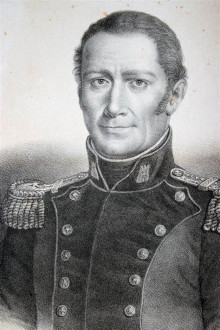
Brigadier John (Juan) Mackenna, Chilean military officer and hero of the Chilean War of Independence, is born in Monaghan, County Monaghan on October 26, 1771. He is considered to be the creator of the Corps of Military Engineers of the Chilean Army.

He is born John MacKenna, the son of William MacKenna of Willville House near Monaghan and Eleanora O’Reilly and, on his mother’s side, a nephew to Count Alejandro O’Reilly. Count O’Reilly takes an interest in the young Mackenna and takes him to Spain where he studies at the Royal School of Mathematics in Barcelona. He also trains in the Royal Military Academy as a Military Engineer between 1785 and 1791.

In 1787 Mackenna is accepted into the Irish Brigade of the Spanish Army, and joins the army fighting in Ceuta in northern Africa, under Lieutenant Colonel Luis Urbina, and is promoted to Second Lieutenant. In 1791 he resumes his studies in Barcelona and acts as liaison with mercenaries recruited in Europe. The following year he is promoted to Lieutenant in the Royal Regiment of Engineers. In the War of the Pyrenees against the French, he fights in Rosselló under General Ricardos and there meets the future liberator of Argentina, José de San Martín. For his exploits in defence of the Plaza de Rozas, he is promoted to captain in 1795.

For the purpose of a new assignment, in October 1796, Mackenna leaves Spain for South America. He arrives in Buenos Aires and then travels to Mendoza and to Chile across the Andes and then to Peru. Once in Lima, he contacts Ambrosio O’Higgins, another Irishman, at that time Viceroy of Perú, who names him Governor of Osorno and puts him in charge of the reconstruction works for the southern Chilean town.

In this capacity, Mackenna convinces the families of Castro, on Chiloé Island, to move to Osorno to found a colony there. He builds the storehouse and two mills, as well as the road between Osorno and present-day Puerto Montt. His successful administration provokes jealousy from Chile’s captain-general Gabriel de Avilés, who fears that Mackenna and Ambrosio O’Higgins will create an Irish colony in Osorno. Both Irishmen are loyal to the Spanish crown, though Mackenna has good relations with O’Higgins’ son Bernardo, the future emancipator of Chile, and is also connected with the Venezuelan Francisco de Miranda and his group of supporters of South American independence. When Ambrosio O’Higgins dies in 1801, Avilés is appointed viceroy of Peru. It takes him eight years to remove Mackenna, O’Higgins’s protégé, from Osorno.

In 1809 Mackenna marries Josefina Vicuña y Larraín, an eighteen-year-old Chilean woman from a family with revolutionary connections, with whom he has three children. After the Declaration of Chilean Independence in 1810, he adheres to the Patriot side and is commissioned by the first Chilean government to prepare a plan for the defense of the country and oversees the equipment of the new Chilean Army. At this juncture he trains the first military engineers for the new army.

The following year Mackenna is called to the defence committee of the new Republic of Chile, and in 1811 is appointed governor of Valparaíso. Owing to political feuds with José Miguel Carrera and his brothers, he is dismissed from the post and taken prisoner. He is a firm ally of Bernardo O’Higgins, who appoints him as one of the key officers to fight the Spanish army of General José Antonio Pareja. His major military honour is attained in 1814 at the Battle of Membrillar, in which the general assures a temporary collapse of the royal forces.

As a reward for his victory, Mackenna is appointed commandant-general by Bernardo O’Higgins, but after a coup d’état led by Luis Carrera he is exiled to Argentina in 1814, when Carrera comes to power. Mackenna dies in Buenos Aires on November 21, 1814, following a duel with Carrera.

A bust of General Mackenna is publicly presented to Monaghan County Museum on August 5, 2004 by his direct descendant, Luis Valentín Ferrada. At the presentation ceremony, MacKenna, the man “unreservedly regarded as the greatest of County Monaghan’s exiles” is commemorated in speeches by Most Rev. Dr. Joseph Duffy, Bishop of Clogher and by his descendant Senor Ferrada who declares, “In this city of Monaghan, very near to Willville House, the tombs of my ancestors are in the old cemetery. There, my own blood is interred in the sacred earth.”


Leave a comment

Death of Anglo-Irish Statesman Henry Flood

henry-flood

Henry Flood, Anglo-Irish statesman and founder of the Patriot movement that in 1782 wins legislative independence for Ireland, dies on December 2, 1791.

Flood is born in Dublin in 1732, the illegitimate son of Warden Flood, Lord Chief Justice of the Court of King’s Bench in Ireland. He is educated at Trinity College, Dublin, and afterwards at Christ Church, Oxford, where he becomes proficient in the classics.

Flood enters the Irish Parliament in 1759 as member for Kilkenny County. Irish Protestants are becoming impatient with the British Parliament’s right to legislate for Ireland over the wishes of the Irish Parliament. Moreover, the British government controls a majority in Ireland’s House of Commons through the distribution of crown patronage by the owners of parliamentary boroughs.

Flood’s outstanding oratorical powers soon enable him to create a small but effective opposition inside the Irish Parliament that agitates for political reforms. They demand provisions for new Irish parliamentary elections every eight years, instead of merely at the start of a new British king’s reign. Their long-range goal is legislative independence. In 1768 his Patriots engineer passage of a bill limiting the duration of Parliament to eight years, and in 1769 and 1771 they defeat measures to grant funds for the British administration in Ireland.

Although Flood had become the first independent Irish statesman, he sacrifices this position in 1775 by accepting the office of vice treasurer under the British viceroy, Lord Simon Harcourt, 1st Earl Harcourt. Henry Grattan, an even greater orator than Flood and who describes Flood as a man “with a metaphor in his mouth and a bribe in his pocket,” replaces him as leader of the Patriots.

Flood, however, leaves the Patriot cause at the wrong time. The movement grows rapidly as more and more Irish people are influenced by the North American colonists who are rebelling against the British in the American Revolution. In 1779 he rejoins his old party, and two years later he is officially dismissed from his government post. Although he has lost his following, he helps Grattan force the British government to renounce its restrictions on Irish trade (1779) and grant legislative independence to Ireland (1782).

Flood then decides to challenge Grattan’s leadership. Charging that Grattan has not gone far enough in his reforms, he obtains passage of a measure requiring the British Parliament to renounce all claims to control of Irish legislation. Nevertheless, his newly acquired popularity is destroyed upon the defeat of his attempt to reform the Irish Parliament in 1784.

Flood is a member of both the British and Irish parliaments from 1783 until he loses his seat in both parliaments in 1790, although in England he fails to achieve the kind of political successes that characterize his Irish parliamentary career.

Following the loss of his seats in parliament, Flood retires to Farmley, his residence in County Kilkenny, where he remains until his death on December 2, 1791. He and his wife Lady Frances Beresford, daughter of Marcus Beresford, 1st Earl of Tyrone, who survives until 1815, have no children, and his property passes to a cousin, John Flood. A large bequest to Trinity College Dublin is declared invalid.

(Pictured: Portrait of Henry Flood (1732 – 1791) by Bartholomew Stoker (1763-1788). John Comerford later makes a sketch of the portrait, from which James Heath makes an engraving.)