seamus dubhghaill

Promoting Irish Culture and History from Little Rock, Arkansas, USA


Leave a comment

Death of Sir Thomas Farrell, Irish Sculptor

Sir Thomas Farrell, Irish sculptor, dies at his home, Redesdale House, Stillorgan, County Dublin, on July 2, 1900.

Farrell is born in 1827 in Mecklenburgh Street (later called Railway Street) in Summerhill, Dublin, one of six sons of Terence Farrell, sculptor, and Maria Farrell (née Ruxton). He trains as a sculptor in his father’s workshops. In 1842 he enters the modelling school of the Royal Dublin Society, where he is awarded the prize for “Original design in clay” the following year. He is awarded premiums by the Royal Irish Art Union in 1844 and 1846. As a student he becomes acquainted with the neoclassical sculpture of John Flaxman and John Hogan. His first commission is a monument to Archbishop Daniel Murray in St. Mary’s Pro-Cathedral in Dublin.

One of the first works that make Farrell prominent is the bas-relief representing the last charge at Waterloo, designed for the Wellington Monument in the Phoenix Park. His work is accepted after public competition. Another of his early works is his memorial to Captain John McNeil Boyd in St. Patrick’s Cathedral, Dublin. He enters the competition for the monument to Daniel O’Connell in 1864, but the commission is awarded to John Henry Foley.

His statue of William Smith O’Brien, the Young Ireland leader, formerly at the head of D’Olier Street, is now in O’Connell Street, as is another statue by him, that of Sir John Gray, the surgeon and politician who is instrumental in giving Dublin its water supply.

Throughout his career, Farrell remains actively involved in the Royal Hibernian Academy (RHA). He is elected directly as a full member in 1860 rather than undergoing an initial phase of associate membership. He exhibits almost annually with the academy until his death. He holds a number of posts, including professor of sculpture and treasurer, before being elected president in 1893, being the first sculptor to be so honoured. His achievements are recognised with a knighthood in May 1894.

Farrell dies at his residence, Redesdale House, in Stillorgan, County Dublin, on July 2, 1900. He is a shy, retiring man, and his death is not announced to the public for three days, in keeping with his wishes to avoid any sort of elaborate display on his behalf. Intensely private, he never marries and lives a life immersed in his work. Contemporary accounts describe him as constantly dissatisfied with his work despite consistent public approval for it.


Leave a comment

Birth of Pauline Flanagan, Stage & Television Actress

Pauline Flanagan, Irish-born actress who has a long career on stage, is born in Sligo, County Sligo, on June 29, 1925. She is best known in the United States for her role as Annie Colleary, on the television soap opera Ryan’s Hope in 1979 and again in 1981. She later returns to the show as Sister Mary Joel.

Flanagan is born to Patrick and Elizabeth (née Mulligan) Flanagan, who are strongly nationalist and republican, and support the Republican Anti-Treaty during the Irish Civil War, both serving as Lord Mayor of Sligo. Her paternal family, originally from County Fermanagh, are driven out by anti‐Catholic pogroms and resettle in Sligo, where her parents manage a retail business. She is good friends with fellow Irish actresses Joan O’Hara and Paddy Croft. She spends much of the early 1950s touring with Anew McMaster, where she meets Harold Pinter at the Gate’s Pinter Festival.

Flanagan appears in many Broadway plays, making her debut in 1957 in the first Main Stem production of Dylan Thomas‘s Under Milk Wood. She stars as Mrs. Grose in the 1976 Broadway revival of the William Archibald play The Innocents. She also appears on Broadway in Brian Friel‘s play Philadelphia, Here I Come! in 1994.

Flanagan also acts in Off-Broadway productions on several occasions with the Irish Repertory Theatre, including Harold Prince‘s Grandchild of Kings (1992), Seán O’Casey‘s Juno and the Paycock (1995). and Hugh Leonard‘s A Life (2001). For her performance in Grandchild of Kings, she receives the 1992 Outer Critics Circle Awards nomination for Best Actress. Other Off-Broadway work includes Yeats! A Celebration by William Butler Yeats.

Flanagan appears as Myra White in Hugh Leonard’s play Summer (1974), both in the original production at the Olney Theatre Center in Olney, Maryland, and at the Olympia Theatre in the Dublin Theatre Festival.

Flanagan is nominated for the 1982 Drama Desk Award for Outstanding Featured Actress in a Play for Medea in which she performs on Broadway in 1982.

In 1997, Flanagan wins the Barclays Theatre Awards for Best Actress in a Supporting Role for her role in Jennifer Johnston‘s The Desert Lullaby: A Play in Two Acts, at the Lyric Theatre, Belfast. The Barclays Theatre Awards are for outstanding regional theatre (including opera and dance) in the United Kingdom.

In 2001, Flanagan wins a Laurence Olivier Award for Best Actress in a Supporting Role, for her performance in Frank McGuinness‘s Dolly West’s Kitchen at The Old Vic in Waterloo, London.

A resident of Glen Rock, New Jersey, Flanagan dies at The Valley Hospital in Ridgewood, New Jersey, on June 28, 2003, one day before her 78th birthday, of heart failure following a battle with lung cancer. She is survived by her husband, George Vogel (whom she married in 1958), a sister, Maura McNally, and her daughters Melissa Brown and Jane Holtzen.


Leave a comment

The Battle of Waterloo

battle-of-waterloo

The Battle of Waterloo is fought on Sunday, June 18, 1815, near Waterloo, Belgium, which is part of the United Kingdom of the Netherlands at the time. The battle marks the end of the Napoleonic Wars.

A French army under the command of Napoleon Bonaparte is defeated by British forces under the command of Arthur Wellesley, 1st Duke of Wellington of Dublin and a Prussian army under the command of Field Marshal Gebhard Leberecht von Blücher. The Iron Duke is not the only Irish presence on the battlefield that day. Napoleon’s horse, Marengo, is reared in County Wexford, and the Duke of Wellington’s mount is from County Cork.

Upon Napoleon’s return to power in March 1815, many states that have opposed him form the Seventh Coalition and begin to mobilise armies. Wellington and Blücher’s armies are cantoned close to the northeastern border of France. Napoleon chooses to attack them separately in the hope of destroying them before they can join in a coordinated invasion of France with other members of the coalition. On June 16, he successfully attacks the bulk of the Prussian army at the Battle of Ligny with his main force, while a portion of the French army simultaneously attacks the Anglo-allied army at the Battle of Quatre Bras. Despite holding his ground at Quatre Bras, the defeat of the Prussians forces Wellington to withdraw north to Waterloo on June 17. Napoleon sends a third of his forces to pursue the Prussians, who have withdrawn parallel to Wellington in good order. This results in the separate and simultaneous Battle of Wavre with the Prussian rear-guard.

Upon learning that the Prussian army is able to support him, Wellington decides to offer battle on the Mont-Saint-Jean escarpment across the Brussels road. Here he withstands repeated attacks by the French throughout the afternoon of June 18, aided by the progressively arriving Prussians. In the evening, Napoleon commits his last reserves, the senior battalions of the French Imperial Guard infantry. The desperate final attack of the Guard is narrowly beaten back. With the Prussians breaking through on the French right flank, Wellington’s Anglo-allied army counterattacks in the centre, and the French army is routed.

Waterloo is the decisive engagement of the Waterloo Campaign and Napoleon’s last. Napoleon abdicates four days later, and coalition forces enter Paris on July 7. The defeat at Waterloo ends Napoleon’s rule as Emperor of the French and marks the end of his Hundred Days return from exile. This ends the First French Empire and sets a chronological milestone between serial European wars and decades of relative peace.

The battlefield is located in the municipalities of Braine-l’Alleud and Lasne, about 15 kilometres south of Brussels, and about 2 kilometres from the town of Waterloo. The site of the battlefield today is dominated by the monument of the Lion’s Mound, constructed from earth taken from the battlefield itself. The topography of the battlefield near the mound has not been preserved.


Leave a comment

Sullivan Brothers Perish in the Sinking of the USS Juneau

sullivan-brothers

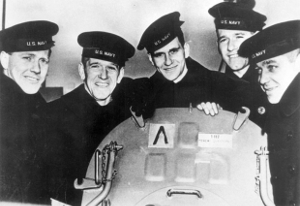
Five Sullivan brothers from Waterloo, Iowa, die when their ship, the light cruiser USS Juneau, is torpedoed and sunk by a Japanese submarine on November 13, 1942. Raised in an Irish Catholic family, the brothers’ great grandfather had emigrated from Ireland.

The five brothers, the sons of Thomas and Alleta Sullivan, are George Thomas Sullivan (27), Francis “Frank” Henry Sullivan (26), Joseph “Joe” Eugene Sullivan (24), Madison “Matt” Abel Sullivan (23), and Albert “Al” Leo Sullivan (20).

The Sullivans enlist in the U.S. Navy on January 3, 1942, with the stipulation that they serve together. The Navy has a policy of separating siblings, but it is not strictly enforced. George and Frank have served in the Navy before, but their brothers have not. All five are assigned to the light cruiser USS Juneau.

The Juneau participates in a number of naval engagements during the months-long Guadalcanal Campaign beginning in August 1942. Early on the morning of November 13, 1942, during the Naval Battle of Guadalcanal, the Juneau is struck by a Japanese torpedo and forced to withdraw. Later that day, as it is leaving the Solomon Islands area for the Allied rear-area base at Espiritu Santo with other surviving U.S. warships from battle, the Juneau is struck again, this time by a torpedo from Japanese submarine I-26. The torpedo apparently hits the thinly armored light cruiser at or near the ammunition magazines and the ship explodes and quickly sinks.

Captain Gilbert C. Hoover, commanding officer of the USS Helena and senior officer present in the battle-damaged U.S. task force, is skeptical that anyone has survived the sinking of the Juneau and believes it would be reckless to look for survivors, thereby exposing his wounded ships to a still-lurking Japanese submarine. Therefore, he orders his ships to continue on towards Espiritu Santo. Helena signals a nearby U.S. B-17 bomber on patrol to notify Allied headquarters to send aircraft or ships to search for survivors.

However, approximately 100 of Juneau‘s crew survive the torpedo attack and the sinking of their ship and are left in the water. The B-17 bomber crew, under orders not to break radio silence, does not pass the message about searching for survivors to their headquarters until they land several hours later. The crew’s report of the location of possible survivors is mixed in with other pending paperwork actions and goes unnoticed for several days. It was not until days later that headquarters staff realize that a search has never been mounted and belatedly orders aircraft to begin searching the area. In the meantime, Juneau‘s survivors, many of whom are seriously wounded, are exposed to the elements, hunger, thirst, and repeated shark attacks.

Eight days after the sinking, ten survivors are found by a PBY Catalina search aircraft and retrieved from the water. The survivors report that Frank, Joe, and Matt died instantly, Al drowned the next day, and George survived for four or five days before, suffering from delirium as a result of hypernatremia, he goes over the side of the raft he occupies and is never seen or heard from again.

Security requires that the Navy not reveal the loss of Juneau or the other ships so as not to provide information to the enemy. Letters from the Sullivan sons stop arriving at the home and the parents grow worried, which prompts Alleta Sullivan to write to the Bureau of Naval Personnel in January 1943, citing rumors that survivors of the task force claim that all five brothers were killed in action.

The letter is answered by President Franklin D. Roosevelt on January 13th, who acknowledges that the Sullivans are missing in action. By then, however, the parents have already been informed of their fate, having learned of their deaths on January 12, 1943. That morning, the boys’ father, Thomas, is preparing for work when three men in uniform approach his door. “I have some news for you about your boys,” one naval officer says. “Which one?” asks Thomas. “I’m sorry,” the officer replies. “All five.”

As a direct result of the Sullivans’ deaths, and the deaths of four of the Borgstrom brothers within a few months of each other two years later, the United States War Department adopts the Sole Survivor Policy.