
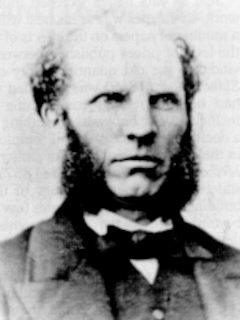
John Elliott Cairnes, Irish-born political economist, dies at the age of 51 at Blackheath, London, England, on July 8, 1875. He has been described as the “last of the classical economists.”
Cairnes is born on December 26, 1823, at Castlebellingham, County Louth, the son of William Elliott Cairnes (1787–1863) of Stameen, near Drogheda, and Marianne Woolsey, whose mother is the sister of Sir William Bellingham, 1st Baronet of Castlebellingham. William decides upon a business career, against the wishes of his mother, Catherine Moore of Moore Hall, Killinchy, and becomes a partner in the Woolsey Brewery at Castlebellingham. In 1825, he starts on his own account in Drogheda, making the Drogheda Brewery an unqualified success. He is remembered for his great business capacity and for the deep interest he takes in charity.
After leaving school, Cairnes spends some years in the counting house of his father at Drogheda. His tastes, however, lay altogether in the direction of study, and he is permitted to enter Trinity College Dublin, where he takes the degree of BA in 1848, and six years later that of MA. After passing through the curriculum of Arts, he engages in the study of Law and is called to the Irish bar. But he lacks a desire to pursue the legal profession, and over some ensuing years, he devotes himself to writing in various publications about social and economic questions and treatises that relate to Ireland. He focuses mostly on political economy, which he studies thoroughly.
While residing in Dublin, Cairnes makes the acquaintance of the Archbishop of Dublin Richard Whately, who conceives a very high respect for Cairnes’ character and abilities. In 1856, a vacancy occurs in the chair of political economy at Dublin, founded by Whately, and Cairnes receives the appointment. In accordance with the regulations of the foundation, the lectures of his first year’s course are published. The book appears in 1857 with the title Character and Logical Method of Political Economy. It follows up on and expands John Stuart Mill‘s treatment in the Essays on some Unsettled Questions in Political Economy and forms an admirable introduction to the study of economics as a science. In it the author’s peculiar powers of thought and expression are displayed to the best advantage. Logical exactness, precision of language, and firm grasp of the true nature of economic facts, are the qualities characteristic of this as of all his other works. If the book had done nothing more, it would still have conferred inestimable benefit on political economists by its clear exposition of the true nature and meaning of the ambiguous term law. To the view of the province and method of political economy expounded in this early work the author always remains true, and several of his later essays, such as those on Political Economy and Land, Political Economy and Laissez-Faire, are but reiterations of the same doctrine. His next contribution to economical science is a series of articles on the gold question, published partly in Fraser’s Magazine, in which the probable consequences of the increased supply of gold attendant on the Australian and Californian gold discoveries are analysed with great skill and ability. And a critical article on Michel Chevalier‘s work, On the Probable Fall in the Value of Gold, appears in the Edinburgh Review for July 1860.
In 1861, Cairnes is appointed to the professorship of jurisprudence and political economy in Queens College Galway, and in the following year he publishes his admirable work The Slave Power, one of the finest specimens of applied economic philosophy. The inherent disadvantages of the employment of slave labour are exposed with great fullness and ability, and the conclusions arrived at have taken their place among the recognised doctrines of political economy. The opinions expressed by Cairnes as to the probable issue of American Civil War are largely verified by the actual course of events, and the appearance of the book has a marked influence on the attitude taken by serious political thinkers in England towards the Confederate States of America.
During the remainder of his residence at Galway, Cairnes publishes nothing beyond some fragments and pamphlets, mainly upon Irish questions. The most valuable of these papers are the series devoted to the consideration of university education. His health, at no time very good, is still further weakened in 1865 by a fall from his horse. He is ever afterwards incapacitated from active exertion and is constantly liable to have his work interfered with by attacks of illness.
In 1866, Cairnes is appointed professor of political economy in University College, London. He is compelled to spend the session 1868–1869 in Italy, but on his return continues to lecture until 1872. During his last session he conducts a mixed class, ladies being admitted to his lectures. His health soon renders it impossible for him to discharge his public duties. He resigns his post in 1872 and retires with the honorary title of professor emeritus of political economy. In 1873 his own university confers on him the degree of LL.D.
Cairnes dies at the age of 51 at Blackheath, London, England, on July 8, 1875.
 seamus dubhghaill