
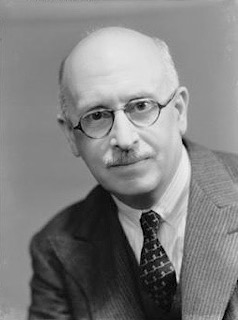
Freeman Wills Crofts FRSA, Irish engineer and mystery author, remembered best for the character of Inspector Joseph French, dies in Worthing, West Sussex, England, on April 11, 1957.
A railway engineer by training, Crofts introduces railway themes into many of his stories, which are notable for their intricate planning. Although Raymond Chandler, Agatha Christie, and authors of the so-called golden age of detective fiction are more famous, he is esteemed by those authors, and many of his books are still in print.
Crofts is born at 26 Waterloo Road, Dublin. His father, also named Freeman Wills Crofts, is a surgeon-lieutenant in the Army Medical Services but dies of fever in Honduras before the young Freeman Wills Crofts is born. In 1883, his mother, Celia Frances (née Wise), marries the Venerable Jonathan Harding, Vicar of Gilford, County Down, later Archdeacon of Dromore, and Crofts is raised in the vicarage at Gilford. He attends Methodist College and Campbell College in Belfast. In 1912, he marries Mary Bellas Canning, daughter of the manager of the Coleraine branch of the Provincial Bank. They have no children.
In 1896, at the age of seventeen, Crofts is apprenticed to his maternal uncle, Berkeley Deane Wise, who is chief engineer of the Belfast and Northern Counties Railway. In 1899, he is appointed Junior Assistant on the construction of the Londonderry and Strabane Extension of the Donegal Railway. In 1900, he becomes District Engineer at Coleraine for the London, Midland and Scottish Railway (LMS) Northern Counties Committee at a salary of £100pa, living at 11 Lodge Road in the town. In 1922, he is promoted to Chief Assistant Engineer of the railway, based in Belfast. He lives at “Grianon” in Jordanstown, a quiet village some six miles north of Belfast, where it is convenient for him to travel by train each day to the railway’s offices at York Road. One of the projects he works on is the design of the “Bleach Green Viaduct” in Whiteabbey, close to his Jordanstown home. This is a significant ten arch reinforced concrete viaduct approved in 1927 and completed in 1934. It carries a new loop line which eliminates the need for trains between Belfast and the northwest to reverse at Greenisland. He continues his engineering career until 1929. In his last task as an engineer, he is commissioned by the Government of Northern Ireland to chair an inquiry into the Bann and Lough Neagh Drainage Scheme.
In 1919, during an absence from work due to a long illness, Crofts writes his first novel, The Cask (1920), which establishes him as a new master of detective fiction. He continues to write steadily, producing a book almost every year for thirty years, in addition to a number of short stories and plays.
Crofts is remembered best for his fictional detective, Inspector Joseph French, who is introduced in his fifth book, Inspector French’s Greatest Case (1924). Inspector French always solves each of the mysteries presented him in a workmanlike, precise manner – this method sets him apart from most other fictional sleuths.
In 1929, Crofts abandones his railway engineering career and becomes a full-time writer. He settles in the village of Blackheath, near Guildford, in Surrey, and a number of his books are set in the Guildford area, including The Hog’s Back Mystery (1933) and Crime at Guildford (1935). Many of his stories have a railway theme, and his particular interest in the apparently unfalsifiable alibi often emphasizes the intricacies of railway timetables. Near the end of his life, he and his wife relocate to Worthing, West Sussex, in 1953, where they live until his death in 1957, the year in which his last book is published.
Crofts also writes one religious book, The Four Gospels in One Story, several short stories, and short plays for the BBC.
Crofts is a member, with Dorothy L. Sayers and Agatha Christie, of the Detection Club which meets in Gerrard Street. In 1939 he is elected a fellow of the Royal Society of Arts.
Crofts is not only a railway engineer and writer, but also an accomplished musician. He is organist and choirmaster in Killowen Parish Church, Coleraine, St. Patrick’s Church, Jordanstown, and the parish church of St. Martin’s in Blackheath.
Crofts is esteemed, not only by his regular readers, but also by his fellow writers of the so-called Golden Age of Detective Fiction. Agatha Christie includes parodies of Inspector French alongside Sherlock Holmes and her own Hercule Poirot in Partners in Crime (1929).
Raymond Chandler describes Crofts as “the soundest builder of them all when he doesn’t get too fancy” (in The Simple Art of Murder). His attention to detail and his concentration on the mechanics of detection makes him the forerunner of the “police procedural” school of crime fiction. However, it has also given rise to a suggestion of a certain lack of flair – Julian Symons describing him as of “the humdrum school.” This may explain why his name has not remained as familiar as other more imaginative Golden Age writers, although he has fifteen books included in the Penguin Books “green” series of the best detective novels and 36 of his books are in print in paperback in 2000.
 seamus dubhghaill